


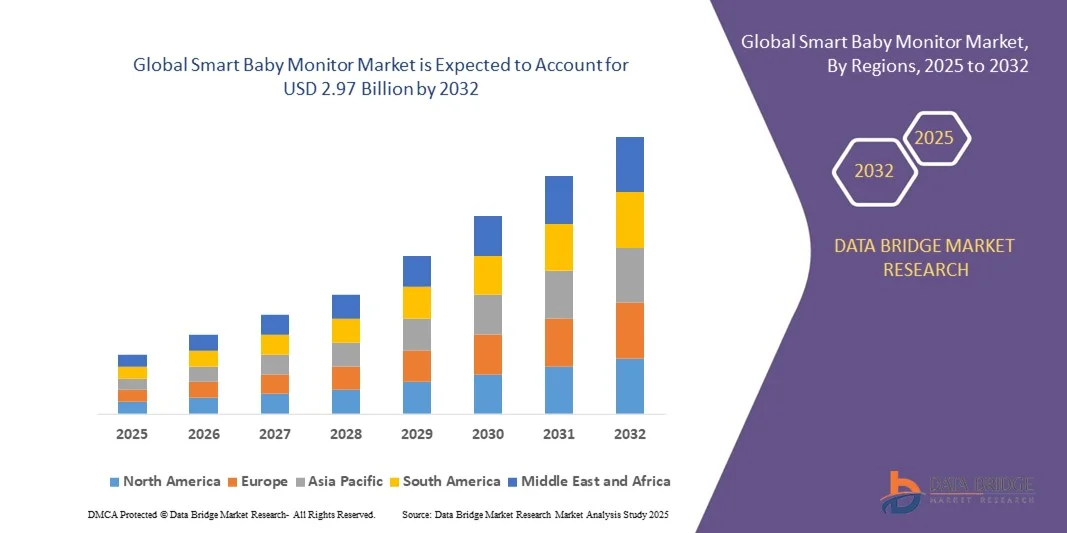
What is the Global Smart Baby Monitor Market Size and Growth Rate?
- The global smart baby monitor market size was valued at USD 1.61 billion in 2024 and is expected to reach USD 2.97 billion by 2032, at a CAGR of 7.9% during the forecast period
- Growth in the volume of nuclear families and enhancement of birth rate are the major factors fostering the growth of the market. Increasing awareness regarding the safety of children amongst parents are some other indirect market growth determinants
- Product innovations and technological advancements giving rise to enhanced benefits such as real-time tracking and communicating ability of parents with children also create lucrative and remunerative market growth opportunities in the long run
What are the Major Takeaways of Smart Baby Monitor Market?
- Growing incidences of infertility due to high-stress lifestyles and environments restraint the growth of market in the long run. Lack of preference among parents to leave their kids alone due to concerns regarding their safety and security will also pose a challenge for the market growth rate
- North America dominated the smart baby monitor market with the largest revenue share of 43.69% in 2024, driven by growing awareness of smart home ecosystems and increasing adoption of connected devices for infant monitoring
- The Asia-Pacific smart baby monitor market is poised to grow at the fastest CAGR of 10.89% between 2025 and 2032, driven by rapid urbanization, rising disposable incomes, and increased adoption of smart homes in countries such as China, Japan, and India
- The video monitor segment dominated the market with the largest revenue share of 52% in 2024, driven by the growing demand for real-time visual monitoring, high-definition clarity, and integration with mobile applications
Report Scope and Smart Baby Monitor Market Segmentation
|
Attributes |
Smart Baby Monitor Key Market Insights |
|
Segments Covered |
|
|
Countries Covered |
North America
Europe
Asia-Pacific
Middle East and Africa
South America
|
|
Key Market Players |
|
|
Market Opportunities |
|
|
Value Added Data Infosets |
In addition to the insights on market scenarios such as market value, growth rate, segmentation, geographical coverage, and major players, the market reports curated by the Data Bridge Market Research also include in-depth expert analysis, pricing analysis, brand share analysis, consumer survey, demography analysis, supply chain analysis, value chain analysis, raw material/consumables overview, vendor selection criteria, PESTLE Analysis, Porter Analysis, and regulatory framework. |
What is the Key Trend in the Smart Baby Monitor Market?
Enhanced Convenience Through AI and Voice Integration
- A significant and accelerating trend in the global smart baby monitor market is the increasing integration with artificial intelligence (AI) and popular voice-controlled ecosystems such as Amazon Alexa, Google Assistant, and Apple HomeKit. This convergence is enhancing parental convenience, allowing seamless monitoring and real-time responses to infant activities
- For instance, models such as Miku Smart Baby Monitor and iBaby Labs monitors enable AI-driven sleep tracking and integrate with multiple voice assistants, providing hands-free monitoring and alerts to caregivers. These features are redefining how parents interact with monitoring devices
- AI integration allows Smart Baby Monitors to analyze sleep patterns, detect unusual movements, and provide intelligent notifications. Certain advanced monitors can even suggest optimal room conditions for infants based on data trends. Voice commands facilitate hands-free control, making multitasking easier for parents
- The interoperability of Smart Baby Monitors with broader smart home platforms allows centralized control, letting caregivers monitor their baby alongside other smart devices such as lighting, climate control, and security cameras from a single interface
- This trend toward more intuitive, interconnected, and automated monitoring systems is reshaping expectations in infant care technology. Companies such as Miku and iBaby are incorporating AI-enabled features, motion alerts, and voice compatibility to enhance user experience
- Growing consumer demand for integrated, intelligent monitoring solutions is rising across households, driven by the desire for convenience, safety, and comprehensive control in baby care
What are the Key Drivers of Smart Baby Monitor Market?
- Rising awareness of infant safety and the growing demand for real-time monitoring are key drivers of the Smart Baby Monitor market. Caregivers increasingly value connected devices that provide peace of mind through advanced monitoring features
- For instance, in 2024, Miku Smart Baby Monitor enhanced AI-based sleep analytics for seamless monitoring, which strengthened adoption rates among tech-savvy parents. Innovations by such companies are driving market growth
- Smart Baby Monitors offer remote monitoring, activity logs, and environmental condition alerts, providing parents with actionable insights beyond traditional audio or video monitors
- The rising trend of smart home ecosystems is making Smart Baby Monitors an essential component, offering integration with other devices such as smart lights, thermostats, and voice assistants
- Features such as mobile app control, notifications, and customizable alerts enhance convenience for parents managing household tasks while monitoring infants. The increasing availability of user-friendly devices and DIY setup options further supports market expansion
Which Factor is Challenging the Growth of the Smart Baby Monitor Market?
- Concerns about cybersecurity vulnerabilities of connected devices, including Smart Baby Monitors, pose a significant barrier to wider adoption. Networked monitors are susceptible to hacking or unauthorized access, raising parental concerns over data privacy
- High-profile incidents of IoT device breaches have made some consumers hesitant to adopt smart monitoring solutions, affecting market penetration
- Addressing cybersecurity through encryption, secure authentication protocols, and regular software updates is critical. Companies such as iBaby and Miku emphasize robust security measures in their product marketing. In addition, higher initial costs of advanced Smart Baby Monitors compared to traditional monitors may limit adoption among price-sensitive consumers
- Although entry-level monitors are becoming more affordable, premium features such as AI analytics, HD video, and biometric sensing come with higher price tags, which can hinder uptake
- Overcoming these challenges with improved security, educational initiatives for parents, and more accessible product options is vital for sustained market growth
How is the Smart Baby Monitor Market Segmented?
The market is segmented on the basis of product, connection, distribution channel, and application.
- By Product
On the basis of product, the smart baby monitor market is segmented into audio and video monitors, tracking devices, and internet-enabled monitors. The video monitor segment dominated the market with the largest revenue share of 52% in 2024, driven by the growing demand for real-time visual monitoring, high-definition clarity, and integration with mobile applications. Parents increasingly prefer video monitors for their ability to provide instant visual feedback and peace of mind, particularly in households with infants and toddlers. Video monitors also offer added features such as night vision, two-way communication, and temperature or motion alerts, enhancing their value over traditional audio-only devices.
The internet-enabled monitor segment is expected to witness the fastest CAGR of 23% during 2025–2032, fueled by the rising adoption of smart home ecosystems, cloud-based monitoring, and remote access through smartphones. The trend toward connected devices for continuous infant monitoring is a key driver of this rapid growth.
- By Connection
On the basis of connection, the smart baby monitor market is segmented into wired and wireless devices. The wireless segment held the largest market revenue share of 68% in 2024, supported by growing consumer preference for flexible placement, portability, and hassle-free installation. Wireless monitors provide parents with freedom to move the monitoring unit across rooms or floors without being limited by cable length, making them ideal for modern homes. In addition, wireless devices are often compatible with mobile apps and cloud platforms, allowing remote access and instant notifications.
The wired segment is expected to witness the fastest CAGR of 18% during 2025–2032, as advancements in durable cabling and hybrid wired/wireless solutions provide reliable connectivity for professional settings, including daycares and hospitals. The combination of reliability and enhanced functionality is driving incremental adoption in niche commercial segments.
- By Distribution Channel
On the basis of distribution channel, the smart baby monitor market is segmented into offline and online sales channels. The offline segment dominated the market with a revenue share of 61% in 2024, supported by consumer confidence in physical retail stores, the ability to test and experience devices firsthand, and personalized purchase assistance from trained staff. Brick-and-mortar stores remain an essential channel in emerging markets where trust and product demonstration influence buying decisions.
The online segment is expected to witness the fastest CAGR of 25% from 2025 to 2032, driven by the convenience of e-commerce, growing smartphone penetration, and increasing preference for doorstep delivery. Online platforms also offer wider product variety, customer reviews, and competitive pricing, which are appealing to tech-savvy parents seeking smart baby monitoring solutions.
- By Application
On the basis of application, the smart baby monitor market is segmented into home family, commercial and daycare, and hospital settings. The home family segment accounted for the largest market revenue share of 70% in 2024, propelled by increasing awareness about infant safety, the rising adoption of smart home ecosystems, and the convenience of real-time remote monitoring. Video and AI-enabled monitors are particularly popular in family homes where continuous infant supervision is a priority.
The commercial and daycare segment is expected to witness the fastest CAGR of 21% during 2025–2032, driven by rising demand for reliable, multi-room monitoring solutions, regulatory safety requirements, and technological adoption in professional childcare facilities. The trend toward centralized monitoring and advanced alert systems is accelerating growth in commercial applications.
Which Region Holds the Largest Share of the Smart Baby Monitor Market?
- North America dominated the smart baby monitor market with the largest revenue share of 43.69% in 2024, driven by growing awareness of smart home ecosystems and increasing adoption of connected devices for infant monitoring
- Consumers in the region highly value convenience, seamless integration with other smart home devices, and features such as remote access, two-way communication, and AI-enabled alerts
- The adoption is further supported by high disposable incomes, a tech-savvy population, and a preference for monitoring solutions that ensure safety and peace of mind, establishing smart baby monitors as a preferred solution in both residential and commercial settings
U.S. Smart Baby Monitor Market Insight
The U.S. smart baby monitor market captured the largest revenue share of 81% in North America in 2024, fueled by widespread integration of smart home technologies and high consumer adoption of IoT-enabled monitoring systems. Parents increasingly prioritize real-time visual monitoring, remote alerts, and AI-based analytics for infant safety. DIY smart home installations, mobile application management, and voice assistant compatibility further accelerate growth. Moreover, the integration of Alexa, Google Assistant, and Apple HomeKit with Smart Baby Monitors is significantly expanding market penetration.
Europe Smart Baby Monitor Market Insight
The Europe smart baby monitor market is expected to expand at a substantial CAGR during the forecast period, supported by strict safety regulations and rising awareness of infant care solutions. Urbanization, growing residential and commercial infrastructure, and demand for connected devices are boosting adoption. Consumers appreciate energy-efficient, user-friendly monitors that integrate with smart home setups. Adoption spans new constructions, renovations, and multi-family housing, with a growing preference for video monitors and tracking-enabled devices.
U.K. Smart Baby Monitor Market Insight
The U.K. smart baby monitor market is anticipated to grow at a notable CAGR through the forecast period, driven by increasing home automation trends and demand for convenience and security. Rising concerns about infant safety and home protection are prompting parents to adopt connected monitoring solutions. The U.K.’s advanced e-commerce infrastructure, coupled with tech-friendly consumers, further supports growth in both retail and online channels, encouraging broader penetration of high-tech Smart Baby Monitors.
Germany Smart Baby Monitor Market Insight
The Germany smart baby monitor market is projected to witness considerable growth, fueled by heightened awareness of digital security, technological adoption, and eco-conscious product preferences. Germany’s strong infrastructure, emphasis on innovation, and regulatory standards promote adoption across residential and commercial applications. Integration with smart home platforms is gaining traction, with consumers seeking reliable, privacy-focused monitoring systems that align with local safety expectations.
Which Region is the Fastest Growing Region in the Smart Baby Monitor Market?
The Asia-Pacific smart baby monitor market is poised to grow at the fastest CAGR of 10.89% between 2025 and 2032, driven by rapid urbanization, rising disposable incomes, and increased adoption of smart homes in countries such as China, Japan, and India. Government initiatives promoting digitalization and smart city projects are accelerating demand. APAC’s position as a manufacturing hub enhances affordability and accessibility, broadening consumer reach.
Japan Smart Baby Monitor Market Insight
The Japan smart baby monitor market is gaining momentum due to the country’s technology-focused culture, high urbanization, and demand for convenient monitoring solutions. Growth is fueled by smart home adoption and integration with IoT devices, including security cameras and lighting systems. The aging population is also driving demand for simplified, secure, and easy-to-use monitoring solutions for both residential and commercial settings.
China Smart Baby Monitor Market Insight
The China smart baby monitor market held the largest revenue share in APAC in 2024, supported by a rapidly expanding middle class, urbanization, and high technological adoption. Smart Baby Monitors are increasingly used in residential, commercial, and rental properties. Government-driven smart city initiatives, affordable device options, and strong domestic manufacturers are key factors propelling market growth in China.
Which are the Top Companies in Smart Baby Monitor Market?
The smart baby monitor industry is primarily led by well-established companies, including:
- SAMSUNG (South Korea)
- Motorola Mobility LLC (U.S.)
- Safety 1st (U.S.)
- iBaby Labs, Inc (U.S.)
- Miku Inc (U.S.)
- NETGEAR (U.S.)
- SUMR BRANDS (U.S.)
- VTech Communications, Inc (Hong Kong)
- Medisana AG (Germany)
- The Holding Angelcare Inc. (Canada)
- Infant Optics (U.S.)
- VentureRadar (U.K.)
- Newell Brands (U.S.)
- Koninklijke Philips N.V (Netherlands)
- Withings (France)
- Snuza (South Africa)
- Dorel Industries (Canada)
What are the Recent Developments in Global Smart Baby Monitor Market?
- In October 2024, Philips, a global leader in health technology and innovation, launched the Philips Avent Connected Baby Monitor with a mobile app, introducing advanced features to enhance child safety and well-being, including high-definition video streaming, two-way communication, clear audio transmission, and motion detection, ensuring parents can monitor their child effectively even in low-light conditions, strengthening Philips’ presence in the connected baby monitor segment
- In February 2024, Harbor, a U.S.-based infant-care start-up, secured USD 3.7 million in seed funding to prepare for the launch of its innovative baby monitor, featuring local and remote streaming access, a high-quality 2K camera, robust data privacy measures, split-screen monitoring for up to four children, and an advanced Smart Audio alerting system, establishing Harbor as a promising entrant in the smart baby monitoring market
- In January 2024, Dorel Industries Inc.'s flagship brand, Maxi-Cosi, unveiled the See Pro 360° Baby Monitor, equipped with pioneering CryAssist™ technology, which leverages AI to decode a baby's cries, providing parents insights into whether their child is sleepy, fussy, gassy, agitated, or hungry, reinforcing Maxi-Cosi’s reputation for innovative infant-care solutions
- In September 2023, VTech, a leader in parenting technology, introduced the V-Care VC2105 Smart Nursery Baby Monitor, utilizing advanced local AI features to offer sleep analytics and real-time alerts, enabling parents to maintain a serene sleep environment for their infants, marking a significant step in enhancing infant care through smart technology

- Interactive Data Analysis Dashboard
- Company Analysis Dashboard for high growth potential opportunities
- Research Analyst Access for customization & queries
- Competitor Analysis with Interactive dashboard
- Latest News, Updates & Trend analysis
- Harness the Power of Benchmark Analysis for Comprehensive Competitor Tracking
Data collection and base year analysis are done using data collection modules with large sample sizes. The stage includes obtaining market information or related data through various sources and strategies. It includes examining and planning all the data acquired from the past in advance. It likewise envelops the examination of information inconsistencies seen across different information sources. The market data is analysed and estimated using market statistical and coherent models. Also, market share analysis and key trend analysis are the major success factors in the market report. To know more, please request an analyst call or drop down your inquiry.
The key research methodology used by DBMR research team is data triangulation which involves data mining, analysis of the impact of data variables on the market and primary (industry expert) validation. Data models include Vendor Positioning Grid, Market Time Line Analysis, Market Overview and Guide, Company Positioning Grid, Patent Analysis, Pricing Analysis, Company Market Share Analysis, Standards of Measurement, Global versus Regional and Vendor Share Analysis. To know more about the research methodology, drop in an inquiry to speak to our industry experts.
Data Bridge Market Research is a leader in advanced formative research. We take pride in servicing our existing and new customers with data and analysis that match and suits their goal. The report can be customized to include price trend analysis of target brands understanding the market for additional countries (ask for the list of countries), clinical trial results data, literature review, refurbished market and product base analysis. Market analysis of target competitors can be analyzed from technology-based analysis to market portfolio strategies. We can add as many competitors that you require data about in the format and data style you are looking for. Our team of analysts can also provide you data in crude raw excel files pivot tables (Fact book) or can assist you in creating presentations from the data sets available in the report.













