What is the Smart Bands Body Area Network Market Size and Growth Rate?
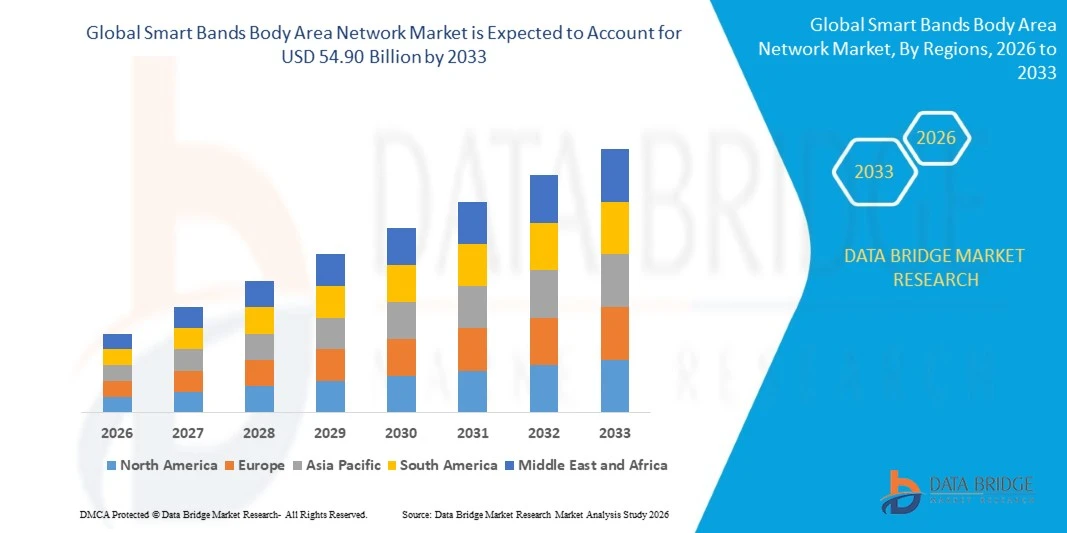
- As per Data Bridge Market Research analysis, the smart bands body area network market was valued at USD 19.65 billion in 2025 and is projected to reach USD 54.90 billion by 2033, growing at a CAGR of 13.70% from 2026 to 2033.
- The market is witnessing steady growth, driven by increasing consumer awareness of preventive healthcare, rising demand for fitness and wellness monitoring, and expanding adoption of connected wearables across healthcare, sports, corporate wellness, and elderly-care applications. Advancements in sensor miniaturization, energy-efficient wireless communication technologies, and smart device connectivity are further supporting market expansion.
- Smart bands increasingly serve as wearable hubs within body area networks, integrating sensors such as optical heart-rate monitors, blood oxygen (SpO₂) sensors, temperature sensors, and motion detectors to collect physiological data and transmit it to connected smartphones, cloud platforms, and AI-enabled analytics systems. This integration is strengthening connectivity with remote patient monitoring solutions, the wearable medical devices market, and the fitness tracker market, expanding opportunities for continuous health monitoring and personalized wellness management.
Market Size & Forecast
- Global Market Value (2025): USD 19.65 Billion
- Expected Market Value (2033): USD 54.90 Billion
- Forecast CAGR (2026–2033): 13.70%
- Leading Region in 2025: North America
- Fastest Growing Region: Asia Pacific
What are the Major Takeaways of the Smart Bands Body Area Network Market?
- North America dominated the smart bands body area network market with the largest revenue share of 35.80% in 2025, supported by high penetration of premium wearables, strong adoption of remote patient monitoring, and the presence of leading wearable and semiconductor companies.
- Asia-Pacific is expected to be the fastest-growing region at a CAGR of 15.90% from 2026 to 2033, fueled by large-scale smart band manufacturing, rising disposable incomes, and rapid smartphone penetration across China, India, and Southeast Asia.
- The sensors segment led the market with a 41.25% share in 2025, driven by the central role of optical heart-rate, accelerometer, SpO2, and skin-temperature sensors in every smart band node.
- Connectivity modules are the fastest-growing component type, projected to register a CAGR of 15.40%, reflecting rising demand for low-power Bluetooth, NFC, and multi-protocol radios that link body-worn nodes.
- The Bluetooth Low Energy segment dominated the connectivity technology category with a 62.80% revenue share in 2025, led by its low power consumption and universal smartphone compatibility.
- Fitness & sports monitoring accounted for 44.10% of the market share in 2025, preferred due to widespread use of activity, heart-rate, and workout tracking among health-conscious consumers.
- The remote patient monitoring segment is the fastest-growing application category, with a CAGR of 16.80%, driven by increasing use of wearable bands for chronic-disease management and post-discharge care.
Report Scope and Smart Bands Body Area Network Market Segmentation
|
Attributes |
Smart Bands Body Area Network Key Market Insights |
|
Segments Covered |
|
|
Countries Covered |
North America
Europe
Asia-Pacific
Middle East and Africa
South America
|
|
Key Market Players |
|
|
Market Opportunities |
|
|
Value Added Data Infosets |
In addition to the insights on market scenarios such as market value, growth rate, segmentation, geographical coverage, and major players, the market reports curated by the Data Bridge Market Research also include in-depth expert analysis, geographically represented company-wise production and capacity, network layouts of distributors and partners, detailed and updated price trend analysis and deficit analysis of supply chain and demand. |
What is the Key Trend in the Smart Bands Body Area Network Market?
- Smart bands are evolving from simple step counters into multi-sensor nodes of body area networks, combining optical, inertial, and temperature sensing with low-power wireless links and on-device machine learning to deliver continuous and clinically relevant health insights.
- For instance, in February 2024, according to arXiv, researchers demonstrated a near-field body area network built from coaxially-shielded textile metamaterial, in which battery-free NFC-enabled sensing nodes placed on clothing communicate with a smartphone, highlighting the shift toward scalable, low-power wearable networks.
- AI-driven analytics are enabling smart bands to convert raw sensor streams into stress, fatigue, sleep-quality, and recovery scores, moving the product proposition from data display to personalized health guidance.
- Screenless and minimalist bands are emerging as a distinct product class that prioritizes round-the-clock biometric tracking over notifications, widening the user base among athletes and recovery-focused consumers.
- For instance, in June 2025, according to Notebookcheck, Amazfit revealed its display-free Helio Strap, designed to monitor heart rate, stress, sleep, and energy levels 24 hours a day and summarized through a new BioCharge metric, illustrating the growing focus on continuous body-sensing wearables.
- As sensor accuracy, battery efficiency, and wireless connectivity continue to advance, smart bands are expected to expand beyond fitness into medical-grade monitoring, workplace safety, insurance wellness programs, and intelligent human–device interaction.
What are the Key Drivers of the Smart Bands Body Area Network Market?
- Rising prevalence of lifestyle-related disorders and growing health awareness are encouraging consumers and healthcare providers to adopt continuous, wearable-based monitoring that supports early detection and preventive care.
- For instance, in December 2021, according to MDPI Sensors, a special issue on wearable and body area network sensors for physical rehabilitation and eHealth architectures compiled 10 published manuscripts spanning sensing technologies, signal processing, and applications in rehabilitation, robotics, diagnostics, and therapy, including a study on the accuracy of hip- and ankle-worn Actigraph GT3X+ accelerometers in measuring steps.
- Widespread smartphone penetration, cloud connectivity, and declining component costs are making smart bands affordable and easy to integrate with health apps, accelerating adoption across both developed and emerging economies.
- For instance, in February 2022, according to the International Journal of Distributed Sensor Networks, researchers studied body area network node design, energy-consumption optimization, and network architecture for physiological-monitoring smart clothing covering electrocardiogram, body temperature, and human movement signals, supporting the technical foundation for wearable monitoring networks.
- Healthcare providers, insurers, employers, and sports organizations are increasingly deploying connected bands to track activity, recovery, and chronic conditions, creating a steady B2B demand base alongside consumer sales.
What Factors Are Challenging the Growth of the Smart Bands Body Area Network Market?
- Smart band body area networks must run multiple sensors and radios on very small batteries, creating constant trade-offs between sensing accuracy, wireless throughput, device size, and battery life.
- For instance, in April 2024, a study published in Internet of Things examined methods for extending the battery life of wireless body area network sensors. The research highlighted the energy consumed during physiological sensing and demonstrated the potential of adaptive sampling to improve battery autonomy, underscoring the challenge of balancing monitoring frequency, measurement precision, and power consumption.
- Continuous collection of biometric data raises concerns related to privacy, data security, and regulatory compliance, which can slow adoption among healthcare providers and enterprises.
- Consumer-grade sensors are affected by motion artefacts, skin contact variability, and ambient conditions, which can reduce measurement accuracy and limit use in clinical-grade decision-making.
- For instance, in October 2021, according to the EAI BODYNETS 2021 conference proceedings, researchers evaluated the properties of commercially available wristbands for pre-birth stress management in maternity care, highlighting the need to validate off-the-shelf body-sensing bands before they are relied upon in healthcare settings.
- The combination of battery constraints, accuracy limitations, interoperability gaps between brands, and price competition in the entry-level segment can constrain adoption and squeeze margins for manufacturers.
How is the Smart Bands Body Area Network Market Segmented?
The smart bands body area network market is segmented on the basis of component, connectivity technology, application, and end user.
- By Component
On the basis of component, the smart bands body area network market is segmented into sensors, processors & microcontrollers, connectivity modules, power management ICs, and others. The sensors segment dominated the market with 41.25% share in 2025, supported by the presence of optical heart-rate, SpO2, accelerometer, gyroscope, and temperature sensors in virtually every smart band. Continuous improvements in sensor sensitivity and size allow manufacturers to add more health metrics without increasing device footprint. Rising demand for medical-grade parameters is further increasing the value content of sensors per device. Strong demand from both entry-level and premium bands keeps this segment at the center of the semiconductor value chain.
The connectivity modules segment is projected to register the fastest growth at a CAGR of 15.40% from 2026 to 2033, driven by the need to link multiple body-worn nodes, smartphones, and cloud platforms reliably. Adoption of Bluetooth 5.x, NFC, and multi-protocol radios is improving range, pairing speed, and power efficiency. Integration of wireless connectivity with secure elements is enabling payments, access control, and health-data exchange from the wrist. Growing demand for interoperability across brands and ecosystems is creating additional opportunities for advanced connectivity chipsets.
- By Connectivity Technology
On the basis of connectivity technology, the smart bands body area network market is segmented into Bluetooth Low Energy, Wi-Fi, NFC, and others. The Bluetooth Low Energy segment dominated the market with 62.80% share in 2025, supported by its very low power consumption, universal support across smartphones, and mature developer ecosystem. It allows smart bands to remain connected for days or weeks on a single charge while streaming heart-rate and activity data in real time. Heart-rate broadcasting to gyms, bikes, and sports apps is further strengthening its adoption.
The NFC segment is projected to register the fastest growth at a CAGR of 16.20% from 2026 to 2033, supported by increasing use of smart bands for contactless payments, transit, and access control. NFC also enables battery-free sensing nodes and quick pairing with smartphones. Growing availability of NFC-enabled variants across mid-range bands is widening the user base. Convenience, security, and compatibility with existing payment infrastructure are key factors supporting segment growth.
- By Application
On the basis of application, the smart bands body area network market is segmented into fitness & sports monitoring, remote patient monitoring, sleep & stress management, and others. The fitness & sports monitoring segment dominated the application category with 44.10% share in 2025, supported by widespread consumer use of step, workout, and heart-rate tracking. Manufacturers are offering over 100 sports modes in affordable bands, which strengthens engagement. Integration with fitness communities and gamified apps helps retain users. Growing participation in running, cycling, and gym activities continues to support this segment.
The remote patient monitoring segment is projected to register the fastest growth at a CAGR of 16.80% from 2026 to 2033, driven by growing requirements for continuous tracking of chronic conditions, post-surgical recovery, and elderly care. Smart bands allow clinicians to receive vitals such as heart rate, SpO2, and activity levels without hospital visits. Hospital-at-home programs and telehealth platforms are increasingly integrating wearable data into care pathways. Regulatory clearances for health features are expected to further accelerate adoption.
- By End User
On the basis of end user, the smart bands body area network market is segmented into consumers, healthcare providers, sports & fitness centers, corporate wellness, and others. The consumers segment dominated the end-user category with 58.30% share in 2025, supported by affordable pricing, long battery life, and rising health consciousness. Entry-level bands priced under USD 50 are bringing wearable tracking to first-time buyers. Fashion-oriented designs, interchangeable straps, and smartphone ecosystem integration are driving repeat purchases.
The healthcare providers segment is projected to register the fastest growth at a CAGR of 17.40% from 2026 to 2033, driven by adoption of wearable bands in remote monitoring, rehabilitation, and chronic-disease programs. Hospitals and clinics are seeking low-cost devices that can stream patient data into electronic health records. Data accuracy, security, and integration with clinical systems remain important considerations for deployment.
Which Region Holds the Largest Share of the Smart Bands Body Area Network Market?
- North America dominated the smart bands body area network market with the largest revenue share of 35.80% in 2025, supported by high penetration of premium wearables, strong adoption of remote patient monitoring, and the presence of leading wearable and semiconductor companies.
- The region also benefits from high disposable income, favorable reimbursement trends for remote monitoring, and strong demand for advanced health-tracking features. Increasing use of smart bands in corporate wellness programs, sports, and chronic-care management continues to strengthen North America’s position in the global market.
U.S. Smart Bands Body Area Network Market Insight
The U.S. smart bands body area network market is witnessing strong growth due to rising adoption of connected health devices, employer wellness programs, and remote patient monitoring across healthcare systems. The country’s mature technology ecosystem, along with high smartphone penetration and a strong base of wearable and semiconductor companies, is driving demand for multi-sensor smart bands. In addition, growing emphasis on preventive care, insurer-backed wellness incentives, and virtual care is accelerating adoption of body-worn monitoring solutions across consumer and clinical settings.
Asia-Pacific Smart Bands Body Area Network Market Insight
The Asia-Pacific smart bands body area network market is expected to witness rapid growth, driven by large-scale wearable manufacturing, rising disposable incomes, and increasing smartphone penetration across countries such as China, India, and Japan. Affordable smart bands with long battery life and wide sports-mode coverage are attracting first-time users. In addition, the region’s strong electronics manufacturing ecosystem, government focus on digital health, and expanding e-commerce channels are accelerating demand for smart bands.
Japan Smart Bands Body Area Network Market Insight
The Japan smart bands body area network market is witnessing consistent growth due to an aging population, high health awareness, and strong demand for compact, reliable wearable devices. Consumers, healthcare institutions, and corporate health-management programs are increasingly adopting bands for sleep, heart-rate, and activity monitoring. Moreover, strong demand for precision, comfort, and long battery life, along with rapid launches of affordable bands in the country, is further contributing to market growth in Japan.
China Smart Bands Body Area Network Market Insight
The China smart bands body area network market is growing rapidly, driven by large domestic wearable brands, extensive electronics manufacturing capacity, and strong consumer demand for affordable fitness and health trackers. Rising participation in running and fitness activities, along with deep integration of bands with smartphone ecosystems and mobile payment platforms, is significantly boosting demand. In addition, strong domestic component supply chains and rapid product refresh cycles are positioning China as a key growth market for smart bands across Asia-Pacific.
U.K. Smart Bands Body Area Network Market Insight
The U.K. smart bands body area network market is experiencing steady growth, supported by increasing health awareness, digital-health initiatives within the National Health Service, and rising use of wearables for activity and sleep tracking. Consumers, sports organizations, and healthcare providers are increasingly utilizing smart bands to monitor fitness and recovery. Furthermore, growing integration of bands with health apps and remote-care programs is supporting wider adoption of body area network based wearable solutions in the U.K.
Germany Smart Bands Body Area Network Market Insight
The Germany smart bands body area network market is expanding steadily due to the country’s strong medical technology base, advanced semiconductor ecosystem, and increasing adoption of digital health applications. Healthcare organizations, insurers, and consumers are utilizing smart bands for activity tracking, rehabilitation, and preventive health programs. Continuous advancements in low-power sensor technology, along with Germany’s focus on data protection and device quality, are further driving market growth in the country.
Which are the Top Companies in Smart Bands Body Area Network Market?
The smart bands body area network market industry is primarily led by well-established companies, including:
- Xiaomi Corporation (China)
- Huawei Technologies Co., Ltd. (China)
- Samsung Electronics Co., Ltd. (South Korea)
- Apple Inc. (U.S.)
- Garmin Ltd. (Switzerland)
- Fitbit (Google LLC) (U.S.)
- Zepp Health Corporation (China)
- Honor Device Co., Ltd. (China)
- Fossil Group, Inc. (U.S.)
- Withings (France)
- Polar Electro Oy (Finland)
- WHOOP, Inc. (U.S.)
- Oura Health Oy (Finland)
- Nordic Semiconductor ASA (Norway)
- STMicroelectronics (Switzerland)
- Texas Instruments Incorporated (U.S.)
- Analog Devices, Inc. (U.S.)
- Qualcomm Technologies, Inc. (U.S.)
- Infineon Technologies AG (Germany)
- NXP Semiconductors N.V. (Netherlands)
What are Latest Developments in Smart Bands Body Area Network Market?
- In April 2026, Huawei officially launched its Band 11 series in Nepal, introducing smart bands with sleep tracking covering heart rate, blood oxygen, and heart-rate variability, continuous 24/7 monitoring, and more than 100 workout modes, with the Band 11 Pro priced at NPR 14,990.
- In February 2026, Huawei listed the Band 11 and Band 11 Pro in the Philippines ahead of its February 26 launch event, featuring 1.62-inch AMOLED displays, up to 14 days of battery life, and over 100 sports modes, with sales starting March 2 at PHP 2,399 and PHP 4,499 respectively.
- In June 2025, Xiaomi launched the Smart Band 10 in global markets starting at USD 49.90, featuring a 1.72-inch AMOLED display with up to 1,500 nits brightness, over 150 sports modes, heart-rate broadcasting, and battery life of up to 21 days.
- In June 2025, Xiaomi Japan began selling the Smart Band 10 on June 27, priced at JPY 6,280 for the standard version and JPY 8,680 for the ceramic edition, with a screen-to-body ratio 7% higher than the previous generation.
- In June 2025, Xiaomi introduced the Smart Band 10 in Singapore with Bluetooth 5.4 connectivity, over 150 sports modes, and a pearl-chain pendant accessory that allows four wearing modes, supported by launch promotions of up to 50% off on straps.
- Interactive Data Analysis Dashboard
- Company Analysis Dashboard for high growth potential opportunities
- Research Analyst Access for customization & queries
- Competitor Analysis with Interactive dashboard
- Latest News, Updates & Trend analysis
- Harness the Power of Benchmark Analysis for Comprehensive Competitor Tracking
Global Smart Bands Body Area Network Market, Supply Chain Analysis and Ecosystem Framework
To support market growth and help clients navigate the impact of geopolitical shifts, DBMR has integrated in-depth supply chain analysis into its Global Smart Bands Body Area Network Market research reports. This addition empowers clients to respond effectively to global changes affecting their industries. The supply chain analysis section includes detailed insights such as Global Smart Bands Body Area Network Market consumption and production by country, price trend analysis, the impact of tariffs and geopolitical developments, and import and export trends by country and HSN code. It also highlights major suppliers with data on production capacity and company profiles, as well as key importers and exporters. In addition to research, DBMR offers specialized supply chain consulting services backed by over a decade of experience, providing solutions like supplier discovery, supplier risk assessment, price trend analysis, impact evaluation of inflation and trade route changes, and comprehensive market trend analysis.
Data collection and base year analysis are done using data collection modules with large sample sizes. The stage includes obtaining market information or related data through various sources and strategies. It includes examining and planning all the data acquired from the past in advance. It likewise envelops the examination of information inconsistencies seen across different information sources. The market data is analysed and estimated using market statistical and coherent models. Also, market share analysis and key trend analysis are the major success factors in the market report. To know more, please request an analyst call or drop down your inquiry.
The key research methodology used by DBMR research team is data triangulation which involves data mining, analysis of the impact of data variables on the market and primary (industry expert) validation. Data models include Vendor Positioning Grid, Market Time Line Analysis, Market Overview and Guide, Company Positioning Grid, Patent Analysis, Pricing Analysis, Company Market Share Analysis, Standards of Measurement, Global versus Regional and Vendor Share Analysis. To know more about the research methodology, drop in an inquiry to speak to our industry experts.
Data Bridge Market Research is a leader in advanced formative research. We take pride in servicing our existing and new customers with data and analysis that match and suits their goal. The report can be customized to include price trend analysis of target brands understanding the market for additional countries (ask for the list of countries), clinical trial results data, literature review, refurbished market and product base analysis. Market analysis of target competitors can be analyzed from technology-based analysis to market portfolio strategies. We can add as many competitors that you require data about in the format and data style you are looking for. Our team of analysts can also provide you data in crude raw excel files pivot tables (Fact book) or can assist you in creating presentations from the data sets available in the report.