What is the Smart Bottle Market Size and Growth Rate?
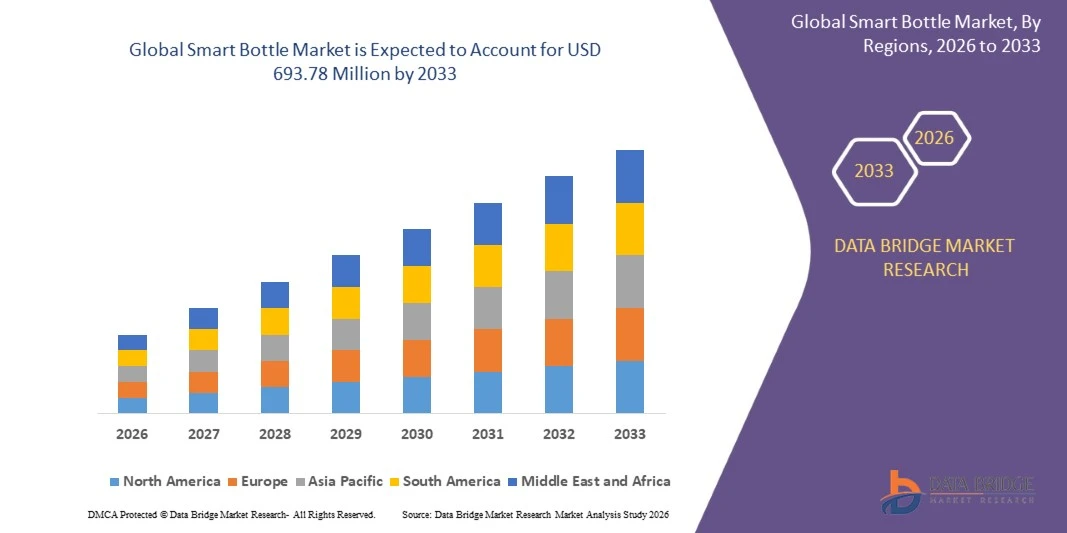
- As per Data Bridge Market Research analysis, the smart bottle market was valued at USD 233.21 million in 2025 and is projected to reach USD 693.78 million by 2033, growing at a CAGR of 14.6% from 2026 to 2033, across consumer wellness and hydration segments.
- The market is experiencing rapid growth driven by rising health awareness, increasing adoption of connected wellness devices, and expanding applications across daily hydration, fitness, healthcare monitoring, corporate wellness, and educational programs worldwide.
- The increasing shift toward personalized hydration, wearable integration, and sustainable reusable drinkware, combined with growing consumer interest in app-based health tracking, is supporting market adoption. Smart bottles are being used across everyday hydration, workouts, travel, workplaces, and clinical studies, offering users sip tracking, glow reminders, self-cleaning functions, and syncing with smart water bottle apps and wearable devices.
Market Size & Forecast
- Global Market Value (2025): USD 233.21 Million
- Expected Market Value (2033): USD 693.78 Million
- Forecast CAGR (2026–2033): 14.6%
- Leading Region in 2025: North America
- Fastest Growing Region: Asia-Pacific
What are the Major Takeaways of the Smart Bottle Market?
- North America dominated the smart bottle market with the largest revenue share of 41.50% in 2025, supported by strong health and fitness culture, early adoption of connected devices, and established smart hydration brands across the region and neighboring markets.
- Asia-Pacific is expected to be the fastest-growing region at a CAGR of 17.80% from 2026 to 2033, fueled by rising health awareness, expanding e-commerce, and growing adoption of connected wellness products across urban markets.
- The hydration-tracking segment led the market with a 54.2% share in 2025, driven by extensive use of sip sensors, reminders, and app integration across user groups.
- Self-cleaning and purifying bottles are the fastest-growing product type, projected to register a CAGR of 16.8%, reflecting the surge in demand for hygienic, UV-enabled drinkware for daily use.
- The Bluetooth segment dominated the connectivity category with a 72.5% revenue share in 2025, led by seamless smartphone and wearable integration and low power use.
- Daily wellness accounted for 46.8% of the market share in 2025, preferred by increasing interest in personalized hydration goals and daily reminders.
- The corporate and workplace wellness segment is the fastest-growing end-user category, with a CAGR of 17.2%, driven by increasing gifting programs and employee wellness initiatives.
Report Scope and Smart Bottle Market Segmentation
|
Attributes |
Smart Bottle Key Market Insights |
|
Segments Covered |
|
|
Countries Covered |
North America
Europe
Asia-Pacific
Middle East and Africa
South America
|
|
Key Market Players |
|
|
Market Opportunities |
|
|
Value Added Data Infosets |
In addition to the insights on market scenarios such as market value, growth rate, segmentation, geographical coverage, and major players, the market reports curated by the Data Bridge Market Research also include in-depth expert analysis, pricing analysis, brand share analysis, consumer survey, demography analysis, supply chain analysis, value chain analysis, raw material/consumables overview, vendor selection criteria, PESTLE Analysis, Porter Analysis, and regulatory framework. |
What is the Key Trend in the Smart Bottle Market?
- Brands are increasingly shifting toward ecosystem-based smart hydration, combining sip-tracking sensors, personalized goals, glow reminders, device-finding features, and wearable integration to make hydration monitoring more accurate, engaging, and convenient for daily users across age groups and lifestyles.
- For instance, in October 2025, HidrateSpark announced the PRO 2 smart water bottle and tumbler in Apple Stores worldwide, featuring SipSense sensor technology and integrated Apple Find My support so users can track both hydration and the bottle’s location, signaling deeper integration between smart hydration products and mainstream consumer ecosystems.
- Hygiene and water quality features are becoming differentiators, with ultraviolet self-cleaning, filtration, and purification technologies being embedded in connected bottles for health-conscious consumers.
- Insulated stainless steel designs, rechargeable batteries, and companion apps are being combined to deliver premium lifestyle products that serve both performance and sustainability goals, with some bottles keeping drinks cold for up to 24 hours.
- For instance, in February 2026, the LARQ Bottle PureVis 2 combined UV-C LED self-cleaning, hydration tracking, and glow-based reminders that prompt users to drink during waking hours, illustrating the shift toward multi-function connected bottles that address hygiene, convenience, and daily habit formation in one device.
- As consumers adopt connected wellness routines and sustainability expectations strengthen, smart bottles are expected to evolve from novelty drinkware into mainstream health, hygiene, and lifestyle devices across regions worldwide.
What are the Key Drivers of the Smart Bottle Market?
- Growing awareness of hydration, wellness, and fitness is increasing demand for bottles that track intake, personalize goals, and remind users to drink throughout the day across work, travel, and exercise.
- For instance, in February 2024, according to BRITA SE, the company acquired LARQ, a brand known for self-cleaning UV-C bottles, to expand its consumer business in North America and grow its own eCommerce presence through a digitally native brand that generates most of its sales directly to consumers.
- Integration with smartphones, fitness trackers, and health platforms is making hydration tracking more convenient, helping smart bottles fit into broader digital wellness routines, including links with Apple Health, Apple Watch, Fitbit, and other fitness trackers.
- For instance, in August 2023, LARQ and SB C&S announced the Japan launch of LARQ products, including PureVis bottles with UV sterilization and filtered bottles, released sequentially starting August 21, 2023, through online stores, expanding the reach of premium self-cleaning hydration products into a major Asian market.
- With rising interest in reusable bottles and reduced single-use plastic, smart bottles offer a premium alternative that combines sustainability with health tracking features for everyday users.
What Factors Are Challenging the Growth of the Smart Bottle Market?
- Smart bottles are priced above conventional bottles, require batteries and sensors, and depend on apps and connectivity, which can limit adoption among price-sensitive consumers in emerging and mature markets.
- For instance, in February 2026, according to CNET, the main drawback of a leading hydration-tracking bottle was price, with the reviewer describing it as expensive for a water bottle despite strong tracking and self-cleaning features across everyday use cases.
- Embedded electronics, batteries, and replaceable filters create maintenance and end-of-life considerations, and some consumers may be reluctant to charge or care for another connected device, since LARQ-type bottles rely on rechargeable batteries that last two to three weeks per charge.
- Competition from conventional insulated bottles and free hydration apps can reduce willingness to pay, particularly when users do not see long-term value from sensors, and lower-priced tap-to-track models are intensifying competition among brands.
- The combination of premium pricing, battery and maintenance needs, sustainability trade-offs, and competition from simpler bottles can limit expansion among price-sensitive buyers, particularly where users already meet hydration goals easily or where consumers rely on free hydration reminder apps.
How is the Smart Bottle Market Segmented?
The smart bottle market is segmented on the basis of product, connectivity, application, and end user across regions.
- By Product
On the basis of product, the smart bottle market is segmented into hydration-tracking, self-cleaning & purifying, and others. The hydration-tracking segment dominated the market with 54.2% share in 2025, supported by extensive use of sip sensors, reminders, and app integration. Hydration-tracking bottles measure intake, calculate personalized goals, and prompt users with lights or notifications. They are widely used across daily wellness, fitness, and workplace routines. Improvements in sensor accuracy, battery life, and app experience are further strengthening demand. Integration with wearables and health platforms also enables better engagement across everyday hydration habits.
The self-cleaning and purifying segment is projected to register the fastest growth at a CAGR of 16.8% from 2026 to 2033, driven by increasing demand for hygienic, UV-enabled drinkware. UV-C LED caps can reduce bacteria inside bottles and in water, with some models activating every two hours to support freshness and odor control. Their applications include travel, gyms, commuting, and outdoor use. Increasing awareness of bottle hygiene is creating additional demand across consumers and gift buyers. Improvements in two-stage filtration, including filters that reduce chlorine and PFAS, are enhancing water quality and taste. Combined tracking, filtering, and cleaning features are also expanding commercial use, although higher prices remain a consideration for mainstream buyers.
- By Connectivity
On the basis of connectivity, the smart bottle market is segmented into Bluetooth, NFC, and Wi-Fi & others. The Bluetooth segment dominated the market with 72.5% share in 2025, supported by seamless smartphone and wearable integration and low power consumption. Bluetooth Low Energy enables automatic syncing of sips and reminders without manual input. Its availability across devices and platforms expands the potential customer base. Users rely on it to keep data updated in apps and connected health ecosystems. The segment also benefits from established app stores and widespread smartphone adoption, and Bluetooth Low Energy allows bottles to sync intake data throughout the day.
The NFC segment is projected to register the fastest growth at a CAGR of 17.4% from 2026 to 2033, supported by increasing demand for affordable tap-to-track bottles and simplified user experience. Tap-to-track technology lets users record a full bottle by tapping a phone, reducing sensor complexity and cost. Brands are increasingly offering lower-priced smart options to reach mainstream buyers. Developers are creating apps that sync with fitness trackers and health platforms. Lower battery needs further strengthen the segment’s attractiveness. Accuracy of manual tracking remains an important consideration for expansion. Brands have positioned tap-to-track bottles as entry-level smart options.
- By Application
On the basis of application, the smart bottle market is segmented into daily wellness, fitness & sports, healthcare monitoring, and others. The daily wellness segment dominated the application category with 46.8% share in 2025, supported by increasing interest in personalized hydration goals. Smart bottles help users build consistent drinking habits through reminders and progress tracking. Health awareness is increasing the use of connected hydration tools. Growth in wellness apps further strengthens demand. Consumers are also seeking products that combine style, insulation, tracking, and easy cleaning for use at home, work, and while traveling. Personalized goals can reflect exercise, weather, altitude, and personal factors, which improves relevance for users and supports regular engagement with app-based goals.
The healthcare monitoring segment is projected to register the fastest growth at a CAGR of 17.9% from 2026 to 2033, driven by increasing interest in hydration data for clinical studies, chronic condition support, and patient engagement. Hydration records can help clinicians and researchers understand fluid intake patterns. Providers and health programs in North America, Europe, and Asia-Pacific are testing connected bottles. Research collaborations are creating additional opportunities. Reliable sensors and privacy safeguards make these products particularly relevant for health programs. Supportive digital health adoption can further improve usage across regions. Brands have noted collaborations with institutions such as Mayo Clinic and Cleveland Clinic on research using connected hydration data and patient engagement programs.
- By End User
On the basis of end user, the smart bottle market is segmented into individual consumers, athletes & fitness enthusiasts, corporate & workplace wellness, healthcare providers, educational institutions, and others. The individual consumers segment dominated the end-user category with 52.7% share in 2025, supported by increasing requirements for convenient hydration tracking. Consumers purchase smart bottles online and in retail stores for health, fitness, and lifestyle reasons. The segment includes tumblers, bottles, and accessories sold directly by brands. Increasing smartphone and wearable use is creating further opportunities. Price, design, and app quality also make product choice an important consideration for buyers across gift, personal, and workplace purchases.
The corporate and workplace wellness segment is projected to register the fastest growth at CAGR of 17.2% from 2026 to 2033, driven by increasing employee wellness programs, branded merchandise, and corporate gifting. Companies use smart bottles to encourage healthy habits and strengthen employee engagement. Brands are offering custom designs and bulk programs for organizations. Closer collaboration between suppliers and corporate buyers is accelerating development of branded products. Interest in sustainability is further supporting adoption. Cost, customization, and app privacy remain important considerations for deployment. Branded bottles are also used in employee wellness challenges, conferences, and customer gifting programs.
Which Region Holds the Largest Share of the Smart Bottle Market?
- North America dominated the smart bottle market with the largest revenue share of 41.50% in 2025, supported by strong health and fitness culture, early adoption of connected devices, and established smart hydration brands across the region and neighboring markets.
- The region also benefits from a strong fitness culture, high smartphone penetration, and the presence of leading smart hydration brands, along with growing demand for premium, connected lifestyle products. Increasing online sales, retail partnerships, and wellness programs continue to strengthen North America’s position in the global market, supported by strong brand awareness and widespread availability through major retailers and online stores.
U.S. Smart Bottle Market Insight
The U.S. smart bottle market is witnessing consistent growth due to rising investments in wellness technology, direct-to-consumer brands, and partnerships with major retailers. Consumers, employers, and health programs are increasingly focusing on hydration tracking. Moreover, a strong fitness culture and continued launches of connected bottles and tumblers, supported by retail availability in major stores, are further contributing to market growth in the U.S., especially among fitness-focused and tech-oriented consumers.
Canada Smart Bottle Market Insight
Canada’s smart bottle market is gaining momentum, driven by rising health awareness, fitness participation, and demand for connected hydration solutions. Features such as hydration tracking, temperature monitoring, app integration, and personalized drinking reminders are attracting tech-savvy consumers. Reusable stainless-steel designs and sustainable materials further support adoption. E-commerce offers expanding distribution opportunities, while premium pricing and battery limitations remain challenges. Innovation, wellness-focused marketing, and strategic retail partnerships will shape future market growth.
Asia-Pacific Smart Bottle Market Insight
The Asia-Pacific smart bottle market is expected to witness rapid growth, driven by rising health awareness, expanding e-commerce, and increasing adoption of connected wellness products across countries such as China, Japan, South Korea, and Australia. Growing urban populations, smartphone use, and interest in premium lifestyle products are supporting regional market expansion. In addition, the region’s strong electronics manufacturing base and expanding retail partnerships are accelerating demand for smart hydration solutions across urban consumers, fitness communities, and corporate buyers.
China Smart Bottle Market Insight
The China smart bottle market is growing steadily, driven by expanding e-commerce, rising middle-class spending, and strong consumer electronics manufacturing. Growing use of connected health devices and wellness apps is boosting market demand. In addition, the country’s large manufacturing base, domestic brands, and rising focus on health and fitness are positioning China as an important market across Asia-Pacific, supported by active online platforms, livestreaming retail, and large consumer electronics supply chains.
Japan Smart Bottle Market Insight
The Japan smart bottle market is experiencing steady growth, supported by strong interest in health, hygiene, and innovative consumer electronics. Retailers, IoT distributors, and brands are increasingly seeking premium hydration products. Furthermore, growing awareness of UV sterilization, water purification, and sustainable lifestyle products, along with partnerships such as LARQ’s with SB C&S, is supporting wider adoption of smart bottles in Japan, particularly among consumers who value health, hygiene, and high-quality design in everyday products.
Which are the Top Companies in Smart Bottle Market?
The smart bottle industry is primarily led by well-established companies, including:
- Hidrate, Inc. (HidrateSpark) (U.S.)
- LARQ, Inc. (U.S.)
- BRITA SE (Germany)
- Thermos L.L.C. (U.S.)
- Cirkul, Inc. (U.S.)
- LifeFuels, Inc. (U.S.)
- Revelyst (CamelBak) (U.S.)
- Newell Brands Inc. (Contigo) (U.S.)
- Helen of Troy Limited (Hydro Flask) (U.S.)
- YETI Holdings, Inc. (U.S.)
- Klean Kanteen, Inc. (U.S.)
- S’well (U.S.)
- Thermo Fisher Scientific Inc. (Nalgene) (U.S.)
- Gululu Interactive Inc. (China)
- Zojirushi Corporation (Japan)
- Tiger Corporation (Japan)
- Lock&Lock Co., Ltd. (South Korea)
- Tupperware Brands Corporation (U.S.)
- Pacific Market International, LLC (U.S.)
- SIGG Switzerland AG (Switzerland)
What are Latest Developments in Smart Bottle Market?
- In October 2025, HidrateSpark launched the HidrateSpark PRO 2 smart water bottle and tumbler in Apple Stores worldwide, featuring SipSense technology, glow reminders, integrated Apple Find My support, and a new 30-ounce tumbler with handle and removable straw alongside a 21-ounce bottle with chug and straw lid, available in white and black finishes.
- In September 2025, Cirkul was named Official Hydration Partner of i9 Sports, the nation’s top provider of community-based youth sports, highlighting growing partnerships between customizable hydration brands and sports organizations, with Cirkul offering a reusable bottle with 150 or more flavor cartridge options and expanding exposure for reusable bottles among active families and young athletes.
- In February 2024, BRITA SE announced the acquisition of LARQ, Inc., the California-based maker of self-cleaning UV-C bottles, with LARQ remaining an independent legal entity under its own brand, supporting Brita’s consumer business and eCommerce growth strategy in North America, where Brita’s consumer products had been limited, and widening access for smart and purifying bottles.
- In August 2023, LARQ and SB C&S announced the Japan launch of LARQ products, including the LARQ Bottle PureVis with UV sterilization, the LARQ Bottle Filtered with a purification filter, and the LARQ Pitcher PureVis, released sequentially from August 21, 2023, through online stores and retail channels, as a sustainable alternative to single-use bottled water.
- In February 2026, CNET published a review of the LARQ Bottle PureVis 2, noting that its hydration tracking, glow reminders, and UV-C self-cleaning helped improve drinking habits, while also noting that price was the main downside, reflecting both strong consumer interest and ongoing cost sensitivity in smart bottles among everyday users and fitness-focused buyers across online and retail channels.
- Interactive Data Analysis Dashboard
- Company Analysis Dashboard for high growth potential opportunities
- Research Analyst Access for customization & queries
- Competitor Analysis with Interactive dashboard
- Latest News, Updates & Trend analysis
- Harness the Power of Benchmark Analysis for Comprehensive Competitor Tracking
Data collection and base year analysis are done using data collection modules with large sample sizes. The stage includes obtaining market information or related data through various sources and strategies. It includes examining and planning all the data acquired from the past in advance. It likewise envelops the examination of information inconsistencies seen across different information sources. The market data is analysed and estimated using market statistical and coherent models. Also, market share analysis and key trend analysis are the major success factors in the market report. To know more, please request an analyst call or drop down your inquiry.
The key research methodology used by DBMR research team is data triangulation which involves data mining, analysis of the impact of data variables on the market and primary (industry expert) validation. Data models include Vendor Positioning Grid, Market Time Line Analysis, Market Overview and Guide, Company Positioning Grid, Patent Analysis, Pricing Analysis, Company Market Share Analysis, Standards of Measurement, Global versus Regional and Vendor Share Analysis. To know more about the research methodology, drop in an inquiry to speak to our industry experts.
Data Bridge Market Research is a leader in advanced formative research. We take pride in servicing our existing and new customers with data and analysis that match and suits their goal. The report can be customized to include price trend analysis of target brands understanding the market for additional countries (ask for the list of countries), clinical trial results data, literature review, refurbished market and product base analysis. Market analysis of target competitors can be analyzed from technology-based analysis to market portfolio strategies. We can add as many competitors that you require data about in the format and data style you are looking for. Our team of analysts can also provide you data in crude raw excel files pivot tables (Fact book) or can assist you in creating presentations from the data sets available in the report.