


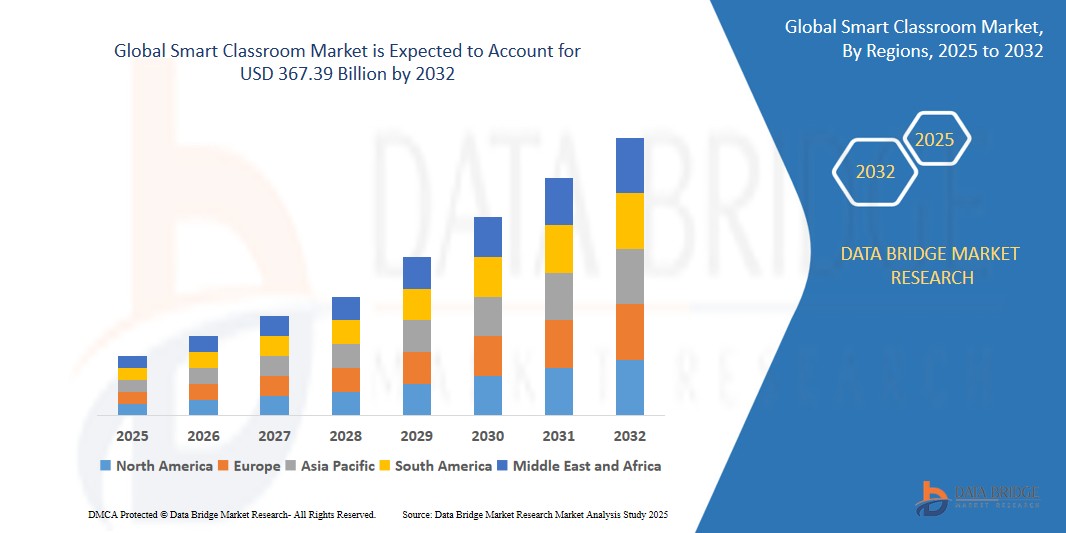
Smart Classroom Market Size
- The Global Smart Classroom Market size was valued at USD 162.44 billion in 2024 and is expected to reach USD 367.39 billion by 2032, at a CAGR of 10.74% during the forecast period
- The market growth is primarily driven by the increasing integration of digital technologies in education systems worldwide, including interactive whiteboards, virtual learning environments, and AI-based teaching aids that enhance student engagement and academic performance.
- Furthermore, the widespread adoption of e-learning platforms, government initiatives to digitize classrooms, and the growing need for flexible and remote learning environments are reinforcing Smart Classrooms as the new norm in modern education infrastructure. These factors are collectively transforming the learning experience and significantly accelerating the expansion of the Smart Classroom industry globally.
Smart Classroom Market Analysis
- Smart Classrooms, which integrate advanced technologies such as interactive whiteboards, smart projectors, AI-driven learning platforms, and cloud-based education systems, are becoming essential to modern educational environments in both K-12 and higher education. These classrooms enable enhanced interactivity, personalized learning, and real-time performance tracking, transforming traditional teaching methods into engaging and data-driven learning experiences.
- The escalating demand for Smart Classrooms is primarily fueled by the widespread adoption of digital education tools, increasing investments in EdTech infrastructure, and government initiatives promoting digital learning ecosystems. Additionally, the growing need for hybrid and remote learning capabilities—especially post-pandemic—has positioned Smart Classrooms as a critical solution for ensuring education continuity and accessibility across urban and rural regions alike.
- North America dominates the Smart Classroom Market with the largest revenue share of 34.51% in 2024, driven by high investments in educational technology, well-established infrastructure, and robust demand for digital learning solutions across schools and universities.
- Asia-Pacific Smart Classroom Market is poised to grow at the fastest CAGR of 27.35% during the forecast period (2025–2032), fueled by rising digital adoption, expanding educational reforms, and growing urban populations in key economies such as China, Japan, and India.
- The learning management systems (LMS) segment dominated the market revenue share in 2024, attributed to its wide adoption across educational institutions for organizing, tracking, and delivering digital learning content.
Report Scope and Smart Classroom Market Segmentation
|
Attributes |
Smart Classroom Key Market Insights |
|
Segments Covered |
|
|
Countries Covered |
North America
Europe
Asia-Pacific
Middle East and Africa
South America
|
|
Key Market Players |
|
|
Market Opportunities |
|
|
Value Added Data Infosets |
In addition to the insights on market scenarios such as market value, growth rate, segmentation, geographical coverage, and major players, the market reports curated by the Data Bridge Market Research also include in-depth expert analysis, pricing analysis, brand share analysis, consumer survey, demography analysis, supply chain analysis, value chain analysis, raw material/consumables overview, vendor selection criteria, PESTLE Analysis, Porter Analysis, and regulatory framework. |
Smart Classroom Market Trends
“Enhanced Learning Outcomes Through Integration of Advanced Educational Technologies”
- The growth of the Smart Classroom Market is the increasing integration of advanced digital tools designed to enhance student engagement, streamline teaching methodologies, and improve overall learning outcomes.
- For instance, in March 2024, Microsoft announced significant enhancements to its Teams for Education platform, incorporating AI-driven features to support interactive learning, real-time feedback, and collaborative classroom experiences. These innovations reflect a broader industry shift toward technology-enabled education.
- Technologies such as interactive whiteboards, learning management systems (LMS), and content creation platforms are revolutionizing the way students interact with educational material. These tools foster personalized learning paths, encourage student participation, and provide analytics to track academic progress.
- Moreover, the shift toward hybrid and distance learning models—accelerated by global events such as the COVID-19 pandemic—has solidified the role of Smart Classrooms as essential components of modern education infrastructure, catering to diverse learning needs.
Smart Classroom Market Dynamics
Driver
“Government-Led Digitization Programs and Public Education Investments”
- Major driver of the market is the surge in government initiatives aimed at modernizing educational infrastructure and promoting digital literacy. Across regions, authorities are allocating significant budgets toward the implementation of smart learning environments in public institutions.
- For instance, in February 2024, the Government of India significantly increased funding under the Digital India initiative, focusing on equipping rural and urban schools with Smart Classroom technologies including tablets, digital boards, and internet access.
- Similar initiatives in the U.S., EU, and parts of Southeast Asia emphasize digital inclusion, ensuring that students across socio-economic backgrounds can benefit from technology-enabled education.
- These programs not only encourage mass adoption of Smart Classrooms but also create partnerships between governments and EdTech companies, paving the way for long-term market growth and technological innovation.
Restraint/Challenge
“Infrastructural Limitations and Budget Constraints in Developing Regions”
- A notable restraint hampering the widespread adoption of Smart Classrooms is the limited technological infrastructure and financial resources in many developing countries.
- Numerous schools, particularly in rural and underserved regions, lack access to high-speed internet, electricity, and modern computing equipment, making it difficult to implement and maintain smart learning systems.
- Furthermore, budgetary constraints often force educational institutions to prioritize basic necessities over digital investments, slowing down the pace of transformation.
- Without sufficient funding, training, and technical support, the deployment of Smart Classrooms in these areas remains a significant challenge. Addressing this gap will require collaborative efforts from governments, NGOs, and private stakeholders to ensure equitable access to digital education.
Smart Classroom Market Scope
The market is segmented on the basis of educational system, component, application, and end use.
- By Educational System
On the basis of educational system, the Smart Classroom Market is segmented into collaboration systems, learning content development systems, document management systems, student response systems, learning management systems, content creation systems, assessment systems, classroom management systems, and learning content management systems. The learning management systems (LMS) segment dominated the market revenue share in 2024, attributed to its wide adoption across educational institutions for organizing, tracking, and delivering digital learning content. LMS platforms support blended learning, personalized education, and real-time performance analysis, making them an integral part of modern education infrastructure.
The student response systems segment is projected to grow at the fastest CAGR from 2025 to 2032, driven by increasing emphasis on interactive learning, instant feedback, and student engagement. These systems are increasingly used for live polling, quizzes, and classroom participation, enhancing the learning experience in real-time..
- By Component
On the basis of component, the market is segmented into hardware, software, and services. The hardware segment accounted for the largest revenue share in 2024, led by high adoption of interactive whiteboards/flat panels, smart projectors, and digital displays in classrooms. These tools enhance visual learning, support multimedia content delivery, and facilitate collaborative education.
The software segment is expected to witness the highest CAGR from 2025 to 2032, propelled by demand for learning management software, assessment tools, and distance learning solutions. The rise of cloud-based and AI-powered platforms is driving innovation and scalability in digital education delivery.
The services segment, which includes professional, implementation, integration, consulting, and operation and maintenance, plays a vital role in customizing, deploying, and managing smart classroom infrastructure, ensuring optimal functionality and user adoption.
- By Application
On the basis of application, the Smart Classroom Market is segmented into educational gaming, educational security, and educational ERP. The educational ERP segment dominated the market in 2024, driven by the need for centralized management of academic operations, including student enrollment, attendance, timetable scheduling, and performance tracking. ERP platforms streamline institutional workflows and enhance administrative efficiency.
The educational gaming segment is projected to grow at the fastest pace during the forecast period, fueled by the gamification trend in education to improve engagement, motivation, and cognitive learning outcomes among students through interactive content and simulations.
- By End Use
On the basis of end use, the market is segmented into kindergarten, K-12, and higher education. The K-12 segment held the largest market share in 2024, driven by the widespread integration of smart technologies into school curricula, rising adoption of blended and remote learning models, and growing government support for digital education initiatives.
The higher education segment is anticipated to register the fastest growth from 2025 to 2032, supported by the increasing demand for virtual classrooms, adaptive learning platforms, and advanced analytics in universities and colleges to personalize learning and improve academic outcomes.
Smart Classroom Market Regional Analysis
- North America dominates the Smart Classroom Market with the largest revenue share of 34.51% in 2024, driven by high investments in educational technology, well-established infrastructure, and robust demand for digital learning solutions across schools and universities.
- The region’s emphasis on modernizing classrooms with AI-powered learning tools, interactive displays, and cloud-based platforms continues to push market growth.
- Government initiatives supporting digital learning, along with high internet penetration and device availability, reinforce North America’s leadership in the Smart Classroom industry.
U.S. Smart Classroom Market Insight
The U.S. Smart Classroom Market captured the largest revenue share of 74.77% in 2024 within North America, propelled by rapid adoption of e-learning solutions and increased funding for digital classroom infrastructure. Educational institutions are actively incorporating smart displays, online collaboration tools, and analytics platforms to enhance learning outcomes. Federal and state-level investments in EdTech and hybrid education models are further accelerating the market’s expansion.
Asia-Pacific Smart Classroom Market Insight
Asia-Pacific Smart Classroom Market is poised to grow at the fastest CAGR of 27.35% during the forecast period (2025–2032), fueled by rising digital adoption, expanding educational reforms, and growing urban populations in key economies such as China, Japan, and India. Government-led smart education initiatives and the availability of affordable smart devices are significantly increasing the accessibility of Smart Classrooms in both rural and urban areas. The region is also emerging as a major hub for EdTech startups and hardware manufacturing, further boosting innovation and cost-efficiency..
China Smart Classroom Market Insight
The China Smart Classroom Market held the largest market share in the Asia-Pacific region in 2024, supported by government investments in smart education infrastructure and a booming EdTech ecosystem. With rapid urbanization, expanding middle class, and widespread internet access, smart classroom tools are being deployed extensively across K-12 and higher education institutions.
Japan Smart Classroom Market Insight
Japan’s Smart Classroom Market is experiencing significant growth due to its tech-savvy culture and aging population. Educational institutions are investing in AI-powered learning assistants, language learning tools, and immersive digital content. The integration of IoT devices and emphasis on remote and lifelong learning are further strengthening demand.
Europe Smart Classroom Market Insight
Europe Smart Classroom Market is projected to grow at a substantial CAGR throughout the forecast period, driven by government-backed education reforms, digital learning strategies, and a focus on sustainability and energy efficiency. High awareness of modern educational practices and strong funding support from the EU are promoting the use of digital whiteboards, virtual reality tools, and e-learning platforms across the continent.
U.K. Smart Classroom Market Insight
The U.K. Smart Classroom Market is expected to expand at a notable CAGR, propelled by widespread digitization of schools and robust public-private investments in EdTech. With rising demand for virtual classrooms and real-time learning analytics, the U.K. remains a key innovator in smart education delivery.
Germany Smart Classroom Market Insight
Germany’s Smart Classroom Market is growing steadily, driven by strong demand for smart and secure learning environments. Emphasis on sustainability, combined with the integration of cloud-based platforms and AI in education, is pushing adoption across secondary schools and universities.
Smart Classroom Market Share
The Smart Classroom industry is primarily led by well-established companies, including:
- IBM(United States)
- Microsoft(United States)
- Panasonic Corporation(Japan)
- Dell(United States)
- SAMSUNG(South Korea)
- FUJITSU (Japan)
- SMART Technologies ULC(Canada)
- AT&T Intellectual Property(United States)
- Blackboard Inc. (United States)
- Apple Inc.(United States)
- Adobe (United States)
- Cisco Systems, Inc.(United States)
- D2L Corporation(Canada)
- Discovery, Inc. (United States)
- Echo360(United States)
- HP Development Company, L.P. (United States)
- Jenzabar, Inc.(United States)
- Lenovo (China)
- Toshiba Corporation(Japan)
- John Wiley & Sons, Inc. (United States)
Latest Developments in Global Smart Classroom Market
- In May 2024, Microsoft Corporation launched new AI-powered capabilities within its Teams for Education platform to enhance collaboration, personalized learning, and student engagement. These upgrades include real-time language translation, intelligent meeting summaries, and adaptive learning pathways. This move highlights Microsoft's continued investment in educational innovation and reinforces its commitment to transforming the learning experience in Smart Classrooms globally.
- In April 2024, SMART Technologies ULC unveiled its next-generation SMART Board RX Series, featuring integrated Android 13, advanced interactive tools, and cloud connectivity for seamless hybrid learning. The new series is designed to support both in-person and remote classrooms, enabling educators to deliver dynamic and interactive lessons. This launch underscores the company's strategy to address evolving digital learning demands and expand its footprint in the Smart Classroom Market.
- In March 2024, Cisco Systems, Inc. partnered with the Indian Ministry of Education to launch a National Digital Education Network initiative aimed at deploying video conferencing and secure network infrastructure across government schools and colleges. The project seeks to improve accessibility and foster inclusive education through Smart Classroom technologies, demonstrating Cisco's focus on social impact and global education transformation.
- In February 2024, HP Development Company, L.P. introduced HP Fortis laptops optimized for digital classrooms with rugged designs, AI-enhanced collaboration tools, and pre-installed educational software. Built specifically for K-12 and higher education environments, these devices support real-time learning analytics and digital content delivery, empowering institutions to build scalable Smart Classroom ecosystems.
- In January 2024, Adobe launched the Creative Cloud Express for Education initiative, providing free access to a suite of design and storytelling tools for students and teachers globally. The platform encourages digital literacy, creativity, and multimedia learning, positioning Adobe as a key enabler of Smart Classroom adoption by integrating visual communication tools into the academic curriculum.

- Interactive Data Analysis Dashboard
- Company Analysis Dashboard for high growth potential opportunities
- Research Analyst Access for customization & queries
- Competitor Analysis with Interactive dashboard
- Latest News, Updates & Trend analysis
- Harness the Power of Benchmark Analysis for Comprehensive Competitor Tracking
Data collection and base year analysis are done using data collection modules with large sample sizes. The stage includes obtaining market information or related data through various sources and strategies. It includes examining and planning all the data acquired from the past in advance. It likewise envelops the examination of information inconsistencies seen across different information sources. The market data is analysed and estimated using market statistical and coherent models. Also, market share analysis and key trend analysis are the major success factors in the market report. To know more, please request an analyst call or drop down your inquiry.
The key research methodology used by DBMR research team is data triangulation which involves data mining, analysis of the impact of data variables on the market and primary (industry expert) validation. Data models include Vendor Positioning Grid, Market Time Line Analysis, Market Overview and Guide, Company Positioning Grid, Patent Analysis, Pricing Analysis, Company Market Share Analysis, Standards of Measurement, Global versus Regional and Vendor Share Analysis. To know more about the research methodology, drop in an inquiry to speak to our industry experts.
Data Bridge Market Research is a leader in advanced formative research. We take pride in servicing our existing and new customers with data and analysis that match and suits their goal. The report can be customized to include price trend analysis of target brands understanding the market for additional countries (ask for the list of countries), clinical trial results data, literature review, refurbished market and product base analysis. Market analysis of target competitors can be analyzed from technology-based analysis to market portfolio strategies. We can add as many competitors that you require data about in the format and data style you are looking for. Our team of analysts can also provide you data in crude raw excel files pivot tables (Fact book) or can assist you in creating presentations from the data sets available in the report.













