


Smart Cleanroom Technologies Market Overview
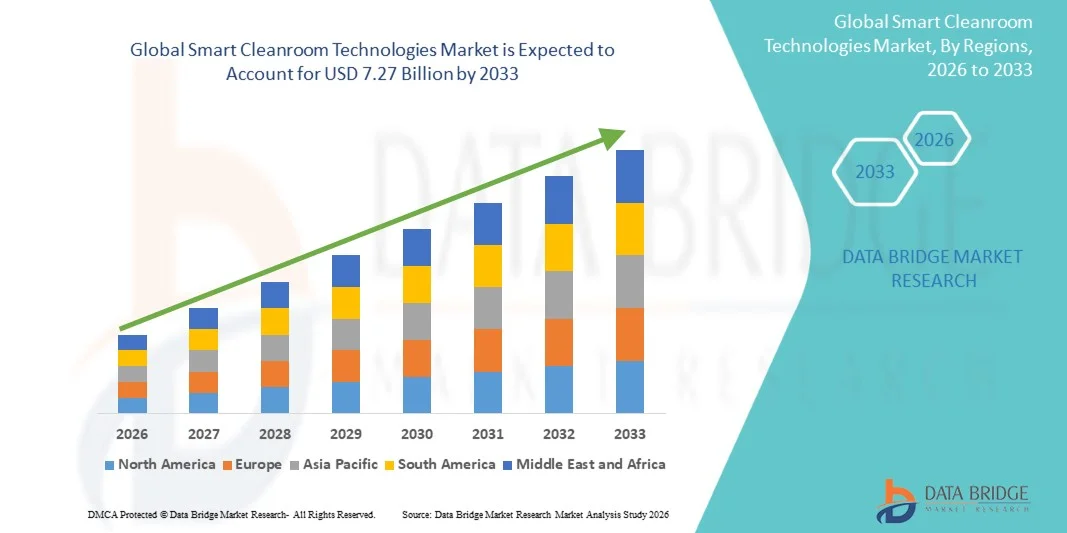
The Smart Cleanroom Technologies Market was valued at USD 2.48 billion in 2025 and is projected to reach USD 7.27 billion by 2033, growing at a CAGR of 14.40% from 2026 to 2033. The market is experiencing consistent growth driven by rising demand for advanced contamination control solutions, increasing adoption of automation and IoT-enabled cleanroom systems, and expanding applications across pharmaceuticals, biotechnology, semiconductor manufacturing, healthcare, and electronics industries.
The growing need for high-quality manufacturing environments, stringent regulatory requirements, and increasing production of sensitive products such as biologics, vaccines, medical devices, and semiconductor components are compelling organizations to adopt smart cleanroom technologies. AI-based monitoring systems, real-time environmental sensors, automated air filtration, and digital cleanroom management platforms are replacing traditional cleanroom operations in many industries, offering improved efficiency, predictive maintenance, enhanced compliance, and reduced operational risks.
Key Market Trends & Insights
- North America dominated the Smart Cleanroom Technologies Market with the largest revenue share of 34.6% in 2025, supported by strong investments in pharmaceutical and biotechnology manufacturing, increasing adoption of advanced cleanroom automation solutions, stringent regulatory standards, and the presence of leading semiconductor, healthcare, and life science companies. The region benefits from rising demand for IoT-enabled monitoring systems, AI-based cleanroom management platforms, advanced HVAC and filtration technologies, and smart sensors to improve contamination control, operational efficiency, and compliance with evolving quality requirements.
- The HVAC & Air filtration systems segment dominated the market with a 34.8% share in 2025, owing to its critical role in maintaining contamination control, air quality, temperature, humidity, and pressure levels in controlled environments.
- Asia-Pacific is expected to be the fastest-growing regional market, registering a CAGR of 9.2% from 2026 to 2033, fueled by rapid expansion of pharmaceutical manufacturing, increasing semiconductor production capacity, rising healthcare infrastructure investments, growing adoption of automation technologies, and government initiatives supporting advanced manufacturing ecosystems across China, India, Japan, South Korea, and Southeast Asia.
- The pharmaceuticals & biotechnology segment dominated the end-user category with a revenue share of 36.5% in 2025, owing to increasing demand for contamination-controlled environments in drug manufacturing, biologics production, vaccine development, and cell and gene therapy applications. Growing regulatory focus on Good Manufacturing Practices (GMP) and increasing investments in advanced pharmaceutical facilities are accelerating adoption of smart cleanroom technologies.
Market Size & Forecast
- Global Market Value (2025): USD 2.48 Billion
- Expected Market Value (2033): USD 7.27 Billion
- Forecast CAGR (2026–2033): 14.40%
- Leading Region in 2025: North America
- Fastest Growing Region: Asia-Pacific
Report Scope and Smart Cleanroom Technologies Market Segmentation
|
Attributes |
Smart Cleanroom Technologies Key Market Insights |
|
Segments Covered |
|
|
Countries Covered |
North America · U.S. · Canada · Mexico Europe · Germany · France · U.K. · Netherlands · Switzerland · Belgium · Russia · Italy · Spain · Turkey · Rest of Europe Asia-Pacific · China · Japan · India · South Korea · Singapore · Malaysia · Australia · Thailand · Indonesia · Philippines · Rest of Asia-Pacific Middle East and Africa · Saudi Arabia · U.A.E. · South Africa · Egypt · Israel · Rest of Middle East and Africa South America · Brazil · Argentina · Rest of South America |
|
Key Market Players |
• Siemens AG (Germany) |
|
Market Opportunities |
· Integration of AI, IoT, and Advanced Automation in Cleanroom Operations · Expansion of Pharmaceutical, Biotechnology, and Advanced Manufacturing Facilities · Growing Adoption of Digital Twins and Predictive Maintenance Solutions |
|
Value Added Data Infosets |
In addition to the insights on market scenarios such as market value, growth rate, segmentation, geographical coverage, and major players, the market reports curated by the Data Bridge Market Research also include in-depth expert analysis, geographically represented company-wise production and capacity, network layouts of distributors and partners, detailed and updated price trend analysis and deficit analysis of supply chain and demand. |
Smart Cleanroom Technologies Market Trends
Trend: Growth in Automation & AI-Driven Cleanroom Management
Industries such as pharmaceuticals, biotechnology, semiconductor manufacturing, and medical devices are increasingly adopting advanced smart cleanroom technologies to improve contamination control, enhance operational efficiency, and ensure compliance with strict quality standards. The integration of IoT-enabled monitoring systems, AI-based analytics, and automated environmental controls allows real-time tracking of critical parameters including particulate levels, temperature, humidity, and pressure differentials. Pharmaceutical and semiconductor companies are leveraging smart cleanrooms to support high-precision manufacturing processes, reduce human intervention, and improve product quality. The growing shift toward personalized medicine, biologics manufacturing, advanced electronics, and semiconductor fabrication is accelerating demand for intelligent cleanroom solutions with predictive monitoring and automated control capabilities.
Smart Cleanroom Technologies Market Dynamics
Key Market Driver: Increasing Demand for Contamination-Controlled Manufacturing in Pharmaceuticals and Semiconductor Industries
The growing expansion of pharmaceutical production, biotechnology research, and semiconductor manufacturing is creating strong demand for smart cleanroom technologies that enable precise environmental monitoring and automated contamination management. The increasing adoption of advanced therapies, vaccines, biologics, and cell and gene therapy products requires highly controlled production environments compliant with global regulatory standards such as Good Manufacturing Practices (GMP). Similarly, semiconductor manufacturers are investing heavily in ultra-clean manufacturing facilities due to the rising demand for advanced chips, artificial intelligence hardware, and electronic devices. For instance, major semiconductor investments in North America and Asia-Pacific are driving the development of advanced fabrication facilities equipped with automated monitoring systems, smart sensors, and advanced HVAC technologies to maintain stringent cleanliness requirements.
Key Restraint/Challenge: High Initial Investment and Complexity of Smart Cleanroom Implementation
A significant challenge in the Smart Cleanroom Technologies Market is the high capital investment required for designing, installing, and maintaining advanced cleanroom infrastructure. Smart cleanrooms require integration of IoT sensors, automated control systems, AI-based analytics platforms, advanced air filtration systems, and specialized monitoring equipment, resulting in substantial upfront costs. In addition, organizations must invest in software upgrades, calibration, cybersecurity measures, and skilled technical personnel to manage these complex systems. These cost barriers can limit adoption among small and medium-sized manufacturers, research institutions, and emerging-market companies with limited infrastructure budgets.
For instance, the development of next-generation pharmaceutical and semiconductor facilities increasingly involves large-scale investments in automated cleanroom environments, highlighting the financial and operational challenges associated with deploying advanced contamination-control technologies.
Key Market Opportunity: Integration of AI, IoT, and Predictive Analytics for Smart Facility Optimization
The integration of artificial intelligence, machine learning, and IoT technologies presents a major growth opportunity for the smart cleanroom technologies market. AI-enabled platforms can analyze real-time environmental data, predict contamination risks, optimize energy consumption, and support predictive maintenance of critical cleanroom equipment. The adoption of digital twin technologies and automated facility management systems is further enhancing cleanroom performance by enabling simulation-based optimization and proactive decision-making. The increasing development of smart manufacturing ecosystems across pharmaceuticals, biotechnology, semiconductor production, and healthcare is creating opportunities for advanced cleanroom solutions. Companies are increasingly deploying connected cleanroom platforms that provide real-time visibility, automated compliance documentation, and improved operational efficiency, supporting market growth across North America, Europe, and Asia-Pacific.
Smart Cleanroom Technologies Market Scope
The smart cleanroom technologies market is segmented on the basis of technology type and end user.
- By Technology Type
On the basis of technology type, the Smart Cleanroom Technologies Market is segmented into IoT-enabled cleanroom monitoring systems, HVAC & air filtration systems, automation & robotics systems, smart sensors & control systems, and AI-based cleanroom management platforms. The HVAC & Air Filtration Systems segment dominated the market with a 34.8% share in 2025, owing to its critical role in maintaining contamination control, air quality, temperature, humidity, and pressure levels in controlled environments. These systems are extensively adopted across pharmaceutical manufacturing, biotechnology laboratories, semiconductor production facilities, and healthcare environments where strict regulatory compliance and environmental control are essential. Increasing demand for advanced filtration technologies, energy-efficient cleanroom operations, and compliance with global cleanroom standards is supporting segment growth. The rising establishment of sterile manufacturing facilities and expansion of life sciences infrastructure are further strengthening the adoption of advanced HVAC and filtration solutions globally.
The AI-based cleanroom management platforms segment is projected to register the fastest growth at a CAGR of 8.2% from 2026 to 2033, driven by increasing adoption of artificial intelligence, predictive analytics, and automated decision-making solutions in cleanroom operations. AI-powered platforms enable real-time monitoring, contamination prediction, process optimization, and automated control of critical cleanroom parameters. Pharmaceutical and biotechnology companies are increasingly integrating AI-based systems to improve operational efficiency, reduce human intervention, and enhance compliance with regulatory requirements. The growing demand for smart manufacturing, Industry 4.0 integration, and data-driven facility management is accelerating adoption of AI-enabled cleanroom technologies. In addition, advancements in machine learning algorithms, cloud connectivity, and IoT integration are creating new opportunities for intelligent cleanroom management solutions.
- By End User
On the basis of end user, the Smart Cleanroom Technologies Market is segmented into pharmaceuticals & biotechnology, medical devices, semiconductor & electronics, healthcare & hospitals, food & beverage, aerospace & defense, and other industries. The pharmaceuticals & biotechnology segment dominated the market with a 36.5% share in 2025, due to increasing demand for sterile manufacturing environments, biologics production, vaccine development, and advanced drug manufacturing processes. Pharmaceutical and biotechnology companies are heavily investing in smart cleanroom solutions to maintain contamination-free production environments, improve process efficiency, and comply with stringent regulatory standards. The expansion of biologics, cell and gene therapies, and personalized medicine is further increasing demand for advanced monitoring, automation, and environmental control technologies. Additionally, growing investments in pharmaceutical manufacturing facilities across North America, Europe, and Asia-Pacific are reinforcing the leading position of this segment in the global market.
The semiconductor & electronics segment is expected to witness the fastest growth at a CAGR of 8.0% from 2026 to 2033, driven by increasing demand for semiconductor chips, advanced electronics, and high-precision manufacturing environments. Semiconductor fabrication facilities require highly controlled cleanroom conditions with advanced contamination monitoring and automated environmental management systems. The rapid expansion of artificial intelligence hardware, electric vehicles, consumer electronics, and semiconductor manufacturing capacity is accelerating adoption of smart cleanroom technologies in this sector. In addition, government initiatives supporting domestic semiconductor production and investments in advanced fabrication plants are creating significant growth opportunities. The integration of IoT-enabled monitoring, robotics, and automated control systems is further enhancing cleanroom efficiency and supporting market expansion across semiconductor and electronics industries.
Smart Cleanroom Technologies Market Regional Analysis
North America dominated the Smart Cleanroom Technologies Market and accounted for the largest revenue share of 34.6% in 2025, supported by strong investments in pharmaceutical and biotechnology manufacturing, increasing adoption of advanced cleanroom automation solutions, stringent regulatory requirements, and the presence of leading semiconductor, healthcare, and life science companies. The region benefits from rising demand for IoT-enabled cleanroom monitoring systems, AI-based cleanroom management platforms, advanced HVAC and air filtration technologies, and smart sensor solutions that enhance contamination control, operational efficiency, and compliance with evolving industry standards. Increasing investments in advanced manufacturing facilities, biologics production, semiconductor fabrication, and healthcare infrastructure continue to strengthen regional market growth.
U.S. Smart Cleanroom Technologies Market Insight
The U.S. smart cleanroom technologies market is witnessing strong growth due to increasing investments in pharmaceutical production, biotechnology research, semiconductor manufacturing, and advanced healthcare infrastructure. The country’s well-established life sciences ecosystem, presence of major pharmaceutical and technology companies, and growing adoption of IoT-enabled monitoring, AI-driven analytics, and automated cleanroom control systems are driving market expansion. In addition, increasing focus on regulatory compliance, contamination prevention, and operational efficiency is accelerating the deployment of smart cleanroom solutions across drug manufacturing facilities, research laboratories, and semiconductor production environments.
Europe Smart Cleanroom Technologies Market Insight
The Europe smart cleanroom technologies market remains a significant contributor to global revenue, driven by strict regulatory standards, strong pharmaceutical and biotechnology industries, and increasing investments in advanced manufacturing technologies. Countries across the region are adopting smart cleanroom solutions to improve quality control, reduce contamination risks, and enhance energy efficiency in critical environments. The growing demand for automated monitoring systems, advanced filtration technologies, and digital cleanroom management platforms across pharmaceutical, medical device, and semiconductor industries is supporting market growth throughout Europe.
U.K. Smart Cleanroom Technologies Market Insight
The U.K. smart cleanroom technologies market is experiencing steady growth, supported by expanding pharmaceutical research, biotechnology innovation, and increasing investments in advanced healthcare manufacturing facilities. The adoption of IoT-based monitoring systems, automated environmental control solutions, and AI-enabled cleanroom management platforms is improving operational efficiency and regulatory compliance. Growing demand for high-quality manufacturing environments in pharmaceutical production, medical research, and healthcare applications is positioning the U.K. as an important market for smart cleanroom technologies.
Germany Smart Cleanroom Technologies Market Insight
The Germany smart cleanroom technologies market is expanding steadily due to the country’s strong pharmaceutical, medical device, semiconductor, and industrial manufacturing base. Companies are increasingly adopting automated cleanroom technologies, smart sensors, and advanced air filtration systems to maintain strict quality standards and optimize production efficiency. Germany’s focus on Industry 4.0, digital manufacturing, and energy-efficient facility management is further supporting the adoption of intelligent cleanroom solutions across multiple industries.
Asia-Pacific Smart Cleanroom Technologies Market Insight
The Asia-Pacific smart cleanroom technologies market is expected to witness the fastest growth, registering a CAGR of 9.2% from 2026 to 2033, driven by rapid expansion of pharmaceutical manufacturing, increasing semiconductor production capacity, rising healthcare infrastructure investments, and growing adoption of automation technologies. Countries such as China, India, Japan, and South Korea are witnessing increased deployment of smart cleanroom systems due to rising demand for advanced manufacturing capabilities, government initiatives supporting high-tech industries, and increasing investments in life sciences and electronics production. The growing adoption of IoT monitoring, AI-based facility management, and automated contamination control systems is accelerating regional market expansion.
Japan Smart Cleanroom Technologies Market Insight
The Japan smart cleanroom technologies market is witnessing consistent growth due to strong demand from semiconductor manufacturing, pharmaceuticals, biotechnology, and precision electronics industries. Japanese manufacturers are increasingly adopting advanced cleanroom automation systems, smart sensors, and AI-based monitoring platforms to improve production accuracy and maintain strict contamination control standards. The country’s focus on advanced manufacturing technologies, robotics integration, and high-quality healthcare production is further contributing to market growth.
China Smart Cleanroom Technologies Market Insight
The China smart cleanroom technologies market is growing rapidly, supported by expanding pharmaceutical manufacturing, increasing semiconductor fabrication investments, and government initiatives promoting advanced manufacturing ecosystems. The rising demand for automated production facilities, intelligent monitoring systems, and contamination-controlled environments across healthcare, electronics, and biotechnology sectors is driving adoption. Increasing investments in semiconductor plants, vaccine production facilities, and smart manufacturing infrastructure are positioning China as one of the fastest-growing markets for smart cleanroom technologies globally.
Smart Cleanroom Technologies Market Share
The Smart Cleanroom Technologies industry is primarily led by well-established companies, including:
- Siemens AG (Germany)
- Schneider Electric (France)
- Honeywell International Inc. (U.S.)
- Emerson Electric Co. (U.S.)
- Thermo Fisher Scientific Inc. (U.S.)
- Danaher Corporation (U.S.)
- Johnson Controls International plc (Ireland)
- Azbil Corporation (Japan)
- Ecolab Inc. (U.S.)
- Camfil AB (Sweden)
- M+W Group GmbH (Germany)
- Illinois Tool Works Inc. (U.S.)
- Nicomatic (France)
- TSI Incorporated (U.S.)
- Clean Air Products (U.S.)
- Terra Universal Inc. (U.S.)
- Labconco Corporation (U.S.)
- Mitsubishi Electric Corporation (Japan)
- Daikin Industries Ltd. (Japan)
- Panasonic Holdings Corporation (Japan)
- Fuji Electric Co., Ltd. (Japan)
- Sartorius AG (Germany)
- Merck KGaA (Germany)
- Azenta Life Sciences (U.S.)
- Aerzen (Germany)
- Nuaire Inc. (U.S.)
- Alfa Laval AB (Sweden)
- AAF International (U.S.)
- Kewaunee Scientific Corporation (U.S.)
- Taikisha Ltd. (Japan)
- Exyte GmbH (Germany)
- Air Techniques International (U.S.)
- Bioquell (U.K.)
- Shibuya Corporation (Japan)
Latest Developments in Smart Cleanroom Technologies Market
- In April 2024, AES Clean Technology, a leading provider of advanced cleanroom solutions, announced the launch of its CleanLock Module, an innovative modular airlock solution designed to improve cleanliness, efficiency, and contamination control in cleanroom environments. The CleanLock Module integrates advanced airflow management, controlled access systems, specialized cleanroom finishes, and automated door technologies to enhance environmental control across pharmaceutical, biotechnology, and medical device manufacturing facilities. This development highlights the industry’s growing shift toward modular, faster-to-deploy, and digitally optimized cleanroom infrastructure
- In April 2024, Exyte GmbH, a global provider of high-tech facility solutions, reported significant expansion driven by increasing demand for advanced cleanroom facilities across semiconductor, biotechnology, pharmaceutical, and data center industries. The company continued strengthening its cleanroom engineering and technology capabilities to support next-generation manufacturing environments requiring advanced contamination control, automation, and sustainable facility designs. This growth reflects increasing global investments in smart cleanroom infrastructure and high-precision production facilities
- In September 2023, Exyte GmbH announced strong business growth supported by rising demand for advanced technology facilities, including cleanrooms for semiconductor, pharmaceutical, biotechnology, and battery manufacturing applications. The company highlighted increased investments in high-tech infrastructure projects and expansion of its engineering capabilities to meet demand for sophisticated clean manufacturing environments. This development reflects the growing importance of smart cleanroom technologies in supporting next-generation industrial production
- In December 2024, Anjuna announced the general availability of Anjuna Northstar, an AI-driven data fusion clean room platform designed to enable secure collaboration and AI-based data analysis. Although focused on digital data clean rooms, the development reflects the broader industry trend toward AI-enabled clean environments, secure data processing, and intelligent automation technologies. The launch demonstrates increasing adoption of AI-driven platforms for improving operational efficiency and data management across industries

- Interactive Data Analysis Dashboard
- Company Analysis Dashboard for high growth potential opportunities
- Research Analyst Access for customization & queries
- Competitor Analysis with Interactive dashboard
- Latest News, Updates & Trend analysis
- Harness the Power of Benchmark Analysis for Comprehensive Competitor Tracking
Data collection and base year analysis are done using data collection modules with large sample sizes. The stage includes obtaining market information or related data through various sources and strategies. It includes examining and planning all the data acquired from the past in advance. It likewise envelops the examination of information inconsistencies seen across different information sources. The market data is analysed and estimated using market statistical and coherent models. Also, market share analysis and key trend analysis are the major success factors in the market report. To know more, please request an analyst call or drop down your inquiry.
The key research methodology used by DBMR research team is data triangulation which involves data mining, analysis of the impact of data variables on the market and primary (industry expert) validation. Data models include Vendor Positioning Grid, Market Time Line Analysis, Market Overview and Guide, Company Positioning Grid, Patent Analysis, Pricing Analysis, Company Market Share Analysis, Standards of Measurement, Global versus Regional and Vendor Share Analysis. To know more about the research methodology, drop in an inquiry to speak to our industry experts.
Data Bridge Market Research is a leader in advanced formative research. We take pride in servicing our existing and new customers with data and analysis that match and suits their goal. The report can be customized to include price trend analysis of target brands understanding the market for additional countries (ask for the list of countries), clinical trial results data, literature review, refurbished market and product base analysis. Market analysis of target competitors can be analyzed from technology-based analysis to market portfolio strategies. We can add as many competitors that you require data about in the format and data style you are looking for. Our team of analysts can also provide you data in crude raw excel files pivot tables (Fact book) or can assist you in creating presentations from the data sets available in the report.













