What is the Global Smart Coffee Maker Market Size and Growth Rate?
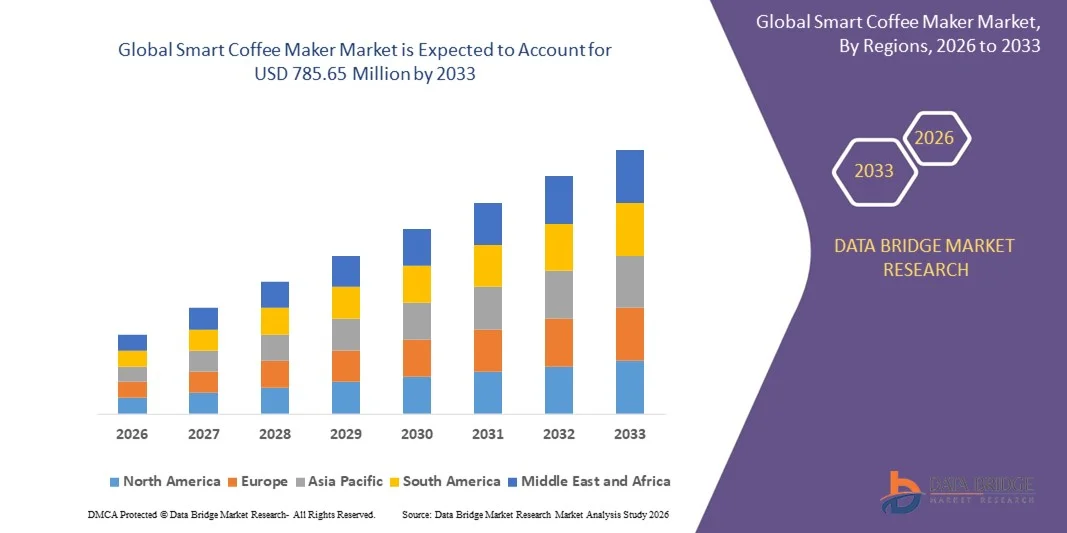
- The global smart coffee maker market size was valued at USD 477.22 million in 2025 and is expected to reach USD 785.65 million by 2033, at a CAGR of 6.43% during the forecast period
- The growing adoption of smart homes and smart appliances, rising number of innovation in technology, design, and customizable features, remote access convenience, growing consumption of coffee and increasing workplaces, rising levels of disposable income of the people along with changing lifestyle of the consumer, expansion of coffee culture and the expansion of coffee shops, increasing preferences towards the consumption of coffee among the youth population are some of the major as well as vital factors which will such asly to augment the growth of the smart coffee maker market
What are the Major Takeaways of Smart Coffee Maker Market?
- Smart coffee machines can be accessed through smartphones and users can control it from anywhere inside the house and can also provide commands from a smartphone along with rising working class population which will further contribute by generating massive opportunities that will lead to the growth of the smart coffee maker market in the above mentioned projected timeframe
- Increasing number of app interface issues along with lack of additional product differentiation which will likely to act as market restraints factor for the growth of the smart coffee maker in the above mentioned projected timeframe. Easy availability of product substitute will become the biggest and foremost challenge for the growth of the market
- North America dominated the smart coffee maker market with a 36.8% revenue share in 2025, supported by widespread adoption of smart, nutrient-fortified coffee solutions across the U.S. and Canada
- Asia-Pacific is projected to record the fastest CAGR of 7.98% from 2026 to 2033, driven by rising disposable incomes, urbanization, and increasing health-conscious consumer behavior in China, India, Japan, and Southeast Asia
- The Wi-Fi-enabled segment dominated the market with a revenue share of 53.2% in 2025, driven by its ability to connect with mobile applications, smart home systems, and cloud-based recipe management
Report Scope and Smart Coffee Maker Market Segmentation
|
Attributes |
Smart Coffee Maker Key Market Insights |
|
Segments Covered |
|
|
Countries Covered |
North America
Europe
Asia-Pacific
Middle East and Africa
South America
|
|
Key Market Players |
|
|
Market Opportunities |
|
|
Value Added Data Infosets |
In addition to the insights on market scenarios such as market value, growth rate, segmentation, geographical coverage, and major players, the market reports curated by the Data Bridge Market Research also include in-depth expert analysis, pricing analysis, brand share analysis, consumer survey, demography analysis, supply chain analysis, value chain analysis, raw material/consumables overview, vendor selection criteria, PESTLE Analysis, Porter Analysis, and regulatory framework. |
What is the Key Trend in the Smart Coffee Maker Market?
Rising Demand for Nutrient-Enriched and Plant-Based Smart Coffee Brewing Technologies
- The smart coffee makers market is witnessing a major trend toward the integration of plant-based ingredients, nutrient-infused coffee pods, and functional additives such as vitamins, minerals, adaptogens, and herbal extracts. This shift is driven by health-conscious consumers seeking wellness-oriented, clean-label, and customizable coffee options in home and commercial settings
- For instance, brands such as Nestlé and De’Longhi have expanded their smart machine ecosystems by supporting functional coffee pods enriched with antioxidants, probiotics, and plant extracts to improve energy, focus, digestion, and immunity
- The rising awareness of lifestyle-related concerns such as stress, fatigue, low immunity, and digestive issues is fueling demand for health-boosting coffee formulations compatible with smart brewers
- Manufacturers are increasingly integrating advanced IoT systems, automated dosing mechanisms, and ingredient-optimization algorithms to prepare nutrient-dense plant-based coffee beverages with consistent taste and bioavailability
- Growing R&D around functional blends, natural flavor extraction, and ingredient stability is accelerating innovation across Smart Coffee Maker platform
- As consumers continue shifting toward plant-based, low-sugar, and functional beverages, Smart Coffee Makers are expected to remain a central technology in the evolving health and wellness coffee landscape
What are the Key Drivers of Smart Coffee Maker Market?
- Rising consumer awareness of the health, convenience, and personalization benefits of Smart Coffee Makers—including automated brewing, real-time monitoring, recipe customization, and integration with wearables—is a major driver of global adoption
- For instance, in 2025, companies such as Keurig and Philips expanded their AI-enabled machines that track user habits, offer personalized brew recommendations, and integrate with functional pod systems targeting wellness-focused consumers
- The growing preference for plant-based, clean-label, low-calorie, and specialty coffee beverages is boosting market penetration across North America, Europe, and Asia-Pacific
- Technological advancements such as IoT-based connectivity, app-controlled brewing, smart scheduling, cold-brewing automation, and machine-learning-based flavor optimization are enhancing product appeal
- Increasing integration of Smart Coffee Makers into smart homes, fitness routines, and workplace wellness programs is strengthening global demand
- With continuous investment in innovative brewing algorithms, sustainability-centered machine designs, and targeted consumer marketing, the Smart Coffee Maker market is expected to maintain a strong growth trajectory in the coming year
Which Factor is Challenging the Growth of the Smart Coffee Maker Market?
- High production costs associated with advanced sensors, IoT components, premium materials, and smart brewing technologies limit affordability, especially in price-sensitive markets
- For instance, during 2024–2025, fluctuations in availability and pricing of high-end components, semiconductors, and eco-friendly machine materials impacted manufacturing timelines for leading smart coffee brands
- Regulatory considerations related to electrical safety, wireless connectivity standards, and food-contact materials add complexity to product development and certification
- Limited consumer awareness in emerging regions regarding smart brewing benefits, app-enabled features, and functional pod compatibility restricts mass adoption
- Competition from traditional coffee makers, instant coffee products, and ready-to-drink functional beverages creates pricing pressure and affects market penetration
- To address these challenges, companies are focusing on cost-optimized components, improved supply chain efficiency, modular machine designs, and consumer education initiatives to offer smarter, affordable, and reliable Smart Coffee Maker solution
How is the Smart Coffee Maker Market Segmented?
The market is segmented on the basis of type, application, and distribution channel.
- By Type
Based on type, the Smart Coffee Maker market is segmented into Wi-Fi-enabled and Bluetooth-enabled machines. The Wi-Fi-enabled segment dominated the market with a revenue share of 53.2% in 2025, driven by its ability to connect with mobile applications, smart home systems, and cloud-based recipe management. Wi-Fi-enabled machines allow users to customize brewing parameters, schedule multiple brews, and integrate with voice assistants, offering convenience and personalization that appeal to tech-savvy and health-conscious consumers.
The Bluetooth-enabled segment is projected to grow at the fastest CAGR during 2026–2033, fueled by increasing adoption of compact, cost-efficient smart brewers suitable for households and small offices. Bluetooth connectivity provides reliable short-range control, allowing seamless interaction with pods and drink customization. Continuous improvements in connectivity, app-based control, and cross-device integration are expected to drive rapid uptake of Bluetooth-enabled Smart Coffee Makers across global markets.
- By Application
On the basis of application, the market is segmented into Commercial, Office, Household, and Other uses. The Household segment dominated the market with a revenue share of 45.8% in 2025, due to rising consumer interest in convenience, customizable brewing, and health-oriented beverage options at home. Smart Coffee Makers for domestic use allow personalized brewing, integration with wellness routines, and compatibility with functional coffee pods, making them highly popular in urban households globally.
The Office segment is expected to register the fastest CAGR between 2026 and 2033, driven by the growing trend of smart coffee solutions in workplaces, co-working spaces, and corporate wellness programs. Automated scheduling, energy efficiency, multi-user functionality, and beverage diversity appeal to businesses looking to enhance employee satisfaction and productivity. Increasing adoption of IoT-enabled machines in office environments is expected to fuel segment growth across North America, Europe, and Asia-Pacific.
- By Distribution Channel
Based on distribution channel, the Smart Coffee Maker market is segmented into Online Sales and Offline Sales. The Offline Sales segment dominated the market with a revenue share of 50.6% in 2025, driven by widespread availability in supermarkets, specialty stores, appliance showrooms, and electronics retailers. Offline channels provide customers with in-person product demonstration, hands-on evaluation, and immediate purchase convenience, making them preferred for high-value smart appliances.
The Online Sales segment is projected to grow at the fastest CAGR during 2026–2033, supported by increasing e-commerce penetration, digital marketing, and subscription-based pod delivery models. Online platforms offer a wide variety of Smart Coffee Maker models, targeted health-focused bundles, and home delivery convenience, appealing particularly to urban and tech-savvy consumers. Growth in direct-to-consumer sales and online retail adoption is expected to accelerate global market expansion.
Which Region Holds the Largest Share of the Smart Coffee Maker Market?
- North America dominated the smart coffee maker market with a 36.8% revenue share in 2025, supported by widespread adoption of smart, nutrient-fortified coffee solutions across the U.S. and Canada. High health consciousness, strong retail infrastructure, and awareness of functional and plant-based beverages contribute to regional leadership
- Leading players are leveraging IoT-enabled machines, functional coffee pods, and eco-friendly packaging to meet growing consumer demand. Government initiatives supporting nutrition labeling, workplace wellness programs, and preventive healthcare further strengthen market dominance
- Urbanization, higher disposable incomes, and active lifestyle trends are boosting adoption of Smart Coffee Makers in North American households and offices
U.S. Smart Coffee Maker Market Insight
The U.S. is the largest contributor to North America’s market, driven by high adoption of vitamin-, protein-, and plant-based coffee solutions. Consumers increasingly prefer functional beverages that support immunity, focus, energy, and overall wellness. Manufacturers are investing in innovative pods, IoT-enabled brewers, and multi-beverage systems, while expanding distribution through supermarkets, specialty stores, and e-commerce platforms. Preventive health trends, clean-label demand, and tech-savvy urban populations underpin strong growth in the U.S.
Canada Smart Coffee Maker Market Insight
Canada contributes steadily, driven by rising awareness of nutrient-fortified and plant-based Smart Coffee Makers. Adoption is supported by specialty retail chains, e-commerce, and workplace wellness programs. Collaborations between beverage brands and nutraceutical firms are expanding functional beverage offerings, including vitamin and mineral-enriched pods. Consumer preference for sustainable, convenient, and clean-label coffee solutions continues to support market growth.
Asia-Pacific Smart Coffee Maker Market Insight
Asia-Pacific is projected to record the fastest CAGR of 7.98% from 2026 to 2033, driven by rising disposable incomes, urbanization, and increasing health-conscious consumer behavior in China, India, Japan, and Southeast Asia. Expanding retail networks, e-commerce adoption, and preventive healthcare trends are accelerating market growth. Smart Coffee Makers enriched with vitamins, protein, and plant-based extracts are gaining popularity, supported by product innovation and awareness campaigns.
China Smart Coffee Maker Market Insight
China leads the Asia-Pacific market, supported by urbanization, rising fitness awareness, and increasing demand for fortified beverages. Consumers are adopting Smart Coffee Makers compatible with functional coffee pods enriched with vitamins, minerals, and plant extracts. Strong distribution across supermarkets, specialty stores, and e-commerce channels enables broad accessibility. R&D investment, innovation, and promotional campaigns continue to drive consumption.
India Smart Coffee Maker Market Insight
India is emerging as a key contributor, fueled by health awareness, government nutrition programs, and expanding retail/e-commerce channels. Affordable Smart Coffee Makers enriched with vitamins, minerals, and plant-based ingredients are in demand for hydration, immunity, and wellness support. Companies are innovating with eco-friendly, clean-label, and convenient packaging. Rising urbanization, disposable incomes, and preventive healthcare trends are expected to sustain long-term growth.
Europe Smart Coffee Maker Market Insight
Europe holds a significant share, led by demand for fortified and functional beverages in Germany, the U.K., France, and the Netherlands. Consumers increasingly prefer vitamin- and protein-enriched coffee pods. Growth is supported by clean-label trends, sustainability initiatives, and health-focused marketing. Innovation in functional ingredients and premium Smart Coffee Maker systems strengthens adoption.
Germany Smart Coffee Maker Market Insight
Germany leads Europe, driven by high consumer demand for functional and plant-based coffee products. Urban populations favor fortified beverages supporting wellness and preventive health. Companies invest in R&D, innovative pod formulations, and IoT-enabled brewing solutions. Supermarkets, specialty stores, and online sales enhance accessibility, while sustainability and clean-label trends boost growth.
U.K. Smart Coffee Maker Market Insight
The U.K. market is expanding steadily, supported by growing awareness of vitamin- and protein-fortified Smart Coffee Makers. Adoption is facilitated through specialty stores and e-commerce platforms, offering functional pods and convenient, eco-friendly brewing solutions. Rising urbanization, active lifestyles, and government wellness initiatives further drive market growth.
Which are the Top Companies in Smart Coffee Maker Market?
The smart coffee maker industry is primarily led by well-established companies, including:
- Behmor, Inc. (U.S.)
- Gourmia (U.S.)
- Hamilton Beach Brands, Inc. (U.S.)
- JURA Elektroapparate AG (Switzerland)
- Koninklijke Philips N.V. (Netherlands)
- Nestlé (Switzerland)
- Newell Brands (U.S.)
- Robert Bosch GmbH (Germany)
- Smarter (U.K.)
- Keurig Green Mountain, Inc. (U.S.)
- De’Longhi Appliances S.r.l. (Italy)
- Electrolux Professional AB (Sweden)
- Melitta Europa GmbH & Co. KG (Germany)
- Morphy Richards India (India)
- illycaffè S.p.A. (Italy)
- Groupe SEB U.K., Ltd. (U.K.)
- Gruppo Cimbali S.p.A. (Italy)
- Zojirushi America Corporation (U.S.)
- Little Bear Electric Appliance Co. LTD. (China)
- Schaerer Ltd (Switzerland)
What are the Recent Developments in Global Smart Coffee Maker Market?
- In February 2022, Nestlé Nespresso S.A. and OpenSC collaborated to launch a new technology aimed at increasing transparency in the supply chain of the KAHAWA ya CONGO coffee, strengthening consumer trust and ethical sourcing initiatives in the coffee industry
- In July 2021, Keurig introduced its BrewID connect technology platform, which customizes brewing settings based on the specific roast and brand of the K-Cup pod, ensuring a tailored, full-flavored coffee experience for users, and enhancing personalization in smart brewing systems
- In May 2021, De’Longhi S.p.A. acquired Eversys, a well-known professional espresso coffee machine company based in Switzerland, expanding its footprint in the commercial and high-end coffee machine segment, supporting growth in the premium smart coffee maker market
- In October 2020, Nestlé Nespresso launched new touchless functionalities for its Nespresso Momento machines, allowing employees to safely interact over coffee while maintaining hygiene, marking a significant step in contactless coffee brewing technology
- In January 2020, Starbucks Corporation deployed AI-enabled coffee machines in multiple stores across the U.S. and the U.K., integrating AI sensors to enhance efficiency and consistency in brewing, reflecting the growing trend of automation and smart technology in coffee preparation

- Interactive Data Analysis Dashboard
- Company Analysis Dashboard for high growth potential opportunities
- Research Analyst Access for customization & queries
- Competitor Analysis with Interactive dashboard
- Latest News, Updates & Trend analysis
- Harness the Power of Benchmark Analysis for Comprehensive Competitor Tracking
Data collection and base year analysis are done using data collection modules with large sample sizes. The stage includes obtaining market information or related data through various sources and strategies. It includes examining and planning all the data acquired from the past in advance. It likewise envelops the examination of information inconsistencies seen across different information sources. The market data is analysed and estimated using market statistical and coherent models. Also, market share analysis and key trend analysis are the major success factors in the market report. To know more, please request an analyst call or drop down your inquiry.
The key research methodology used by DBMR research team is data triangulation which involves data mining, analysis of the impact of data variables on the market and primary (industry expert) validation. Data models include Vendor Positioning Grid, Market Time Line Analysis, Market Overview and Guide, Company Positioning Grid, Patent Analysis, Pricing Analysis, Company Market Share Analysis, Standards of Measurement, Global versus Regional and Vendor Share Analysis. To know more about the research methodology, drop in an inquiry to speak to our industry experts.
Data Bridge Market Research is a leader in advanced formative research. We take pride in servicing our existing and new customers with data and analysis that match and suits their goal. The report can be customized to include price trend analysis of target brands understanding the market for additional countries (ask for the list of countries), clinical trial results data, literature review, refurbished market and product base analysis. Market analysis of target competitors can be analyzed from technology-based analysis to market portfolio strategies. We can add as many competitors that you require data about in the format and data style you are looking for. Our team of analysts can also provide you data in crude raw excel files pivot tables (Fact book) or can assist you in creating presentations from the data sets available in the report.