


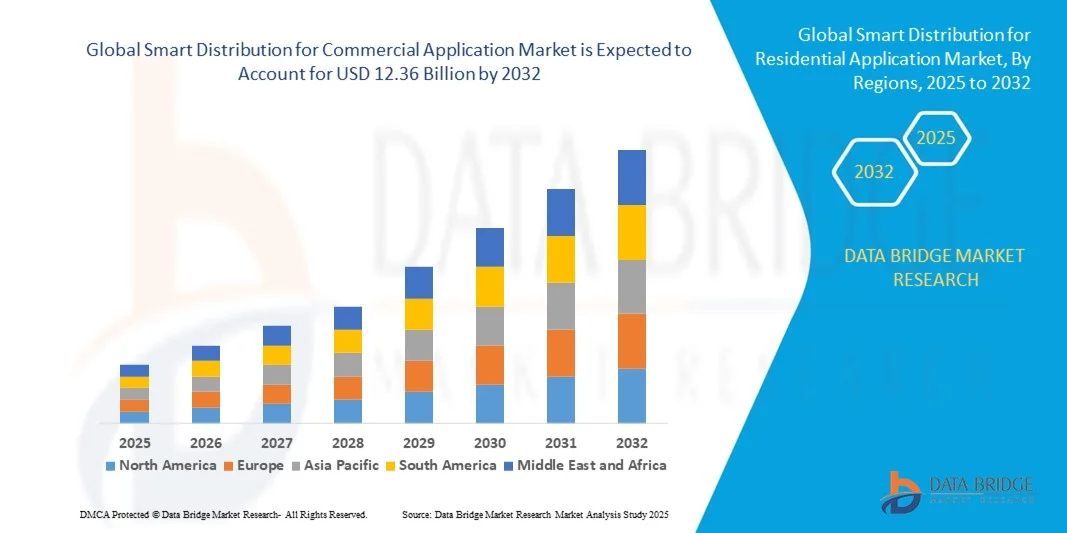
Smart Distribution for Commercial Application Market Size
- The global smart distribution for commercial application market size was valued at USD 3.87 billion in 2024 and is expected to reach USD 12.36 billion by 2032, at a CAGR of 15.63% during the forecast period
- The market growth is largely fueled by the increasing integration of automation, digital monitoring, and intelligent control technologies within commercial power systems, enabling businesses to achieve higher efficiency, reliability, and energy optimization. Growing investments in smart grid infrastructure and digital transformation initiatives across industries are further propelling the adoption of smart distribution systems for commercial applications
- Furthermore, the demand for real-time energy analytics, predictive maintenance, and seamless power management is driving organizations to deploy intelligent distribution solutions. These systems enhance operational visibility, reduce downtime, and improve sustainability, making them an essential component of modern commercial infrastructure
Smart Distribution for Commercial Application Market Analysis
- Smart distribution systems are becoming a critical part of commercial energy management networks, offering automated control, fault detection, and data-driven optimization of electrical power across buildings and facilities. Their deployment enables businesses to manage energy use efficiently, minimize losses, and ensure consistent power delivery, aligning with global energy efficiency goals
- The increasing adoption of IoT, AI, and cloud-based monitoring platforms across commercial environments is further accelerating market growth. These technologies enable remote supervision, advanced diagnostics, and integration with existing enterprise systems, driving the widespread acceptance of smart distribution solutions in sectors such as healthcare, retail, manufacturing, and intelligent buildings
- North America dominated the smart distribution for commercial application market in 2024, due to the strong presence of advanced commercial infrastructure and early adoption of smart grid technologies
- Asia-Pacific is expected to be the fastest growing region in the smart distribution for commercial application market during the forecast period due to rapid urbanization, infrastructure expansion, and the increasing adoption of digital energy management solutions
- Intelligent medium voltage switchgear segment dominated the market with a market share of 47.3% in 2024, due to its critical role in ensuring safe, reliable, and efficient power distribution in commercial setups. This segment benefits from its ability to monitor and control electrical loads, reduce downtime, and integrate with smart grid systems, making it highly valuable for large commercial facilities. In addition, intelligent medium voltage switchgear offers advanced protection features and remote monitoring capabilities, which appeal to facility managers seeking robust and future-ready electrical infrastructure
Report Scope and Smart Distribution for Commercial Application Market Segmentation
|
Attributes |
Smart Distribution for Commercial Application Key Market Insights |
|
Segments Covered |
|
|
Countries Covered |
North America
Europe
Asia-Pacific
Middle East and Africa
South America
|
|
Key Market Players |
|
|
Market Opportunities |
|
|
Value Added Data Infosets |
In addition to the insights on market scenarios such as market value, growth rate, segmentation, geographical coverage, and major players, the market reports curated by the Data Bridge Market Research also include in-depth expert analysis, geographically represented company-wise production and capacity, network layouts of distributors and partners, detailed and updated price trend analysis and deficit analysis of supply chain and demand. |
Smart Distribution for Commercial Application Market Trends
AI and IoT Integration for Energy Efficiency
- The smart distribution market for commercial applications is evolving rapidly through the integration of AI and IoT technologies aimed at enhancing energy efficiency and operational control. These innovations enable intelligent demand management, predictive fault detection, and automated load balancing to optimize energy consumption across commercial facilities
- For instance, Siemens AG has implemented AI-driven grid management systems that integrate IoT-enabled sensors for real-time monitoring in commercial buildings, allowing dynamic adjustments to power distribution based on usage patterns. Similarly, Schneider Electric offers EcoStruxure solutions that combine AI analytics and IoT connectivity to improve energy utilization and reduce operational waste
- AI and IoT integration enhances visibility into energy flows, enabling detailed analysis of consumption trends and identification of inefficiencies. Commercial enterprises can use this data to implement targeted energy-saving actions such as automated lighting control, HVAC optimization, and equipment load scheduling
- The deployment of connected distribution systems supports proactive maintenance by detecting anomalies in power quality, load distribution, or equipment performance before they lead to operational disruptions. This approach reduces downtime and extends asset life in high-demand commercial environments
- IoT devices in smart distribution networks facilitate interoperability between diverse energy systems, allowing centralized management of renewable inputs, storage solutions, and backup power infrastructure. AI algorithms further optimize the mix of available energy sources for cost efficiency and sustainability objectives
- The growing application of AI and IoT in commercial energy distribution represents a shift toward intelligent infrastructure capable of supporting sustainability targets, operational resilience, and regulatory compliance. As industries pursue carbon reduction goals, these technologies will play a critical role in shaping future-ready commercial power systems
Smart Distribution for Commercial Application Market Dynamics
Driver
Growing Adoption of Smart Grid Systems
- The increasing deployment of smart grid systems is a key driver for the smart distribution market in commercial applications. Smart grids provide advanced monitoring, automated control, and optimized energy distribution, enabling businesses to achieve greater operational efficiency and reliability in power management
- For instance, ABB Ltd has delivered smart grid solutions integrated with intelligent distribution management systems for large commercial complexes, improving load forecasting and demand response capabilities. This allows operators to align energy supply with dynamic consumption requirements effectively
- Smart grids enhance commercial energy distribution by enabling two-way communication between utility providers and end-users. This capability supports real-time adjustments in energy delivery, facilitating demand response programs and peak load management that reduce operational costs
- Integration with renewable energy sources such as solar and wind supports commercial facilities in meeting sustainability commitments. Smart distribution systems efficiently balance power from renewable inputs with grid supply, ensuring a stable and uninterrupted energy flow
- The accelerated roll-out of smart grid technologies across regions prioritizing modernization of electrical infrastructure continues to open opportunities for advanced commercial distribution solutions. These systems play a vital role in achieving operational efficiency, resilience, and scalability in modern commercial energy management
Restraint/Challenge
High Installation Costs
- High installation costs for smart distribution systems pose a significant challenge to market adoption, especially among mid-sized commercial enterprises. Expenses include advanced hardware acquisition, IoT sensor integration, AI analytics platforms, and the upgrading of legacy distribution infrastructure to support smart capabilities
- For instance, installing Schneider Electric’s fully integrated smart energy management solutions requires substantial investment in connected sensors, automation controllers, and network infrastructure. This capital requirement often limits accessibility for businesses with constrained budgets or shorter ROI timelines
- Costs are further increased by the need for specialized engineering services to design, configure, and commission smart systems. Retrofitting older facilities may involve complex rewiring, structural adjustments, and compliance with modern electrical standards, adding to overall project expenditure
- The technological sophistication of smart distribution systems also demands ongoing software updates, calibration, and cybersecurity measures to protect data integrity in IoT-enabled networks. These factors contribute to higher long-term ownership costs beyond initial installation
- Addressing this challenge will require the introduction of modular smart distribution solutions, leasing models, and financial incentives to offset upfront investments. Facilitating cost-effective adoption strategies will be critical for expanding the reach of smart distribution technologies in commercial applications worldwide
Smart Distribution for Commercial Application Market Scope
The market is segmented on the basis of product type and end user.
- By Product Type
On the basis of product type, the smart distribution market for commercial applications is segmented into Distribution Automation Terminal, Intelligent Medium Voltage Switchgear, and Complete Set of Low Voltage Electrical Equipment. The Intelligent Medium Voltage Switchgear segment dominated the market with the largest revenue share of 47.3% in 2024, driven by its critical role in ensuring safe, reliable, and efficient power distribution in commercial setups. This segment benefits from its ability to monitor and control electrical loads, reduce downtime, and integrate with smart grid systems, making it highly valuable for large commercial facilities. In addition, intelligent medium voltage switchgear offers advanced protection features and remote monitoring capabilities, which appeal to facility managers seeking robust and future-ready electrical infrastructure.
The Distribution Automation Terminal segment is anticipated to witness the fastest growth rate from 2025 to 2032, fueled by rising demand for real-time monitoring and automated control in commercial power networks. These terminals enable operators to optimize energy usage, detect faults quickly, and maintain operational efficiency, making them increasingly preferred in modern intelligent building solutions. Their compatibility with IoT-based platforms and ease of integration with existing power systems further accelerate adoption across diverse commercial environments.
- By End User
On the basis of end user, the smart distribution market is segmented into Power Systems, Intelligent Building, Petrochemical, Medical, Metallurgy, Traffic, and Other sectors. The Intelligent Building segment dominated the market in 2024, owing to the increasing integration of smart electrical infrastructure for energy management, operational efficiency, and sustainability in commercial and institutional buildings. Intelligent buildings prioritize automated control of lighting, HVAC, and other electrical systems, and rely on smart distribution solutions to support seamless, centralized monitoring and real-time fault management. The adoption is further enhanced by growing emphasis on green building certifications and smart city initiatives, which demand reliable and energy-efficient electrical distribution systems.
The Medical segment is expected to register the fastest growth rate from 2025 to 2032, driven by the need for uninterrupted power supply, advanced monitoring, and safety-critical electrical infrastructure in hospitals and healthcare facilities. Smart distribution solutions in medical environments ensure high reliability, protect sensitive equipment from power fluctuations, and allow remote monitoring of electrical systems. The increasing deployment of technologically advanced medical equipment and expansion of healthcare infrastructure in emerging regions further support rapid adoption in this sector.
Smart Distribution for Commercial Application Market Regional Analysis
- North America dominated the smart distribution for commercial application market with the largest revenue share in 2024, driven by the strong presence of advanced commercial infrastructure and early adoption of smart grid technologies
- The region’s focus on enhancing energy efficiency, operational reliability, and automated power management has accelerated market demand. The integration of IoT-based monitoring systems and intelligent distribution networks within commercial buildings further supports the region’s dominance
- Robust investments in modernization of power systems and the increasing need for real-time data analytics in energy distribution also strengthen market expansion
U.S. Smart Distribution for Commercial Application Market Insight
The U.S. smart distribution for commercial application market captured the largest revenue share in 2024 within North America, primarily due to rapid digital transformation and widespread implementation of smart energy management solutions across commercial and industrial sectors. The country’s strong regulatory push toward grid modernization and energy efficiency has led to significant adoption of intelligent distribution systems. Growing focus on sustainability and automation, coupled with rising demand from large commercial facilities such as data centers and corporate offices, continues to drive the market.
Europe Smart Distribution for Commercial Application Market Insight
The Europe smart distribution for commercial application market is projected to grow at a substantial CAGR during the forecast period, supported by stringent energy efficiency regulations and the growing adoption of smart grid technologies across commercial buildings. The region’s focus on reducing carbon emissions and promoting renewable energy integration into distribution systems is stimulating market growth. Smart distribution solutions are increasingly deployed in offices, shopping complexes, and public infrastructure to optimize energy usage and reduce operational costs.
U.K. Smart Distribution for Commercial Application Market Insight
The U.K. market is anticipated to grow at a notable CAGR through 2032, driven by government initiatives for building energy efficiency and smart infrastructure development. Commercial facilities are increasingly adopting automated distribution networks to improve reliability and reduce downtime. The growing integration of IoT platforms and advanced monitoring systems across corporate and retail environments is further fueling the market, supported by the country’s strong emphasis on energy transition and sustainability.
Germany Smart Distribution for Commercial Application Market Insight
The Germany market is expected to expand significantly during the forecast period, attributed to the country’s advanced industrial base and focus on integrating smart automation into electrical systems. The transition toward Industry 4.0 and the adoption of intelligent switchgear and control systems in commercial and manufacturing facilities are driving market demand. In addition, Germany’s commitment to achieving energy efficiency targets and maintaining grid stability through digital solutions enhances the deployment of smart distribution systems.
Asia-Pacific Smart Distribution for Commercial Application Market Insight
The Asia-Pacific market is poised to grow at the fastest CAGR from 2025 to 2032, driven by rapid urbanization, infrastructure expansion, and the increasing adoption of digital energy management solutions. Countries such as China, Japan, and India are investing heavily in smart grid technologies and automation for commercial and industrial power systems. The rising demand for intelligent monitoring, coupled with supportive government initiatives for energy modernization, continues to fuel market growth across the region.
China Smart Distribution for Commercial Application Market Insight
China accounted for the largest revenue share in the Asia-Pacific market in 2024, supported by large-scale investments in smart cities, commercial automation, and digital power infrastructure. The country’s strong manufacturing ecosystem and government-backed energy transformation policies are accelerating deployment of intelligent switchgear and automation terminals. Growing construction of commercial complexes and data centers further amplifies the demand for advanced distribution systems.
Japan Smart Distribution for Commercial Application Market Insight
Japan’s market is witnessing robust growth, driven by its commitment to energy efficiency, safety, and technological advancement. Commercial buildings are increasingly incorporating automated power distribution systems to enhance reliability and minimize energy waste. The adoption of IoT-enabled monitoring and predictive maintenance systems, coupled with the country’s emphasis on modern, eco-efficient infrastructure, continues to boost market expansion in the coming years.
Smart Distribution for Commercial Application Market Share
The smart distribution for commercial application industry is primarily led by well-established companies, including:
- ABB (Switzerland)
- Siemens (Germany)
- Schneider Electric (France)
- Emerson Electric Co. (U.S.)
- Rockwell Automation, Inc. (U.S.)
- Danaher (U.S.)
- Honeywell International Inc. (U.S.)
- Wipro Limited (India)
- General Electric Company (U.S.)
- Hitachi, Ltd. (Japan)
- Eaton (Ireland)
- OMRON Corporation (Japan)
- Itron Inc. (U.S.)
- Landis+Gyr (Switzerland)
- Aclara Technologies LLC (U.S.)
- Yokogawa India Ltd. (India)
- Mitsubishi Electric Corporation (Japan)
- Cisco (U.S.)
- Open Systems International, Inc. (U.S.)
- IBM Corporation (U.S.)
- Oracle (U.S.)
- S&C Electric Company (U.S.)
- Kamstrup A/S (Denmark)
- Trilliant Holdings Inc. (U.S.)
- Globema (Poland)
Latest Developments in Global Smart Distribution for Commercial Application Market
- In September 2025, Lighthouse launched its Smart Distribution platform to automate pricing and channel management for independent hotels, marking a major milestone in the digital transformation of the commercial distribution space. This innovation empowers hotels to manage room pricing dynamically, streamline channel partnerships, and improve overall profitability through AI-driven automation. Its introduction reflects the growing shift toward data-centric distribution models, enabling independent hospitality operators to compete more effectively with large chains. The platform’s ability to provide real-time insights and reduce manual errors significantly enhances operational efficiency and scalability within the smart distribution for commercial application market
- In May 2025, Schneider Electric unveiled its One Digital Grid Platform at Distributech 2025, integrating previously isolated grid management systems into a unified AI-driven solution. This launch has a transformative impact on the smart distribution for commercial application market, offering utilities and enterprises enhanced control, real-time analytics, and predictive maintenance capabilities. The platform’s ability to optimize energy flow and reduce downtime strengthens its appeal among large commercial infrastructures. By enabling data-driven energy management, Schneider Electric’s innovation advances the adoption of smart grids and intelligent power distribution systems across modern commercial facilities
- In March 2024, Landis+Gyr introduced an upgraded Advanced Metering Infrastructure (AMI) system incorporating advanced cybersecurity protocols and real-time data management tools. This development reinforces the reliability and integrity of commercial distribution networks by securing energy data exchanges and providing granular visibility into consumption patterns. For the smart distribution market, this innovation represents a step forward in building trustworthy, intelligent, and automated distribution systems that support both operational resilience and regulatory compliance. Its strong emphasis on security and interoperability promotes wider deployment across industries seeking stable and efficient energy solutions
- In February 2024, at MWC Barcelona 2024, Huawei launched 24 new commercial solutions and 12 new HUAWEI eKit products aimed at empowering small and medium-sized enterprises through digital transformation. This initiative underscores Huawei’s growing investment in the smart distribution ecosystem by providing scalable tools that enhance automation, connectivity, and intelligent decision-making in commercial power and data systems. By focusing on SMEs, Huawei’s launch democratizes access to advanced technologies, fostering innovation and accelerating global adoption of smart distribution systems across diverse commercial sectors
- In January 2024, NovaTech announced the strategic expansion of its Distribution Automation System (DAS) solutions into the Asian market, highlighting the region’s rising demand for intelligent energy infrastructure. The company’s entry into Asia enables localized customization, improved service support, and faster deployment of smart distribution systems for commercial users. This development accelerates the modernization of regional power systems, particularly in countries experiencing rapid urbanization and industrialization. NovaTech’s expansion strengthens its global presence and also contributes to the advancement of efficient, automated distribution networks across emerging markets

- Interactive Data Analysis Dashboard
- Company Analysis Dashboard for high growth potential opportunities
- Research Analyst Access for customization & queries
- Competitor Analysis with Interactive dashboard
- Latest News, Updates & Trend analysis
- Harness the Power of Benchmark Analysis for Comprehensive Competitor Tracking
Global Smart Distribution For Commercial Application Market, Supply Chain Analysis and Ecosystem Framework
To support market growth and help clients navigate the impact of geopolitical shifts, DBMR has integrated in-depth supply chain analysis into its Global Smart Distribution For Commercial Application Market research reports. This addition empowers clients to respond effectively to global changes affecting their industries. The supply chain analysis section includes detailed insights such as Global Smart Distribution For Commercial Application Market consumption and production by country, price trend analysis, the impact of tariffs and geopolitical developments, and import and export trends by country and HSN code. It also highlights major suppliers with data on production capacity and company profiles, as well as key importers and exporters. In addition to research, DBMR offers specialized supply chain consulting services backed by over a decade of experience, providing solutions like supplier discovery, supplier risk assessment, price trend analysis, impact evaluation of inflation and trade route changes, and comprehensive market trend analysis.
Data collection and base year analysis are done using data collection modules with large sample sizes. The stage includes obtaining market information or related data through various sources and strategies. It includes examining and planning all the data acquired from the past in advance. It likewise envelops the examination of information inconsistencies seen across different information sources. The market data is analysed and estimated using market statistical and coherent models. Also, market share analysis and key trend analysis are the major success factors in the market report. To know more, please request an analyst call or drop down your inquiry.
The key research methodology used by DBMR research team is data triangulation which involves data mining, analysis of the impact of data variables on the market and primary (industry expert) validation. Data models include Vendor Positioning Grid, Market Time Line Analysis, Market Overview and Guide, Company Positioning Grid, Patent Analysis, Pricing Analysis, Company Market Share Analysis, Standards of Measurement, Global versus Regional and Vendor Share Analysis. To know more about the research methodology, drop in an inquiry to speak to our industry experts.
Data Bridge Market Research is a leader in advanced formative research. We take pride in servicing our existing and new customers with data and analysis that match and suits their goal. The report can be customized to include price trend analysis of target brands understanding the market for additional countries (ask for the list of countries), clinical trial results data, literature review, refurbished market and product base analysis. Market analysis of target competitors can be analyzed from technology-based analysis to market portfolio strategies. We can add as many competitors that you require data about in the format and data style you are looking for. Our team of analysts can also provide you data in crude raw excel files pivot tables (Fact book) or can assist you in creating presentations from the data sets available in the report.













