


What is the Smart Drug Delivery Implant Devices Market Size and Growth Rate?
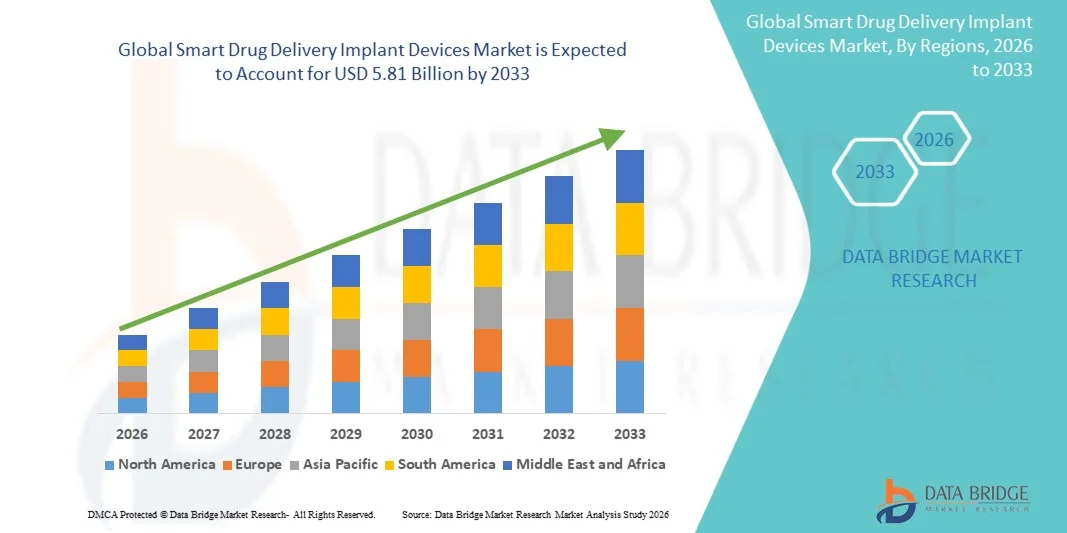
- As per Data Bridge Market Research Analysis the global Smart Drug Delivery Implant Devices market size was valued at USD 1.38 billion in 2025 and is expected to reach USD 5.81 billion by 2033, at a CAGR of 19.70% during the forecast period
- The market growth is largely fueled by the increasing prevalence of chronic diseases such as diabetes, cancer, and cardiovascular disorders, along with rising demand for targeted and controlled drug administration, leading to greater adoption of Smart Drug Delivery Implant Devices across healthcare settings
- Furthermore, advancements in biomedical engineering, miniaturization of implantable devices, and integration of smart technologies such as sensors and automated drug release systems are improving treatment precision and patient compliance. Growing focus on personalized medicine and long-term therapeutic efficiency is establishing Smart Drug Delivery Implant Devices as a key innovation in modern healthcare. These converging factors are accelerating the uptake of Smart Drug Delivery Implant Devices, thereby significantly boosting the industry’s growth
Market Size & Forecast
- Global Market Value (2025): USD 1.38 billion
- Expected Market Value (2033): USD 5.81 billion
- Forecast CAGR (2026–2033): 19.70%
What are the Major Takeaways of Smart Drug Delivery Implant Devices Market?
- Smart Drug Delivery Implant Devices, designed for controlled and targeted release of therapeutics within the body over an extended period, are increasingly critical in modern healthcare due to their ability to improve treatment precision, reduce dosing frequency, and enhance patient compliance across chronic disease management
- The escalating demand for Smart Drug Delivery Implant Devices is primarily driven by the rising prevalence of chronic diseases such as cancer, diabetes, and cardiovascular disorders, along with increasing adoption of personalized medicine and advancements in implantable biomedical technologies, enabling more efficient and controlled drug administration
- North America dominated the smart drug delivery implant devices market with the largest revenue share of 38.9% in 2025, supported by advanced healthcare infrastructure, strong R&D investments, high adoption of innovative drug delivery technologies, and the presence of leading pharmaceutical and medical device companies
- Asia-Pacific is expected to be the fastest-growing region in the smart drug delivery implant Devices market during the forecast period, driven by rising healthcare expenditure, expanding patient population base, improving access to advanced medical treatments, and increasing adoption of innovative implantable drug delivery solutions in countries such as China and India
- The implantable infusion pumps segment dominated the largest market revenue share of approximately 44.6% in 2025, driven by their high precision in delivering controlled doses of medication over extended periods
Report Scope and Smart Drug Delivery Implant Devices Market Segmentation
|
Attributes |
Smart Drug Delivery Implant Devices Key Market Insights |
|
Segments Covered |
|
|
Countries Covered |
North America
Europe
Asia-Pacific
Middle East and Africa
South America
|
|
Key Market Players |
|
|
Market Opportunities |
|
|
Value Added Data Infosets |
In addition to the insights on market scenarios such as market value, growth rate, segmentation, geographical coverage, and major players, the market reports curated by the Data Bridge Market Research also include in-depth expert analysis, patient epidemiology, pipeline analysis, pricing analysis, and regulatory framework. |
What is the Key Trend in the Smart Drug Delivery Implant Devices Market?
“Advancements in Targeted Drug Release Mechanisms and Biodegradable Implant Technologies”
- A significant and accelerating trend in the global smart drug delivery implant devices market is the development of advanced targeted drug release systems and biodegradable implant technologies, which are improving treatment precision and patient outcomes
- For instance, modern implant devices are increasingly designed to release drugs in controlled doses over extended periods, ensuring consistent therapeutic levels and reducing the need for frequent dosing
- The integration of smart polymers and nano-engineered materials is enabling site-specific drug delivery, improving treatment efficiency while minimizing systemic side effects
- Furthermore, biodegradable implant technologies are gaining traction as they eliminate the need for surgical removal after drug exhaustion, improving patient comfort and reducing healthcare burden
- The growing use of programmable drug release systems is also allowing clinicians to adjust dosage timing and intensity based on patient response
- This shift toward precision-based, long-acting, and patient-friendly drug delivery systems is significantly transforming the treatment landscape across chronic and critical diseases
Smart Drug Delivery Implant Devices Market Dynamics
Driver
“Rising Prevalence of Chronic Diseases and Growing Demand for Targeted Therapies”
- The increasing global burden of chronic diseases such as cancer, diabetes, cardiovascular disorders, and neurological conditions is a major driver for the smart drug delivery implant devices market
- For instance, the rising incidence of cancer has significantly increased the demand for localized and controlled drug delivery systems that improve treatment effectiveness while reducing systemic toxicity
- As patients require long-term and consistent medication management, implantable drug delivery devices offer improved compliance and better therapeutic outcomes compared to conventional methods
- Furthermore, advancements in healthcare infrastructure and increasing adoption of innovative treatment technologies are supporting wider clinical use of implantable drug systems
- The growing focus on personalized medicine and precision therapeutics is also accelerating the demand for targeted drug delivery solutions
- Increasing investment in research and development by pharmaceutical and medical device companies is further driving market expansion
Restraint/Challenge
“High Development Costs and Regulatory Approval Complexities”
- The high cost associated with research, development, and manufacturing of smart drug delivery implant devices poses a significant challenge to market growth
- For instance, developing biocompatible materials, ensuring controlled drug release mechanisms, and conducting long-term clinical trials require substantial financial investment
- In addition, strict regulatory requirements and lengthy approval processes for implantable medical devices can delay product commercialization
- The risk of device-related complications such as infection, rejection, or malfunction further adds to clinical and regulatory scrutiny
- Limited accessibility in low- and middle-income regions due to high treatment costs also restricts market penetration
- Addressing these challenges requires continued innovation, streamlined regulatory pathways, and increased collaboration between healthcare stakeholders
- While technological advancements are progressing, these barriers continue to limit the widespread adoption of smart drug delivery implant devices across global healthcare systems
How is the Smart Drug Delivery Implant Devices Market Segmented?
The market is segmented on the basis of device type, application, and end user.
• By Device Type
On the basis of device type, the Smart Drug Delivery Implant Devices market is segmented into implantable infusion pumps, targeted drug delivery implants, biodegradable drug delivery implants, and others. The implantable infusion pumps segment dominated the largest market revenue share of approximately 44.6% in 2025, driven by their high precision in delivering controlled doses of medication over extended periods. These devices are widely used in chronic disease management such as pain therapy, diabetes, and spasticity treatment. Their ability to provide continuous and programmable drug delivery significantly improves patient outcomes. Increasing prevalence of chronic diseases globally further supports segment dominance. Advancements in pump miniaturization and battery life enhancement improve device efficiency. Hospitals and specialty clinics prefer these systems for long-term treatment. Rising adoption of minimally invasive therapies also boosts demand. Strong clinical validation and regulatory approvals enhance market penetration. Growing geriatric population further drives usage. Continuous technological innovation supports sustained growth.
The biodegradable drug delivery implants segment is expected to witness the fastest CAGR of 10.8% from 2026 to 2033, driven by increasing demand for minimally invasive and sustainable drug delivery solutions. These implants gradually dissolve in the body, eliminating the need for surgical removal. Growing focus on patient comfort and reduced post-treatment complications supports adoption. Rising investment in biomaterials and polymer science is accelerating innovation. Increasing application in oncology and targeted therapies further boosts growth. In addition, regulatory support for biodegradable medical devices enhances commercialization. Expanding clinical trials improve safety and efficacy profiles. The segment benefits from reduced hospital revisit rates. Growing preference for long-acting drug delivery systems also drives demand. The segment is expected to expand rapidly with advancements in bioengineering technologies.
• By Application
On the basis of application, the market is segmented into diabetes, cancer, cardiovascular diseases, neurological disorders, pain management, and others. The diabetes segment dominated the market with a revenue share of approximately 31.9% in 2025, driven by the rapidly increasing global prevalence of diabetes. Smart implantable drug delivery systems are widely used for controlled insulin administration. The rising burden of lifestyle-related disorders significantly contributes to segment dominance. Increasing adoption of continuous drug delivery systems improves glycemic control. Advancements in closed-loop insulin delivery technologies further support growth. Growing awareness regarding diabetes management enhances treatment adoption. Hospitals and specialty clinics increasingly use implantable devices for long-term care. Expanding diabetic patient population worldwide strengthens demand. Continuous R&D in endocrine therapies supports innovation. Favorable reimbursement policies in developed regions also boost growth.
The oncology (cancer) segment is expected to witness the fastest CAGR of 11.6% from 2026 to 2033, driven by the increasing global cancer burden and demand for targeted therapies. Implantable drug delivery systems enable localized chemotherapy with reduced systemic side effects. Rising adoption of precision medicine supports segment growth. Increasing clinical trials for implant-based oncology treatments further accelerate demand. Advancements in nanotechnology and targeted drug release systems enhance treatment efficiency. Growing preference for minimally invasive cancer therapies boosts adoption. Expanding oncology infrastructure in emerging economies supports growth. Continuous innovation in biodegradable implants improves patient outcomes. Increasing healthcare investments in cancer treatment further strengthen the segment. The market is expected to expand rapidly due to rising cancer incidence worldwide.
• By End User
On the basis of end user, the market is segmented into hospitals, specialty clinics, ambulatory surgical centers, research institutes, and others. The hospitals segment dominated the market with a share of approximately 52.4% in 2025, driven by the high volume of complex drug delivery procedures performed in hospital settings. Hospitals are equipped with advanced infrastructure and skilled professionals for implantable device procedures. Increasing patient admissions for chronic disease management supports segment dominance. Availability of multidisciplinary care enhances treatment efficiency. Rising healthcare expenditure further strengthens hospital adoption. Continuous technological upgrades in hospital systems improve device utilization. Growing prevalence of chronic diseases boosts long-term therapy demand. Government investments in healthcare infrastructure support expansion. Hospitals also play a key role in post-operative monitoring.
The specialty clinics segment is expected to witness the fastest CAGR of 10.9% from 2026 to 2033, driven by increasing preference for personalized and targeted treatment approaches. These clinics focus on advanced drug delivery therapies and minimally invasive procedures. Growing patient awareness about specialized care supports segment growth. Increasing number of outpatient procedures boosts adoption. Advancements in implant technologies make treatments more accessible outside hospitals. Rising healthcare decentralization trends further support expansion. Specialty clinics offer faster treatment turnaround and better patient engagement. Expanding private healthcare sector in emerging economies drives growth. Continuous innovation in outpatient implant procedures enhances adoption rates.
Which Region Holds the Largest Share of the Smart Drug Delivery Implant Devices Market?
- North America dominated the smart drug delivery implant devices market with the largest revenue share of 38.9% in 2025, supported by advanced healthcare infrastructure, strong R&D investments, high adoption of innovative drug delivery technologies, and the presence of leading pharmaceutical and medical device companies
- The region benefits from early commercialization of implantable drug delivery systems and strong clinical research activity, which accelerates product innovation and adoption
- In addition, rising prevalence of chronic diseases such as cancer, diabetes, and neurological disorders is further driving demand for targeted and controlled drug delivery solutions
U.S. Smart Drug Delivery Implant Devices Market Insight
The U.S. smart drug delivery implant devices market captured the largest revenue share within North America in 2025, driven by rapid adoption of advanced implantable drug delivery systems and strong innovation in precision medicine. The country’s robust healthcare ecosystem, high healthcare spending, and extensive clinical trials landscape are key factors supporting market expansion. Moreover, increasing demand for long-acting and minimally invasive therapies, along with strong participation from leading pharmaceutical and medtech companies, is significantly contributing to market growth in the United States.
Europe Smart Drug Delivery Implant Devices Market Insight
The Europe smart drug delivery implant devices market is projected to expand at a substantial CAGR throughout the forecast period, driven by rising prevalence of chronic diseases and growing focus on advanced therapeutic solutions. Strong regulatory frameworks supporting medical device innovation, combined with increasing healthcare investments, are fostering market growth. In addition, the region’s emphasis on patient-centric care and adoption of precision drug delivery technologies is accelerating the uptake of implantable drug delivery systems across hospitals and specialty clinics.
U.K. Smart Drug Delivery Implant Devices Market Insight
The U.K. smart drug delivery implant devices market is anticipated to grow at a noteworthy CAGR during the forecast period, supported by strong clinical research capabilities and increasing adoption of advanced drug delivery technologies. The country’s well-established healthcare system and focus on innovative treatment approaches are driving demand for implantable solutions. Furthermore, rising burden of chronic diseases and increasing government support for healthcare innovation are contributing to market expansion in the U.K.
Germany Smart Drug Delivery Implant Devices Market Insight
The Germany smart drug delivery implant devices market is expected to expand at a considerable CAGR during the forecast period, fueled by increasing healthcare expenditure and strong presence of medical device manufacturers. Germany’s emphasis on technological innovation, combined with rapid adoption of minimally invasive and precision drug delivery systems, is enhancing market growth. In addition, rising demand for advanced treatment options and strong hospital infrastructure are supporting widespread adoption of implantable drug delivery technologies.
Asia-Pacific Smart Drug Delivery Implant Devices Market Insight
The Asia-Pacific smart drug delivery implant devices market is expected to grow at the fastest CAGR during the forecast period, driven by rising healthcare expenditure, expanding patient population base, and improving access to advanced medical treatments. Increasing prevalence of chronic diseases, along with growing awareness of innovative implantable therapies, is significantly boosting demand. In addition, government initiatives to strengthen healthcare infrastructure in countries such as China and India are accelerating the adoption of smart drug delivery implant devices across the region.
Japan Smart Drug Delivery Implant Devices Market Insight
The Japan smart drug delivery implant devices market is gaining momentum due to its advanced healthcare system, aging population, and strong focus on technological innovation. The country’s increasing adoption of precision medicine and minimally invasive treatment solutions is driving demand for implantable drug delivery systems. Moreover, continuous advancements in biomedical engineering and strong regulatory support for innovative therapies are further supporting market growth in Japan.
China Smart Drug Delivery Implant Devices Market Insight
The China smart drug delivery implant devices market accounted for the largest market revenue share in Asia-Pacific in 2025, supported by rapid healthcare infrastructure development, a large patient population, and increasing adoption of advanced medical technologies. Strong domestic manufacturing capabilities and rising investment in pharmaceutical innovation are further driving market expansion. In addition, growing focus on chronic disease management and improved access to advanced therapies are key factors propelling demand in China.
Which are the Top Companies in Smart Drug Delivery Implant Devices Market?
The Smart Drug Delivery Implant Devices industry is primarily led by well-established companies, including:
- Medtronic plc (Ireland)
- Johnson & Johnson MedTech (U.S.)
- Boston Scientific Corporation (U.S.)
- Abbott (U.S.)
- B. Braun SE (Germany)
- Roche Holding AG (Switzerland)
- Novartis AG (Switzerland)
- Pfizer Inc. (U.S.)
- Merck & Co., Inc. (U.S.)
- Eli Lilly and Company (U.S.)
- Bayer AG (Germany)
- Stryker Corporation (U.S.)
- Smith & Nephew plc (U.K.)
- Terumo Corporation (Japan)
- BD (U.S.)
- Teleflex Incorporated (U.S.)
- Integer Holdings Corporation (U.S.)
- Integer NeuroSolutions (U.S.)
- Alimera Sciences (U.S.)
- Evonik Industries AG (Germany)
What are Latest Developments in Smart Drug Delivery Implant Devices Market?
- In February 2021, the U.S. Food and Drug Administration (FDA) approved Casimersen (Amondys 45), an antisense oligonucleotide therapy administered via intravenous infusion, reflecting a major advancement in targeted and programmable drug delivery approaches that laid the foundation for next-generation smart implantable delivery systems. The approval highlighted the growing regulatory acceptance of precision drug-delivery technologies used in chronic genetic and neuromuscular disorders
- In August 2021, Boston Scientific, a global medical technology leader, expanded clinical adoption of its implantable and infusion-based drug delivery technologies used in chronic pain and neurological disorders. The company highlighted increasing integration of smart, programmable infusion systems designed to optimize dosing accuracy and patient-specific therapy delivery, strengthening its leadership in implantable drug delivery innovation
- In October 2022, Medtronic, a global leader in implantable medical technologies, advanced its implantable drug infusion systems portfolio, focusing on smart pump systems used in pain management and neurological conditions. These systems incorporate programmable dosing and remote monitoring capabilities, improving therapeutic precision and reducing medication errors in long-term implantable drug delivery applications
- In November 2023, researchers and biomedical engineers globally reported major progress in stimuli-responsive and biodegradable implantable drug delivery systems, including nano-enabled implants and wirelessly controlled platforms capable of real-time drug release adjustments. These innovations marked a significant step toward fully “smart” implants that respond to biological signals and external controls for personalized therapy delivery
- In March 2024, Supernus Pharmaceuticals, received U.S. FDA approval for Onapgo (apomorphine infusion system), a drug-device combination that continuously delivers medication through a wearable subcutaneous infusion system for Parkinson’s disease. This development represents a major advancement in smart, continuous drug delivery systems that reduce “off episodes” and improve symptom control through programmable dosing
- In February 2025, the U.S. Food and Drug Administration (FDA) approved an adaptive brain pacemaker (Medtronic) for Parkinson’s disease, representing a major breakthrough in closed-loop neuromodulation systems. The implant adjusts stimulation in real time based on patient neural signals, showcasing advanced integration of implantable drug-device technologies with smart feedback control systems

- Interactive Data Analysis Dashboard
- Company Analysis Dashboard for high growth potential opportunities
- Research Analyst Access for customization & queries
- Competitor Analysis with Interactive dashboard
- Latest News, Updates & Trend analysis
- Harness the Power of Benchmark Analysis for Comprehensive Competitor Tracking
Data collection and base year analysis are done using data collection modules with large sample sizes. The stage includes obtaining market information or related data through various sources and strategies. It includes examining and planning all the data acquired from the past in advance. It likewise envelops the examination of information inconsistencies seen across different information sources. The market data is analysed and estimated using market statistical and coherent models. Also, market share analysis and key trend analysis are the major success factors in the market report. To know more, please request an analyst call or drop down your inquiry.
The key research methodology used by DBMR research team is data triangulation which involves data mining, analysis of the impact of data variables on the market and primary (industry expert) validation. Data models include Vendor Positioning Grid, Market Time Line Analysis, Market Overview and Guide, Company Positioning Grid, Patent Analysis, Pricing Analysis, Company Market Share Analysis, Standards of Measurement, Global versus Regional and Vendor Share Analysis. To know more about the research methodology, drop in an inquiry to speak to our industry experts.
Data Bridge Market Research is a leader in advanced formative research. We take pride in servicing our existing and new customers with data and analysis that match and suits their goal. The report can be customized to include price trend analysis of target brands understanding the market for additional countries (ask for the list of countries), clinical trial results data, literature review, refurbished market and product base analysis. Market analysis of target competitors can be analyzed from technology-based analysis to market portfolio strategies. We can add as many competitors that you require data about in the format and data style you are looking for. Our team of analysts can also provide you data in crude raw excel files pivot tables (Fact book) or can assist you in creating presentations from the data sets available in the report.













