


Smart Earphones Body Area Network Market Size
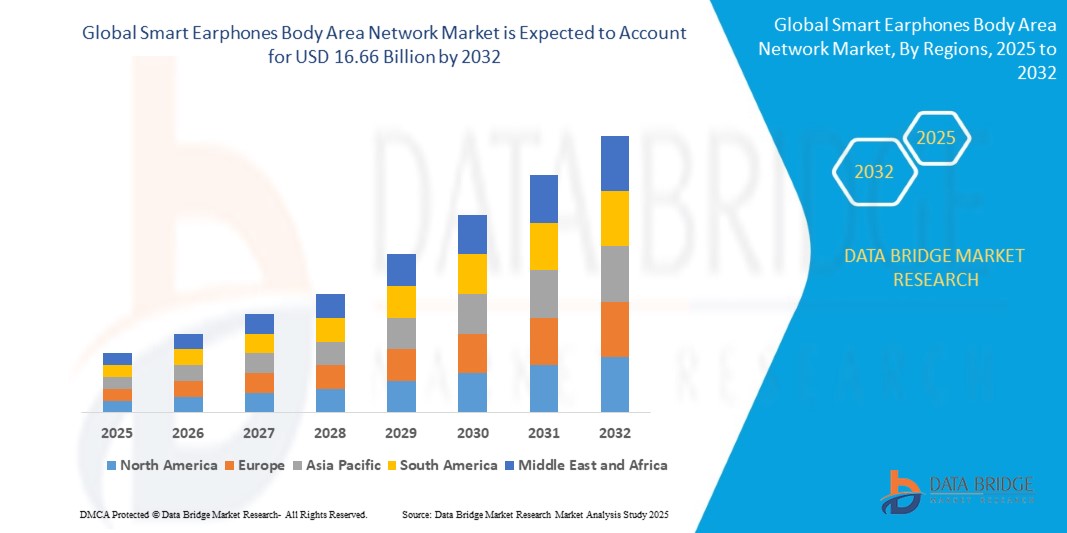
- The global smart earphones body area network market size was valued at USD 8.30 billion in 2024 and is expected to reach USD 16.66 billion by 2032, at a CAGR of 9.10% during the forecast period
- The market growth is largely fuelled by the increasing demand for wireless audio solutions, rising adoption of fitness and health tracking technologies, and advancements in sensor integration and artificial intelligence
- The growing popularity of hands-free communication and immersive audio experiences is also contributing to the widespread adoption of smart earphones across consumer and professional segments
Smart Earphones Body Area Network Market Analysis
- The market is witnessing significant traction as consumers shift towards multi-functional smart earphones capable of audio streaming, voice interaction, and biometric monitoring
- Integration with body area networks allows real-time health data collection such as heart rate, oxygen levels, and activity tracking, driving adoption among fitness enthusiasts and healthcare providers
- North America dominated the smart earphones body area network market with the largest revenue share of 39.6% in 2024, driven by widespread adoption of wearable technology, growing health consciousness, and the popularity of wireless audio solutions
- Asia-Pacific region is expected to witness the highest growth rate in the global smart earphones body area network market, driven by urbanization, expanding middle-class demographics, and the presence of major electronics manufacturers offering innovative and affordable devices
- The sensors segment dominated the market with the largest market revenue share in 2024, driven by the rising demand for real-time health and activity tracking. Earphones equipped with biometric sensors such as heart rate, SpO2, and motion detectors are increasingly preferred by health-conscious consumers and fitness enthusiasts. The seamless integration of these sensors enables continuous, non-invasive monitoring and enhances the appeal of smart earphones as multifunctional wearable devices
Report Scope and Smart Earphones Body Area Network Market Segmentation
|
Attributes |
Smart Earphones Body Area Network Key Market Insights |
|
Segments Covered |
|
|
Countries Covered |
North America
Europe
Asia-Pacific
Middle East and Africa
South America
|
|
Key Market Players |
|
|
Market Opportunities |
|
|
Value Added Data Infosets |
In addition to the insights on market scenarios such as market value, growth rate, segmentation, geographical coverage, and major players, the market reports curated by the Data Bridge Market Research also include in-depth expert analysis, geographically represented company-wise production and capacity, network layouts of distributors and partners, detailed and updated price trend analysis and deficit analysis of supply chain and demand. |
Smart Earphones Body Area Network Market Trends
“Integration Of Biometric Sensors For Real-Time Health Monitoring”
- Manufacturers are embedding biometric sensors such as heart rate and SpO2 monitors directly into smart earphones for seamless, continuous tracking
- Consumers are increasingly favoring earphones that double as health devices, offering real-time data without the need for wrist-worn wearables
- These devices are becoming popular among fitness enthusiasts and individuals seeking hands-free, health-focused technology
- The trend supports preventive healthcare, allowing early detection of irregularities through passive monitoring
- For instance, Jabra Sport Pulse includes built-in heart rate tracking to assist athletes with real-time performance monitoring
Smart Earphones Body Area Network Market Dynamics
Driver
“Rising Demand For Multifunctional Wearables With Audio And Health Capabilities”
- Consumers are shifting toward compact, multifunctional devices that integrate communication, entertainment, and health tracking
- Smart earphones now support audio playback, biometric monitoring, voice assistant access, and mobile notifications in one device
- The trend is supported by growing health awareness and the demand for on-the-go lifestyle solutions
- Seamless syncing with mobile apps and smart ecosystems is enhancing user convenience and engagement
- For instance, Apple’s AirPods Pro integrate noise cancellation, Siri voice commands, and motion sensors to track movement and usage
Restraint/Challenge
“Limited Battery Life And Power Efficiency Constraints”
- High power consumption by biometric sensors and wireless modules shortens battery life in compact smart earphones
- Users often face inconvenience due to frequent charging requirements, especially when using advanced features simultaneously
- Miniaturized designs limit battery size, making it difficult to balance power and performance
- Efficiency challenges in managing thermal output and power draw hinder longer usage cycles
- For instance, many premium earbuds with active noise cancellation and health tracking last only 4–6 hours on a single charge, as seen in models such as the Samsung Galaxy Buds Pro
Smart Earphones Body Area Network Market Scope
The market is segmented on the basis of components, connectivity, and end-user.
• By Components
On the basis of components, the smart earphones body area network market is segmented into processors, memory modules, displays, sensors, electro-mechanicals, and communication interface components. The sensors segment dominated the market with the largest market revenue share in 2024, driven by the rising demand for real-time health and activity tracking. Earphones equipped with biometric sensors such as heart rate, SpO2, and motion detectors are increasingly preferred by health-conscious consumers and fitness enthusiasts. The seamless integration of these sensors enables continuous, non-invasive monitoring and enhances the appeal of smart earphones as multifunctional wearable devices.
The processors segment is expected to witness the fastest growth rate from 2025 to 2032, fuelled by growing advancements in low-power, high-performance chipsets. These processors support faster data processing, real-time analytics, and efficient operation of embedded features such as voice assistants and AI-based functionalities, making smart earphones more intelligent and responsive.
• By Connectivity
On the basis of connectivity, the market is segmented into Bluetooth, Wi-Fi, Zig-Bee, and others. The Bluetooth segment held the largest market revenue share in 2024, attributed to its widespread compatibility with smartphones and low-power consumption benefits. Bluetooth-enabled smart earphones are preferred for personal audio streaming, fitness tracking, and hands-free communication due to their reliable performance and ease of connectivity within short ranges.
The Wi-Fi segment is expected to witness the fastest growth rate from 2025 to 2032, driven by the increasing need for continuous data transfer and cloud synchronization. Wi-Fi-enabled smart earphones are gaining traction for real-time updates, high-bandwidth applications, and seamless integration with smart home and healthcare systems.
• By End-User
On the basis of end-user, the smart earphones body area network market is segmented into healthcare, sports, fitness, security, military, and others. The fitness segment led the market in 2024, supported by the increasing adoption of wearable devices for performance tracking, workout guidance, and personalized health insights. Fitness users prefer smart earphones that combine entertainment with real-time biometric monitoring, making them ideal for active lifestyles.
The healthcare segment is expected to witness the fastest growth rate from 2025 to 2032, driven by the rising need for remote patient monitoring, early diagnosis, and non-intrusive data collection. Medical institutions and technology providers are exploring smart earphones as part of body area network systems for continuous health tracking and telemedicine applications.
Smart Earphones Body Area Network Market Regional Analysis
- North America dominated the smart earphones body area network market with the largest revenue share of 39.6% in 2024, driven by widespread adoption of wearable technology, growing health consciousness, and the popularity of wireless audio solutions
- Consumers in the region prioritize multifunctional devices that combine audio performance with fitness and health tracking capabilities, supported by advanced sensor integration and voice assistant compatibility
- This regional growth is further supported by high disposable incomes, early adoption of technology, and a robust ecosystem of consumer electronics and healthcare wearables across both fitness and medical segments
U.S. Smart Earphones Body Area Network Market Insight
The U.S. smart earphones body area network market captured the largest revenue share of 80.5% in 2024 within North America, driven by rising interest in health monitoring wearables and increasing smartphone penetration. Consumers are opting for smart earphones that offer biometric tracking, seamless app integration, and voice-activated controls. The demand is particularly strong among fitness enthusiasts, remote workers, and users seeking hands-free health monitoring. Brands such as Apple and Bose continue to lead innovation, with features such as heart rate tracking, motion sensors, and integration with iOS and Android health platforms fueling sustained market expansion.
Europe Smart Earphones Body Area Network Market Insight
The Europe smart earphones body area network market is expected to witness the fastest growth rate from 2025 to 2032, propelled by increased consumer focus on wellness, advancements in wearable technology, and greater demand for smart audio devices in both professional and personal applications. The region benefits from strong health awareness, tech-savvy consumers, and support for digital health innovation. Smart earphones are gaining traction in fitness centers, corporate wellness programs, and home healthcare setups, especially in countries such as Germany, France, and the U.K., where users are seeking connected solutions for active lifestyles.
U.K. Smart Earphones Body Area Network Market Insight
The U.K. smart earphones body area network market is expected to witness the fastest growth rate from 2025 to 2032, supported by increasing demand for connected wearables and voice-controlled audio systems. British consumers are adopting smart earphones for fitness tracking, remote communication, and media consumption, especially as home-based work and workouts become more prevalent. Furthermore, integration with popular digital ecosystems such as Alexa, Google Assistant, and Apple Health is enhancing the appeal of these devices.
Germany Smart Earphones Body Area Network Market Insight
The Germany smart earphones body area network market is expected to witness the fastest growth rate from 2025 to 2032, driven by the country’s emphasis on innovation, data privacy, and sustainable consumer electronics. Demand is rising for high-quality, sensor-rich audio wearables that offer biometric tracking and user-friendly interfaces. Germany's well-developed infrastructure and health-conscious population are contributing to the adoption of smart earphones in wellness, fitness, and telehealth environments.
Asia-Pacific Smart Earphones Body Area Network Market Insight
The Asia-Pacific smart earphones body area network market is expected to witness the fastest growth rate from 2025 to 2032, driven by rising urbanization, growing middle-class populations, and strong demand for affordable wearable technologies in countries such as China, Japan, and India. Government initiatives promoting digital healthcare and fitness awareness are supporting the expansion of smart earphone usage across demographics. In addition, the region's dominance in consumer electronics manufacturing is enabling competitive pricing and widespread availability of innovative smart audio products.
Japan Smart Earphones Body Area Network Market Insight
The Japan smart earphones body area network market is expected to witness the fastest growth rate from 2025 to 2032, due to the country's leadership in technology innovation, high demand for compact health solutions, and an aging population seeking non-intrusive monitoring tools. Japanese consumers favor multifunctional devices that enhance daily convenience, combining audio, voice assistance, and wellness tracking in one. The use of smart earphones in healthcare settings and for remote elderly care is expanding, backed by local manufacturers' focus on advanced, lightweight, and reliable designs.
China Smart Earphones Body Area Network Market Insight
The China smart earphones body area network market held the largest revenue share in Asia-Pacific in 2024, fuelled by the rapid adoption of smart wearables, expanding e-commerce infrastructure, and increasing awareness of health and fitness tracking. China’s large population base and growing digital ecosystem create favorable conditions for high-volume sales, especially among young consumers seeking affordable, feature-rich smart earphones. Domestic companies are innovating aggressively, offering products that combine biometric capabilities with AI-enabled functionality, making smart earphones an essential part of the connected lifestyle in urban China.
Smart Earphones Body Area Network Market Share
The Smart Earphones Body Area Network industry is primarily led by well-established companies, including:
- Fitbit LLC (U.S.)
- SAMSUNG ELECTRONICS CO., LTD. (South Korea)
- Garmin Ltd. (U.S.)
- Xiaomi. (China)
- Huawei Technologies Co., Ltd. (China)
- CASIO COMPUTER CO., LTD. (Japan)
- LG Electronics. (South Korea)
- Medtronic (Ireland)
- Bragi (Germany)
- GOQii. (U.S.)
- Haylou (China)
- Withings (France)
- Abbott. (U.S.)
- MATRIX INDUSTRIES (U.S.)
- Apple Inc. (U.S.)
- Fujitsu (Japan)
- Renesas Electronics Corporation. (Japan)
- General Electric Company (U.S.)
- Fossil Group (U.S.)
- Polar Electro (Finland)

- Interactive Data Analysis Dashboard
- Company Analysis Dashboard for high growth potential opportunities
- Research Analyst Access for customization & queries
- Competitor Analysis with Interactive dashboard
- Latest News, Updates & Trend analysis
- Harness the Power of Benchmark Analysis for Comprehensive Competitor Tracking
Global Smart Earphones Body Area Network Market, Supply Chain Analysis and Ecosystem Framework
To support market growth and help clients navigate the impact of geopolitical shifts, DBMR has integrated in-depth supply chain analysis into its Global Smart Earphones Body Area Network Market research reports. This addition empowers clients to respond effectively to global changes affecting their industries. The supply chain analysis section includes detailed insights such as Global Smart Earphones Body Area Network Market consumption and production by country, price trend analysis, the impact of tariffs and geopolitical developments, and import and export trends by country and HSN code. It also highlights major suppliers with data on production capacity and company profiles, as well as key importers and exporters. In addition to research, DBMR offers specialized supply chain consulting services backed by over a decade of experience, providing solutions like supplier discovery, supplier risk assessment, price trend analysis, impact evaluation of inflation and trade route changes, and comprehensive market trend analysis.
Data collection and base year analysis are done using data collection modules with large sample sizes. The stage includes obtaining market information or related data through various sources and strategies. It includes examining and planning all the data acquired from the past in advance. It likewise envelops the examination of information inconsistencies seen across different information sources. The market data is analysed and estimated using market statistical and coherent models. Also, market share analysis and key trend analysis are the major success factors in the market report. To know more, please request an analyst call or drop down your inquiry.
The key research methodology used by DBMR research team is data triangulation which involves data mining, analysis of the impact of data variables on the market and primary (industry expert) validation. Data models include Vendor Positioning Grid, Market Time Line Analysis, Market Overview and Guide, Company Positioning Grid, Patent Analysis, Pricing Analysis, Company Market Share Analysis, Standards of Measurement, Global versus Regional and Vendor Share Analysis. To know more about the research methodology, drop in an inquiry to speak to our industry experts.
Data Bridge Market Research is a leader in advanced formative research. We take pride in servicing our existing and new customers with data and analysis that match and suits their goal. The report can be customized to include price trend analysis of target brands understanding the market for additional countries (ask for the list of countries), clinical trial results data, literature review, refurbished market and product base analysis. Market analysis of target competitors can be analyzed from technology-based analysis to market portfolio strategies. We can add as many competitors that you require data about in the format and data style you are looking for. Our team of analysts can also provide you data in crude raw excel files pivot tables (Fact book) or can assist you in creating presentations from the data sets available in the report.













