


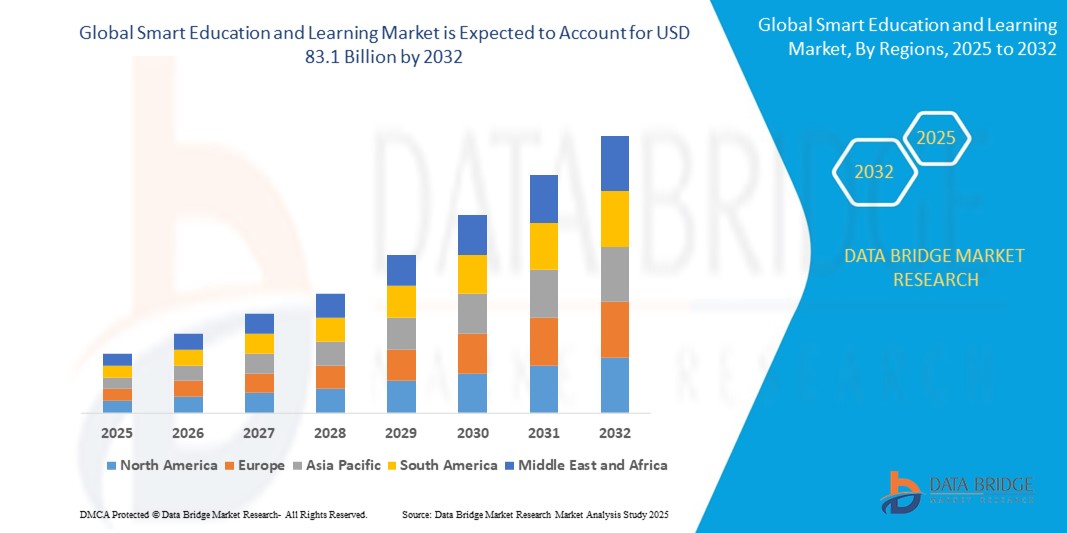
Global Smart Education and Learning Market Size
- The Global Smart Education and Learning Market was valued at approximately USD 52.4 billion in 2024 and is projected to reach USD 83.1 billion by 2032, expanding at a CAGR of 6.1% during the forecast period.
- This growth is fueled by the rising demand for digitally-enabled, personalized learning experiences across schools, universities, and corporate training environments. The integration of AI, IoT, machine learning, cloud platforms, and immersive technologies like AR/VR is transforming traditional learning methods into interactive and adaptive systems. Furthermore, the rapid expansion of e-learning platforms, government initiatives promoting digital education, and increased investments in smart classroom infrastructure and EdTech startups are accelerating market development worldwide.
Global Smart Education and Learning Market Analysis
- The smart education and learning technology incorporate the application of cloud platform, learning applications and software to impart learning and education. This technology provides smart and customized learning solutions involving graphics and videos.
- Rising expenditure for research and development activities on smart education and learning technology is creating lucrative growth opportunities for the market. Boost in the connectivity of handheld devices will further induce growth in the smart education and learning market value.
- North America is expected to dominate the Global Smart Education and Learning Market due to factors such as high investments in EdTech, widespread adoption of digital learning platforms in schools and universities, and the presence of advanced ICT infrastructure. Additionally, strong government support for digital education policies, early adoption of AI and cloud-based learning systems, and a tech-savvy population continue to drive market growth in this region.
- Asia-Pacific is anticipated to be the fastest-growing region in the Global Smart Education and Learning Market during the forecast period. This growth is propelled by rapid urbanization, increasing access to affordable smartphones and high-speed internet, and government-led digital literacy programs. Countries like China, India, Indonesia, and Vietnam are seeing a surge in online education, mobile learning apps, and virtual classrooms, making the region a hotspot for smart education innovation.
- In 2025, the Software segment is projected to dominate the Global Smart Education and Learning Market, holding the largest share of 34.2%. This dominance is driven by the high demand for Learning Management Systems (LMS), adaptive learning platforms, and virtual classroom tools that enhance teaching efficiency and personalize the learning experience. The shift toward remote and hybrid education models further accelerates the adoption of smart learning software.
Report Scope and Global Smart Education and Learning Market Segmentation
|
Attributes |
Global Smart Education and Learning Market Key Market Insights |
|
Segments Covered |
|
|
Countries Covered |
North America
Europe
Asia-Pacific
Middle East and Africa
South America
|
|
Key Market Players |
|
|
Market Opportunities |
|
|
Value Added Data Infosets |
In addition to the insights on market scenarios such as market value, growth rate, segmentation, geographical coverage, and major players, the market reports curated by the Data Bridge Market Research also include import export analysis, production capacity overview, production consumption analysis, price trend analysis, climate change scenario, supply chain analysis, value chain analysis, raw material/consumables overview, vendor selection criteria, PESTLE Analysis, Porter Analysis, and regulatory framework. |
Global Smart Education and Learning Market Trends
“Personalized learning experiences gain momentum”
- he Global Smart Education and Learning Market is undergoing a transformative shift towards personalized learning, driven by the increasing demand for education that caters to individual learning styles and speeds. AI-driven tools and adaptive learning platforms are now providing tailored learning pathways, allowing students to progress at their own pace while receiving real-time feedback.
- These innovations help educators create more engaging and effective learning environments, improving student outcomes by addressing diverse needs. The integration of AI, machine learning, and analytics is enhancing the ability to monitor progress, predict learning challenges, and recommend relevant resources.
- For instance, in 2025, the Global Smart Education and Learning Market is expected to benefit from the rise of Generative AI tools, which will enable further customization of content, improve student interaction, and provide real-time data analytics, driving more personalized educational experiences.
- Governments and education providers are increasingly adopting AI-powered solutions to meet the growing demand for flexible, scalable, and customized learning. As a result, personalized learning tools are becoming an essential component of modern education systems, with widespread adoption across both traditional and online learning environments
Global Smart Education and Learning Market Dynamics
Driver
“Growing demand for digital education boosts system adoption”
- The increasing global demand for accessible, flexible, and high-quality education is a key driver for the growth of the Global Smart Education and Learning Market. With the rising need for upskilling and reskilling, particularly in the corporate sector, there is a surge in demand for digital learning solutions that offer scalable, interactive, and personalized learning experiences.
- Governments, educational institutions, and enterprises are increasingly adopting cloud-based platforms, e-learning tools, and virtual classrooms to address the evolving educational needs. These technologies allow for better engagement, accessibility, and real-time tracking of student progress.
- Moreover, the rapid rise in the adoption of mobile learning applications and the demand for immersive technologies like AR/VR are driving the expansion of the market, particularly in K-12 and higher education sectors.
For instance,
- On March 2025, platforms like Coursera and Udemy are expected to see a significant boost in demand for courses related to AI, coding, and data science as industries look for talent with these skills. The demand for learning management systems (LMS) continues to rise as more companies invest in employee training and development.
- As the demand for digital learning and corporate training continues to surge, the need for more robust and advanced learning technologies will accelerate the market's growth trajectory.
Opportunity
“Emerging markets fuel growth potential”
- Emerging economies present a significant growth opportunity for smart education providers as educational institutions in regions like Asia, Africa, and Latin America increasingly modernize their learning environments.
- Governments are encouraging the adoption of digital learning solutions through policies, subsidies, and infrastructure development programs, while private investments in e-learning platforms and ed-tech companies are rapidly increasing. Schools, colleges, and businesses in these regions are transitioning from traditional to digital learning environments to enhance educational access and quality.
- • Companies offering cost-effective, scalable, and localized solutions tailored to the unique needs of emerging markets can capitalize on the growing demand for accessible, affordable, and efficient learning tools.
For instance,
- On April 2025, BYJU'S expanded its reach in Africa by launching an affordable e-learning platform for students, helping improve access to quality education in underprivileged regions. The platform provides tailored content and offline accessibility to support learners with limited internet access.
- The increasing focus on improving education quality in emerging markets is driving the growth of smart education solutions, opening new opportunities for providers of digital learning systems, content delivery platforms, and corporate training solutions.
Restraint/Challenge
“High costs hinder widespread adoption”
- Despite their benefits, the high upfront costs of digital learning technologies remain a major barrier to the widespread adoption of smart education solutions. Educational institutions, particularly in developing regions, often lack the capital to invest in advanced learning management systems (LMS), content delivery platforms, and maintenance services.
- Additionally, the complexity of integrating new technologies with existing infrastructure requires technical expertise, which may not be readily available in rural or underserved areas. The implementation of smart education systems can also disrupt traditional teaching methods and require significant retraining of educators.
- While long-term savings in operational costs and improved learning outcomes may justify the investment, the initial financial burden and the need for continuous investment in technology infrastructure slow the market's growth.
For instance,
- On March 2025, the affordability of smart education solutions was highlighted by the World Bank's report on the education sector in low-income countries. The report showed that while governments are eager to digitize learning, budget constraints make it difficult for them to roll out large-scale adoption of smart technologies in schools.
- Providers of smart education technologies must focus on offering modular, affordable solutions and financing options to make these technologies accessible to a wider range of educational institutions, especially in underserved regions
Global Smart Education and Learning Market Scope
The market is segmented on the basis product, learning mode, age, deployment and user type.
|
Segmentation |
Sub-Segmentation |
|
By Product |
|
|
By Learning Mode |
|
|
By Age |
|
|
By Deployment |
|
|
By User Type |
|
In 2025, the Software segment in Global Smart Education and Learning Market is projected to dominate the market with a largest share in by product segment
In 2025, the Software segment is projected to dominate the Global Smart Education and Learning Market, holding the largest share of 34.2%. This dominance is driven by the high demand for Learning Management Systems (LMS), adaptive learning platforms, and virtual classroom tools that enhance teaching efficiency and personalize the learning experience. The shift toward remote and hybrid education models further accelerates the adoption of smart learning software
The Services is expected to account for the largest share during the forecast period in Global Smart Education and Learning Market
In 2025, the Services segment is anticipated to account for the second-largest share in the Global Smart Education and Learning Market, with a projected market share of 27.9%. Growth in this segment is attributed to rising demand for training, support, system integration, and consulting services that help educational institutions and corporates deploy and maintain smart learning systems effectively.
Global Smart Education and Learning Market Regional Analysis
“Europe Holds the Largest Share in the Global Smart Education and Learning Market Market”
- Europe dominates the Global Smart Education and Learning Market Market, driven by the widespread adoption of advanced technologies in agriculture, the strong presence of leading Global Smart Education and Learning Market providers, and growing demand for automated, energy-efficient feeding solutions in dairy, poultry, and swine farming.
- The region's extensive agricultural infrastructure and increasing focus on automation in farming practices contribute to market growth. The demand for smart feeding solutions to optimize resource management, improve efficiency, and increase livestock productivity is expected to continue driving Europe’s dominance.
- Additionally, rising investments in innovative farm technologies, along with government incentives supporting sustainable farming, reinforce Europe’s leadership in the Global Smart Education and Learning Market Market.
“North America is Projected to Register the Highest CAGR in the Global Smart Education and Learning Market Market”
- The North America region is expected to register the highest growth rate in the Global Smart Education and Learning Market Market, fueled by rapid technological advancements, increasing adoption of automation, and rising demand for efficient livestock management across commercial and residential agricultural sectors.
- The U.S. is anticipated to hold a significant share due to the widespread use of automated Global Smart Education and Learning Market in dairy farms, poultry farms, and large-scale animal husbandry operations. The emphasis on precision farming and innovations in animal nutrition further contribute to market expansion.
- Countries like Canada and Mexico are also witnessing substantial investments in Feeding Systems, driven by modernization efforts in agriculture, including the integration of Internet of Things (IoT) technologies to optimize feeding schedules and enhance animal welfare.
- Rising awareness of sustainability practices, coupled with growing consumer demand for traceable and ethically produced food, continues to drive North America's growth in the Global Smart Education and Learning Market Market.
Global Smart Education and Learning Market Share
The market competitive landscape provides details by competitor. Details included are company overview, company financials, revenue generated, market potential, investment in research and development, new market initiatives, global presence, production sites and facilities, production capacities, company strengths and weaknesses, product launch, product width and breadth, application dominance. The above data points provided are only related to the companies' focus related to market.
The Major Market Leaders Operating in the Market Are:
- Adobe (U.S.)
- Educomp Solutions Ltd (India)
- Cisco Systems, Inc. (U.S.)
- McGraw Hill (U.S.)
- NIIT (India)
- D2L Corporation (Canada)
- SAMSUNG (South Korea)
- Sumtotal Systems, LLC (U.S.)
- SMART Technologies ULC (Canada)
- Ellucian Company L.P. (U.S.)
- MPS Interactive Systems Limited (India)
- Saba Software (U.S.)
- BYJU'S (India)
- Instructure, Inc. (U.S.)
- PROMETHEAN LIMITED (U.K.)
- Pearson India Educations Services Pvt. Ltd. (India)
- Jenzabar, Inc. (U.S.)
- Cengage Learning, Inc. (U.S.)
- SkillSoft (U.S.)
Latest Developments in Global Global Smart Education and Learning Market Market
- On April 2025, Microsoft launched its AI-powered Copilot for Education, integrating generative AI into Microsoft Teams and other 365 applications. Designed for teachers and students, it streamlines lesson planning, grading, and real-time tutoring, making digital learning more efficient and personalized
- On March 2025, Google Classroom introduced Practice Sets, an interactive feature that provides instant feedback to students using adaptive learning algorithms. It leverages AI to tailor quizzes and study materials based on performance, aimed at improving learning outcomes across global classrooms
- In February 2025, BYJU’S unveiled Wizlab, a virtual STEM lab platform for middle and high school students globally. It offers hands-on learning via 3D simulations and AR-based experiments, encouraging curiosity and experiential education in science and mathematics
- In January 2025, Kahoot! rolled out Kahoot! Courses, a comprehensive solution combining live games, self-paced challenges, and embedded instructional content to promote blended and flipped learning in schools and corporate settings

- Interactive Data Analysis Dashboard
- Company Analysis Dashboard for high growth potential opportunities
- Research Analyst Access for customization & queries
- Competitor Analysis with Interactive dashboard
- Latest News, Updates & Trend analysis
- Harness the Power of Benchmark Analysis for Comprehensive Competitor Tracking
Global Smart Education Learning Market, Supply Chain Analysis and Ecosystem Framework
To support market growth and help clients navigate the impact of geopolitical shifts, DBMR has integrated in-depth supply chain analysis into its Global Smart Education Learning Market research reports. This addition empowers clients to respond effectively to global changes affecting their industries. The supply chain analysis section includes detailed insights such as Global Smart Education Learning Market consumption and production by country, price trend analysis, the impact of tariffs and geopolitical developments, and import and export trends by country and HSN code. It also highlights major suppliers with data on production capacity and company profiles, as well as key importers and exporters. In addition to research, DBMR offers specialized supply chain consulting services backed by over a decade of experience, providing solutions like supplier discovery, supplier risk assessment, price trend analysis, impact evaluation of inflation and trade route changes, and comprehensive market trend analysis.
Data collection and base year analysis are done using data collection modules with large sample sizes. The stage includes obtaining market information or related data through various sources and strategies. It includes examining and planning all the data acquired from the past in advance. It likewise envelops the examination of information inconsistencies seen across different information sources. The market data is analysed and estimated using market statistical and coherent models. Also, market share analysis and key trend analysis are the major success factors in the market report. To know more, please request an analyst call or drop down your inquiry.
The key research methodology used by DBMR research team is data triangulation which involves data mining, analysis of the impact of data variables on the market and primary (industry expert) validation. Data models include Vendor Positioning Grid, Market Time Line Analysis, Market Overview and Guide, Company Positioning Grid, Patent Analysis, Pricing Analysis, Company Market Share Analysis, Standards of Measurement, Global versus Regional and Vendor Share Analysis. To know more about the research methodology, drop in an inquiry to speak to our industry experts.
Data Bridge Market Research is a leader in advanced formative research. We take pride in servicing our existing and new customers with data and analysis that match and suits their goal. The report can be customized to include price trend analysis of target brands understanding the market for additional countries (ask for the list of countries), clinical trial results data, literature review, refurbished market and product base analysis. Market analysis of target competitors can be analyzed from technology-based analysis to market portfolio strategies. We can add as many competitors that you require data about in the format and data style you are looking for. Our team of analysts can also provide you data in crude raw excel files pivot tables (Fact book) or can assist you in creating presentations from the data sets available in the report.













