


Smart Fab Automation Software Market Size
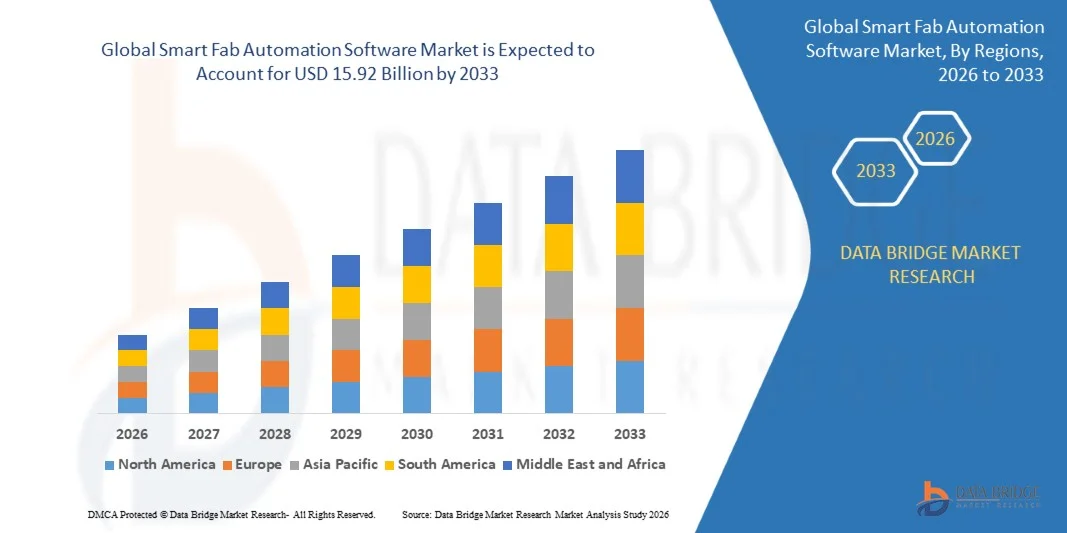
- The global Smart Fab Automation Software market size was valued at USD 6.84 billion in 2025 and is expected to reach USD 15.92 billion by 2033, at a CAGR of 11.1% during the forecast period
- The market growth is primarily driven by increasing semiconductor manufacturing complexity, rapid adoption of Industry 4.0 technologies, growing demand for AI-driven automation solutions, and rising investments in smart semiconductor fabrication facilities globally
- In addition, increasing demand for high-yield semiconductor production, rising adoption of digital twin and predictive analytics technologies, and expansion of advanced node semiconductor manufacturing are positioning smart fab automation software as a critical component in next-generation semiconductor manufacturing ecosystems, thereby significantly accelerating overall market growth
Smart Fab Automation Software Market Analysis
- Smart fab automation software enables real-time monitoring, process optimization, predictive maintenance, automated material handling, and yield enhancement across semiconductor fabrication facilities through AI, IoT, robotics, and advanced analytics integration
- The increasing demand for high-performance semiconductors for AI chips, electric vehicles, data centers, 5G infrastructure, consumer electronics, and industrial automation is significantly accelerating adoption of smart fab automation software globally
- Asia-Pacific dominated the smart fab automation software market with the largest revenue share of 44.6% in 2025, supported by the presence of leading semiconductor manufacturing hubs in China, Taiwan, South Korea, and Japan along with large-scale investments in advanced fabs
- North America is expected to witness significant CAGR of 11.9% during the forecast period due to increasing semiconductor reshoring initiatives, government support under semiconductor manufacturing programs, and rising investments in AI-driven fab automation technologies
- The Manufacturing Execution Systems (MES) segment dominated the market with a share of 28.9% in 2025, driven by increasing demand for real-time production visibility, workflow automation, process traceability, and operational efficiency in semiconductor manufacturing plants
Report Scope and Smart Fab Automation Software Market Segmentation
|
Attributes |
Smart Fab Automation Software Key Market Insights |
|
Segments Covered |
|
|
Countries Covered |
North America
Europe
Asia-Pacific
Middle East and Africa
South America
|
|
Key Market Players |
|
|
Market Opportunities |
|
|
Value Added Data Infosets |
In addition to the market insights such as market value, growth rate, market segments, geographical coverage, market players, and market scenario, the market report curated by the Data Bridge Market Research team includes in-depth expert analysis, import/export analysis, pricing analysis, production consumption analysis, and pestle analysis. |
Smart Fab Automation Software Market Trends
“Rapid Adoption of AI-Driven Autonomous Semiconductor Manufacturing ”
- A major and accelerating trend in the global smart fab automation software market is the increasing adoption of AI-driven autonomous manufacturing systems capable of improving semiconductor yield, minimizing downtime, and optimizing fab productivity in real time
- Semiconductor manufacturers are increasingly integrating machine learning algorithms, predictive analytics, robotics automation, and digital twin technologies into fab operations to reduce operational complexity and improve throughput efficiency
- Advanced process control software and AI-powered defect detection systems are gaining strong traction across advanced semiconductor fabrication facilities due to their ability to improve process precision and reduce manufacturing defects
- Increasing deployment of IoT-enabled sensors and edge computing technologies is enabling real-time monitoring and automated decision-making across semiconductor production environments
- Digital twin adoption is rapidly increasing as semiconductor manufacturers seek virtual simulation environments for process optimization, predictive maintenance, and operational risk reduction
- Growing focus on smart factories, autonomous robotics, and data-driven semiconductor manufacturing ecosystems is reshaping fab operational models globally .
Smart Fab Automation Software Market Dynamics
Driver
“Growing Complexity of Semiconductor Manufacturing and Rising Demand for High-Yield Production ”
- Increasing semiconductor manufacturing complexity due to shrinking process nodes and advanced chip architectures is a major factor driving adoption of smart fab automation software globally
- Semiconductor fabs require highly precise and automated process control systems to maintain production efficiency, reduce defects, and improve yield rates in advanced semiconductor manufacturing environments
- Rising global demand for semiconductors across AI, automotive electronics, consumer devices, industrial automation, and data centers is significantly increasing investments in fab modernization and automation technologies
- Government initiatives supporting domestic semiconductor manufacturing and supply chain resilience are further accelerating investments in smart manufacturing software solutions
- Integration of AI, machine learning, robotics, and industrial IoT technologies into fab environments is enabling predictive maintenance, autonomous production optimization, and improved operational visibility
- Increasing need to reduce production downtime, labor dependency, and manufacturing costs is further supporting adoption of advanced fab automation software platforms
Restraint/Challenge
“High Implementation Cost and Integration Complexity ”
- High deployment costs associated with advanced fab automation software and semiconductor smart factory infrastructure remain significant challenges for market growth, particularly for small and mid-sized semiconductor manufacturers
- Integration of automation software with legacy semiconductor manufacturing equipment and existing enterprise systems can be highly complex and time-consuming
- Semiconductor fabs require extremely high operational reliability and cybersecurity protection, increasing the complexity of software deployment and maintenance
- Shortage of skilled professionals capable of managing AI-driven semiconductor manufacturing systems and industrial automation platforms may limit adoption in developing regions
- Data interoperability challenges across multi-vendor fab ecosystems and high software customization requirements can further increase deployment timelines and operational costs
Smart Fab Automation Software Market Scope
The market is segmented on the basis of deployment, component, fab type, technology, application, and end user.
- By Deployment
On the basis of deployment, the global smart fab automation software market is segmented into cloud-based, on-premise, and hybrid. The on-premise segment dominated the market with the largest revenue share of 47.3% in 2025, driven by increasing preference among semiconductor manufacturers for secure, low-latency, and highly customized software deployment environments. Semiconductor fabs require real-time processing capabilities and strict data security compliance, making on-premise deployment highly preferred for mission-critical operations.
The cloud-based segment is expected to witness the fastest growth during the forecast period due to increasing adoption of scalable analytics platforms, remote monitoring capabilities, and AI-powered manufacturing intelligence solutions. Growing investments in cloud-enabled semiconductor manufacturing ecosystems are further accelerating segment growth.
- By Component
On the basis of component, the market is segmented into Manufacturing Execution Systems (MES), Advanced Process Control (APC), Predictive Maintenance Software, Yield Management Software, Robotics Control Software, Digital Twin Solutions, and others. The MES segment dominated the market with a share of 28.9% in 2025 due to increasing demand for real-time production visibility, automated workflow management, and traceability across semiconductor fabs. MES platforms help manufacturers optimize operational efficiency while maintaining stringent quality standards.
The digital twin solutions segment is expected to witness the fastest growth during the forecast period due to rising adoption of virtual fab simulation technologies for predictive maintenance, process optimization, and operational risk reduction..
- By Fab Type
On the basis of fab type, the market is segmented into wafer fabrication, assembly & packaging, and testing facilities. The wafer fabrication segment dominated the market with a market share of 52.4% in 2025 due to increasing investments in advanced semiconductor node manufacturing and growing complexity of wafer production processes requiring highly automated control systems.
The assembly & packaging segment is expected to witness notable growth due to increasing demand for advanced semiconductor packaging technologies including 3D packaging and heterogeneous integration.
- By Technology
On the basis of technology, the market is segmented into AI & machine learning, IoT integration, big data analytics, edge computing, and computer vision. The AI & machine learning segment dominated the market in 2025 with a share of 31.6%, supported by growing use of predictive analytics, automated defect detection, and autonomous process optimization technologies in semiconductor manufacturing.
The computer vision segment is expected to witness rapid growth during the forecast period due to increasing deployment of AI-based visual inspection systems for semiconductor defect analysis and quality assurance applications.
- By Application
On the basis of application, the market is segmented into production monitoring, process optimization, material handling automation, quality control, predictive maintenance, workforce management, and others. The process optimization segment dominated the market with the largest revenue share in 2025, driven by increasing need for high production yield, operational efficiency, and advanced process control across semiconductor fabrication facilities.
The predictive maintenance segment is expected to witness the fastest growth during the forecast period due to increasing focus on reducing equipment downtime and improving fab productivity through AI-powered maintenance analytics.
- By End User
On the basis of end user, the market is segmented into Integrated Device Manufacturers (IDMs), foundries, and Outsourced Semiconductor Assembly and Test (OSAT) providers. The foundries segment dominated the market in 2025 due to increasing investments by large semiconductor foundries in advanced automation technologies to improve manufacturing scalability and efficiency.
The OSAT providers segment is expected to witness notable growth due to increasing demand for advanced chip packaging and testing automation solutions globally.
Smart Fab Automation Software Market Regional Analysis
- Asia-Pacific dominated the Smart Fab Automation Software market with the largest revenue share of 44.6% in 2025, supported by the strong presence of semiconductor manufacturing hubs across China, Taiwan, South Korea, and Japan, along with rising investments in advanced semiconductor fabrication facilities and smart manufacturing technologies
- Semiconductor manufacturers in the region are increasingly focusing on AI-driven automation, real-time production monitoring, predictive maintenance, and digital transformation initiatives to improve production efficiency, reduce operational downtime, and enhance semiconductor yield performance
- This strong regional position is further supported by increasing government investments in domestic semiconductor manufacturing, rapid expansion of foundry capacity, and growing adoption of Industry 4.0 technologies, establishing smart fab automation software as a critical component in next-generation semiconductor production ecosystems across Asia-Pacific
U.S. Smart Fab Automation Software Market Insight
The U.S. Smart Fab Automation Software market captured the largest revenue share of 78.4% in 2025 within North America, driven by increasing investments in semiconductor reshoring initiatives, advanced chip manufacturing facilities, and AI-powered semiconductor production systems. Semiconductor manufacturers are increasingly adopting automation software solutions to improve operational efficiency, enhance production scalability, and reduce manufacturing defects. Rising government support for domestic semiconductor production and increasing investments in smart semiconductor fabs are significantly supporting market growth. Moreover, the strong presence of leading semiconductor equipment and automation software providers such as Applied Materials Inc., KLA Corporation, and Rockwell Automation Inc. continues to accelerate technological advancements and market expansion.
Europe Smart Fab Automation Software Market Insight
The Europe Smart Fab Automation Software market is projected to expand at a steady CAGR throughout the forecast period, primarily driven by increasing focus on semiconductor supply chain resilience, industrial automation, and digital manufacturing transformation. Rising investments in smart factories and advanced semiconductor manufacturing technologies are accelerating adoption of automation software across fabrication and testing facilities. European manufacturers emphasize operational efficiency, sustainability, and precision manufacturing, fostering increasing implementation of AI-driven process optimization and predictive maintenance solutions. Growth is further supported by government-backed semiconductor initiatives and increasing adoption of Industry 4.0 technologies across the region..
U.K. Smart Fab Automation Software Market Insight
The U.K. Smart Fab Automation Software market is anticipated to grow at a notable CAGR during the forecast period, supported by increasing focus on semiconductor innovation, industrial automation, and advanced electronics manufacturing. Rising investments in AI-driven manufacturing technologies and smart production systems are driving adoption of automation software across semiconductor production facilities. The country’s strong focus on research and development, coupled with increasing government initiatives supporting semiconductor ecosystem expansion, is further enhancing market growth. In addition, increasing implementation of predictive analytics and intelligent manufacturing platforms is improving operational efficiency across semiconductor manufacturing operations..
Germany Smart Fab Automation Software Market Insight
The Germany Smart Fab Automation Software market is expected to expand at a considerable CAGR during the forecast period, driven by the country’s strong industrial automation expertise and increasing investments in semiconductor manufacturing infrastructure. High emphasis on smart manufacturing technologies, precision engineering, and digital factory solutions is supporting rapid adoption of fab automation software across semiconductor facilities. Germany’s leadership in Industry 4.0 and advanced manufacturing technologies is promoting integration of AI, robotics, and industrial IoT into semiconductor production environments. The increasing focus on operational efficiency, process optimization, and high-yield manufacturing continues to accelerate market expansion..
Asia-Pacific Smart Fab Automation Software Market Insight
The Asia-Pacific Smart Fab Automation Software market is poised to grow at the fastest CAGR during the forecast period of 2026 to 2033, driven by rapid semiconductor manufacturing expansion, rising demand for advanced chips, and increasing investments in smart fabs across China, Taiwan, South Korea, Japan, and India. Expanding foundry capacity, increasing AI semiconductor production, and growing demand for consumer electronics and automotive semiconductors are accelerating adoption of advanced automation software solutions. Government initiatives supporting semiconductor self-sufficiency and increasing implementation of digital manufacturing technologies further support regional market growth. In addition, the region’s strong semiconductor ecosystem and manufacturing scale significantly enhance technology deployment and software adoption across fabs.
Japan Smart Fab Automation Software Market Insight
The Japan Smart Fab Automation Software market is gaining momentum due to increasing focus on advanced semiconductor manufacturing, robotics integration, and precision production technologies. Strong emphasis on automation efficiency, quality control, and high-performance semiconductor manufacturing is driving adoption across wafer fabrication and semiconductor testing facilities. The country’s established semiconductor equipment industry and continuous investments in AI-driven manufacturing solutions are supporting sustained market growth. Integration of smart factory technologies and predictive analytics into semiconductor production processes continues to improve operational efficiency and manufacturing precision across the industry.
India Smart Fab Automation Software Market Insight
The India Smart Fab Automation Software market accounted for a significant revenue share in Asia-Pacific in 2025, attributed to increasing government initiatives promoting domestic semiconductor manufacturing, rapid industrial digitalization, and rising investments in electronics production infrastructure. Growing demand for semiconductors across automotive, telecommunications, consumer electronics, and industrial applications is accelerating adoption of smart manufacturing technologies. Semiconductor manufacturers are increasingly implementing automation software solutions to improve productivity, operational visibility, and process optimization capabilities. Government initiatives supporting semiconductor ecosystem development and expansion of electronics manufacturing clusters are key factors driving long-term market growth in India.
Smart Fab Automation Software Market Share
The Smart Fab Automation Software industry is primarily led by well-established companies, including:
- Applied Materials Inc. (U.S.)
- Siemens AG (Germany)
- ABB Ltd. (Switzerland)
- Rockwell Automation Inc. (U.S.)
- Schneider Electric SE (France)
- Honeywell International Inc. (U.S.)
- KLA Corporation (U.S.)
- Lam Research Corporation (U.S.)
- Tokyo Electron Limited (Japan)
- ASML Holding N.V. (Netherlands)
- Dassault Systèmes SE (France)
- Advantest Corporation (Japan)
- Cognex Corporation (U.S.)
- Hitachi High-Tech Corporation (Japan)
What are the Recent Developments in Global Smart Fab Automation Software Market?
- In December 2025, Siemens AG expanded its semiconductor smart manufacturing portfolio by launching advanced AI-driven fab automation solutions focused on predictive maintenance and autonomous process optimization
- In October 2025, Applied Materials Inc. introduced next-generation smart manufacturing analytics software designed to improve semiconductor yield management and production efficiency
- In August 2025, KLA Corporation announced new AI-powered inspection and process control software solutions for advanced semiconductor fabs targeting defect reduction and operational optimization
- In June 2025, Rockwell Automation Inc. partnered with semiconductor manufacturers to deploy industrial IoT-enabled smart fab software systems for real-time production intelligence and automated workflow management
- In March 2024, Dassault Systèmes SE expanded its digital twin platform capabilities for semiconductor manufacturing simulation and predictive process optimization applications

- Interactive Data Analysis Dashboard
- Company Analysis Dashboard for high growth potential opportunities
- Research Analyst Access for customization & queries
- Competitor Analysis with Interactive dashboard
- Latest News, Updates & Trend analysis
- Harness the Power of Benchmark Analysis for Comprehensive Competitor Tracking
Data collection and base year analysis are done using data collection modules with large sample sizes. The stage includes obtaining market information or related data through various sources and strategies. It includes examining and planning all the data acquired from the past in advance. It likewise envelops the examination of information inconsistencies seen across different information sources. The market data is analysed and estimated using market statistical and coherent models. Also, market share analysis and key trend analysis are the major success factors in the market report. To know more, please request an analyst call or drop down your inquiry.
The key research methodology used by DBMR research team is data triangulation which involves data mining, analysis of the impact of data variables on the market and primary (industry expert) validation. Data models include Vendor Positioning Grid, Market Time Line Analysis, Market Overview and Guide, Company Positioning Grid, Patent Analysis, Pricing Analysis, Company Market Share Analysis, Standards of Measurement, Global versus Regional and Vendor Share Analysis. To know more about the research methodology, drop in an inquiry to speak to our industry experts.
Data Bridge Market Research is a leader in advanced formative research. We take pride in servicing our existing and new customers with data and analysis that match and suits their goal. The report can be customized to include price trend analysis of target brands understanding the market for additional countries (ask for the list of countries), clinical trial results data, literature review, refurbished market and product base analysis. Market analysis of target competitors can be analyzed from technology-based analysis to market portfolio strategies. We can add as many competitors that you require data about in the format and data style you are looking for. Our team of analysts can also provide you data in crude raw excel files pivot tables (Fact book) or can assist you in creating presentations from the data sets available in the report.













