What is the Smart Fitness Market Size and Growth Rate?
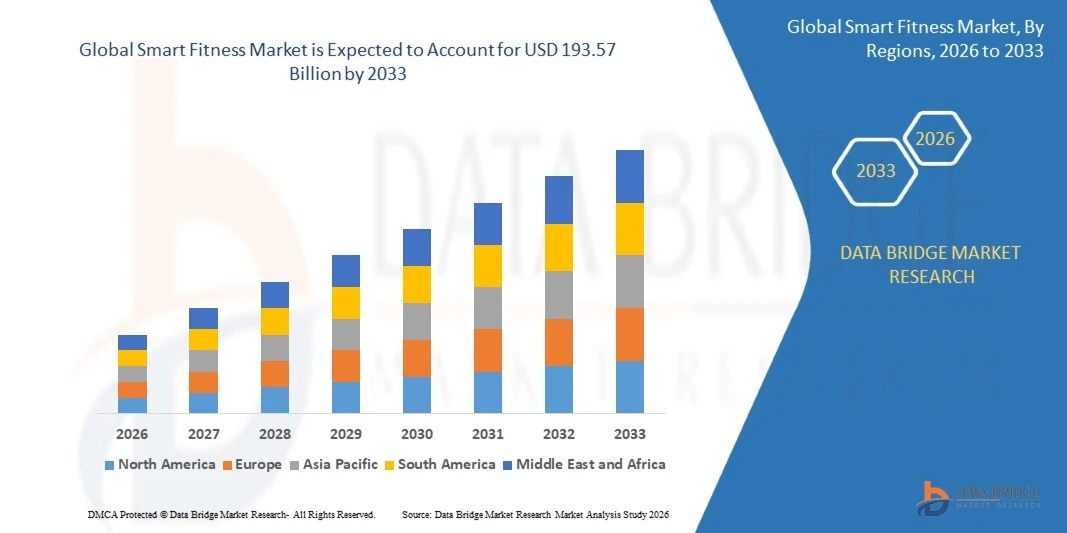
- As per Data Bridge Market Research analysis, the Smart Fitness market was valued at USD 82.2 billion in 2025 and is projected to reach USD 193.57 billion by 2033, growing at a CAGR of 11.30% from 2026 to 2033.
- · The market is experiencing consistent growth driven by increasing health and fitness awareness, rising adoption of wearable fitness devices, growing demand for real-time health monitoring, and increasing focus on preventive healthcare and personalized fitness management.
- The increasing adoption of smartwatches, fitness bands, smart clothing, and connected fitness applications globally, combined with advancements in artificial intelligence, sensor technology, and health-tracking capabilities, is encouraging consumers to monitor their physical activity and overall well-being. The growing demand for personalized workout recommendations, remote fitness tracking, sleep monitoring, heart rate monitoring, and digital fitness coaching is compelling consumers to adopt smart fitness solutions. Rising smartphone penetration, increasing internet connectivity, and the expansion of digital fitness platforms are further supporting market growth.
Market Size & Forecast
- Global Market Value (2025): USD 82.2 Billion
- Expected Market Value (2033): USD 193.57 Billion
- Forecast CAGR (2026–2033): 11.30%
- Leading Region in 2025: North America
- Fastest Growing Region: Asia Pacific
What are the Major Takeaways of the Smart Fitness Market?
- North America dominated the global smart fitness market with the largest revenue share of 37.0% in 2025, supported by high adoption of wearable fitness devices, advanced digital infrastructure, increasing health awareness, and strong presence of leading technology providers.
- Asia-Pacific is expected to be the fastest-growing region at a CAGR of 12.0% from 2026 to 2033, fueled by increasing smartphone penetration, rising disposable incomes, growing fitness awareness, and expanding adoption of connected fitness devices in China, Japan, and India.
- The smartwatch segment led the product category with a 55.0% revenue share in 2025, driven by its advanced capabilities, including heart rate monitoring, sleep tracking, calorie tracking, step counting, and real-time fitness monitoring.
- Smart clothing is expected to be the fastest-growing product category, projected to register a CAGR of 26.8%, reflecting increasing demand for biometric monitoring, advanced wearable technologies, and personalized fitness tracking solutions.
- Hand-wear dominated the wearing position category in 2025, supported by widespread adoption of smartwatches and smart bands, convenient accessibility, and continuous health and activity monitoring capabilities.
- Advanced fitness tracking dominated the functionality category, driven by increasing consumer demand for comprehensive activity monitoring, performance measurement, calorie tracking, and personalized workout insights.
Report Scope and Smart Fitness Market Segmentation
|
Attributes |
Smart Fitness Key Market Insights |
|
Segments Covered |
|
|
Countries Covered |
North America
Europe
Asia-Pacific
Middle East and Africa
South America
|
|
Key Market Players |
|
|
Market Opportunities |
|
|
Value Added Data Infosets |
In addition to the market insights such as market value, growth rate, market segments, geographical coverage, market players, and market scenario, the market report curated by the Data Bridge Market Research team includes in-depth expert analysis, import/export analysis, pricing analysis, production consumption analysis, and pestle analysis. |
What is the Key Trend in the Smart Fitness Market?
- Increasing adoption of AI-enabled fitness tracking and personalized wellness solutions is emerging as a key trend in the smart fitness market, enabling users to monitor physical activity, track health metrics, and receive customized workout recommendations.
- For instance, in June 2025, ABC Fitness released its Summer 2025 Wellness Watch Report, which found that nearly 50% of consumers used AI-powered fitness and wellness applications daily, highlighting the growing adoption of technology-driven fitness solutions.
- Smart fitness devices are increasingly integrating advanced sensors, real-time health monitoring, sleep tracking, and performance analytics to provide users with a more comprehensive understanding of their physical activity and wellness.
- For instance, in June 2026, Rock Health reported that 46% of U.S. respondents owned a wearable device, with physical activity, sleep, and heart rate among the most commonly tracked metrics.
- As consumers increasingly prioritize personalized fitness experiences and continuous health monitoring, the adoption of AI-enabled wearables, connected fitness applications, and customized coaching solutions is expected to strengthen, supporting innovation in the smart fitness market.
What are the Key Drivers of the Smart Fitness Market?
- The increasing focus on health awareness, preventive wellness, and active lifestyles is significantly driving demand for smart fitness devices, particularly smartwatches, fitness bands, and connected fitness applications.
- For instance, in July 2025, NielsenIQ reported that 56% of Indian consumers were already using wearable devices, while 40% planned to purchase one in the following year, highlighting rising consumer interest in technology-enabled health and fitness monitoring.
- Consumers are increasingly adopting smart fitness technologies to monitor daily physical activity, track fitness performance, measure health indicators, and support personalized exercise routines.
- For instance, in June 2025, ABC Fitness reported that nearly 50% of consumers used AI-powered fitness and wellness applications daily, demonstrating the growing role of digital platforms and personalized technology in fitness engagement.
- With rising health consciousness, increasing wearable device adoption, and growing integration of AI-enabled fitness applications, demand for smart fitness products and connected wellness solutions is expected to increase.
What Factors are Challenging the Growth of the Smart Fitness Market?
- Data privacy and security concerns remain major challenges for the smart fitness market, as wearable devices and connected applications collect sensitive personal information, including activity patterns, heart rate, sleep data, and other health-related metrics.
- For instance, in June 2025, ABC Fitness reported that 55% of consumers expressed concerns about data privacy while using AI-powered fitness and wellness applications, highlighting the importance of secure data collection and management.
- The accuracy and reliability of wearable device measurements can vary depending on sensor technology, device design, user behavior, and data-processing algorithms, potentially affecting consumer confidence and the usefulness of fitness insights.
- For instance, in March 2021, a systematic review published in JMIR mHealth and uHealth identified issues involving incomplete, incorrect, and inconsistent wearable-device data, highlighting challenges related to device performance, user behavior, and data standardization.
- The relatively high cost of advanced smartwatches, connected fitness equipment, and subscription-based applications can limit adoption among price-sensitive consumers, particularly in emerging markets.
- In addition, compatibility issues across devices and fitness applications, concerns regarding personal data protection, and the need for continuous software updates can create barriers to wider adoption.
- The impact of data privacy concerns, device accuracy limitations, affordability, and interoperability challenges continues to influence consumer adoption and market expansion, particularly in price-sensitive markets and among first-time users.
How is the Smart Fitness Market Segmented?
The smart fitness market is segmented on the basis of product, wearing position, functionality, application, distribution channel, and end user.
- By Product
On the basis of product, the smart fitness market is segmented into smartwatch, smart band, smart clothing, fitness app, and others. The smartwatch segment dominated the product category with an estimated 55.0% revenue share in 2025, owing to its multifunctional capabilities, including activity tracking, heart-rate monitoring, sleep analysis, GPS navigation, and workout performance measurement. Smartwatches are widely adopted because they combine fitness monitoring with smartphone connectivity, notifications, and health-related features. Continuous improvements in sensor technology, battery performance, and mobile application integration further support their demand.
The smart clothing segment is expected to witness significant growth during the forecast period, driven by increasing demand for wearable garments integrated with sensors that monitor body movement, posture, heart rate, and physical performance. Growing interest in advanced biometric monitoring among athletes and fitness enthusiasts is encouraging manufacturers to develop sensor-integrated apparel. Improvements in textile technology, wireless connectivity, and real-time performance tracking are further supporting the adoption of smart clothing.
- By Wearing Position
On the basis of wearing position, the smart fitness market is segmented into torso-wear, hand-wear, and leg-wear. The hand-wear segment dominated the wearing position category, owing to the widespread adoption of smartwatches and smart bands. These devices provide convenient access to activity tracking, heart-rate monitoring, step counting, calorie measurement, and workout tracking. Their ease of use, smartphone compatibility, and availability across different price ranges further support their widespread adoption.
The torso-wear segment is expected to witness significant growth during the forecast period, driven by increasing demand for smart clothing and sensor-integrated garments. These products enable users to monitor body movement, posture, heart rate, and other physiological parameters during exercise. Growing adoption among athletes and fitness professionals, along with advancements in wearable textile technologies, is supporting the development of advanced fitness apparel.
- By Functionality
On the basis of functionality, the smart fitness market is segmented into basic tracking, advanced fitness tracking, coaching and training, and health monitoring. The basic tracking segment is supported by widespread demand for monitoring everyday physical activities, including steps, distance covered, calories burned, and active minutes. These features are commonly incorporated into smartwatches and smart bands, making them accessible to consumers seeking to monitor routine activity and maintain fitness goals.
The coaching and training segment is expected to witness significant growth during the forecast period, driven by increasing demand for personalized workout guidance and structured exercise programs. Smart fitness applications and connected devices provide customized training plans, performance feedback, and progress tracking. Integration of artificial intelligence, virtual coaching, and data-driven recommendations is further supporting the adoption of personalized fitness solutions.
- By Application
On the basis of application, the smart fitness market is segmented into home, gym and fitness centers, corporate wellness programs, and healthcare providers. The home segment is supported by increasing adoption of personal fitness devices, connected exercise equipment, and digital workout applications. Consumers are increasingly using smart fitness technologies to monitor activity levels, follow customized exercise routines, and manage wellness goals conveniently from home.
The gym and fitness centers segment is expected to witness significant growth during the forecast period, driven by increasing integration of connected fitness equipment, wearable devices, and digital performance monitoring platforms. Fitness centers are increasingly adopting technology-enabled solutions to track workout progress, improve member engagement, and deliver personalized training experiences. Growing demand for data-driven fitness programs and connected exercise environments is further supporting adoption.
- By Distribution Channel
On the basis of distribution channel, the smart fitness market is segmented into online and offline. The online segment is supported by the growing popularity of e-commerce platforms, direct-to-consumer websites, and digital retail channels. Online platforms allow consumers to compare product specifications, features, prices, and customer reviews before purchasing smart fitness devices. Wider product availability, promotional offers, and convenient delivery options further support online sales.
The online segment is also expected to witness significant growth during the forecast period, driven by increasing internet penetration, expanding e-commerce infrastructure, and growing consumer preference for convenient digital shopping. Direct-to-consumer platforms and online marketplaces are enabling manufacturers to reach a wider customer base and introduce new smart fitness products more efficiently.
- By End User
On the basis of end user, the smart fitness market is segmented into individual consumers, fitness centers and gyms, and corporate wellness programs. The individual consumers segment is supported by increasing health awareness and growing interest in personal fitness monitoring. Consumers are adopting smartwatches, smart bands, fitness applications, and connected devices to track daily activity, monitor health indicators, and follow personalized workout routines.
The corporate wellness programs segment is expected to witness significant growth during the forecast period, driven by increasing organizational focus on employee health, physical activity, and preventive wellness. Companies are incorporating wearable devices, digital fitness platforms, and activity-tracking applications into employee wellness initiatives. Fitness challenges, personalized activity goals, and digital engagement programs are further supporting the adoption of smart fitness solutions across corporate environments.
Which Region Holds the Largest Share of the Smart Fitness Market?
- North America dominated the Smart Fitness market with the largest revenue share of 37.0% in 2025, supported by high adoption of wearable fitness devices, strong consumer awareness of health and wellness, and the presence of leading smart fitness technology companies.
- The region also benefits from advanced digital infrastructure, widespread smartphone penetration, established e-commerce channels, and increasing integration of artificial intelligence into fitness applications and wearable devices. Growing demand for real-time activity tracking, personalized workout recommendations, and continuous health monitoring further supports North America's leading position in the global market.
U.S. Smart Fitness Market Insight
The U.S. smart fitness market is witnessing steady growth due to increasing consumer awareness of health and wellness, rising adoption of wearable technologies, and growing demand for personalized fitness solutions. The country's advanced technology infrastructure, strong presence of leading smart fitness brands, and established e-commerce ecosystem are supporting the adoption of smartwatches, smart bands, and connected fitness applications. In addition, increasing use of AI-enabled coaching, real-time activity tracking, and health-monitoring features is contributing to market growth.
Asia-Pacific Smart Fitness Market Insight
The Asia-Pacific smart fitness market is expected to witness rapid growth, driven by rising health awareness, expanding smartphone penetration, increasing disposable incomes, and growing adoption of wearable fitness technologies across countries such as China, Japan, and India. The region is benefiting from the expansion of e-commerce platforms, increasing availability of affordable smart fitness devices, and growing interest in digital wellness applications. In addition, advancements in sensor technology, AI-enabled fitness tracking, and connected workout solutions are supporting regional market expansion.
Japan Smart Fitness Market Insight
The Japan smart fitness market is witnessing consistent growth due to increasing consumer interest in health monitoring, advanced wearable technologies, and personalized fitness solutions. The country's technologically advanced consumer electronics industry and strong adoption of smart devices are supporting demand for smartwatches, fitness bands, and connected fitness applications. In addition, the presence of established wearable technology brands and growing interest in smart rings and other innovative fitness devices are contributing to market development.
China Smart Fitness Market Insight
The China smart fitness market is growing steadily, driven by increasing health consciousness, expanding digital infrastructure, and rising adoption of smart wearable devices. The country's strong consumer electronics manufacturing ecosystem and presence of domestic technology companies are supporting the availability of smartwatches, smart bands, and connected fitness products across different price ranges. In addition, growing e-commerce penetration, smartphone usage, and demand for real-time fitness tracking are encouraging the adoption of smart fitness technologies.
U.K. Smart Fitness Market Insight
The U.K. smart fitness market is witnessing consistent growth due to rising awareness of health and wellness, increasing use of digital fitness applications, and growing adoption of wearable tracking devices. Consumers are increasingly using smartphones, smartwatches, and heart-rate monitors to track physical activity, monitor fitness progress, and support personal wellness goals. In addition, the growing use of AI-enabled fitness tools and customized workout applications is supporting market development.
Germany Smart Fitness Market Insight
The Germany smart fitness market is expanding steadily, supported by increasing consumer interest in health monitoring, advanced wearable technologies, and connected fitness solutions. The growing adoption of smart wearables, including smartwatches and smart rings, is supporting demand for devices that combine fitness tracking with everyday digital functions. Furthermore, increasing interest in AI-assisted personal coaching, health-related monitoring features, and online retail channels is contributing to market growth.
Which are the Top Companies in Smart Fitness Market?
The smart fitness industry is primarily led by well-established companies, including:
- Apple Inc. (U.S.)
- Garmin Ltd. (Switzerland)
- Samsung Electronics Co., Ltd. (South Korea)
- Huawei Technologies Co., Ltd. (China)
- Xiaomi Corporation (China)
- Fitbit (U.S.)
- Amazfit (China)
- Polar Electro Oy (Finland)
- Suunto Oy (Finland)
- Whoop, Inc. (U.S.)
- Oura Health Oy (Finland)
- Withings (France)
- Zepp Health Corporation (China)
- Nike, Inc. (U.S.)
- Adidas AG (Germany)
- Peloton Interactive, Inc. (U.S.)
- Technogym S.p.A. (Italy)
- iFIT Inc. (U.S.)
- Under Armour, Inc. (U.S.)
- Wahoo Fitness (U.S.)
What are Latest Developments in Smart Fitness Market?
- In March 2026, Myzone announced three product innovations at the HFA Show, including Strength Tracking, Garmin integration, and Switch 2.0. The new strength-tracking feature is designed to recognize and monitor strength-based workouts, while Garmin integration enables users to connect smartwatch workout data with the Myzone platform. These developments highlight the growing integration of wearable devices, fitness tracking, and connected training platforms to improve workout monitoring and user engagement.
- In May 2025, WHOOP introduced WHOOP 5.0 and WHOOP MG, two next-generation wearable devices designed to enhance personal health and fitness monitoring. The devices introduced features such as Healthspan with WHOOP Age, ECG-based heart screening, blood pressure insights, and comprehensive fitness tracking across more than 145 activities. The launch also included improved sensor technology and extended battery performance, highlighting the increasing focus on advanced health monitoring and personalized fitness insights.
- In April 2025, Garmin announced the vívoactive 6 health and fitness smartwatch, featuring advanced activity tracking, sleep coaching, Body Battery energy monitoring, and more than 80 built-in sports applications. The device also provides personalized workout recommendations and continuous health monitoring through features such as wrist-based heart-rate tracking and heart-rate variability status. This development highlights the growing integration of personalized coaching, advanced fitness tracking, and health-monitoring functionalities in smart fitness devices.
- In February 2025, OPPO introduced the OPPO Watch X2, a smartwatch equipped with advanced health and fitness monitoring capabilities. The device includes ECG analysis, blood oxygen tracking, and a 60-second health checkup feature, along with improved battery performance. The launch reflects increasing innovation in wearable technologies and the growing demand for multifunctional smartwatches that combine fitness tracking, health monitoring, and connected digital features.
- In January 2025, Amazfit announced the Active 2 smartwatch at CES 2025, targeting consumers seeking advanced fitness monitoring and everyday health tracking. The device features an AMOLED display, GPS capabilities, and fitness-related functionalities designed to support active lifestyles. Its launch highlights the increasing availability of smart fitness devices that combine wearable technology, lifestyle-oriented design, and accessible fitness-monitoring features.
- Interactive Data Analysis Dashboard
- Company Analysis Dashboard for high growth potential opportunities
- Research Analyst Access for customization & queries
- Competitor Analysis with Interactive dashboard
- Latest News, Updates & Trend analysis
- Harness the Power of Benchmark Analysis for Comprehensive Competitor Tracking
Data collection and base year analysis are done using data collection modules with large sample sizes. The stage includes obtaining market information or related data through various sources and strategies. It includes examining and planning all the data acquired from the past in advance. It likewise envelops the examination of information inconsistencies seen across different information sources. The market data is analysed and estimated using market statistical and coherent models. Also, market share analysis and key trend analysis are the major success factors in the market report. To know more, please request an analyst call or drop down your inquiry.
The key research methodology used by DBMR research team is data triangulation which involves data mining, analysis of the impact of data variables on the market and primary (industry expert) validation. Data models include Vendor Positioning Grid, Market Time Line Analysis, Market Overview and Guide, Company Positioning Grid, Patent Analysis, Pricing Analysis, Company Market Share Analysis, Standards of Measurement, Global versus Regional and Vendor Share Analysis. To know more about the research methodology, drop in an inquiry to speak to our industry experts.
Data Bridge Market Research is a leader in advanced formative research. We take pride in servicing our existing and new customers with data and analysis that match and suits their goal. The report can be customized to include price trend analysis of target brands understanding the market for additional countries (ask for the list of countries), clinical trial results data, literature review, refurbished market and product base analysis. Market analysis of target competitors can be analyzed from technology-based analysis to market portfolio strategies. We can add as many competitors that you require data about in the format and data style you are looking for. Our team of analysts can also provide you data in crude raw excel files pivot tables (Fact book) or can assist you in creating presentations from the data sets available in the report.