


Smart Grid Networking Market Overview
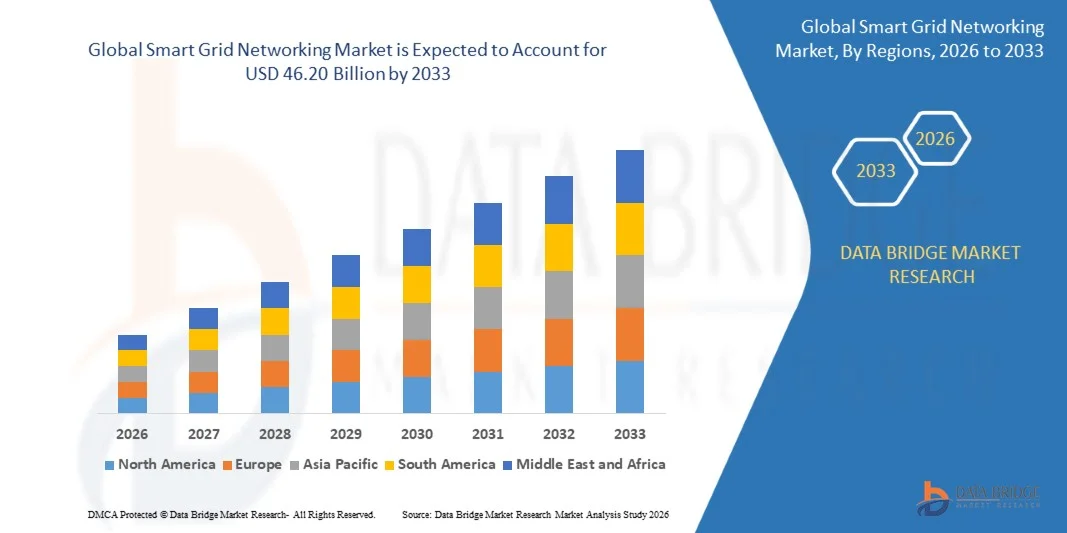
The Smart Grid Networking Market was valued at USD 19.48 billion in 2025 and is projected to reach USD 46.20 billion by 2033, growing at a CAGR of 11.40% from 2026 to 2033. The market is witnessing robust growth driven by increasing investments in smart grid infrastructure, rising deployment of advanced metering systems, and growing demand for reliable, secure, and real-time communication networks across power distribution systems. The integration of digital technologies into utility operations is further accelerating the adoption of smart grid networking solutions worldwide.
Governments and utility providers are increasingly focusing on modernizing aging electricity infrastructure to improve grid efficiency, reduce transmission losses, and support the integration of renewable energy sources. The growing need for grid resilience, enhanced energy management, and real-time monitoring capabilities is driving demand for advanced networking technologies such as wireless mesh networks, fiber-optic communication, and IoT-enabled grid connectivity. In addition, the expansion of distributed energy resources, electric vehicle charging infrastructure, and smart city initiatives is creating significant opportunities for smart grid networking deployment across both developed and emerging economies.
Key Market Trends & Insights
- North America dominated the smart grid networking market with the largest revenue share of 38.9% in 2025, supported by extensive utility investments in grid modernization, widespread smart meter deployment, strong regulatory support, and increasing adoption of advanced communication technologies across electricity transmission and distribution networks.
- Asia-Pacific is expected to be the fastest-growing region, recording a CAGR of 13.2% from 2026 to 2033. Growth is driven by rapid urbanization, increasing electricity demand, large-scale smart city projects, government-led grid modernization initiatives, and growing investments in renewable energy infrastructure across China, Japan, India, and Southeast Asian countries.
- The Smart Meter Communication Modules segment held the largest market revenue share of approximately 31.6% in 2025 driven by the rapid deployment of Advanced Metering Infrastructure (AMI) projects across North America, Europe, and Asia-Pacific. Utilities are increasingly investing in smart meter connectivity solutions to enable real-time energy monitoring, remote meter reading, and grid automation, supporting widespread adoption of communication modules across distribution networks.
- The Routers and Switches segment is projected to register the fastest growth at a CAGR of 12.8% from 2026 to 2033, driven by increasing demand for secure, high-speed data transmission across substations, control centers, and distributed energy resource networks. Growing investments in grid digitalization and utility communication infrastructure are accelerating segment expansion.
- The Network Security Management segment accounted for the largest market revenue share of approximately 27.9% in 2025 due to growing cybersecurity concerns associated with interconnected smart grid infrastructure. Utilities are increasingly deploying advanced security management platforms to protect critical communication networks from cyber threats, unauthorized access, and operational disruptions.
- The Network Performance Monitoring Management segment is anticipated to witness the fastest growth at a CAGR of 13.4% from 2026 to 2033 driven by increasing demand for real-time network visibility, predictive maintenance, and operational optimization across modern power grids. Rising deployment of intelligent grid communication systems continues to support segment growth.
- The Design and Integration segment held the largest market revenue share of approximately 29.8% in 2025 driven by large-scale smart grid modernization projects requiring seamless integration of communication networks, smart meters, sensors, and utility management platforms. Utilities increasingly rely on specialized integration services to ensure interoperability across complex grid ecosystems.
- The Network Risk and Security Assessment segment is projected to register the fastest growth at a CAGR of 13.1% from 2026 to 2033 owing to the increasing need for vulnerability assessments, compliance management, and cybersecurity preparedness across critical energy infrastructure. Growing regulatory requirements and cyber risk awareness are supporting segment expansion.
- The Advance Metering Infrastructure (AMI) segment dominated the market with a revenue share of approximately 38.7% in 2025 driven by extensive smart meter deployment programs and utility investments in real-time consumption monitoring systems. AMI networks play a critical role in enabling automated meter reading, outage detection, and customer energy management across modern electricity grids.
- The Demand Response segment is expected to register the fastest growth at a CAGR of 13.7% from 2026 to 2033 due to increasing adoption of intelligent energy management programs designed to balance electricity demand and improve grid reliability. Growing integration of renewable energy resources and electric vehicle charging infrastructure is further accelerating demand response network deployments globally.
Market Size & Forecast
- Global Market Value (2025): USD 19.48 Billion
- Expected Market Value (2033): USD 46.20 Billion
- Forecast CAGR (2026–2033): 11.40%
- Leading Region in 2025: North America
- Fastest Growing Region: Asia-Pacific
Report Scope and Smart Grid Networking Market Segmentation
|
Attributes |
Smart Grid Networking Key Market Insights |
|
Segments Covered |
· By Hardware: Controllers, Cables, Smart Meter Communication Modules, Routers, Switches, and Other Hardware · By Software: Internet Protocol Address Management, Network Performance Monitoring Management, Network Device Management, Network Traffic Management, Network Security Management, Network Configuration Management, and Other Software · By Services: Network Planning, Consulting, Network Risk and Security Assessment, Design and Integration, Support Services, Network Maintenance and Other Services · By Application: Transmission, Demand Response, Advance Metering Infrastructure (AMI), and Other Application Areas |
|
Countries Covered |
North America · U.S. · Canada · Mexico Europe · Germany · France · U.K. · Netherlands · Switzerland · Belgium · Russia · Italy · Spain · Turkey · Rest of Europe Asia-Pacific · China · Japan · India · South Korea · Singapore · Malaysia · Australia · Thailand · Indonesia · Philippines · Rest of Asia-Pacific Middle East and Africa · Saudi Arabia · U.A.E. · South Africa · Egypt · Israel · Rest of Middle East and Africa South America · Brazil · Argentina · Rest of South America |
|
Key Market Players |
• ABB Ltd. (Switzerland) |
|
Market Opportunities |
|
|
Value Added Data Infosets |
In addition to the market insights such as market value, growth rate, market segments, geographical coverage, market players, and market scenario, the market report curated by the Data Bridge Market Research team includes in-depth expert analysis, import/export analysis, pricing analysis, production consumption analysis, and pestle analysis. |
Smart Grid Networking Market Trends
Trend: Expansion Of Advanced Metering Infrastructure And Grid Digitalization
The increasing modernization of power transmission and distribution networks is accelerating the adoption of advanced smart grid networking technologies across utility sectors worldwide. Traditional grid communication systems often lack the capability to support real-time monitoring, automated fault detection, and two-way communication required for modern electricity networks, encouraging utilities to deploy high-speed and secure networking infrastructure. Growing integration of renewable energy sources, distributed generation assets, and electric vehicle charging networks is further increasing the need for reliable grid connectivity and intelligent communication platforms.
Utilities are increasingly deploying smart grid communication networks, For instance wireless mesh, fiber-optic, and cellular-based systems, to enable real-time data exchange between substations, smart meters, and control centers. In North America, utility companies have expanded Advanced Metering Infrastructure (AMI) deployments to improve outage management and energy efficiency. Similarly, large-scale grid modernization programs across Europe and Asia-Pacific are strengthening investments in digital substations and intelligent distribution networks. According to the International Energy Agency, global smart meter installations exceeded 1.8 billion units by 2025, highlighting the growing requirement for robust networking infrastructure to support large-scale grid digitalization initiatives.
Smart Grid Networking Market Dynamics
Key Market Driver: Rising Investments In Grid Modernization And Renewable Energy Integration
Governments and utility providers worldwide are increasing investments in grid modernization projects to improve electricity reliability, reduce transmission losses, and support growing renewable energy penetration. Aging power infrastructure, rising electricity demand, and increasing frequency of weather-related grid disruptions are creating strong demand for advanced networking technologies capable of enabling real-time grid visibility and automated system management.
Utilities are increasingly implementing smart grid communication platforms, For instance IP-based networking systems and intelligent distribution management solutions, to improve operational efficiency and enhance grid resilience. Renewable energy integration is further driving demand for advanced communication networks capable of managing decentralized power generation assets. In the U.S., grid modernization investments surpassed USD 39 billion in 2024 across transmission and distribution projects. Similarly, China continued expanding its nationwide smart grid development program, deploying advanced communication infrastructure across thousands of substations to support large-scale renewable energy integration and grid automation.
Key Restraint/Challenge: High Infrastructure Deployment Costs And Cybersecurity Risks
The deployment of smart grid networking infrastructure requires substantial capital investment in communication hardware, software platforms, smart meters, sensors, and network management systems. Utilities operating in developing economies often face budget constraints that limit large-scale implementation of advanced networking technologies, slowing modernization efforts in cost-sensitive regions.
In addition, increasing digitalization of power infrastructure exposes utility networks to cybersecurity threats, data breaches, and potential operational disruptions. Protecting critical grid communication systems requires continuous investments in cybersecurity frameworks, encryption technologies, and network monitoring solutions, increasing overall deployment and maintenance costs. Industry assessments indicate that utility cybersecurity spending continues to rise globally as cyberattacks targeting energy infrastructure become more sophisticated. Several utility operators reported significant increases in cybersecurity expenditure during 2024 to strengthen protection of interconnected smart grid communication networks and operational technology environments.
Key Market Opportunity: Growth Of Smart Cities And Intelligent Energy Management Systems
Rapid development of smart cities, connected infrastructure, and intelligent energy management platforms is creating significant opportunities for smart grid networking providers worldwide. Modern urban infrastructure increasingly relies on interconnected energy systems capable of supporting smart buildings, electric vehicle charging stations, distributed renewable energy resources, and real-time energy optimization.
Municipal authorities and utility companies are expanding investments in advanced networking technologies, For instance IoT-enabled grid communication systems and edge computing platforms, to improve energy efficiency and support smart city operations. The growing adoption of electric vehicles is also increasing demand for intelligent grid communication networks capable of balancing charging loads and maintaining grid stability. In addition, emerging technologies such as artificial intelligence, digital twins, and predictive grid analytics are creating new opportunities for advanced networking solutions. Smart city projects across the U.A.E., Singapore, and South Korea have demonstrated measurable improvements in energy monitoring and grid responsiveness through deployment of intelligent communication infrastructure supporting real-time energy management systems.
Smart Grid Networking Market Scope
The market is segmented on the basis of hardware, software, services, and application.
- By Hardware
On the basis of hardware, the smart grid networking market is segmented into Controllers, Cables, Smart Meter Communication Modules, Routers, Switches, and Other Hardware. The Smart Meter Communication Modules segment held the largest market revenue share of approximately 31.6% in 2025 driven by the rapid deployment of Advanced Metering Infrastructure (AMI) projects across North America, Europe, and Asia-Pacific. Utilities are increasingly investing in smart meter connectivity solutions to enable real-time energy monitoring, remote meter reading, and grid automation, supporting widespread adoption of communication modules across distribution networks.
The Routers and Switches segment is projected to register the fastest growth at a CAGR of 12.8% from 2026 to 2033, driven by increasing demand for secure, high-speed data transmission across substations, control centers, and distributed energy resource networks. Growing investments in grid digitalization and utility communication infrastructure are accelerating segment expansion.
- By Software
On the basis of software, the smart grid networking market is segmented into Internet Protocol Address Management, Network Performance Monitoring Management, Network Device Management, Network Traffic Management, Network Security Management, Network Configuration Management, and Other Software. The Network Security Management segment accounted for the largest market revenue share of approximately 27.9% in 2025 due to growing cybersecurity concerns associated with interconnected smart grid infrastructure. Utilities are increasingly deploying advanced security management platforms to protect critical communication networks from cyber threats, unauthorized access, and operational disruptions.
The Network Performance Monitoring Management segment is anticipated to witness the fastest growth at a CAGR of 13.4% from 2026 to 2033 driven by increasing demand for real-time network visibility, predictive maintenance, and operational optimization across modern power grids. Rising deployment of intelligent grid communication systems continues to support segment growth.
- By Services
On the basis of services, the smart grid networking market is segmented into Network Planning, Consulting, Network Risk and Security Assessment, Design and Integration, Support Services, Network Maintenance, and Other Services. The Design and Integration segment held the largest market revenue share of approximately 29.8% in 2025 driven by large-scale smart grid modernization projects requiring seamless integration of communication networks, smart meters, sensors, and utility management platforms. Utilities increasingly rely on specialized integration services to ensure interoperability across complex grid ecosystems.
The Network Risk and Security Assessment segment is projected to register the fastest growth at a CAGR of 13.1% from 2026 to 2033 owing to the increasing need for vulnerability assessments, compliance management, and cybersecurity preparedness across critical energy infrastructure. Growing regulatory requirements and cyber risk awareness are supporting segment expansion.
- By Application
On the basis of application, the smart grid networking market is segmented into Transmission, Demand Response, Advance Metering Infrastructure (AMI), and Other Application Areas. The Advance Metering Infrastructure (AMI) segment dominated the market with a revenue share of approximately 38.7% in 2025 driven by extensive smart meter deployment programs and utility investments in real-time consumption monitoring systems. AMI networks play a critical role in enabling automated meter reading, outage detection, and customer energy management across modern electricity grids.
The Demand Response segment is expected to register the fastest growth at a CAGR of 13.7% from 2026 to 2033 due to increasing adoption of intelligent energy management programs designed to balance electricity demand and improve grid reliability. Growing integration of renewable energy resources and electric vehicle charging infrastructure is further accelerating demand response network deployments globally.
Smart Grid Networking Market Regional Analysis
North America Smart Grid Networking Market Insight
North America dominated the smart grid networking market with the largest revenue share of 38.9% in 2025, supported by extensive investments in grid modernization, advanced metering infrastructure deployment, and increasing adoption of renewable energy resources. Utility providers across the region are actively upgrading aging transmission and distribution networks with intelligent communication technologies to improve grid reliability, operational efficiency, and outage management capabilities. Strong government support, favorable regulatory policies, and growing electricity demand continue to accelerate the deployment of advanced smart grid networking solutions across the region.
U.S. Smart Grid Networking Market Insight
The U.S. smart grid networking market captured the largest revenue share in 2025 within North America, fueled by large-scale investments in grid digitalization and utility modernization initiatives. Utilities are increasingly deploying advanced communication networks, smart meters, and intelligent distribution systems to improve energy management and grid resilience. The rapid expansion of renewable energy projects, electric vehicle charging infrastructure, and distributed energy resources is further driving demand for secure and high-performance grid communication platforms. Federal funding programs and ongoing transmission infrastructure upgrades continue to support market growth.
Europe Smart Grid Networking Market Insight
The Europe smart grid networking market is expected to witness significant growth from 2026 to 2033, primarily driven by ambitious decarbonization targets, renewable energy integration initiatives, and increasing investments in smart energy infrastructure. Utilities across the region are focusing on enhancing grid flexibility and supporting decentralized energy generation through advanced communication technologies. Growing deployment of smart meters, intelligent substations, and automated distribution networks is strengthening demand for smart grid networking solutions across residential, commercial, and industrial applications.
U.K. Smart Grid Networking Market Insight
The U.K. smart grid networking market is expected to witness the fastest growth rate from 2026 to 2033, driven by ongoing smart meter rollout programs and increasing investments in low-carbon energy infrastructure. Utility operators are expanding deployment of advanced communication systems to support renewable energy integration, demand response programs, and grid automation initiatives. The country's commitment to achieving net-zero emissions and improving energy efficiency is expected to continue stimulating demand for smart grid networking technologies.
Germany Smart Grid Networking Market Insight
The Germany smart grid networking market is expected to witness strong growth from 2026 to 2033, fueled by the country's energy transition strategy and increasing investments in intelligent power infrastructure. The growing penetration of renewable energy sources, particularly wind and solar power, is creating substantial demand for advanced communication networks capable of supporting real-time grid management. Germany's emphasis on industrial digitalization, energy efficiency, and grid stability continues to promote adoption of sophisticated smart grid networking solutions across utility operations.
Asia-Pacific Smart Grid Networking Market Insight
The Asia-Pacific smart grid networking market is expected to witness the fastest growth rate from 2026 to 2033, supported by rapid urbanization, rising electricity consumption, and large-scale smart city development initiatives. Governments across the region are investing heavily in grid modernization projects to improve energy efficiency, reduce transmission losses, and support increasing renewable energy capacity. Expanding deployment of smart meters, digital substations, and advanced distribution management systems is accelerating adoption of smart grid networking technologies throughout the region.
Japan Smart Grid Networking Market Insight
The Japan smart grid networking market is expected to witness significant growth from 2026 to 2033 due to increasing investments in grid resilience, renewable energy integration, and advanced energy management systems. Utility companies are adopting intelligent communication platforms to enhance operational efficiency and support distributed energy resources. The country's focus on energy security, disaster preparedness, and digital transformation is driving the implementation of sophisticated smart grid networking infrastructure across power generation and distribution networks.
China Smart Grid Networking Market Insight
The China smart grid networking market accounted for the largest market revenue share in Asia-Pacific in 2025, attributed to extensive government investments in smart grid development and transmission infrastructure expansion. China continues to deploy large-scale smart meters, digital substations, and ultra-high-voltage transmission networks to support rising electricity demand and renewable energy integration. The country's smart city initiatives, strong manufacturing capabilities, and commitment to energy modernization are key factors propelling the adoption of advanced smart grid networking solutions.
Smart Grid Networking Market Share
The Smart Grid Networking industry is primarily led by well-established companies, including:
• ABB Ltd. (Switzerland)
• Cisco Systems, Inc. (U.S.)
• Schneider Electric SE (France)
• Lockheed Martin Corporation (U.S.)
• Sophos Ltd. (U.K.)
• General Electric Company (U.S.)
• Honeywell International Inc. (U.S.)
• Siemens AG (Germany)
• Eaton Corporation plc (Ireland)
• Itron, Inc. (U.S.)
• BAE Systems plc (U.K.)
• N-Dimension Solutions Inc. (Canada)
• AlertEnterprise Inc. (U.S.)
• Sophos Ltd. (U.K.)
• Sourcefire, Inc. (U.S.)
• Sentryo SAS (France)
• IOActive, Inc. (U.S.)
• Osaki Electric Co., Ltd. (Japan)
Latest Developments in Smart Grid Networking Market
- In December 2025, Schneider Electric announced an investment of USD 450 million to establish a new grid software development center in Bangalore focused on advanced distribution management systems and distributed energy resource (DER) orchestration. The initiative is expected to strengthen smart grid intelligence, improve renewable energy integration capabilities, and accelerate digital transformation across utility networks, supporting long-term growth in the smart grid networking market.
- In March 2025, Itron partnered with CHINT Global to launch the first residential smart meter compliant with the DLMS Generic Companion Profile standard. The development enhances interoperability across multi-vendor utility environments, simplifies smart meter deployment, and supports broader adoption of advanced metering infrastructure, contributing to increased efficiency and standardization within smart grid communication networks.
- In February 2025, Germany amended its Energy Industry Law to mandate smart meter deployment for households consuming more than 6,000 kWh annually while introducing caps on metering service charges. The regulatory update is expected to accelerate smart meter penetration, expand grid digitalization efforts, and create significant demand for smart grid networking and communication infrastructure across the country.
- In January 2025, NV Energy deployed LineVision dynamic line-rating sensors across key transmission corridors to optimize existing grid capacity and improve operational reliability. The implementation enables real-time monitoring of transmission assets, enhances power flow management, and reduces the need for costly infrastructure expansion, supporting increased adoption of intelligent grid networking technologies.

- Interactive Data Analysis Dashboard
- Company Analysis Dashboard for high growth potential opportunities
- Research Analyst Access for customization & queries
- Competitor Analysis with Interactive dashboard
- Latest News, Updates & Trend analysis
- Harness the Power of Benchmark Analysis for Comprehensive Competitor Tracking
Data collection and base year analysis are done using data collection modules with large sample sizes. The stage includes obtaining market information or related data through various sources and strategies. It includes examining and planning all the data acquired from the past in advance. It likewise envelops the examination of information inconsistencies seen across different information sources. The market data is analysed and estimated using market statistical and coherent models. Also, market share analysis and key trend analysis are the major success factors in the market report. To know more, please request an analyst call or drop down your inquiry.
The key research methodology used by DBMR research team is data triangulation which involves data mining, analysis of the impact of data variables on the market and primary (industry expert) validation. Data models include Vendor Positioning Grid, Market Time Line Analysis, Market Overview and Guide, Company Positioning Grid, Patent Analysis, Pricing Analysis, Company Market Share Analysis, Standards of Measurement, Global versus Regional and Vendor Share Analysis. To know more about the research methodology, drop in an inquiry to speak to our industry experts.
Data Bridge Market Research is a leader in advanced formative research. We take pride in servicing our existing and new customers with data and analysis that match and suits their goal. The report can be customized to include price trend analysis of target brands understanding the market for additional countries (ask for the list of countries), clinical trial results data, literature review, refurbished market and product base analysis. Market analysis of target competitors can be analyzed from technology-based analysis to market portfolio strategies. We can add as many competitors that you require data about in the format and data style you are looking for. Our team of analysts can also provide you data in crude raw excel files pivot tables (Fact book) or can assist you in creating presentations from the data sets available in the report.













