


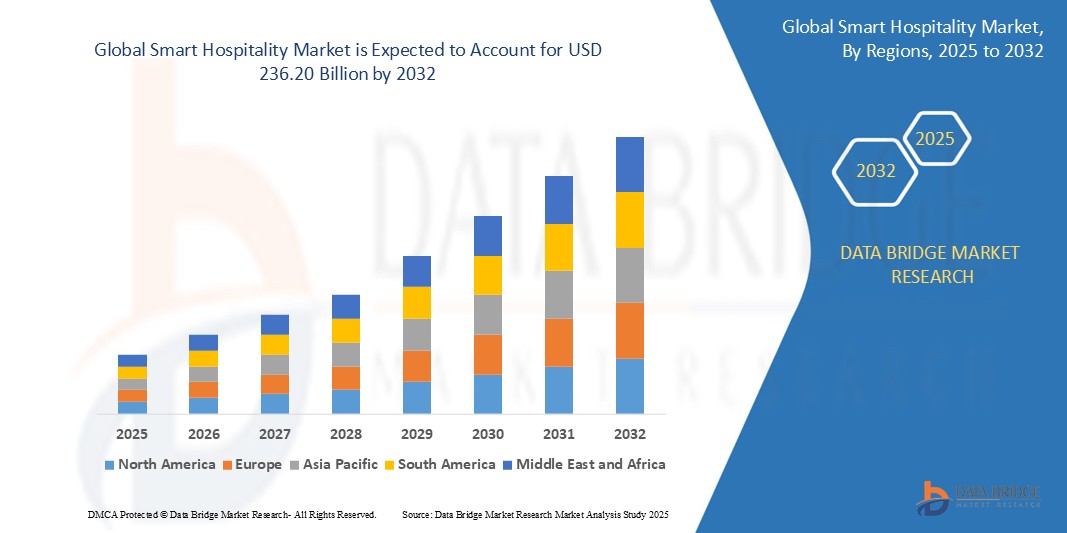
Smart Hospitality Market Size
- The global smart hospitality market size was valued at USD 36.48 billion in 2024 and is expected to reach USD 236.20 billion by 2032, at a CAGR of 26.3% during the forecast period
- This growth is driven by factors such as technological advancements, demand for personalized guest experiences, improved operational efficiency, sustainability initiatives, rising need for contactless services, and better connectivity
Smart Hospitality Market Analysis
- Smart hospitality refers to the integration of advanced technologies such as IoT, AI, automation, and mobile solutions within the hospitality industry to enhance guest experience, streamline operations, and optimize service delivery
- The smart hospitality market is experiencing robust growth, driven by increasing demand for personalized guest services, rising adoption of smart room controls and mobile check-ins, growing focus on energy efficiency and sustainability, and the hospitality sector’s digital transformation
- Europe is expected to dominate the smart hospitality market with a share of 33.5% due to technological advancements and a well-established digital infrastructure
- Asia-Pacific is expected to be the fastest growing region in the smart hospitality market during the forecast period due to rapid technological adoption, large-scale urbanization, and a thriving tourism industry
- Guest experience management system segment is expected to dominate the market with a market share of 56.22% due to increasing demand for personalized guest experiences. These systems allow hotels and resorts to enhance customer satisfaction by offering tailored services, improving operational efficiency, and collecting real-time feedback. The growing focus on customer-centric solutions and the integration of advanced technologies such as AI and IoT are driving this segment's growth, as businesses aim to differentiate themselves in a highly competitive market
Report Scope and Smart Hospitality Market Segmentation
|
Attributes |
Smart Hospitality Key Market Insights |
|
Segments Covered |
|
|
Countries Covered |
North America
Europe
Asia-Pacific
Middle East and Africa
South America
|
|
Key Market Players |
|
|
Market Opportunities |
|
|
Value Added Data Infosets |
In addition to the market insights such as market value, growth rate, market segments, geographical coverage, market players, and market scenario, the market report curated by the Data Bridge Market Research team includes in-depth expert analysis, import/export analysis, pricing analysis, production consumption analysis, and pestle analysis. |
Smart Hospitality Market Trends
“Increasing Adoption of IoT Technologies”
- One prominent trend in the global smart hospitality market is the increasing adoption of IoT technologies
- This trend is driven by the growing demand for seamless, personalized services, the need for energy-efficient solutions, and the desire for real-time data to optimize hotel operations
- For instance, hotels are implementing IoT-based systems such as smart thermostats, voice-activated assistants, and connected room controls to give guests greater control over their environment while improving energy management and maintenance processes
- The use of IoT technologies is expanding rapidly across both developed and emerging markets, as properties look for ways to enhance guest satisfaction and streamline back-end operations
- As demand for personalization, convenience, and sustainability increases, IoT integration is expected to be a key driver of innovation and long-term growth in the smart hospitality market
Smart Hospitality Market Dynamics
Driver
“Rising Demand for Personalized Guest Experiences”
- The growing demand for personalized guest experiences is a key driver of growth in the smart hospitality market, as both hotels and consumers prioritize tailored services that enhance satisfaction and comfort
- This shift is particularly evident in high-end and luxury properties, where guests seek unique, customized stays, as well as in tech-savvy markets where personalization through mobile apps and smart devices is in high demand
- As expectations for individualized services rise, the market is focusing on AI-driven solutions, IoT-enabled devices, and real-time data analytics to offer customized experiences that cater to guest preferences, from room temperature to dining options
- Hotels are responding by integrating advanced technologies to collect and analyze guest data, enabling the provision of personalized services, such as customized room settings and tailored recommendations based on guest behavior
- This push for personalized experiences is accelerating the adoption of smart technologies in hotels, driving innovation in customer service and operational efficiency across the hospitality sector
For instance,
- Companies such as Hilton and Marriott are incorporating AI and IoT solutions to create smart rooms where guests can control lighting, temperature, and entertainment via mobile apps
- Many properties are using data analytics to anticipate guest preferences and offer personalized promotions or services, enhancing loyalty and guest retention
- As personalized experiences continue to define consumer expectations in the hospitality industry, this driver is expected to significantly influence the development and expansion of smart hospitality solutions globally
Opportunity
“Increasing Competition in the Hospitality Industry”
- The rising competition in the hospitality industry presents a significant opportunity for the smart hospitality market, as hotels seek to differentiate themselves through innovative, technology-driven guest experiences and operational efficiencies
- Hospitality businesses are leveraging smart technologies such as AI, IoT, and data analytics to improve guest personalization, streamline service delivery, and enhance overall customer satisfaction, enabling them to stand out in a highly competitive market
- This opportunity aligns with the increasing demand for convenience, comfort, and unique experiences among travelers, as well as the growing need for cost-effective and efficient operations to maintain profitability in a competitive landscape
For instance,
- Leading hotel chains such as Accor and Marriott are incorporating IoT-based systems that allow guests to control room settings through mobile apps, while utilizing data analytics to personalize guest experiences and optimize resource usage
- Many hotels are investing in AI-powered chatbots and virtual assistants to provide 24/7 customer service, helping to improve efficiency and enhance guest engagement
- As competition intensifies, the smart hospitality market is well-positioned to capitalize on this opportunity by providing innovative solutions that help hotels offer unique, customized experiences and maintain operational excellence, ultimately driving market growth and adoption
Restraint/Challenge
“Data Privacy and Security Concerns”
- Data privacy and security concerns present a significant challenge for the smart hospitality market, as the integration of advanced technologies such as IoT and AI generates vast amounts of sensitive customer data
- Hotels and hospitality providers must ensure that they implement robust cybersecurity measures to protect personal information, payment details, and preferences from potential breaches, which can severely impact customer trust and brand reputation
- The challenge is heightened by the complexity of managing and securing data across multiple platforms, devices, and service channels, particularly as smart technologies become more interconnected and widespread
For instance,
- Many hotels are adopting encryption methods and secure cloud storage solutions to safeguard guest data, but these security measures can be costly and require constant monitoring and updates
- Without significant investment in cybersecurity infrastructure or clearer regulations regarding data protection in the hospitality industry, concerns around data privacy may hinder widespread adoption of smart technologies and limit market growth, especially in regions with stringent privacy laws
Smart Hospitality Market Scope
The market is segmented on the basis of type, hotel type, deployment mode, and application.
|
Segmentation |
Sub-Segmentation |
|
By Type |
|
|
By Hotel Type |
|
|
By Deployment Mode |
|
|
By Application
|
|
In 2025, the guest experience management system is projected to dominate the market with a largest share in type segment
The guest experience management system segment is expected to dominate the smart hospitality market in 2025 due to increasing demand for personalized guest experiences. These systems allow hotels and resorts to enhance customer satisfaction by offering tailored services, improving operational efficiency, and collecting real-time feedback. The growing focus on customer-centric solutions and the integration of advanced technologies such as AI and IoT are driving this segment's growth, as businesses aim to differentiate themselves in a highly competitive market.
The on-cloud is expected to account for the largest share during the forecast period in deployment mode segment
In 2025, the on-cloud segment is expected to dominate the market due to its scalability, cost-effectiveness, and flexibility. Cloud-based solutions enable businesses to access advanced technologies without the need for significant upfront infrastructure investments. In addition, the increasing adoption of remote work, enhanced data security measures, and the ability to quickly scale operations are driving the shift toward cloud platforms. The ease of integration with other digital tools and the ability to update systems seamlessly further contribute to the growing preference for on-cloud solutions.
Smart Hospitality Market Regional Analysis
“Europe Holds the Largest Share in the Smart hospitality Market”
- Europe dominates the smart hospitality market with a share of 33.5%, driven by the technological advancements and a well-established digital infrastructure
- U.K. holds a significant share due to strong emphasis on enhancing customer experiences through smart room solutions, energy efficiency, and AI-driven personalization
- Europe’s dominance is further reinforced by the growing demand for sustainable practices and the increasing number of hotels and resorts investing in advanced automation and guest experience management systems
- With continuous advancements in AI, IoT, and 5G technologies, Europe is expected to maintain its leading position in the smart hospitality market through 2032
“Asia-Pacific is Projected to Register the Highest CAGR in the Smart hospitality Market”
- Asia-Pacific is expected to witness the highest growth rate in the smart hospitality market, driven by rapid technological adoption, large-scale urbanization, and a thriving tourism industry
- China holds a significant share due to growing infrastructure investments, rapid adoption of IoT, and a high level of digitalization in hospitality operations
- The region's growth is also supported by a rising middle-class population, increased demand for personalized guest experiences, and a rapidly expanding hotel and tourism sector, particularly in emerging economies such as India and Southeast Asia
- With advancements in AI-powered services, data analytics, and automation, Asia-Pacific is expected to become the fastest-growing region in the global smart hospitality market through 2032
Smart Hospitality Market Share
The market competitive landscape provides details by competitor. Details included are company overview, company financials, revenue generated, market potential, investment in research and development, new market initiatives, global presence, production sites and facilities, production capacities, company strengths and weaknesses, product launch, product width and breadth, application dominance. The above data points provided are only related to the companies' focus related to market.
The Major Market Leaders Operating in the Market Are:
- NEC Corporation (Japan)
- Huawei Technologies Co., Ltd. (China)
- IBM (U.S.)
- Cisco Systems, Inc. (U.S.)
- Siemens (U.S.)
- Schneider Electric (France)
- Johnson Controls (Ireland)
- Honeywell International Inc. (U.S.)
- Oracle (U.S.)
- Infor. (U.S.)
- Winhotel Solution (Spain)
- BuildingIQ (U.S.)
- WiSuite (U.S.)
- Qualsoft Systems Pvt. Ltd. (India)
- SAMSUNG (South Korea)
- BLAZON HOTELS (U.A.E.)
- Control4 Corporation (U.S.)
- Guestline (U.K.)
- Cloudbeds (U.S.)
- Frontdesk Anywhere (U.S.)
Latest Developments in Global Smart Hospitality Market
- In March 2025, at MWC Barcelona, Huawei and Meliá Hotels International unveiled the Global Smart Hotel Showcase at the Torre Melina Gran Meliá hotel, a premium luxury brand of Meliá. This initiative is set to drive advancements in smart hotel network connectivity and infrastructure, facilitating the digital and intelligent transformation of the global hospitality industry, and positioning both companies as key innovators in the market. The showcase is expected to influence the widespread adoption of smart technologies, enhancing guest experiences and operational efficiency across the sector
- In August 2022, the Ministry of Education, Culture, Research, and Technology (MoECRT) of the Republic of Indonesia and Oracle Indonesia renewed an agreement focusing on safety issues. This agreement aims to integrate the Oracle Academy curriculum and technology resources into MoECRT’s Directorate General of Vocational Education (DGVE) initiatives for the next four years. The collaboration aims to train 2,000 educators and their 50,000 students across Indonesia
- In November 2022, Infor formed a partnership with Rosen Hotels & Resorts to implement essential back-of-house hospitality solutions. This collaboration includes the automation of critical business functions such as financials, human resources, talent management, analytics, and workforce management

- Interactive Data Analysis Dashboard
- Company Analysis Dashboard for high growth potential opportunities
- Research Analyst Access for customization & queries
- Competitor Analysis with Interactive dashboard
- Latest News, Updates & Trend analysis
- Harness the Power of Benchmark Analysis for Comprehensive Competitor Tracking
Data collection and base year analysis are done using data collection modules with large sample sizes. The stage includes obtaining market information or related data through various sources and strategies. It includes examining and planning all the data acquired from the past in advance. It likewise envelops the examination of information inconsistencies seen across different information sources. The market data is analysed and estimated using market statistical and coherent models. Also, market share analysis and key trend analysis are the major success factors in the market report. To know more, please request an analyst call or drop down your inquiry.
The key research methodology used by DBMR research team is data triangulation which involves data mining, analysis of the impact of data variables on the market and primary (industry expert) validation. Data models include Vendor Positioning Grid, Market Time Line Analysis, Market Overview and Guide, Company Positioning Grid, Patent Analysis, Pricing Analysis, Company Market Share Analysis, Standards of Measurement, Global versus Regional and Vendor Share Analysis. To know more about the research methodology, drop in an inquiry to speak to our industry experts.
Data Bridge Market Research is a leader in advanced formative research. We take pride in servicing our existing and new customers with data and analysis that match and suits their goal. The report can be customized to include price trend analysis of target brands understanding the market for additional countries (ask for the list of countries), clinical trial results data, literature review, refurbished market and product base analysis. Market analysis of target competitors can be analyzed from technology-based analysis to market portfolio strategies. We can add as many competitors that you require data about in the format and data style you are looking for. Our team of analysts can also provide you data in crude raw excel files pivot tables (Fact book) or can assist you in creating presentations from the data sets available in the report.













