


Smart Irrigation Market Size
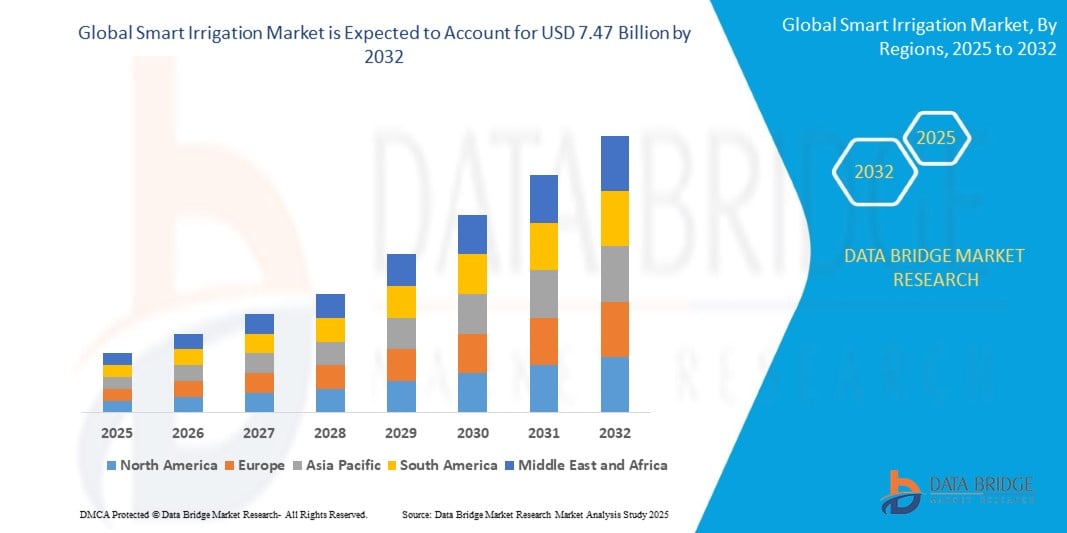
- The global Smart irrigation market size was valued at USD 1.89 billion in 2024 and is expected to reach USD 7.47 billion by 2032, at a CAGR of 21.7% during the forecast period
- Th This growth is driven by increasing concerns about water scarcity, rising adoption of IoT-based irrigation systems, and government initiatives promoting sustainable agriculture and water conservation
Smart Irrigation Market Analysis
- Smart irrigation systems utilize advanced technologies such as sensors, controllers, and IoT to optimize water usage in agriculture, landscaping, and other applications, ensuring efficient water management and enhanced crop yields.
- The market is propelled by the growing need for water conservation, integration of AI and IoT technologies, and the shift toward automated, data-driven irrigation solutions.
- North America holds a significant market share due to its advanced agricultural infrastructure, high adoption of smart irrigation technologies, and presence of key players like Rain Bird Corporation and The Toro Company.
- Asia-Pacific is expected to register the fastest growth, fueled by rapid agricultural modernization, smart city initiatives, and increasing water scarcity concerns in countries like China, India, and Australia.
- The agricultural segment is projected to account for a significant market share of approximately 38.5% in 2025, driven by the widespread adoption of smart irrigation systems to improve crop productivity and water efficiency.
Report Scope and Smart irrigation Market Segmentation
|
Attributes |
Smart irrigation Key Market Insights |
|
Segments Covered |
|
|
Countries Covered |
North America
Europe
Asia-Pacific
Middle East and Africa
South America
|
|
Key Market Players |
|
|
Market Opportunities |
|
|
Value Added Data Infosets |
In addition to the insights on market scenarios such as market value, growth rate, segmentation, geographical coverage, and major players, the market reports curated by the Data Bridge Market Research also include import export analysis, production capacity overview, production consumption analysis, price trend analysis, climate change scenario, supply chain analysis, value chain analysis, raw material/consumables overview, vendor selection criteria, PESTLE Analysis, Porter Analysis, and regulatory framework. |
Smart irrigation Market Trends
“Advancements in IoT and Sensor-Based Irrigation Technologies”
- The adoption of sensor-based irrigation systems, such as soil moisture and weather sensors, is a key trend, offering precise water management for agricultural and non-agricultural applications.
- Integration of IoT and cloud-based platforms enables remote monitoring, real-time data analytics, and automated irrigation scheduling.
For instance, in September 2024, Jain Irrigation Systems partnered with Sher-e-Kashmir University in India to deploy IoT-enabled smart irrigation solutions for farmers in Jammu and Kashmir, enhancing water efficiency.
- These innovations are accelerating the adoption of smart irrigation systems across agriculture, golf courses, and residential landscapes.
Smart irrigation Market Dynamics
Driver
“Rising Concerns Over Water Scarcity and Sustainable Agriculture”
- The increasing need to conserve water amid global scarcity drives demand for smart irrigation systems that optimize water usage.
- Government policies, such as subsidies for water-saving technologies in the U.S. and India, mandate efficient irrigation practices.
For instance, a 2024 USDA Report noted that 65% of U.S. farms have adopted smart irrigation to comply with water conservation regulations, highlighting their critical role.
- Growing agricultural demand and climate change impacts further propel market growth.
Opportunity
“Adoption of IoT and AI Technologies in Smart Irrigation”
- The integration of IoT and AI technologies in smart irrigation systems offers enhanced precision, scalability, and remote management, making them ideal for modern agriculture and smart city applications.
- These technologies enable cost-effective solutions, supporting growth in agricultural and non-agricultural sectors like golf courses and residential landscapes.
For instance, in November 2023, ImoLaza launched ImoLaza PRO, a next-generation smart irrigation system with AI-driven monitoring, targeting residential and commercial users.
- The growing demand for sustainable irrigation solutions presents significant growth opportunities.
Restraint/Challenge
“High Installation Costs and Limited Technical Expertise”
- Implementing advanced smart irrigation systems, such as IoT-enabled controllers and sensors, involves high installation and maintenance costs, posing challenges for small-scale farmers.
- Limited technical knowledge among farmers, particularly in developing regions, impacts the adoption of smart irrigation solutions.
For instance, a 2024 FAO Report highlighted a 50% increase in adoption barriers due to technical skill shortages in rural Asia and Africa.
- Cybersecurity risks in IoT-based systems further complicate market expansion.
Smart irrigation Market Scope
The market is segmented based on type, component, application, and end user.
|
Segmentation |
Sub-Segmentation |
|
By Type |
|
|
By Component |
|
|
By Application |
|
|
By End User |
|
In 2025, the agriculture segment is projected to dominate the end-user segment
The agriculture segment is expected to hold a market share of approximately 38.5% in 2025, driven by the widespread adoption of smart irrigation systems in farming to enhance water efficiency and crop yields.
The agricultural application segment is expected to account for the largest share during the forecast period in the application market
In 2025, the agricultural application segment is projected to account for a market share of 38.5%, driven by global demand for sustainable farming practices and water-efficient irrigation systems.
“North America Holds the Largest Share in the Smart irrigation Market”
- North America dominates the market due to its advanced agricultural infrastructure, widespread adoption of IoT-based irrigation systems, and presence of leading vendors like Rain Bird Corporation and The Toro Company.
- The U.S. holds a significant share, driven by high demand for smart irrigation in agriculture and non-agricultural applications, robust R&D investments, and government subsidies for water conservation.
- The region benefits from significant advancements in sensor and IoT technologies
“Asia-Pacific is Projected to Register the Highest CAGR in the Smart irrigation Market”
- Asia-Pacific’s growth is driven by rapid agricultural modernization, expanding farming sectors, and government initiatives for water conservation in countries like China, India, and Australia.
- India is projected to exhibit the highest CAGR due to its leadership in agricultural technology adoption and growing smart irrigation investments.
- The region’s increasing focus on sustainable agriculture and water management further accelerates market growth.
Smart irrigation Market Share
The market competitive landscape provides details by competitor. Details included are company overview, company financials, revenue generated, market potential, investment in research and development, new market initiatives, global presence, production sites and facilities, production capacities, company strengths and weaknesses, product launch, product width and breadth, application dominance. The above data points provided are only related to the companies' focus related to market.
The Major Market Leaders Operating in the Market Are:
- Rain Bird Corporation (U.S.)
- The Toro Company (U.S.)
- Hunter Industries (U.S.)
- Netafim (Israel)
- HydroPoint Data Systems (U.S.)
- Rachio Inc. (U.S.)
- Jain Irrigation Systems (India)
- Weathermatic (U.S.)
- Galcon Ltd. (Israel)
- Delta-T Devices Ltd. (U.K.)
Latest Developments in Global Smart irrigation Market
- In June 2023, Rain Bird Corporation partnered with a California farming cooperative to enhance smart irrigation solutions. The collaboration integrated Rain Bird’s sensor-based systems, improving water efficiency and crop yields.
- In August 2023, Netafim launched a new IoT-enabled irrigation controller for agricultural applications. The controller offers real-time monitoring and cloud-based management, targeting precision farming.
- In January 2024, The Toro Company introduced a next-generation weather-based irrigation system for golf courses. The system features advanced analytics and compliance with water conservation standards.
- In April 2024, Jain Irrigation Systems unveiled a cloud-based smart irrigation platform for small-scale farmers. The platform supports seamless integration with IoT technologies for enhanced water management.
- In October 2024, HydroPoint announced a strategic partnership with a smart city project in Australia to deploy sensor-based irrigation systems for urban landscapes, enhancing water efficiency and sustainability.

- Interactive Data Analysis Dashboard
- Company Analysis Dashboard for high growth potential opportunities
- Research Analyst Access for customization & queries
- Competitor Analysis with Interactive dashboard
- Latest News, Updates & Trend analysis
- Harness the Power of Benchmark Analysis for Comprehensive Competitor Tracking
Global Smart Irrigation Market, Supply Chain Analysis and Ecosystem Framework
To support market growth and help clients navigate the impact of geopolitical shifts, DBMR has integrated in-depth supply chain analysis into its Global Smart Irrigation Market research reports. This addition empowers clients to respond effectively to global changes affecting their industries. The supply chain analysis section includes detailed insights such as Global Smart Irrigation Market consumption and production by country, price trend analysis, the impact of tariffs and geopolitical developments, and import and export trends by country and HSN code. It also highlights major suppliers with data on production capacity and company profiles, as well as key importers and exporters. In addition to research, DBMR offers specialized supply chain consulting services backed by over a decade of experience, providing solutions like supplier discovery, supplier risk assessment, price trend analysis, impact evaluation of inflation and trade route changes, and comprehensive market trend analysis.
Data collection and base year analysis are done using data collection modules with large sample sizes. The stage includes obtaining market information or related data through various sources and strategies. It includes examining and planning all the data acquired from the past in advance. It likewise envelops the examination of information inconsistencies seen across different information sources. The market data is analysed and estimated using market statistical and coherent models. Also, market share analysis and key trend analysis are the major success factors in the market report. To know more, please request an analyst call or drop down your inquiry.
The key research methodology used by DBMR research team is data triangulation which involves data mining, analysis of the impact of data variables on the market and primary (industry expert) validation. Data models include Vendor Positioning Grid, Market Time Line Analysis, Market Overview and Guide, Company Positioning Grid, Patent Analysis, Pricing Analysis, Company Market Share Analysis, Standards of Measurement, Global versus Regional and Vendor Share Analysis. To know more about the research methodology, drop in an inquiry to speak to our industry experts.
Data Bridge Market Research is a leader in advanced formative research. We take pride in servicing our existing and new customers with data and analysis that match and suits their goal. The report can be customized to include price trend analysis of target brands understanding the market for additional countries (ask for the list of countries), clinical trial results data, literature review, refurbished market and product base analysis. Market analysis of target competitors can be analyzed from technology-based analysis to market portfolio strategies. We can add as many competitors that you require data about in the format and data style you are looking for. Our team of analysts can also provide you data in crude raw excel files pivot tables (Fact book) or can assist you in creating presentations from the data sets available in the report.













