


Smart Label FMCG Products Market Overview
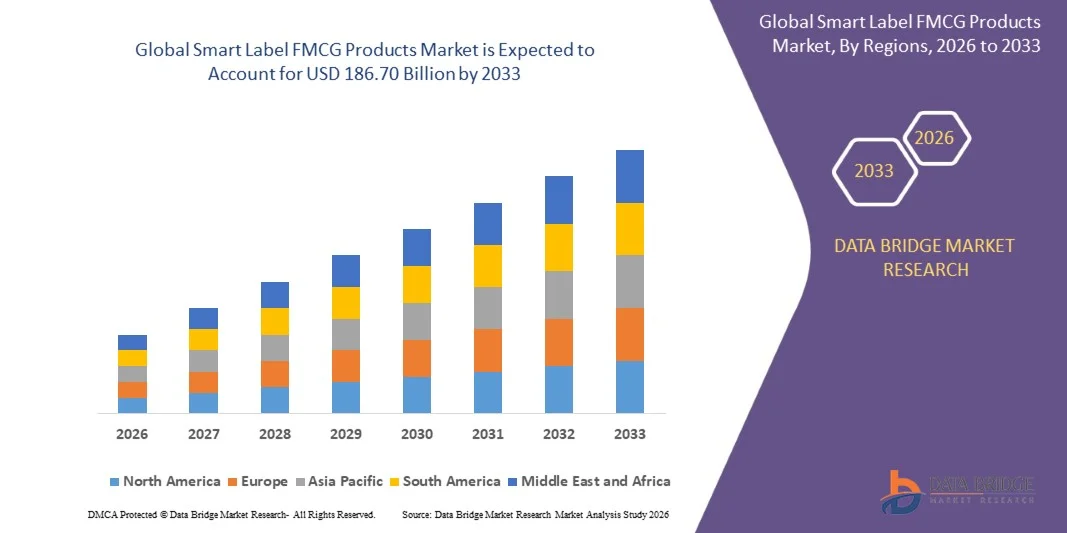
As per Data Bridge Market Research analysis the Smart Label FMCG Products Market was valued at USD 96.5 Billion in 2025 and is projected to reach USD 186.70 Billion by 2033, growing at a CAGR of 8.60% from 2026 to 2033. The market is experiencing consistent growth driven by increasing adoption of smart packaging technologies, rising demand for real-time inventory tracking, and growing implementation of product authentication solutions across FMCG supply chains. Expanding use of RFID, NFC, and sensor-enabled labels, coupled with advancements in connected packaging and retail automation technologies, is further supporting market expansion across developed and emerging economies.
The increasing focus on supply chain transparency, operational efficiency, and consumer engagement, combined with rising concerns regarding counterfeit products and product traceability, is encouraging FMCG manufacturers and retailers to invest in smart labeling solutions. Smart labels are increasingly being utilized for inventory management, cold-chain monitoring, anti-theft protection, and interactive consumer experiences, helping companies improve product visibility and enhance customer trust. Growing digital transformation initiatives across the retail and FMCG sectors are further accelerating the adoption of intelligent labeling technologies worldwide.
Key Market Trends & Insights
- Asia-Pacific dominated the Smart Label FMCG Products Market with the largest revenue share of 38.79% in 2025, supported by rapid retail digitalization, expanding FMCG manufacturing activities, and growing adoption of smart packaging technologies across major economies
- The RFID segment led the market with a 41.8% share in 2025, driven by its widespread adoption for real-time inventory visibility, supply chain optimization, and retail automation
- North America is expected to be the fastest-growing region at a CAGR of 6.6% from 2026 to 2033, fueled by increasing investments in smart packaging technologies, advanced retail automation, and connected supply chain systems
- Sensors are the fastest-growing component type, projected to register a CAGR of 15.1% from 2026 to 2033, supported by increasing demand for real-time environmental and product condition monitoring
- The inventory tracking segment dominated the application category with a 38.9% revenue share in 2025, led by the growing need for efficient stock management and supply chain visibility across FMCG operations
- Micro-Controllers/ICs accounted for 34.6% of the market in 2025, preferred by their critical role in enabling data processing, communication, and identification functions within smart labels
- The Sensing Labels segment is the fastest-growing technology category, with a CAGR of 14.2% from 2026 to 2033, driven by rising demand for product condition monitoring throughout the supply chain
Market Size & Forecast
- Global Market Value (2025): USD 96.5 Billion
- Expected Market Value (2033): USD 186.70 Billion
- Forecast CAGR (2026–2033): 8.60%
- Leading Region in 2025: Asia-Pacific
- Fastest Growing Region: North America
Report Scope and Smart Label FMCG Products Market Segmentation
|
Attributes |
Smart Label FMCG Products Key Market Insights |
|
Segments Covered |
|
|
Countries Covered |
North America · U.S. · Canada · Mexico Europe · Germany · France · U.K. · Netherlands · Switzerland · Belgium · Russia · Italy · Spain · Turkey · Rest of Europe Asia-Pacific · China · Japan · India · South Korea · Singapore · Malaysia · Australia · Thailand · Indonesia · Philippines · Rest of Asia-Pacific Middle East and Africa · Saudi Arabia · U.A.E. · South Africa · Egypt · Israel · Rest of Middle East and Africa South America · Brazil · Argentina · Rest of South America |
|
Key Market Players |
· Honeywell International Inc. (U.S.) · Stora Enso Oyj (Finland) · Invengo Information Technology Co., Ltd. (China) · Impinj, Inc. (U.S.) · SES-imagotag SA (France) · Avery Dennison Corporation (U.S.) · Pricer AB (Sweden) · Alien Technology LLC (U.S.) · NXP Semiconductors N.V. (Netherlands) · CCL Industries Inc. (Canada) · Roambee Corporation (U.S.) · SATO Holdings Corporation (Japan) · Checkpoint Systems, Inc. (U.S.) · Thin Film Electronics ASA (Norway) · William Frick & Company (U.S.) · Identiv, Inc. (U.S.) · Digimarc Corporation (U.S.) · Confidex Ltd. (Finland) · Zebra Technologies Corporation (U.S.) · Tapwow LLC (U.S.) · Scanbuy, Inc. (U.S.) |
|
Market Opportunities |
· Expansion of Smart Labels for Cold-Chain Monitoring in Perishable FMCG Products · Growing Deployment of NFC-Based Consumer Engagement and Digital Marketing Labels · Increasing Adoption of Anti-Counterfeiting Smart Labels in Premium Personal Care and Cosmetics Products |
|
Value Added Data Infosets |
In addition to the insights on market scenarios such as market value, growth rate, segmentation, geographical coverage, and major players, the market reports curated by the Data Bridge Market Research also include in-depth expert analysis, pricing analysis, brand share analysis, consumer survey, demography analysis, supply chain analysis, value chain analysis, raw material/consumables overview, vendor selection criteria, PESTLE Analysis, Porter Analysis, and regulatory framework. |
Smart Label FMCG Products Market Trends
Trend: Rising Adoption of RFID and NFC-Enabled Smart Packaging Solutions
FMCG manufacturers and retailers are increasingly adopting RFID and NFC-enabled smart labels to improve inventory visibility, enhance product traceability, and strengthen consumer engagement across the value chain. These technologies enable real-time tracking of products from production facilities to retail shelves while providing consumers with access to digital product information through smartphone interactions. The growing expansion of omnichannel retailing, automated warehousing, and connected packaging solutions is further accelerating adoption across global FMCG markets.
Companies such as Avery Dennison are actively expanding RFID capabilities through new manufacturing investments and advanced RFID inlay launches, while Walmart continues to scale RFID deployment across multiple product categories to improve inventory accuracy and supply chain efficiency throughout its retail operations.
Smart Label FMCG Products Market Dynamics
Key Market Driver: Increasing Demand for Real-Time Inventory Visibility and Supply Chain Traceability
The growing need for accurate inventory management and end-to-end supply chain visibility is significantly driving demand for smart label technologies across the FMCG industry. Manufacturers and retailers are increasingly implementing RFID, NFC, and sensor-enabled labels to reduce stock discrepancies, improve replenishment efficiency, and enhance product traceability throughout distribution networks. Rising e-commerce activities, complex supply chains, and increasing consumer expectations for transparency are further supporting adoption of intelligent labeling systems.
Major retailers including Walmart and Target have expanded RFID implementation programs to improve inventory accuracy and operational efficiency, while companies such as Avery Dennison and Impinj continue to develop advanced smart labeling solutions that support large-scale traceability and inventory management applications.
Key Restraint/Challenge: High Implementation and Integration Costs Across FMCG Supply Chains
A major challenge in the Smart Label FMCG Products market is the significant investment required for deploying and integrating smart labeling infrastructure across manufacturing, logistics, and retail operations. Implementation often involves expenditures on RFID readers, sensors, software platforms, cloud connectivity systems, data analytics tools, and employee training programs. Integration with existing enterprise resource planning and warehouse management systems can further increase deployment complexity and operational costs, particularly for small and medium-sized businesses.
The large-scale RFID modernization initiatives undertaken by major retailers such as Walmart demonstrate the substantial infrastructure investment, technology integration requirements, and operational adjustments necessary to establish comprehensive smart labeling ecosystems across extensive supply chain networks.
Key Market Opportunity: Expansion of Smart Labels for Cold-Chain Monitoring in Perishable FMCG Products
The growing demand for temperature-sensitive product monitoring is creating significant growth opportunities for smart labels in the FMCG sector. Sensor-enabled labels can continuously monitor temperature, humidity, and product conditions throughout transportation and storage, helping manufacturers reduce spoilage, improve product quality, and comply with food safety regulations. Expanding global cold-chain logistics networks and increasing consumption of perishable food and beverage products are further accelerating demand for advanced monitoring solutions.
Companies such as Identiv and InPlay have introduced Bluetooth Low Energy-enabled smart labels designed for cold-chain monitoring and real-time product tracking, supporting enhanced visibility and quality assurance across food, beverage, and other temperature-sensitive FMCG supply chains.
Smart Label FMCG Products Market Scope
The smart label FMCG products market is segmented on the basis of technology, component, application, and end-user industry.
- By Technology
On the basis of technology, the Smart Label FMCG Products Market is segmented into RFID, NFC, Electronic Article Surveillance (EAS), Sensing Labels, and Electronic Shelf Labels. The RFID segment dominated the market with the largest share of 41.8% in 2025, driven by its widespread adoption for real-time inventory visibility, supply chain optimization, and retail automation. RFID-enabled labels facilitate rapid product identification and tracking across warehouses, distribution centers, and retail outlets. The technology supports bulk scanning capabilities, reducing labor costs and improving operational efficiency. Increasing investments by FMCG manufacturers and retailers in smart logistics infrastructure further strengthen segment leadership. Growing integration with cloud-based inventory management systems continues to enhance adoption across global markets.
The Sensing Labels segment is projected to register the fastest growth at a CAGR of 14.2% from 2026 to 2033, driven by rising demand for product condition monitoring throughout the supply chain. These labels provide real-time information regarding temperature, humidity, freshness, and product quality, making them highly suitable for perishable FMCG products. Expanding cold-chain logistics networks are creating significant opportunities for sensing label deployment. Advancements in printed electronics and sensor miniaturization are improving functionality while reducing implementation costs. Growing consumer demand for product transparency and safety is further accelerating segment expansion across food and personal care applications.
- By Component
On the basis of component, the Smart Label FMCG Products Market is segmented into Micro-Controllers/ICs, Sensors, Antennas & Transceivers, Batteries, and Software & Middleware. The Micro-Controllers/ICs segment dominated the market with a share of 34.6% in 2025, supported by their critical role in enabling data processing, communication, and identification functions within smart labels. These components serve as the operational backbone of RFID, NFC, and sensing label technologies. Growing demand for intelligent tracking solutions across FMCG supply chains continues to drive adoption. Continuous advancements in semiconductor technology are improving processing efficiency while reducing power consumption. Large-scale deployment of connected labeling systems further reinforces segment dominance.
The Sensors segment is projected to register the fastest growth at a CAGR of 15.1% from 2026 to 2033, driven by increasing demand for real-time environmental and product condition monitoring. Sensors enable enhanced visibility into temperature-sensitive and quality-sensitive FMCG products throughout transportation and storage processes. Rising concerns regarding product spoilage, contamination, and regulatory compliance are accelerating adoption. Technological advancements are enabling smaller, more accurate, and cost-efficient sensor integration within labels. Growing implementation of smart packaging solutions is expected to significantly support segment growth during the forecast period.
- By Application
On the basis of application, the Smart Label FMCG Products Market is segmented into Anti-Theft & Security, Cold-Chain Monitoring, Inventory Tracking, Brand Authentication, and Consumer Engagement. The Inventory Tracking segment dominated the market with the largest share of 38.9% in 2025, driven by the growing need for efficient stock management and supply chain visibility across FMCG operations. Smart labels enable real-time tracking of products from manufacturing facilities to retail shelves, reducing inventory inaccuracies and stock shortages. Retailers are increasingly deploying automated inventory systems to improve operational efficiency and customer satisfaction. Enhanced traceability capabilities support better demand forecasting and replenishment planning. Rising adoption of digital retail ecosystems further strengthens segment leadership.
The Brand Authentication segment is projected to register the fastest growth at a CAGR of 14.8% from 2026 to 2033, driven by increasing concerns regarding counterfeit products and brand protection. Smart labels equipped with NFC and authentication technologies enable consumers and retailers to verify product authenticity instantly. Growing incidences of counterfeit FMCG goods are encouraging manufacturers to invest in advanced security labeling solutions. Regulatory requirements related to product traceability and consumer safety are further supporting adoption. Increasing consumer awareness regarding genuine products is expected to accelerate segment expansion globally.
- By End-User Industry
On the basis of end-user industry, the Smart Label FMCG Products Market is segmented into Food & Beverage, Personal Care & Cosmetics, Household Products, Consumer Electronics, and Other FMCG Products. The Food & Beverage segment dominated the market with the largest share of 44.3% in 2025, driven by strong demand for traceability, freshness monitoring, and regulatory compliance throughout food supply chains. Smart labels help manufacturers and retailers monitor storage conditions, expiration dates, and product movement in real time. Increasing focus on food safety and quality assurance is accelerating adoption across packaged food and beverage categories. Expanding cold-chain infrastructure and growing consumption of perishable products further support market growth. Rising consumer demand for transparency regarding product origin and ingredients reinforces segment dominance.
The Personal Care & Cosmetics segment is projected to register the fastest growth at a CAGR of 13.9% from 2026 to 2033, driven by increasing emphasis on product authenticity, consumer engagement, and premium brand positioning. Smart labels enable interactive customer experiences through digital product information, usage instructions, and promotional content. Growing concerns regarding counterfeit cosmetics are encouraging brands to adopt authentication-enabled labeling technologies. Increasing adoption of connected packaging and mobile-enabled customer engagement solutions is supporting segment growth. Rapid expansion of premium beauty and personal care products across emerging economies is expected to further accelerate demand.
Smart Label FMCG Products Market Regional Analysis
Asia-Pacific dominated the smart label FMCG products market and accounted for the largest revenue share of 38.79% in 2025, supported by rapid retail digitalization, expanding FMCG manufacturing activities, and growing adoption of smart packaging technologies across major economies. The region benefits from large-scale consumer goods production, increasing investments in supply chain automation, and rising deployment of RFID and NFC-enabled labeling solutions. Strong growth in e-commerce, organized retail, and logistics infrastructure is accelerating demand for intelligent product tracking and inventory management systems. Increasing focus on product authentication, operational efficiency, and consumer engagement is further supporting regional market expansion.
China Smart Label FMCG Products Market Insight
China held the largest share in the Asia-Pacific Smart Label FMCG Products market in 2025, supported by its extensive FMCG manufacturing base and strong adoption of smart retail technologies. The country has established electronics, semiconductor, and packaging industries that facilitate large-scale production of advanced labeling solutions. Growing deployment of RFID-enabled inventory systems by retailers and logistics operators is strengthening market growth. In addition, increasing government support for digital transformation and supply chain modernization is reinforcing China's leadership position within the regional market.
India Smart Label FMCG Products Market Insight
India is witnessing the fastest growth in the Asia-Pacific region, driven by expanding organized retail networks, rising FMCG consumption, and increasing adoption of digital supply chain solutions. Growing investments in inventory automation, anti-counterfeiting technologies, and smart packaging systems are significantly supporting market expansion. The country is benefiting from rapid e-commerce growth and increasing demand for enhanced product traceability across food, personal care, and household product categories. In addition, rising awareness regarding consumer engagement technologies and connected packaging solutions is accelerating long-term market growth.
Europe Smart Label FMCG Products Market Insight
The Europe Smart Label FMCG Products market is expanding steadily, supported by strong demand for product traceability, regulatory compliance, and sustainable packaging solutions. Consumers and manufacturers across the region are increasingly adopting smart labels to improve supply chain visibility and enhance product transparency. Growing implementation of RFID and NFC technologies across retail and food sectors is contributing to market expansion. In addition, increasing focus on anti-counterfeiting measures, waste reduction initiatives, and digital consumer interaction is supporting regional market development.
Germany Smart Label FMCG Products Market Insight
Germany accounted for the largest share in the Europe Smart Label FMCG Products market in 2025, driven by its advanced manufacturing ecosystem, strong retail sector, and widespread adoption of Industry 4.0 technologies. The country has a well-developed packaging and logistics infrastructure that supports large-scale implementation of intelligent labeling systems. Rising demand for automated inventory management and real-time product tracking solutions is further strengthening market growth. In addition, growing investments in smart packaging innovation and digital retail transformation are reinforcing Germany’s leading market position.
U.K. Smart Label FMCG Products Market Insight
The U.K. market is supported by increasing adoption of connected packaging solutions, growing e-commerce activities, and rising demand for enhanced consumer engagement technologies. Retailers and FMCG manufacturers are increasingly utilizing smart labels to improve inventory accuracy, product authentication, and customer interaction. The country is also witnessing growing implementation of NFC-enabled packaging across premium consumer goods categories. In addition, expansion of digital retail ecosystems and increasing demand for transparent product information are further supporting market growth.
North America Smart Label FMCG Products Market Insight
North America is projected to grow at the fastest CAGR of 6.6% from 2026 to 2033, driven by increasing investments in smart packaging technologies, advanced retail automation, and connected supply chain systems. Rising demand for real-time inventory visibility, anti-counterfeiting solutions, and enhanced consumer experiences is significantly supporting market expansion across the region. Strong adoption of RFID, NFC, and sensing label technologies among major FMCG manufacturers is further accelerating growth. In addition, increasing emphasis on product traceability, food safety, and digital customer engagement is boosting regional demand for smart labeling solutions.
U.S. Smart Label FMCG Products Market Insight
The U.S. accounted for the largest share in the North America Smart Label FMCG Products market in 2025, supported by strong adoption of advanced retail technologies and extensive deployment of intelligent supply chain management systems. The country benefits from a highly developed FMCG sector that increasingly utilizes smart labels for inventory tracking, brand protection, and customer engagement purposes. Growing demand for data-driven retail operations and connected packaging solutions is further strengthening market growth. In addition, increasing investments in IoT-enabled packaging technologies and automated logistics infrastructure are reinforcing the U.S. leadership position in the regional market.
Smart Label FMCG Products Market Share
The smart label FMCG products industry is primarily led by well-established companies, including:
- Honeywell International Inc. (U.S.)
- Stora Enso Oyj (Finland)
- Invengo Information Technology Co., Ltd. (China)
- Impinj, Inc. (U.S.)
- SES-imagotag SA (France)
- Avery Dennison Corporation (U.S.)
- Pricer AB (Sweden)
- Alien Technology LLC (U.S.)
- NXP Semiconductors N.V. (Netherlands)
- CCL Industries Inc. (Canada)
- Roambee Corporation (U.S.)
- SATO Holdings Corporation (Japan)
- Checkpoint Systems, Inc. (U.S.)
- Thin Film Electronics ASA (Norway)
- William Frick & Company (U.S.)
- Identiv, Inc. (U.S.)
- Digimarc Corporation (U.S.)
- Confidex Ltd. (Finland)
- Zebra Technologies Corporation (U.S.)
- Tapwow LLC (U.S.)
- Scanbuy, Inc. (U.S.)
Latest Developments in Smart Label FMCG Products Market
- In October 2025, Avery Dennison expanded its collaboration with Walmart to deploy RFID-enabled smart labeling solutions across fresh food categories. This development is strengthening the Smart Label FMCG Products market by improving inventory visibility, reducing food waste, enhancing product traceability, and enabling more efficient stock management across large-scale retail operations. The initiative supports real-time tracking of perishable goods from distribution centers to store shelves, helping retailers optimize replenishment processes and improve overall supply chain efficiency. It is also accelerating the adoption of RFID technology within the global FMCG sector
- In September 2025, Avery Dennison broadened its strategic partnership with Wiliot to accelerate the adoption of ambient IoT-enabled smart labels and connected packaging technologies. This initiative is supporting market growth by enabling real-time product monitoring, enhancing supply chain transparency, and increasing the adoption of intelligent labeling solutions across FMCG distribution networks. The collaboration allows products to communicate operational data throughout the supply chain without requiring traditional power sources, creating new opportunities for connected packaging and digital inventory management systems
- In June 2025, Avery Dennison introduced the industry's first RFID label to receive APR Design for Recyclability recognition. This development is advancing the Smart Label FMCG Products market by supporting sustainable packaging objectives, encouraging adoption of environmentally responsible labeling technologies, and helping FMCG brands meet circular economy and regulatory requirements. The innovation demonstrates that smart labels can deliver advanced tracking and authentication capabilities while remaining compatible with recycling processes, thereby promoting wider adoption among sustainability-focused consumer goods companies
- In May 2025, Identiv partnered with InPlay to develop a new generation of Bluetooth Low Energy (BLE)-enabled smart labels designed for cold-chain monitoring and asset tracking applications. This collaboration is driving market expansion by improving real-time product condition monitoring, enhancing supply chain efficiency, and increasing demand for advanced smart labeling solutions in temperature-sensitive FMCG segments. The technology enables continuous tracking of environmental conditions during transportation and storage, helping manufacturers minimize spoilage risks, improve product quality assurance, and strengthen regulatory compliance
- In April 2025, Avery Dennison inaugurated its first RFID inlays and labels manufacturing facility in India and launched the AD Cobra RFID inlay for local market requirements. This investment is strengthening the Smart Label FMCG Products market by expanding production capacity, improving regional supply chain capabilities, reducing deployment costs, and accelerating RFID adoption among FMCG manufacturers and retailers. The facility enhances local availability of smart labeling products while supporting growing demand for inventory automation, product authentication, and digital retail transformation across emerging markets

- Interactive Data Analysis Dashboard
- Company Analysis Dashboard for high growth potential opportunities
- Research Analyst Access for customization & queries
- Competitor Analysis with Interactive dashboard
- Latest News, Updates & Trend analysis
- Harness the Power of Benchmark Analysis for Comprehensive Competitor Tracking
Data collection and base year analysis are done using data collection modules with large sample sizes. The stage includes obtaining market information or related data through various sources and strategies. It includes examining and planning all the data acquired from the past in advance. It likewise envelops the examination of information inconsistencies seen across different information sources. The market data is analysed and estimated using market statistical and coherent models. Also, market share analysis and key trend analysis are the major success factors in the market report. To know more, please request an analyst call or drop down your inquiry.
The key research methodology used by DBMR research team is data triangulation which involves data mining, analysis of the impact of data variables on the market and primary (industry expert) validation. Data models include Vendor Positioning Grid, Market Time Line Analysis, Market Overview and Guide, Company Positioning Grid, Patent Analysis, Pricing Analysis, Company Market Share Analysis, Standards of Measurement, Global versus Regional and Vendor Share Analysis. To know more about the research methodology, drop in an inquiry to speak to our industry experts.
Data Bridge Market Research is a leader in advanced formative research. We take pride in servicing our existing and new customers with data and analysis that match and suits their goal. The report can be customized to include price trend analysis of target brands understanding the market for additional countries (ask for the list of countries), clinical trial results data, literature review, refurbished market and product base analysis. Market analysis of target competitors can be analyzed from technology-based analysis to market portfolio strategies. We can add as many competitors that you require data about in the format and data style you are looking for. Our team of analysts can also provide you data in crude raw excel files pivot tables (Fact book) or can assist you in creating presentations from the data sets available in the report.













