


Smart Labware with IoT Integration Market Size
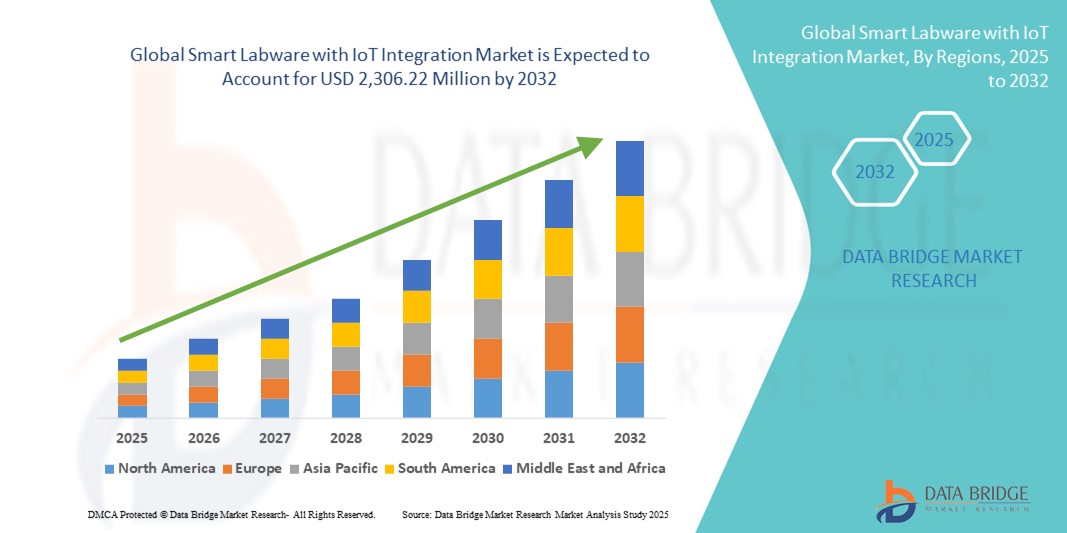
- The global smart labware with IoT integration market size was valued at USD 764.48 Million in 2024 and is expected to reach USD 2,306.22 Million by 2032, at a CAGR of 14.80% during the forecast period
- The market growth is largely fueled by the growing adoption and technological progress within connected laboratory equipment and smart lab technologies, leading to increased digitalization in both academic and industrial research environments
- Furthermore, rising demand for precise, automated, and real-time data-driven experimentation is establishing smart labware with IoT integration as the preferred choice in modern laboratories. These converging factors are accelerating the uptake of Smart Labware with IoT Integration solutions, thereby significantly boosting the industry's growth
Smart Labware with IoT Integration Market Analysis
- Smart labware, which includes IoT-enabled beakers, pipettes, storage containers, and monitoring devices, is becoming an essential component of modern laboratories due to its enhanced functionality, remote monitoring capabilities, and seamless integration with laboratory information management systems (LIMS) and cloud platforms
- The escalating demand for smart labware is primarily driven by the increasing adoption of automated laboratory systems, growing demand for real-time data collection and traceability, and the need for higher operational efficiency in pharmaceutical, biotech, academic, and diagnostic labs
- North America dominated the smart labware with IoT integration market with the largest revenue share of 39.2% in 2024, characterized by early adoption of digital lab infrastructure, strong R&D investments, and the presence of leading players such as Thermo Fisher Scientific and Labcon. The U.S., in particular, is seeing substantial growth in implementation across both academic institutions and private research labs, supported by AI integration and smart data analytics
- Asia-Pacific is projected to be the fastest growing region in the smart labware with IoT integration market during the forecast period, with a CAGR of over 24.8% from 2025 to 2032, driven by increasing research funding, rising digital transformation in healthcare and life sciences, and the emergence of smart lab start-ups across China, India, and South Korea
- The pharmaceutical & biotechnology companies segment dominated the smart labware with IoT integration market with a revenue share of 39.1% in 2024, driven by automation in drug discovery, rising R&D spending, and increased need for data-integrated environments
Report Scope and Smart Labware with IoT Integration Market Segmentation
|
Attributes |
Smart Labware with IoT Integration Key Market Insights |
|
Segments Covered |
|
|
Countries Covered |
North America
Europe
Asia-Pacific
Middle East and Africa
South America
|
|
Key Market Players |
|
|
Market Opportunities |
|
|
Value Added Data Infosets |
In addition to the insights on market scenarios such as market value, growth rate, segmentation, geographical coverage, and major players, the market reports curated by the Data Bridge Market Research also include in-depth expert analysis, pricing analysis, brand share analysis, consumer survey, demography analysis, supply chain analysis, value chain analysis, raw material/consumables overview, vendor selection criteria, PESTLE Analysis, Porter Analysis, and regulatory framework. |
Smart Labware with IoT Integration Market Trends
“Growing Demand for Intelligent and Connected Lab Operations”
- A significant and accelerating trend in the global Smart Labware with IoT Integration market is the deepening integration with artificial intelligence (AI) and voice-controlled ecosystems such as Amazon Alexa, Google Assistant, and Apple HomeKit. This technological fusion is greatly enhancing the convenience, accuracy, and control of lab operations
- For instance, smart pipettes, refrigerators, and inventory tracking systems can now interact with voice-enabled digital assistants, allowing users to perform tasks such as temperature adjustment, inventory checks, or calibration status updates through simple verbal commands
- AI integration in smart labware allows these devices to learn from usage patterns, detect anomalies, and offer predictive maintenance alerts—thereby optimizing workflow and reducing downtime. For instance, smart incubators can adjust internal conditions based on historical performance and experiment types, improving reliability and reproducibility
- Furthermore, the centralized control and interoperability with broader lab ecosystems enable researchers to manage multiple lab devices through a single platform, improving data synchronization, lab safety, and user efficiency
- This trend toward more intelligent, intuitive, and interconnected laboratory systems is fundamentally reshaping expectations in scientific research environments. Companies such as Thermo Fisher Scientific, Eppendorf, and Hamilton are leading the charge by launching IoT-enabled smart labware with remote management, AI-powered feedback, and integration with lab information systems (LIS)
- The demand for smart labware that offers seamless integration with cloud services, AI insights, and voice control is rapidly growing across pharmaceutical, biotech, academic, and industrial research labs, as institutions prioritize precision, automation, and digital connectivity
Smart Labware with IoT Integration Market Dynamics
Driver
“Growing Need Due to Rising Data Accuracy, Remote Monitoring, and Automation in Laboratory Workflows”
- The increasing demand for precision, efficiency, and traceability in laboratory environments—especially in pharmaceutical, biotech, and academic research settings—is a major driver behind the rapid adoption of Smart Labware with IoT Integration
- For instance, in April 2024, Thermo Fisher Scientific introduced an advanced line of IoT-connected smart freezers and sample storage systems designed to enhance inventory management and reduce sample loss, showcasing how key players are propelling the market forward through digital innovation
- As laboratories strive to minimize errors and increase reproducibility, smart labware enables real-time tracking of equipment performance, environmental conditions, and reagent usage. These functionalities offer a compelling upgrade over traditional, manually tracked systems
- Furthermore, the growing focus on automation and remote monitoring, driven by post-pandemic hybrid work trends, is making IoT-integrated labware a vital component of modern digital laboratories
- Smart beakers, pipettes, and storage systems that connect to cloud platforms or lab information management systems (LIMS) facilitate remote data access, usage alerts, calibration notifications, and predictive maintenance—greatly improving productivity and equipment longevity
- The convenience of centralized data logging, improved regulatory compliance, and automated calibration tracking are key factors fueling adoption across research and quality assurance labs. The trend towards DIY automation setups in academic and emerging-market labs, coupled with more user-friendly smart labware solutions, continues to support market expansion
Restraint/Challenge
“Data Security Concerns and High Upfront Investment”
- Despite the clear benefits, the Smart Labware with IoT Integration Market faces challenges related to cybersecurity vulnerabilities and integration costs. These connected devices rely on cloud networks and software systems, making them susceptible to cyberattacks, data breaches, and unauthorized access
- For instance, recent industry alerts have highlighted security risks in healthcare and lab IoT devices, raising alarms about patient or proprietary research data being exposed through unsecured endpoints
- Addressing these challenges requires robust data encryption, access control, and compliance with standards such as GDPR and HIPAA. Leading players like Eppendorf and Hamilton have invested heavily in secure communication protocols and device-level authentication to earn customer trust
- In addition, the high initial costs of deploying a fully integrated smart labware setup—especially in labs without existing infrastructure—can be a deterrent for smaller institutions and cost-sensitive markets. Upgrades to legacy systems and staff training further add to total ownership costs
- While smart labware solutions are becoming more modular and cost-competitive, premium features such as real-time analytics, cloud synchronization, and AI-assisted functionality often come at a premium
- Overcoming these hurdles will require a combination of cost-efficient deployment models, scalable platforms, and greater education around digital lab transformation, ensuring broader market adoption and long-term growth potential
Smart Labware with IoT Integration Market Scope
The market is segmented on the basis of type, integration mechanism, and application.
- By Type
On the basis of type, the smart labware with IoT integration market is segmented into smart beakers, smart flasks, smart test tubes, smart petri dishes, smart well plates, and others. The smart well plates segment dominated the market with a revenue share of 31.6% in 2024, driven by their high utility in high-throughput screening and compatibility with automated lab equipment.
The smart test tubes segment is anticipated to grow at the highest CAGR of 19.2% from 2025 to 2032, fueled by rising demand for sensor-enabled individual sample analysis in diagnostics and life sciences.
- By Integration Mechanism
On the basis of integration mechanism, the smart labware with IoT integration market is segmented into sensor-based, RFID-enabled, barcode-based, cloud-connected, and AI-powered. The sensor-based segment held the largest market share of 34.8% in 2024, owing to its widespread implementation in monitoring critical parameters such as pH, temperature, and pressure.
The AI-powered segment is projected to witness the fastest CAGR of 22.5% during the forecast period, as laboratories increasingly deploy predictive analytics and autonomous decision-making systems for advanced experimentation and compliance.
- By Application
On the basis of application, the smart labware with IoT integration market is segmented into pharmaceutical & biotechnology companies, academic & research institutions, clinical diagnostic laboratories, industrial & environmental testing labs, and others. The pharmaceutical & biotechnology companies segment captured the largest revenue share of 39.1% in 2024, driven by automation in drug discovery, rising R&D spending, and increased need for data-integrated environments.
The clinical diagnostic laboratories segment is expected to register the highest CAGR of 20.4% from 2025 to 2032, due to the growing use of smart labware in improving workflow efficiency, traceability, and accuracy of diagnostic testing.
Smart Labware with IoT Integration Market Regional Analysis
- North America dominated the Smart Labware with IoT Integration market with the largest revenue share of 39.2% in 2024, driven by rapid digital transformation in life science
- Growing demand for precision laboratory instrumentation, and widespread adoption of smart technologies in research and diagnostics
- Regional labs highly value the convenience, automation, and data-driven workflows offered by IoT-integrated labware—such as connected pipettes, sample storage systems, and smart centrifuges—that seamlessly link with Laboratory Information Management Systems (LIMS) and cloud platforms
U.S. Smart Labware with IoT Integration Market Insight
The U.S. smart labware with IOT integration market captured the largest revenue share of 51% in 2024 within North America, fueled by strong investments in healthcare innovation, a large base of biotechnology and clinical research labs, and increasing demand for automation The adoption of connected labware is further propelled by the prevalence of hybrid and remote lab operations, integration with AI and analytics platforms, and strict regulatory compliance requirements Major market players are leveraging this demand to offer scalable, cloud-enabled smart lab solutions that support real-time monitoring, predictive maintenance, and digital inventory management
Europe Smart Labware with IoT Integration Market Insight
The Europe smart labware with IOT integration market is projected to expand at a substantial CAGR throughout the forecast period, driven by rising demand for digitized lab workflows, sustainability goals, and growing usage of smart consumables and reusable labware in university and pharmaceutical labs Smart labware is increasingly being deployed to reduce human error, enhance traceability, and streamline quality assurance in line with evolving EU compliance norms such as GDPR and ISO standards The integration of smart reagents, RFID-enabled vials, and IoT-connected cold storage systems is gaining traction across research institutions and biotech companies
U.K. Smart Labware with IoT Integration Market Insight
The U.K. smart labware with IOT integration market is anticipated to grow at a noteworthy CAGR, propelled by strong government support for life sciences innovation, NHS-led digitization of diagnostics labs, and the country's robust academic research ecosystem Smart pipetting systems, connected bioreactors, and temperature-controlled sample tracking devices are gaining adoption due to their contribution to reproducibility, audit readiness, and real-time process control
Germany Smart Labware with IoT Integration Market Insight
The Germany smart labware with IOT integration market is expected to expand significantly, backed by high R&D spending, automation in pharmaceutical manufacturing, and the adoption of sustainable smart lab products As Europe’s leading economy, Germany is embracing connected lab tools that offer energy efficiency, digital calibration, and centralized lab control—especially in pharma, biotech, and university labs seeking scalable digital transformation.
Asia-Pacific Smart Labware with IoT Integration Market Insight
The Asia-Pacific smart labware with IOT integration market is poised to grow at the fastest CAGR of 24.8% from 2025 to 2032, driven by booming biotech sectors, rapid expansion of clinical research organizations (CROs), and national digitalization initiatives in China, India, and Japan Increasing adoption of affordable smart lab devices—such as connected pH meters, real-time temperature monitoring systems, and IoT-enabled microplate readers—is transforming the efficiency of APAC labs
Japan Smart Labware with IoT Integration Market Insight
The Japan market is growing steadily, supported by its mature pharmaceutical industry, emphasis on quality control, and a strong cultural focus on innovation and miniaturization. Smart labware integration with robotics and cloud data sharing platforms is gaining traction in academic institutions and contract research organizations (CROs).
China Smart Labware with IoT Integration Market Insight
The China smart labware with IOT integration market accounted for the largest revenue share in Asia-Pacific in 2024, supported by the government’s push toward “Smart Lab 4.0,” a strong domestic manufacturing base, and increasing investment in precision medicine. Local companies are rapidly innovating and supplying cost-effective connected labware solutions, enabling wide adoption across both top-tier pharmaceutical firms and mid-sized labs.
Smart Labware with IoT Integration Market Share
The smart labware with IoT integration industry is primarily led by well-established companies, including:
- Thermo Fisher Scientific (U.S.)
- Eppendorf AG (Germany)
- Merck KGaA (Germany)
- PerkinElmer (U.S.)
- Agilent Technologies, Inc. (U.S.)
- Sartorius AG (Germany)
- Shimadzu Corporation (Japan)
- Waters Corporation (U.S.)
- LabSensor Solutions (U.S.)
- Siemens Healthineers AG (Germany)
- Danaher Corporation (U.S.)
- Bruker Corporation (U.S.)
- LabVantage Solutions (U.S.)
- Dotmatics Ltd (U.K.)
- Biosero Inc. (U.S.)
- Hamilton Company (U.S.)
- Tecan Group Ltd. (Switzerland)
- Chemspeed Technologies AG (Switzerland)
- SmartLab Hub (U.S.)
- Elemental Machines (U.S.)
Latest Developments in Global Smart Labware with IoT Integration Market
- In June 2025, INTEGRA Biosciences introduced the PIPETBOY GENIUS serological pipet controller, designed to enhance ergonomic pipetting and precision. This lightweight, IoT-ready controller supports repeat dispensing and reduces physical strain for lab personnel, with intelligent features like overfill protection and automatic aliquoting—boosting efficiency in biotech and academic labs
- In June 2025, Gilson launched the PIPETMAN M96, a 96-channel motorized pipette that accelerates high-throughput workflows. With touchscreen controls, Bluetooth connectivity tied to the PipetteScope app, and compatibility with standard labware, this smart lab tool enhances accuracy, reduces fatigue, and integrates easily into IoT-connected systems

- Interactive Data Analysis Dashboard
- Company Analysis Dashboard for high growth potential opportunities
- Research Analyst Access for customization & queries
- Competitor Analysis with Interactive dashboard
- Latest News, Updates & Trend analysis
- Harness the Power of Benchmark Analysis for Comprehensive Competitor Tracking
Data collection and base year analysis are done using data collection modules with large sample sizes. The stage includes obtaining market information or related data through various sources and strategies. It includes examining and planning all the data acquired from the past in advance. It likewise envelops the examination of information inconsistencies seen across different information sources. The market data is analysed and estimated using market statistical and coherent models. Also, market share analysis and key trend analysis are the major success factors in the market report. To know more, please request an analyst call or drop down your inquiry.
The key research methodology used by DBMR research team is data triangulation which involves data mining, analysis of the impact of data variables on the market and primary (industry expert) validation. Data models include Vendor Positioning Grid, Market Time Line Analysis, Market Overview and Guide, Company Positioning Grid, Patent Analysis, Pricing Analysis, Company Market Share Analysis, Standards of Measurement, Global versus Regional and Vendor Share Analysis. To know more about the research methodology, drop in an inquiry to speak to our industry experts.
Data Bridge Market Research is a leader in advanced formative research. We take pride in servicing our existing and new customers with data and analysis that match and suits their goal. The report can be customized to include price trend analysis of target brands understanding the market for additional countries (ask for the list of countries), clinical trial results data, literature review, refurbished market and product base analysis. Market analysis of target competitors can be analyzed from technology-based analysis to market portfolio strategies. We can add as many competitors that you require data about in the format and data style you are looking for. Our team of analysts can also provide you data in crude raw excel files pivot tables (Fact book) or can assist you in creating presentations from the data sets available in the report.













