


What is the Smart-Sensor Packaging Polymers Market Size and Growth Rate?
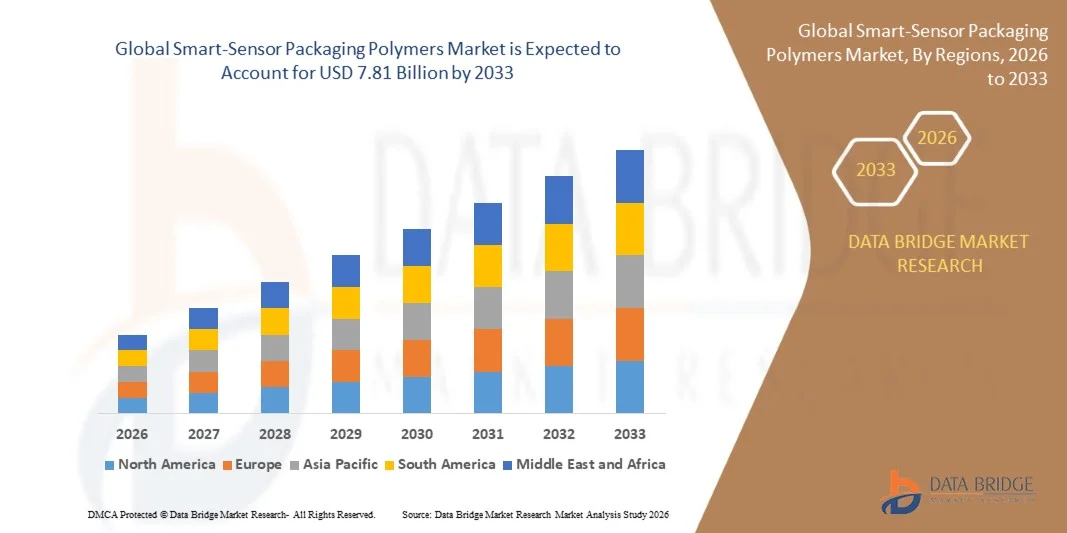
- As per Data Bridge Market Research analysis the smart-sensor packaging polymers market was valued at USD 3.20 billion in 2025 and is projected to reach USD 7.81 billion by 2033, growing at a CAGR of 11.80% from 2026 to 2033.
- The market is experiencing strong growth driven by increasing demand for intelligent packaging solutions, rising adoption of sensors for real-time monitoring of product conditions, and advancements in functional polymers that enable improved sensing, protection, and communication capabilities.
- The growing need for enhanced product safety, extended shelf life, and supply chain visibility, combined with increasing adoption of smart packaging across food and beverages, pharmaceuticals, and consumer goods, is encouraging manufacturers to integrate sensor-enabled polymer materials into packaging applications.
Market Size & Forecast
- Market Value (2025): USD 3.20 Billion
- Expected Market Value (2033): USD 7.81 Billion
- Forecast CAGR (2026–2033): 11.80%
- Leading Region in 2025: North America
- Fastest Growing Region: Asia-Pacific
What are the Major Takeaways of the Smart-Sensor Packaging Polymers Market?
- North America dominated the smart-sensor packaging polymers market with a significant revenue share in 2025, supported by strong demand for intelligent packaging, advanced polymer materials, and sensor-enabled solutions across food and beverages, pharmaceuticals, and consumer goods.
- Asia-Pacific smart-sensor packaging polymers market is expected to witness the fastest growth rate from 2026 to 2033, supported by rapid urbanization, rising packaged food consumption, expanding pharmaceutical industries, and increasing adoption of smart packaging technologies.
- The polyethylene (PE) segment held the largest market revenue share in 2025, supported by its extensive use in flexible films, pouches, multilayer structures, and sensor-integrated packaging because of its lightweight structure, chemical resistance, and strong barrier performance. Polypropylene (PP) is also widely adopted in rigid and flexible smart packaging applications due to its durability and heat resistance.
- The polyethylene terephthalate (PET) segment is projected to register the fastest growth at a CAGR from 2026 to 2033, supported by increasing demand for transparent, lightweight, and durable packaging formats capable of incorporating intelligent labels, RFID technologies, and sensing components. Growing adoption of PET in food, beverage, pharmaceutical, and consumer packaging applications is further supporting segment expansion.
- The temperature sensors segment held the largest market revenue share in 2025, driven by increasing use in food, pharmaceutical, and cold-chain packaging to monitor temperature exposure and protect product quality. Temperature monitoring is particularly important for vaccines, biologics, and perishable foods requiring controlled transportation and storage.
- The humidity sensors segment is projected to register the fastest growth at a CAGR from 2026 to 2033, supported by rising demand for moisture monitoring in pharmaceuticals, electronics, cosmetics, and dry food products. Humidity-sensitive packaging helps identify moisture exposure that can adversely affect product stability, shelf life, and quality.
Report Scope and Smart-Sensor Packaging Polymers Market Segmentation
|
Attributes |
Smart-Sensor Packaging Polymers Key Market Insights |
|
Segments Covered |
|
|
Countries Covered |
North America
Europe
Asia-Pacific
Middle East and Africa
South America
|
|
Key Market Players |
|
|
Market Opportunities |
|
|
Value Added Data Infosets |
In addition to the insights on market scenarios such as market value, growth rate, segmentation, geographical coverage, and major players, the market reports curated by the Data Bridge Market Research also include import export analysis, production capacity overview, production consumption analysis, price trend analysis, climate change scenario, supply chain analysis, value chain analysis, raw material/consumables overview, vendor selection criteria, PESTLE Analysis, Porter Analysis, and regulatory framework. |
What is the Key Trend in the Smart-Sensor Packaging Polymers Market?
- Packaging manufacturers are increasingly integrating digital identification, connected technologies, and sensor-enabled functionalities into polymer-based packaging to improve product traceability, authenticity, freshness monitoring, and supply chain visibility.
- For instance, in July 2025, Avery Dennison launched an RFID-enabled In-Mold Label portfolio designed to be embedded into plastic products during injection molding, providing durable RFID performance and enabling tracking, traceability, and reuse across industrial and consumer applications.
- Real-time data capture through RFID, NFC, and sensor technologies enables manufacturers and retailers to monitor packaging and product conditions while improving inventory visibility and consumer engagement.
- Food and beverage companies are increasingly adopting smart packaging to address freshness, food waste, and supply chain monitoring requirements, creating demand for polymer structures capable of integrating intelligent functionalities.
- For instance, in July 2025, Multisorb Technologies highlighted the integration of real-time sensor data with moisture-sensitive packaging to monitor humidity, temperature, and gas composition, demonstrating the growing convergence of packaging materials and sensing technologies.
- As packaging manufacturers continue combining functional polymers with digital identification and sensing technologies, smart-sensor packaging is expected to become increasingly important for improving product protection, traceability, and supply chain efficiency.
What are the Key Drivers of the Smart-Sensor Packaging Polymers Market?
- Rising demand for real-time product monitoring, traceability, authentication, and supply chain visibility is significantly increasing the adoption of smart packaging solutions that integrate sensors and digital technologies with polymer-based packaging structures.
- For instance, in February 2025, Tetra Pak and Dutch Mill introduced a smart packaging solution using unique QR codes on carton packages to create interactive consumer touchpoints and strengthen product engagement and traceability.
- The growing need to reduce food waste and improve product quality is encouraging food and beverage manufacturers to adopt packaging technologies capable of monitoring environmental conditions such as temperature, humidity, and gas composition.
- For instance, in 2025, research published in Sustainability found that smart Tetra Pak packaging could provide a 29.17% lower climate-change impact in the average-case scenario, while the economic analysis indicated only a small additional cost, supporting the potential sustainability benefits of intelligent packaging.
- Regulatory developments are also accelerating the adoption of digitally enabled packaging, with the European Union’s Packaging and Packaging Waste Regulation introducing requirements and provisions for QR codes and standardized digital data carriers to support packaging information, tracking, and recycling.
- With manufacturers increasingly seeking greater product visibility, waste reduction, authentication, and regulatory compliance, the integration of sensing and digital technologies into advanced polymer packaging is expected to remain a major growth driver.
Which Factors are Challenging the Growth of the Smart-Sensor Packaging Polymers Market?
- The integration of sensors, RFID or NFC components, conductive materials, and digital technologies into polymer packaging increases material and manufacturing complexity, while manufacturers must also maintain barrier performance, food-contact safety, recyclability, and cost efficiency.
- The challenge is particularly significant for packaging formats that combine multiple materials or electronic components, as recycling systems must effectively identify and separate these structures without compromising material recovery.
- For instance, the Ellen MacArthur Foundation’s HolyGrail 2.0 initiative demonstrated the complexity of implementing digital identification technologies at scale, although digital watermark detection achieved rates above 96% in control testing and purity rates above 93% for selected attributes in semi-industrial trials.
- The European Union’s Packaging and Packaging Waste Regulation further increases compliance requirements by establishing requirements covering packaging composition, recyclability, waste management, and standardized digital marking technologies.
- In addition, research into recyclable thin-film electronics for smart packaging highlights the continuing technical challenge of recovering electronic components and conductive materials after use, particularly when more complex sensing functions are incorporated into packaging.
- The higher production complexity, integration costs, recycling requirements, and need to balance sensor functionality with polymer performance continue to restrict widespread adoption, particularly in cost-sensitive packaging applications.
How is the Smart-Sensor Packaging Polymers Market Segmented?
The market is segmented on the basis of polymer type, sensor type, packaging type, and application.
- By Polymer Type
On the basis of polymer type, the smart-sensor packaging polymers market is segmented into polyethylene (PE), polypropylene (PP), polyethylene terephthalate (PET), polystyrene (PS), polyvinyl chloride (PVC), and others. The polyethylene (PE) segment held the largest market revenue share in 2025, supported by its extensive use in flexible films, pouches, multilayer structures, and sensor-integrated packaging because of its lightweight structure, chemical resistance, and strong barrier performance. Polypropylene (PP) is also widely adopted in rigid and flexible smart packaging applications due to its durability and heat resistance.
The polyethylene terephthalate (PET) segment is projected to register the fastest growth at a CAGR from 2026 to 2033, supported by increasing demand for transparent, lightweight, and durable packaging formats capable of incorporating intelligent labels, RFID technologies, and sensing components. Growing adoption of PET in food, beverage, pharmaceutical, and consumer packaging applications is further supporting segment expansion.
- By Sensor Type
On the basis of sensor type, the smart-sensor packaging polymers market is segmented into temperature sensors, humidity sensors, gas sensors, biosensors, pressure sensors, and others. The temperature sensors segment held the largest market revenue share in 2025, driven by increasing use in food, pharmaceutical, and cold-chain packaging to monitor temperature exposure and protect product quality. Temperature monitoring is particularly important for vaccines, biologics, and perishable foods requiring controlled transportation and storage.
The humidity sensors segment is projected to register the fastest growth at a CAGR from 2026 to 2033, supported by rising demand for moisture monitoring in pharmaceuticals, electronics, cosmetics, and dry food products. Humidity-sensitive packaging helps identify moisture exposure that can adversely affect product stability, shelf life, and quality.
- By Packaging Type
On the basis of packaging type, the smart-sensor packaging polymers market is segmented into flexible packaging, rigid packaging, active packaging, intelligent packaging, and modified atmosphere packaging. The active packaging segment held the largest market revenue share in 2025, driven by the widespread use of oxygen scavengers, antimicrobial films, moisture-control systems, and other technologies that extend shelf life and maintain product quality.
The modified atmosphere packaging segment is projected to register the fastest growth at a CAGR from 2026 to 2033, supported by increasing adoption in food and beverage applications to control oxygen and carbon dioxide levels and extend the shelf life of perishable products. The intelligent packaging segment is also projected to register strong growth as RFID, NFC, indicators, and sensor technologies become increasingly integrated into packaging systems.
- By Application
On the basis of application, the smart-sensor packaging polymers market is segmented into food and beverages, pharmaceuticals, cosmetics and personal care, electronics, logistics and supply chain, and others. The food and beverages segment held the largest market revenue share in 2025, driven by increasing demand for freshness monitoring, extended shelf life, product safety, and real-time condition monitoring across food and beverage supply chains.
The pharmaceuticals segment is projected to register the fastest growth at a CAGR from 2026 to 2033, supported by increasing requirements for temperature monitoring, product authentication, traceability, and protection of temperature-sensitive medicines and biologics. The growing use of smart labels, RFID technologies, and sensor-enabled packaging across pharmaceutical supply chains is further accelerating segment expansion.
Which Region Holds the Largest Share of the Smart-Sensor Packaging Polymers Market?
- North America dominated the smart-sensor packaging polymers market with a significant revenue share in 2025, supported by strong demand for intelligent packaging, advanced polymer materials, and sensor-enabled solutions across food and beverages, pharmaceuticals, and consumer goods.
- The region benefits from established packaging infrastructure, high adoption of RFID and connected technologies, and stringent requirements for product safety and traceability. Growing investment in smart packaging technologies and increasing demand for real-time product monitoring are further supporting market expansion.
U.S. Smart-Sensor Packaging Polymers Market Insight
U.S. smart-sensor packaging polymers market captured the largest revenue share in 2025 within North America, fueled by rapid adoption of intelligent packaging technologies and increasing demand for product authentication, traceability, and condition monitoring. The country's advanced food, pharmaceutical, and e-commerce sectors are encouraging manufacturers to integrate sensors, RFID, and digital identification technologies into polymer-based packaging. Moreover, growing consumer preference for connected packaging and increasing focus on supply chain visibility are significantly contributing to market growth.
Europe Smart-Sensor Packaging Polymers Market Insight
Europe smart-sensor packaging polymers market is expected to witness strong growth from 2026 to 2033, primarily driven by stringent packaging regulations, increasing sustainability requirements, and growing demand for traceability and product safety. The region's emphasis on recyclable packaging and circular economy practices is encouraging manufacturers to develop advanced polymer structures compatible with intelligent technologies. Increasing adoption across food and beverages, pharmaceuticals, cosmetics, and logistics applications is further supporting market expansion.
U.K. Smart-Sensor Packaging Polymers Market Insight
U.K. smart-sensor packaging polymers market is expected to witness strong growth from 2026 to 2033, driven by increasing demand for sustainable packaging, product traceability, and digitally connected packaging solutions. The country's focus on reducing packaging waste and improving recycling is encouraging manufacturers to adopt advanced polymer materials and digital identification technologies. Moreover, the strong presence of food, pharmaceutical, and consumer goods industries is expected to continue stimulating demand for sensor-enabled packaging.
Germany Smart-Sensor Packaging Polymers Market Insight
Germany smart-sensor packaging polymers market is expected to witness strong growth from 2026 to 2033, fueled by increasing awareness of sustainable packaging, advanced manufacturing capabilities, and growing demand for product traceability. Germany's strong focus on recycling, resource efficiency, and industrial innovation promotes the adoption of intelligent packaging technologies and recyclable polymer structures. The integration of sensors, RFID, and digital identification systems across food, pharmaceutical, and industrial packaging applications is also supporting market growth.
Asia-Pacific Smart-Sensor Packaging Polymers Market Insight
Asia-Pacific smart-sensor packaging polymers market is expected to witness the fastest growth rate from 2026 to 2033, supported by rapid urbanization, rising packaged food consumption, expanding pharmaceutical industries, and increasing adoption of smart packaging technologies. Countries such as China, Japan, and India are witnessing growing investments in connected packaging, RFID, sensors, and advanced polymer materials. Furthermore, the region's expanding manufacturing base and increasing demand for product safety and supply chain visibility are accelerating market adoption.
Japan Smart-Sensor Packaging Polymers Market Insight
Japan smart-sensor packaging polymers market is expected to witness strong growth from 2026 to 2033 due to the country's advanced manufacturing capabilities, strong emphasis on product quality, and high adoption of innovative packaging technologies. Japanese consumers place significant importance on freshness, safety, and convenience, encouraging manufacturers to adopt intelligent packaging solutions. The integration of sensors, digital identification, and advanced polymer materials across food, pharmaceutical, and consumer goods packaging is fueling market growth.
China Smart-Sensor Packaging Polymers Market Insight
China smart-sensor packaging polymers market accounted for a significant revenue share in Asia-Pacific in 2025, attributed to rapid urbanization, expanding packaged food consumption, and increasing adoption of digital technologies. China has a large packaging manufacturing base and growing demand for intelligent solutions that improve product authentication, traceability, freshness, and supply chain visibility. The expansion of e-commerce, modern retail, pharmaceutical manufacturing, and smart logistics is further accelerating the adoption of sensor-enabled polymer packaging.
Which are the Top Companies in Smart-Sensor Packaging Polymers Market?
The smart-sensor packaging polymers industry is primarily led by well-established companies, including:
- Amcor plc (Switzerland)
- Sealed Air Corporation (U.S.)
- Avery Dennison Corporation (U.S.)
- BASF SE (Germany)
- 3M Company (U.S.)
- Berry Global Inc. (U.S.)
- Tetra Pak International S.A. (Switzerland)
- Huhtamäki Oyj (Finland)
- Stora Enso Oyj (Finland)
- Mondi plc (U.K.)
- Smurfit Westrock plc (U.S.)
- Crown Holdings, Inc. (U.S.)
- Ball Corporation (U.S.)
- Zebra Technologies Corporation (U.S.)
- Multisorb Technologies, Inc. (U.S.)
What are Latest Developments in Smart-Sensor Packaging Polymers Market?
- In September 2025, Avery Dennison expanded its intelligent packaging portfolio by integrating Impinj Gen2X chips into its RFID inlays, supporting improved inventory control, item tracking, and anti-counterfeiting across connected packaging applications.
- In July 2025, Avery Dennison launched RFID-enabled In-Mold Label solutions designed to embed RFID functionality directly into plastic products during injection molding, enabling durable traceability, real-time item visibility, and reuse across packaging and logistics applications.
- In June 2025, Avery Dennison introduced an RFID label that received APR Design for Recyclability recognition for compatibility with the PET recycling stream, supporting the development of intelligent packaging solutions that combine digital identification with improved recyclability.
- In October 2025, Amcor showcased its RS01X digitally connected inhaler featuring built-in sensors and a companion application that tracks usage and inhalation technique, demonstrating the increasing integration of sensor technologies with advanced packaging and healthcare delivery systems.
- In January 2026, Multisorb Technologies highlighted next-generation IoT-connected packaging capable of monitoring and transmitting temperature, humidity, and freshness data, indicating increasing convergence between moisture-control materials, sensors, and connected supply chain platforms.

- Interactive Data Analysis Dashboard
- Company Analysis Dashboard for high growth potential opportunities
- Research Analyst Access for customization & queries
- Competitor Analysis with Interactive dashboard
- Latest News, Updates & Trend analysis
- Harness the Power of Benchmark Analysis for Comprehensive Competitor Tracking
Global Smart Sensor Packaging Polymers Market, Supply Chain Analysis and Ecosystem Framework
To support market growth and help clients navigate the impact of geopolitical shifts, DBMR has integrated in-depth supply chain analysis into its Global Smart Sensor Packaging Polymers Market research reports. This addition empowers clients to respond effectively to global changes affecting their industries. The supply chain analysis section includes detailed insights such as Global Smart Sensor Packaging Polymers Market consumption and production by country, price trend analysis, the impact of tariffs and geopolitical developments, and import and export trends by country and HSN code. It also highlights major suppliers with data on production capacity and company profiles, as well as key importers and exporters. In addition to research, DBMR offers specialized supply chain consulting services backed by over a decade of experience, providing solutions like supplier discovery, supplier risk assessment, price trend analysis, impact evaluation of inflation and trade route changes, and comprehensive market trend analysis.
Data collection and base year analysis are done using data collection modules with large sample sizes. The stage includes obtaining market information or related data through various sources and strategies. It includes examining and planning all the data acquired from the past in advance. It likewise envelops the examination of information inconsistencies seen across different information sources. The market data is analysed and estimated using market statistical and coherent models. Also, market share analysis and key trend analysis are the major success factors in the market report. To know more, please request an analyst call or drop down your inquiry.
The key research methodology used by DBMR research team is data triangulation which involves data mining, analysis of the impact of data variables on the market and primary (industry expert) validation. Data models include Vendor Positioning Grid, Market Time Line Analysis, Market Overview and Guide, Company Positioning Grid, Patent Analysis, Pricing Analysis, Company Market Share Analysis, Standards of Measurement, Global versus Regional and Vendor Share Analysis. To know more about the research methodology, drop in an inquiry to speak to our industry experts.
Data Bridge Market Research is a leader in advanced formative research. We take pride in servicing our existing and new customers with data and analysis that match and suits their goal. The report can be customized to include price trend analysis of target brands understanding the market for additional countries (ask for the list of countries), clinical trial results data, literature review, refurbished market and product base analysis. Market analysis of target competitors can be analyzed from technology-based analysis to market portfolio strategies. We can add as many competitors that you require data about in the format and data style you are looking for. Our team of analysts can also provide you data in crude raw excel files pivot tables (Fact book) or can assist you in creating presentations from the data sets available in the report.













