


Global Smart Stickers-Labels Market Size
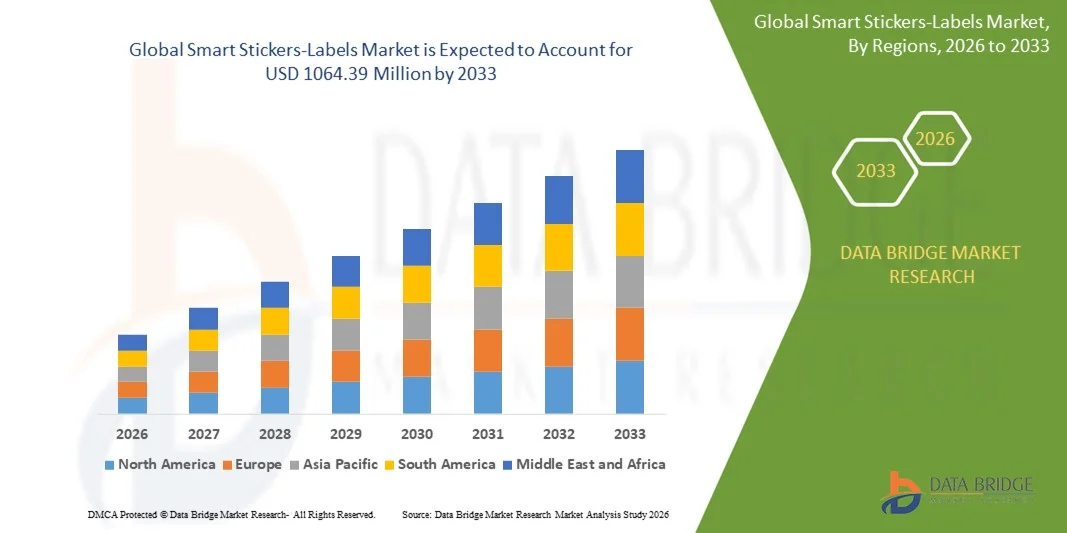
- The global Smart Stickers-Labels Market size was valued at USD 887.35 million in 2025 and is expected to reach USD 1064.39 million by 2033, at a CAGR of 2.30% during the forecast period.
- The market growth is primarily driven by the increasing adoption of IoT-enabled devices, rising demand for product authentication, and the growing integration of smart labels in supply chain management, retail, and healthcare sectors.
- Additionally, advancements in NFC, RFID, and QR code technologies, combined with consumer preference for real-time tracking, secure packaging, and enhanced product interaction, are fueling the demand for smart stickers and labels. These factors are collectively accelerating market expansion and solidifying smart labels as a key component of modern digital solutions.
Global Smart Stickers-Labels Market Analysis
- Smart stickers and labels, offering digital tracking, authentication, and interactive capabilities, are becoming essential tools in modern retail, supply chain, and healthcare applications due to their ability to provide real-time data, improve operational efficiency, and enhance customer engagement.
- The increasing demand for smart stickers and labels is primarily driven by the widespread adoption of IoT and RFID technologies, growing concerns about product authenticity and counterfeiting, and a rising preference for connected, data-driven solutions.
- North America dominated the Global Smart Stickers-Labels Market with the largest revenue share of 35% in 2025, characterized by early adoption of digital tracking solutions, strong retail and healthcare infrastructure, and the presence of leading technology providers, with the U.S. witnessing substantial growth in smart label deployment, particularly in pharmaceuticals, logistics, and high-value retail, fueled by innovations in NFC and RFID-enabled solutions.
- Asia-Pacific is expected to be the fastest-growing region in the Global Smart Stickers-Labels Market during the forecast period due to increasing urbanization, growing industrial automation, and rising disposable incomes.
- The RFID labels segment dominated the market with the largest revenue share of 38.5% in 2025, driven by their versatility in supply chain tracking, inventory management, and product authentication across retail, healthcare, and logistics sectors.
Report Scope and Global Smart Stickers-Labels Market Segmentation
|
Attributes |
Smart Stickers-Labels Key Market Insights |
|
Segments Covered |
|
|
Countries Covered |
North America
Europe
Asia-Pacific
Middle East and Africa
South America
|
|
Key Market Players |
• Smartrac (Netherlands) |
|
Market Opportunities |
|
|
Value Added Data Infosets |
In addition to the insights on market scenarios such as market value, growth rate, segmentation, geographical coverage, and major players, the market reports curated by the Data Bridge Market Research also include in-depth expert analysis, pricing analysis, brand share analysis, consumer survey, demography analysis, supply chain analysis, value chain analysis, raw material/consumables overview, vendor selection criteria, PESTLE Analysis, Porter Analysis, and regulatory framework. |
Global Smart Stickers-Labels Market Trends
Enhanced Functionality Through AI and Voice Integration
- A significant and accelerating trend in the global Smart Stickers-Labels Market is the growing integration of artificial intelligence (AI) and voice-controlled ecosystems such as Amazon Alexa, Google Assistant, and Apple HomeKit. This convergence is enabling smarter, real-time tracking, interactive product information, and enhanced consumer engagement.
- For instance, NFC-enabled smart labels can now provide voice-guided instructions for product use, allow instant reordering via connected apps, or relay personalized product recommendations when scanned by smart devices. Similarly, AI-powered labels in logistics can dynamically optimize inventory management by predicting stock movement patterns.
- AI integration in smart stickers and labels enables features such as predictive analytics for supply chains, automated alerts for product recalls, and anomaly detection in shipping conditions. Some smart labels now monitor environmental factors like temperature and humidity, sending intelligent notifications to stakeholders if thresholds are breached. Voice-enabled functionality allows users to query product information or verify authenticity through simple verbal commands.
- The seamless integration of smart stickers and labels with digital assistants and broader IoT platforms facilitates centralized monitoring of products, shipments, and inventory. Through a single interface, users can track multiple assets, receive alerts, and manage interactive labels across various touchpoints, creating a unified and efficient operational workflow.
- This trend toward more intelligent, interactive, and connected labeling solutions is fundamentally reshaping expectations across retail, healthcare, and logistics sectors. Consequently, companies such as Smartrac and Avery Dennison are developing AI-enabled smart labels with features such as predictive analytics, interactive consumer engagement, and voice-assisted product tracking.
- The demand for smart stickers and labels that offer seamless AI and voice integration is growing rapidly across both commercial and consumer markets, as businesses increasingly prioritize efficiency, product security, and enhanced customer interaction.
Global Smart Stickers-Labels Market Dynamics
Driver
Growing Need Due to Rising Security Concerns and Digital Tracking Adoption
- The increasing prevalence of product counterfeiting, theft, and supply chain inefficiencies, coupled with the accelerating adoption of IoT-enabled asset management and smart retail ecosystems, is a significant driver for the heightened demand for smart stickers and labels.
- For instance, in 2025, Avery Dennison launched an advanced NFC-enabled smart label solution for pharmaceuticals, integrating tamper-evident sensors and real-time tracking capabilities. Such strategies by key companies are expected to drive the smart stickers-labels industry growth during the forecast period.
- As businesses and consumers become more aware of potential risks related to counterfeit products or shipment losses, smart labels offer advanced features such as real-time tracking, authentication verification, and condition monitoring, providing a compelling upgrade over traditional labeling methods.
- Furthermore, the growing popularity of connected retail and logistics platforms and the desire for end-to-end visibility are making smart stickers and labels an integral component of these systems, offering seamless integration with inventory management, supply chain monitoring, and consumer engagement platforms.
- The convenience of real-time tracking, automated alerts for product movement, and interactive features for consumer engagement are key factors propelling the adoption of smart stickers and labels across retail, healthcare, and logistics sectors. The trend toward user-friendly smart labeling solutions and decreasing hardware costs further contributes to market growth.
Restraint/Challenge
Concerns Regarding Data Security and High Implementation Costs
- Concerns surrounding the cybersecurity vulnerabilities of connected smart labels and IoT-enabled tracking systems pose a significant challenge to broader market penetration. As smart stickers and labels rely on network connectivity and software, they are susceptible to hacking, data breaches, and unauthorized access, raising anxieties among potential users about product security and sensitive data.
- For instance, reports of vulnerabilities in RFID and NFC-enabled products have made some businesses hesitant to adopt smart labeling solutions, particularly in high-value or regulated industries.
- Addressing these security concerns through robust encryption, secure authentication protocols, and regular software updates is crucial for building trust among consumers and enterprises. Companies such as Smartrac and Zebra Technologies emphasize advanced security measures in their solutions to reassure potential buyers. Additionally, the relatively high initial cost of some advanced smart labeling systems compared to traditional labels can be a barrier to adoption, especially for small and medium-sized enterprises or price-sensitive sectors. While basic smart labels are becoming more affordable, premium features such as AI-based analytics, environmental monitoring, or interactive consumer engagement often come with higher costs.
- While prices are gradually decreasing, the perceived premium for advanced smart labeling technology can still hinder widespread adoption, particularly for businesses that do not yet see immediate ROI from digital tracking solutions.
- Overcoming these challenges through enhanced cybersecurity measures, enterprise education on best practices, and the development of more cost-effective smart labeling solutions will be vital for sustained market growth.
Global Smart Stickers-Labels Market Scope
Smart stickers/labels market is segmented on the basis of technology, component, application and end user.
- By Technology
On the basis of technology, the Global Smart Stickers-Labels Market is segmented into Electronic Article Surveillance (EAS) labels, RFID labels, sensing labels, electronic shelf/dynamic display labels, and Near Field Communication (NFC) tags. The RFID labels segment dominated the market with the largest revenue share of 38.5% in 2025, driven by their versatility in supply chain tracking, inventory management, and product authentication across retail, healthcare, and logistics sectors. RFID labels offer real-time monitoring, anti-counterfeiting measures, and seamless integration with enterprise software, making them a preferred choice for businesses seeking operational efficiency.
The NFC tags segment is expected to witness the fastest CAGR of 22.1% from 2026 to 2033, fueled by growing adoption in interactive consumer engagement, contactless payments, and smart product authentication. NFC tags’ compatibility with smartphones and emerging IoT ecosystems is boosting their popularity across retail, FMCG, and high-value goods markets.
- By Component
On the basis of component, the Global Smart Stickers-Labels Market is segmented into transceivers, memories, batteries, microprocessors, and others. The transceivers segment accounted for the largest market revenue share of 35.7% in 2025, driven by their critical role in enabling communication between smart labels and connected devices. Transceivers provide real-time data transmission for tracking, authentication, and inventory management, forming the backbone of most RFID and NFC labeling systems.
The microprocessors segment is expected to register the fastest CAGR of 21.8% from 2026 to 2033, owing to increased adoption of intelligent labels capable of processing data locally, enabling condition monitoring, predictive analytics, and interactive consumer engagement. Advanced microprocessor-based labels allow more complex functionalities such as AI-driven insights, tamper alerts, and automated reporting, boosting demand in logistics, healthcare, and retail applications.
- By Application
On the basis of application, the Global Smart Stickers-Labels Market is segmented into retail inventory, perishable goods, electronic and IT assets, pallets tracking, equipment, and others. The retail inventory segment dominated the market with a 36.4% share in 2025, driven by the rapid digitalization of inventory management, anti-theft measures, and demand for real-time stock visibility. Smart labels enhance operational efficiency, reduce losses, and support omnichannel retail strategies.
The perishable goods segment is expected to witness the fastest CAGR of 23.2% from 2026 to 2033, owing to increasing demand for real-time monitoring of temperature-sensitive products such as food and pharmaceuticals. These labels ensure product freshness, reduce wastage, and comply with regulatory requirements, thereby increasing adoption in the food, beverage, and healthcare industries.
- By End User
On the basis of end user, the Global Smart Stickers-Labels Market is segmented into food and beverages, healthcare, FMCG, automotive, manufacturing, retail, logistics, and others. The retail segment dominated the market with the largest revenue share of 33.8% in 2025, supported by widespread adoption of smart labels for inventory optimization, anti-theft measures, and enhanced consumer engagement.
The logistics segment is expected to witness the fastest CAGR of 22.5% from 2026 to 2033, driven by the growing need for real-time shipment tracking, asset monitoring, and operational efficiency across global supply chains. The increasing integration of IoT and AI-based analytics in logistics operations is further accelerating the adoption of smart stickers and labels in this sector.
Global Smart Stickers-Labels Market Regional Analysis
- North America dominated the Global Smart Stickers-Labels Market with the largest revenue share of 35% in 2025, driven by the growing adoption of smart retail solutions, IoT-enabled inventory management, and increasing awareness of product authentication technologies.
- Businesses and consumers in the region highly value the efficiency, real-time tracking, and anti-counterfeiting capabilities offered by smart stickers and labels, which enhance supply chain transparency and improve operational workflows.
- This widespread adoption is further supported by high technological penetration, strong retail and logistics infrastructure, and rising demand for connected, data-driven solutions, establishing smart stickers and labels as a preferred tool for enhancing product security, traceability, and consumer engagement across multiple sectors.
U.S. Smart Stickers-Labels Market Insight
The U.S. smart stickers-labels market captured the largest revenue share of 81% in 2025 within North America, fueled by the rapid adoption of IoT-enabled inventory management systems and digital tracking solutions. Businesses are increasingly prioritizing real-time product monitoring, anti-counterfeiting measures, and supply chain efficiency. The growing preference for smart retail technologies, combined with robust demand for NFC and RFID-enabled labels, further propels market growth. Moreover, the integration of smart labels with mobile applications and cloud-based analytics platforms is significantly enhancing operational visibility and consumer engagement, driving continued expansion.
Europe Smart Stickers-Labels Market Insight
The Europe smart stickers-labels market is projected to expand at a substantial CAGR throughout the forecast period, primarily driven by stringent regulations on product traceability, anti-counterfeiting measures, and the growing need for supply chain transparency. Urbanization and digital transformation initiatives are fostering the adoption of smart labeling technologies. European businesses are increasingly leveraging smart labels for retail inventory management, perishable goods tracking, and asset protection, with widespread integration across commercial, healthcare, and logistics sectors.
U.K. Smart Stickers-Labels Market Insight
The U.K. smart stickers-labels market is anticipated to grow at a noteworthy CAGR during the forecast period, driven by the rising trend of smart retail, supply chain digitization, and consumer demand for product authenticity. Concerns regarding counterfeiting and theft are encouraging businesses to adopt advanced tracking solutions. The U.K.’s strong e-commerce infrastructure and emphasis on technological adoption continue to stimulate market growth across retail, healthcare, and logistics sectors.
Germany Smart Stickers-Labels Market Insight
The Germany smart stickers-labels market is expected to expand at a considerable CAGR during the forecast period, fueled by growing awareness of product security, regulatory compliance, and demand for technologically advanced labeling solutions. Germany’s well-developed industrial and logistics infrastructure, combined with its focus on innovation and sustainability, promotes adoption in retail, healthcare, and manufacturing sectors. Integration with IoT platforms and real-time monitoring solutions is increasingly prevalent, meeting local expectations for secure, reliable, and eco-friendly labeling technologies.
Asia-Pacific Smart Stickers-Labels Market Insight
The Asia-Pacific smart stickers-labels market is poised to grow at the fastest CAGR of 24% during the forecast period of 2026 to 2033, driven by rapid urbanization, increasing disposable incomes, and technological advancement in countries such as China, Japan, and India. The region’s growing emphasis on smart retail, supply chain automation, and perishable goods monitoring is boosting adoption. Government initiatives promoting digitalization and smart logistics, coupled with APAC’s role as a manufacturing hub for smart labeling components, are enhancing affordability and accessibility for businesses and consumers.
Japan Smart Stickers-Labels Market Insight
The Japan smart stickers-labels market is gaining momentum due to the country’s high-tech culture, advanced retail infrastructure, and demand for operational efficiency. Adoption is driven by increasing implementation of smart labels in retail, healthcare, and logistics, alongside integration with IoT platforms for real-time monitoring and inventory management. Japan’s aging population and preference for automated, easy-to-use systems further support demand for smart labeling solutions across residential and commercial applications.
China Smart Stickers-Labels Market Insight
The China smart stickers-labels market accounted for the largest market revenue share in Asia-Pacific in 2025, attributed to rapid urbanization, rising middle-class consumption, and high technology adoption rates. Smart labels are increasingly implemented in retail, FMCG, healthcare, and logistics for tracking, authentication, and inventory optimization. The government’s smart city initiatives, coupled with affordable and innovative domestic smart labeling solutions, are key factors driving growth in the country.
Global Smart Stickers-Labels Market Share
The Smart Stickers-Labels industry is primarily led by well-established companies, including:
• Smartrac (Netherlands)
• Avery Dennison (U.S.)
• Zebra Technologies (U.S.)
• Alien Technology (U.S.)
• Confidex (Finland)
• Identiv (U.S.)
• Omni-ID (U.K.)
• HID Global (U.S.)
• Toppan Printing (Japan)
• Thinfilm Electronics (Norway)
• FEIG ELECTRONIC (Germany)
• Smartrac Technology (China)
• Checkpoint Systems (U.S.)
• Controlant (Iceland)
• Xerafy (U.K.)
• GAO RFID (U.S.)
• NXP Semiconductors (Netherlands)
• Brady Corporation (U.S.)
• Smartrac Solutions (Singapore)
• Sato Holdings (Japan)
What are the Recent Developments in Global Smart Stickers-Labels Market?
- In April 2024, Smartrac, a global leader in smart labeling and RFID solutions, launched a strategic initiative in South Africa aimed at enhancing supply chain visibility and product security across retail and healthcare sectors. This initiative underscores the company’s dedication to delivering innovative, reliable smart labeling solutions tailored to the specific needs of regional businesses. By leveraging its global expertise and cutting-edge products, Smartrac is not only addressing local challenges but also reinforcing its position in the rapidly growing global Smart Stickers-Labels Market.
- In March 2024, Avery Dennison, a leading provider of advanced labeling solutions, introduced a new NFC-enabled smart label designed for perishable goods and pharmaceuticals. The innovative solution enables real-time tracking, anti-counterfeiting verification, and condition monitoring, highlighting Avery Dennison’s commitment to developing smart labeling technologies that improve product safety and operational efficiency.
- In March 2024, Zebra Technologies successfully deployed its Smart Label Tracking Project in Bengaluru, aimed at enhancing logistics efficiency and inventory management in large-scale warehouses. This initiative leverages state-of-the-art RFID and IoT-enabled labels to create a more secure and transparent supply chain environment, emphasizing the growing importance of smart labeling in modern operations.
- In February 2024, Confidex announced a strategic partnership with a leading European retail chain to implement RFID-enabled smart labels across all store inventories. The collaboration is designed to enhance stock visibility, reduce theft, and streamline operations, underscoring Confidex’s commitment to driving innovation and operational excellence in the retail sector.
- In January 2024, Thinfilm Electronics unveiled its NFC smart label for interactive consumer engagement at the CES 2024 event. The label allows users to access product information, promotions, and authentication features through smartphones. This launch highlights Thinfilm’s dedication to integrating advanced technology into smart labeling solutions, offering brands enhanced consumer interaction while ensuring product security and traceability.

- Interactive Data Analysis Dashboard
- Company Analysis Dashboard for high growth potential opportunities
- Research Analyst Access for customization & queries
- Competitor Analysis with Interactive dashboard
- Latest News, Updates & Trend analysis
- Harness the Power of Benchmark Analysis for Comprehensive Competitor Tracking
Global Smart Stickers Labels Market, Supply Chain Analysis and Ecosystem Framework
To support market growth and help clients navigate the impact of geopolitical shifts, DBMR has integrated in-depth supply chain analysis into its Global Smart Stickers Labels Market research reports. This addition empowers clients to respond effectively to global changes affecting their industries. The supply chain analysis section includes detailed insights such as Global Smart Stickers Labels Market consumption and production by country, price trend analysis, the impact of tariffs and geopolitical developments, and import and export trends by country and HSN code. It also highlights major suppliers with data on production capacity and company profiles, as well as key importers and exporters. In addition to research, DBMR offers specialized supply chain consulting services backed by over a decade of experience, providing solutions like supplier discovery, supplier risk assessment, price trend analysis, impact evaluation of inflation and trade route changes, and comprehensive market trend analysis.
Data collection and base year analysis are done using data collection modules with large sample sizes. The stage includes obtaining market information or related data through various sources and strategies. It includes examining and planning all the data acquired from the past in advance. It likewise envelops the examination of information inconsistencies seen across different information sources. The market data is analysed and estimated using market statistical and coherent models. Also, market share analysis and key trend analysis are the major success factors in the market report. To know more, please request an analyst call or drop down your inquiry.
The key research methodology used by DBMR research team is data triangulation which involves data mining, analysis of the impact of data variables on the market and primary (industry expert) validation. Data models include Vendor Positioning Grid, Market Time Line Analysis, Market Overview and Guide, Company Positioning Grid, Patent Analysis, Pricing Analysis, Company Market Share Analysis, Standards of Measurement, Global versus Regional and Vendor Share Analysis. To know more about the research methodology, drop in an inquiry to speak to our industry experts.
Data Bridge Market Research is a leader in advanced formative research. We take pride in servicing our existing and new customers with data and analysis that match and suits their goal. The report can be customized to include price trend analysis of target brands understanding the market for additional countries (ask for the list of countries), clinical trial results data, literature review, refurbished market and product base analysis. Market analysis of target competitors can be analyzed from technology-based analysis to market portfolio strategies. We can add as many competitors that you require data about in the format and data style you are looking for. Our team of analysts can also provide you data in crude raw excel files pivot tables (Fact book) or can assist you in creating presentations from the data sets available in the report.













