


Smart Street Lighting Wi-Sun Technology Market Size
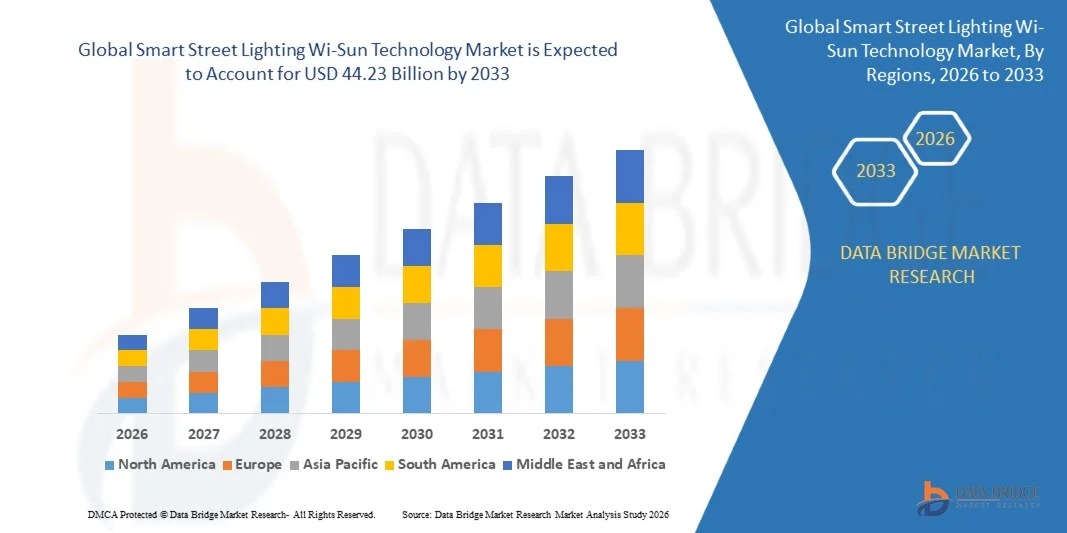
- The global smart street lighting Wi-sun technology market size was valued at USD 5.69 billion in 2025 and is expected to reach USD 44.23 billion by 2033, at a CAGR of 29.20% during the forecast period
- The market growth is largely fueled by the increasing adoption of smart city initiatives and the technological advancement of connected street lighting systems, leading to enhanced urban infrastructure management and energy-efficient public lighting
- Furthermore, rising demand from municipalities for real-time monitoring, predictive maintenance, and integration with IoT-based urban services is establishing Wi-sun-enabled smart street lighting as a preferred solution for modern cities. These factors are accelerating the deployment of intelligent street lighting networks, thereby significantly boosting the industry’s growth
Smart Street Lighting Wi-Sun Technology Market Analysis
- Smart street lighting Wi-sun technology systems, offering wireless connectivity, adaptive control, and energy optimization, are becoming vital components of modern urban infrastructure due to their ability to reduce operational costs, improve public safety, and support sustainability goals
- The escalating demand for these systems is primarily fueled by government-backed smart city projects, increasing urbanization, and the need for efficient energy management, coupled with the growing trend of integrating street lighting with broader IoT and smart city applications
- Europe dominated the smart street lighting Wi-sun technology market in 2025, due to extensive government initiatives promoting smart city infrastructure, energy-efficient street lighting, and sustainable urban planning
- Asia-Pacific is expected to be the fastest growing region in the smart street lighting Wi-sun technology market during the forecast period due to rapid urbanization, increasing government initiatives for smart cities, and rising adoption of energy-efficient street lighting in countries such as China, Japan, and India
- Hardware segment dominated the market with a market share of 39% in 2025, due to the essential role of LED luminaires, poles, and control units in establishing a robust smart street lighting infrastructure. Cities prioritize hardware investments to ensure long-lasting performance, energy efficiency, and integration with emerging smart city solutions. The demand for durable and modular hardware components is reinforced by urban authorities seeking scalable solutions for maintenance and upgrades. Hardware segments also benefit from technological enhancements that allow easy compatibility with sensors and controllers for intelligent lighting operations
Report Scope and Smart Street Lighting Wi-Sun Technology Market Segmentation
|
Attributes |
Smart Street Lighting Wi-Sun Technology Key Market Insights |
|
Segments Covered |
|
|
Countries Covered |
North America
Europe
Asia-Pacific
Middle East and Africa
South America
|
|
Key Market Players |
|
|
Market Opportunities |
|
|
Value Added Data Infosets |
In addition to the market insights such as market value, growth rate, market segments, geographical coverage, market players, and market scenario, the market report curated by the Data Bridge Market Research team includes in-depth expert analysis, import/export analysis, pricing analysis, production consumption analysis, and pestle analysis. |
Smart Street Lighting Wi-Sun Technology Market Trends
“Growing Integration of IoT and Smart City Infrastructure”
- A significant trend in the smart street lighting Wi-sun technology market is the increasing integration of IoT-enabled street lighting systems into smart city projects, driven by the growing need for energy-efficient, connected, and responsive urban lighting networks. This integration is positioning Wi-sun-enabled lighting as a core component of intelligent city infrastructure that supports real-time monitoring, adaptive control, and enhanced public safety
- For instance, Signify and Telensa are deploying Wi-sun-based street lighting solutions that incorporate wireless communication, motion sensors, and cloud-based management platforms. These systems enable municipalities to remotely control street lighting, optimize energy consumption, and improve urban management
- The adoption of adaptive street lighting solutions is growing rapidly as motion sensors and environmental monitoring systems allow lights to respond to traffic, pedestrian movement, and weather conditions. This is enhancing operational efficiency while reducing energy costs, thereby reinforcing the importance of connected street lighting in modern urban planning
- Urban authorities are increasingly integrating smart lighting with other IoT-enabled city infrastructure such as traffic management, environmental monitoring, and public Wi-Fi networks. This trend is driving the adoption of interoperable solutions capable of supporting multiple urban services through a single platform
- Municipalities are focusing on deploying scalable and modular smart lighting networks to facilitate predictive maintenance and minimize downtime. The integration of Wi-sun connectivity ensures long-range, low-power communication across thousands of streetlights, enabling efficient city-wide management
- The market is witnessing strong growth in regions investing heavily in smart city initiatives, where Wi-sun-enabled street lighting forms a backbone for connected infrastructure. This rising incorporation of intelligent lighting systems is reinforcing the transition toward energy-efficient, data-driven, and fully connected urban environments
Smart Street Lighting Wi-Sun Technology Market Dynamics
Driver
“Rising Municipal Demand for Energy-Efficient and Connected Street Lighting”
- The growing push by municipalities to reduce energy consumption, lower operational costs, and improve public safety is driving the demand for Wi-sun-enabled smart street lighting systems. These systems offer real-time monitoring, adaptive control, and seamless integration with city IoT infrastructure, helping local authorities achieve sustainability and efficiency goals
- For instance, cities in Europe and North America are implementing Wi-sun networks to replace traditional streetlights, enabling remote management, dimming control, and predictive maintenance. These solutions reduce energy costs and extend the lifespan of lighting infrastructure
- Government-backed smart city initiatives are further fueling adoption, as municipalities seek connected solutions capable of supporting broader urban services such as traffic and environmental monitoring
- The rising requirement for compliance with energy-efficiency regulations and sustainability targets encourages local authorities to invest in smart street lighting solutions that provide measurable reductions in energy usage
- As cities expand and urban populations grow, the need for scalable, reliable, and remotely manageable lighting infrastructure continues to strengthen this driver, reinforcing Wi-sun-enabled street lighting as a preferred technology for modern urban development
Restraint/Challenge
“High Initial Deployment and Integration Costs”
- The smart street lighting Wi-sun technology market faces challenges due to the high capital investment required for installing connected lighting networks, integrating IoT-enabled controllers, and deploying sensors across city-wide infrastructure. These upfront costs can slow adoption, particularly in smaller municipalities with limited budgets
- For instance, cities investing in Wi-sun-based networks must account for costs associated with streetlight retrofitting, wireless nodes, cloud management platforms, and technical expertise. Such comprehensive deployment can be cost-prohibitive, delaying implementation
- Integrating smart lighting systems with existing urban infrastructure, including power grids, traffic management systems, and other IoT services, adds complexity and increases total project expenditure
- The reliance on advanced hardware, long-range wireless communication, and software platforms further elevates deployment costs, impacting return on investment timelines
- The market continues to encounter constraints related to balancing technological benefits with economic feasibility, requiring municipalities and solution providers to optimize deployment strategies while managing costs effectively
Smart Street Lighting Wi-Sun Technology Market Scope
The market is segmented on the basis of component, connectivity, application, and networking technology.
• By Component
On the basis of component, the smart street lighting Wi-sun technology market is segmented into hardware, sensors, controllers/relays, software, and service. The hardware segment dominated the market with the largest revenue share of 39% in 2025, driven by the essential role of LED luminaires, poles, and control units in establishing a robust smart street lighting infrastructure. Cities prioritize hardware investments to ensure long-lasting performance, energy efficiency, and integration with emerging smart city solutions. The demand for durable and modular hardware components is reinforced by urban authorities seeking scalable solutions for maintenance and upgrades. Hardware segments also benefit from technological enhancements that allow easy compatibility with sensors and controllers for intelligent lighting operations.
The sensors segment is anticipated to witness the fastest growth from 2026 to 2033, fueled by increasing adoption of motion, ambient light, and environmental sensors for real-time street lighting optimization. For instance, companies such as Signify are integrating advanced sensors to adjust lighting intensity based on pedestrian movement and traffic conditions, enabling energy savings and improved urban safety. The growing focus on adaptive lighting solutions in smart cities contributes to this segment’s accelerated adoption. Sensors offer seamless connectivity with controllers and cloud-based systems, ensuring automated responses to dynamic urban environments. Their integration supports predictive maintenance, reducing downtime and operational costs while enhancing sustainability targets.
• By Connectivity
On the basis of connectivity, the market is segmented into wired and wireless. The wired segment held the largest market revenue share in 2025, driven by its reliability, stable performance, and lower susceptibility to interference in urban environments. Wired connectivity is preferred in large-scale municipal installations where long-term durability, maintenance predictability, and secure communication are critical. Its established infrastructure allows integration with existing street lighting networks and power systems, making it a practical choice for city planners. The segment benefits from consistent performance under adverse weather conditions and minimal signal loss, ensuring uninterrupted street lighting management.
The wireless segment is expected to witness the fastest CAGR from 2026 to 2033, driven by its flexibility, ease of installation, and cost-effective deployment in retrofit projects. For instance, companies such as Telensa are deploying wireless-enabled Wi-sun nodes to facilitate real-time remote control and monitoring without extensive civil work. Wireless solutions enable scalable and modular expansion, allowing cities to gradually transition to smart lighting ecosystems. Their capability to integrate with IoT platforms and cloud-based analytics enhances operational efficiency and supports adaptive lighting strategies. This segment’s growth is reinforced by the rising focus on smart city projects and sustainable energy management initiatives.
• By Application
On the basis of application, the market is segmented into smart meters, smart street lighting, smart buildings & industrial applications, and others. The smart street lighting segment dominated the market in 2025 with the largest revenue share, driven by the widespread deployment of LED-based street lights and networked control systems in urban areas. Municipalities prioritize smart street lighting for energy efficiency, operational cost reduction, and public safety improvements. The adoption is reinforced by government initiatives promoting smart city infrastructure and sustainable urban planning. Smart street lighting solutions enable adaptive dimming, remote monitoring, and predictive maintenance, providing both economic and environmental benefits. Integration with traffic management and environmental sensors further enhances the functionality and demand for this segment.
Smart buildings & industrial applications are anticipated to witness the fastest growth from 2026 to 2033, driven by the increasing implementation of intelligent lighting systems in commercial complexes and industrial zones. For instance, companies such as GE Lighting are deploying Wi-sun-enabled systems in industrial parks to automate lighting schedules and optimize energy usage. The adoption is accelerated by growing awareness of energy management, operational efficiency, and regulatory compliance requirements. Wireless integration with building management systems allows seamless monitoring, reporting, and predictive control, boosting the appeal of smart lighting in corporate and industrial applications. Growing investments in sustainable and IoT-enabled infrastructure further support this segment’s rapid expansion.
• By Networking Technology
On the basis of networking technology, the market is segmented into narrowband and broadband. The narrowband segment held the largest market revenue share in 2025, driven by its energy-efficient, long-range communication capabilities that support city-wide street lighting networks. Narrowband Wi-sun technology enables reliable data transfer with minimal power consumption, making it ideal for large-scale municipal deployments. Its resilience against interference and ability to support thousands of nodes ensures consistent operation and management of smart street lights. Municipal authorities favor narrowband networks for predictable maintenance cycles, cost-effective monitoring, and seamless integration with urban IoT infrastructure.
The broadband segment is expected to witness the fastest CAGR from 2026 to 2033, fueled by increasing demand for high-data-rate applications such as video surveillance, environmental monitoring, and advanced analytics integration. For instance, companies such as Cisco are integrating broadband-enabled Wi-sun networks to facilitate multi-service smart city deployments with real-time data transmission. Broadband networks allow simultaneous control and monitoring of multiple systems, enhancing operational efficiency and urban safety. The segment benefits from scalability and compatibility with cloud platforms, enabling cities to adopt smarter and more connected urban infrastructures. Its growth is further supported by rising investments in smart city initiatives and advanced data-driven services.
Smart Street Lighting Wi-Sun Technology Market Regional Analysis
- Europe dominated the smart street lighting Wi-sun technology market with the largest revenue share in 2025, driven by extensive government initiatives promoting smart city infrastructure, energy-efficient street lighting, and sustainable urban planning
- Cities across the region are increasingly implementing connected lighting networks to reduce energy consumption, improve public safety, and enable real-time monitoring and control of municipal lighting systems
- This widespread adoption is further supported by stringent regulations on energy efficiency, high urbanization rates, and the growing deployment of IoT-enabled solutions, establishing Europe as a key hub for smart street lighting technologies
Germany Smart Street Lighting Wi- Sun Market Insight
The Germany market captured the largest revenue share in Europe in 2025, fueled by the rapid adoption of LED-based street lighting systems integrated with Wi-sun connectivity. Municipal authorities are increasingly prioritizing sustainable infrastructure projects, enhancing energy efficiency, and reducing operational costs. The demand is reinforced by technological innovations that allow real-time monitoring, predictive maintenance, and integration with other smart city applications. Germany’s emphasis on innovation and environmental sustainability is significantly contributing to the expansion of the Wi-sun smart street lighting market.
U.K. Smart Street Lighting Wi- Sun Market Insight
The U.K. market is projected to grow at a notable CAGR during the forecast period, driven by government-backed smart city initiatives and the need for energy-efficient street lighting. Municipalities are deploying Wi-sun-enabled networks to improve public safety, reduce energy consumption, and streamline maintenance. The increasing integration with IoT platforms, cloud-based management systems, and data analytics further propels market growth. The U.K.’s robust urban infrastructure and technological adoption foster the expansion of smart street lighting solutions in both residential and commercial zones.
North America Smart Street Lighting Wi- Sun Market Insight
The North America market is poised to grow steadily, supported by increasing investments in smart city projects, energy-efficient lighting, and connected municipal infrastructure. For instance, cities in the U.S. are deploying Wi-sun-enabled street lighting to optimize energy use and reduce maintenance costs. The region’s high technological adoption, government incentives, and focus on sustainable infrastructure contribute to the market expansion. U.S. cities are leveraging IoT-enabled solutions to enhance operational efficiency and real-time monitoring of street lighting networks.
Asia-Pacific Smart Street Lighting Wi- Sun Market Insight
The Asia-Pacific market is expected to register the fastest CAGR during 2026–2033, driven by rapid urbanization, increasing government initiatives for smart cities, and rising adoption of energy-efficient street lighting in countries such as China, Japan, and India. For instance, China is implementing large-scale Wi-sun smart lighting networks to reduce energy costs and improve city safety. The region benefits from growing awareness of sustainable infrastructure and increased deployment of IoT-enabled street lighting solutions across residential, commercial, and industrial sectors.
China Smart Street Lighting Wi- Sun Market Insight
China accounted for the largest market revenue share in Asia-Pacific in 2025, owing to government-backed smart city programs, rapid urbanization, and high adoption of connected devices. Municipal authorities are deploying Wi-sun-based street lighting networks for energy optimization, enhanced monitoring, and integration with broader urban infrastructure. Domestic manufacturers are driving affordability and accessibility, enabling rapid adoption in both new and retrofit projects.
Japan Smart Street Lighting Wi- Sun Market Insight
The Japan market is witnessing strong growth due to technological advancements, urban modernization, and a focus on energy efficiency. Smart street lighting solutions integrated with Wi-sun connectivity are increasingly deployed for real-time monitoring, predictive maintenance, and sustainable urban development. The aging population also encourages adoption of automated lighting systems to enhance safety and convenience across public spaces.
Smart Street Lighting Wi-Sun Technology Market Share
The smart street lighting Wi-sun technology industry is primarily led by well-established companies, including:
- Fuji Electric Co., Ltd. (Japan)
- OSAKA LIGHTING (Japan)
- Murata Manufacturing Co., Ltd. (Japan)
- Analog Devices, Inc. (U.S.)
- ROHM CO, LTD. (Japan)
- Trilliant Holdings Inc. (U.S.)
- Landis+Gyr (Switzerland)
- Itron (U.S.)
- OMRON Corporation (Japan)
- Renesas Electronics Corporation (Japan)
- TOSHIBA CORPORATION (Japan)
- Cisco Systems, Inc. (U.S.)
- Wi-SUN Alliance (U.S.)
- Dimonoff Inc. (Spain)
- CITELUM (France)
- Schréder (Belgium)
- ACUITY BRANDS LIGHTING, INC. (U.S.)
- OSRAM Licht Group (Germany)
- Philips Lighting N.V. (Netherlands)
- EnGo PLANET (U.S.)
- Telensa Inc. (U.K.)
Latest Developments in Global Smart Street Lighting Wi-Sun Technology Market
- In November 2025, Flashnet announced that its inteliLIGHT platform now controls over 1 million smart streetlights worldwide. This milestone demonstrates the scalability and interoperability of Flashnet’s solutions across multiple cities and regions. The achievement strengthens the company’s market position as a provider of reliable, energy-efficient, and IoT-enabled street lighting networks, supporting municipalities in achieving smart city objectives while optimizing operational costs
- In September 2025 Signify rolled out its new modular solar‑and‑connected street lighting systems under the Signify SunStay Pro gen2 / gen2 mini lineup, offering all‑in‑one solar luminaires with motion‑sensing multi‑sensors, hybrid charging (grid + solar), and light‑on‑demand dimming and forward‑triggering features. This development strengthens Signify’s position in energy‑efficient smart street lighting, enabling municipalities to deploy off‑grid or hybrid street lights, reduce electricity use and maintenance costs, and support sustainability goals in urban lighting infrastructure
- In September 2025 Schneider Electric announced a collaboration with a telecommunications provider to build a 5G‑enabled smart street lighting network allowing real‑time data transmission and remote management of lighting systems. This initiative enhances operational efficiency, responsiveness to changing urban conditions, and supports real‑time monitoring and control — positioning the company to meet growing demand from smart cities for advanced lighting solutions
- In July 2025 Honeywell expanded its smart street lighting portfolio by acquiring a startup specializing in AI‑driven lighting solutions, aiming to integrate AI capabilities for adaptive lighting control that responds to environmental conditions and user behavior. This acquisition suggests Honeywell is preparing to offer next‑generation intelligent lighting systems that deliver energy optimization, dynamic control, and improved urban lighting experiences
- In April 2025 Signify announced a partnership with Cornerstone and Dense Air to deploy a city‑wide multi‑operator wireless network through existing street lighting infrastructure, starting in Oxford (UK). This strategic move transforms street lights into multi‑operator 4G/5G‑enabled connectivity nodes supporting IoT, CCTV, public Wi‑Fi and other high‑bandwidth urban services — significantly enhancing urban connectivity while reducing the need for separate telecom infrastructure

- Interactive Data Analysis Dashboard
- Company Analysis Dashboard for high growth potential opportunities
- Research Analyst Access for customization & queries
- Competitor Analysis with Interactive dashboard
- Latest News, Updates & Trend analysis
- Harness the Power of Benchmark Analysis for Comprehensive Competitor Tracking
Data collection and base year analysis are done using data collection modules with large sample sizes. The stage includes obtaining market information or related data through various sources and strategies. It includes examining and planning all the data acquired from the past in advance. It likewise envelops the examination of information inconsistencies seen across different information sources. The market data is analysed and estimated using market statistical and coherent models. Also, market share analysis and key trend analysis are the major success factors in the market report. To know more, please request an analyst call or drop down your inquiry.
The key research methodology used by DBMR research team is data triangulation which involves data mining, analysis of the impact of data variables on the market and primary (industry expert) validation. Data models include Vendor Positioning Grid, Market Time Line Analysis, Market Overview and Guide, Company Positioning Grid, Patent Analysis, Pricing Analysis, Company Market Share Analysis, Standards of Measurement, Global versus Regional and Vendor Share Analysis. To know more about the research methodology, drop in an inquiry to speak to our industry experts.
Data Bridge Market Research is a leader in advanced formative research. We take pride in servicing our existing and new customers with data and analysis that match and suits their goal. The report can be customized to include price trend analysis of target brands understanding the market for additional countries (ask for the list of countries), clinical trial results data, literature review, refurbished market and product base analysis. Market analysis of target competitors can be analyzed from technology-based analysis to market portfolio strategies. We can add as many competitors that you require data about in the format and data style you are looking for. Our team of analysts can also provide you data in crude raw excel files pivot tables (Fact book) or can assist you in creating presentations from the data sets available in the report.













