


What is the Smart Syringes Market Size and Overview?
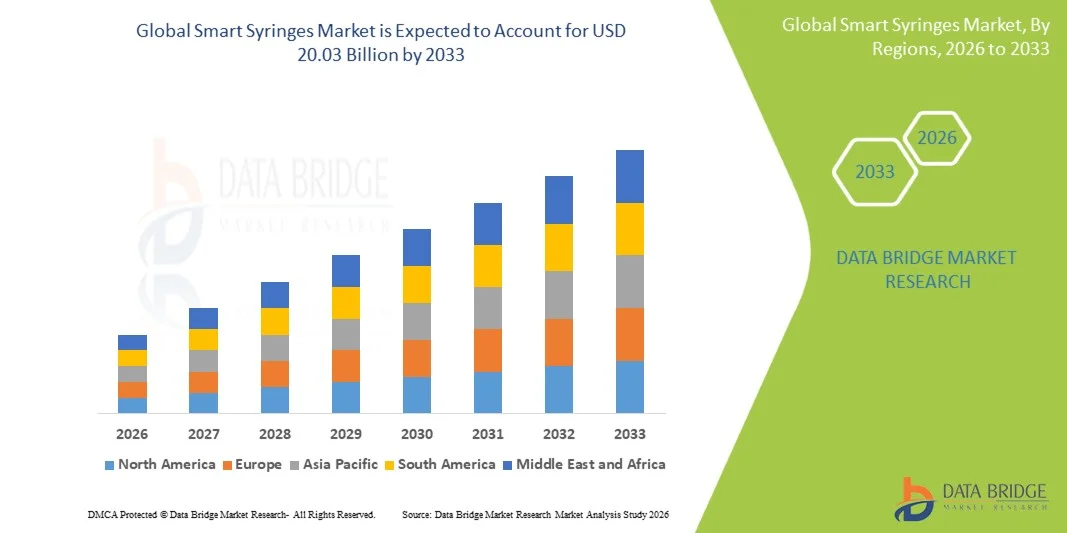
As per Data Bridge Market Research Analysis the Smart Syringes Market was valued at USD 8.51 billion in 2025 and is projected to reach USD 20.03 billion by 2033, growing at a CAGR of 11.30% from 2026 to 2033. The market is experiencing consistent growth driven by rising demand for safe injection practices, increasing prevalence of chronic and infectious diseases, and expanding adoption of advanced drug delivery technologies across hospitals, clinics, and vaccination programs. Rapid advancements in safety-engineered syringe technologies, growing healthcare awareness, and increasing government initiatives for needlestick injury prevention are further supporting market expansion globally.
The increasing incidence of blood-borne infections globally, combined with stringent healthcare regulations regarding injection safety and medical waste management, is compelling hospitals, healthcare providers, and public health organizations to adopt advanced smart syringe technologies. Auto-disable syringes, retractable safety syringes, and passive safety-engineered injection systems are increasingly replacing conventional syringes in many healthcare settings, offering safer, more efficient, and contamination-resistant solutions for drug administration, vaccination, and chronic disease management.
Market Size & Forecast
- Global Market Value (2025): USD 8.51 billion
- Expected Market Value (2033): USD 20.03 billion by 2033
- Forecast CAGR (2026–2033): 11.30%
What are the Major Takeaways of Smart Syringes Market?
- North America dominated the Smart Syringes Market with the largest revenue share of 38.46% in 2025, supported by advanced healthcare infrastructure, strong regulatory frameworks for injection safety, and high adoption of safety-engineered medical devices across hospitals, clinics, and ambulatory care centers.
- The adults segment dominated the market with a share of 71.64% in 2025 due to the high prevalence of chronic diseases requiring frequent injectable therapies, including diabetes, arthritis, cancer, and hormonal disorders.
- Asia-Pacific is expected to be the fastest-growing region at a CAGR of 8.2% from 2026 to 2033, fueled by expanding healthcare infrastructure, increasing vaccination coverage, rising prevalence of chronic diseases, and growing healthcare investments across China, India, and Southeast Asian countries.
- The Passive Safety Syringes segment is the fastest-growing product category, projected to register a CAGR of 7.8%, reflecting rising demand for automatic needle protection technologies that reduce needlestick injuries and improve healthcare worker safety.
- The Drug Delivery segment dominates the application category with a 44.27% revenue share in 2025, led by increasing use of smart syringes for insulin delivery, biologics administration, and injectable therapeutics across hospitals and homecare settings.
- The Adults segment accounted for 71.64% of the market in 2025, supported by the growing prevalence of chronic diseases such as diabetes, cardiovascular disorders, and autoimmune conditions requiring frequent injectable treatments.
- The Hospitals and HMOs segment is the fastest-growing end user category, with a CAGR of 7.6%, driven by increasing adoption of safety syringes, strict infection prevention regulations, and rising focus on reducing healthcare-associated infections and needlestick injuries across healthcare facilities.
Report Scope and Smart Syringes Market Segmentation
|
Attributes |
Smart Syringes Key Market Insights |
|
Segments Covered |
· By Product: Auto Disable Syringes, Active Safety Syringes, nd Passive Safety Syringes · By Application: Drug Delivery, Vaccination, Blood Specimen Collection · By Age Group: Pediatrics and Adults · By End User: Hospitals and HMOs, Diabetic Patients, Family Practices, Psychiatrics, and Others |
|
Countries Covered |
North America
Europe
Asia-Pacific
Middle East and Africa
South America
|
|
Key Market Players |
|
|
Market Opportunities |
|
|
Value Added Data Infosets |
|
What is the Key Trend in the Smart Syringes Market?
Trend: Rising Adoption of Safety Injection Practices and Infection Prevention
Healthcare providers, vaccination centers, and pharmaceutical organizations are increasingly adopting Smart Syringes to improve injection safety, prevent needle reuse, and reduce the risk of healthcare-associated infections (HAIs) and bloodborne disease transmission. Hospitals and public healthcare systems are rapidly transitioning from conventional syringes to auto-disable and safety-engineered syringes equipped with retractable needles and needle-shielding technologies to enhance patient and healthcare worker safety. In addition, growing immunization programs and chronic disease management initiatives are accelerating demand for safe injection devices across hospitals, clinics, and home healthcare settings.
According to the World Health Organization (WHO), unsafe injection practices were previously responsible for millions of hepatitis B, hepatitis C, and HIV infections globally, significantly increasing the need for safety-engineered injection devices. WHO and UNICEF increasingly recommend the use of smart syringes for immunization programs, particularly auto-disable syringes that prevent syringe reuse after a single injection. Furthermore, increasing adoption of self-administration therapies for diabetes, rheumatoid arthritis, and hormonal disorders is driving demand for easy-to-use smart syringe systems integrated with enhanced safety mechanisms and accurate dosing technologies.
Smart Syringes Market Dynamics
Key Market Driver: Increasing Demand for Safe Injection Systems and Expanding Vaccination Programs
The growing prevalence of chronic diseases, rising immunization coverage, and increasing awareness regarding infection prevention are significantly driving demand for Smart Syringes globally. Hospitals, vaccination centers, and healthcare organizations are increasingly adopting active safety syringes, passive safety syringes, and auto-disable syringes to minimize accidental needle-stick injuries and prevent cross-contamination during drug administration and blood collection procedures.
According to the World Health Organization (WHO), billions of injections are administered globally every year, creating substantial demand for safer injection technologies across healthcare systems. In vaccination campaigns, particularly for influenza, COVID-19, hepatitis, and childhood immunization programs, smart syringes are increasingly being used to improve patient safety and reduce syringe reuse risks. In addition, stringent regulatory guidelines from organizations such as the U.S. FDA, CDC, and European health authorities are encouraging healthcare facilities to implement advanced injection safety protocols. Rising healthcare expenditure, expanding hospital infrastructure, and increasing adoption of injectable biologics and specialty drugs are further accelerating market growth worldwide.
Key Restraint/Challenge: High Cost of Safety-Engineered Syringes and Disposal Concerns
A significant restraint in the Smart Syringes Market is the relatively high cost associated with advanced safety-engineered syringe systems compared to conventional disposable syringes. Smart syringes integrate retractable needles, shielding systems, and automatic disabling technologies, increasing manufacturing complexity and procurement costs for hospitals and healthcare providers, particularly in low- and middle-income countries.
In addition, the growing volume of medical waste generated from single-use syringes creates disposal and environmental management challenges for healthcare systems. Regulatory requirements regarding safe disposal of biohazardous sharps and plastic medical waste increase operational burdens for hospitals and diagnostic laboratories. Furthermore, limited reimbursement policies and budget constraints in public healthcare facilities can restrict large-scale adoption of premium smart syringe technologies in cost-sensitive markets. Although technological advancements are improving affordability, pricing pressures and waste management concerns continue to remain key operational challenges across the industry.
For instance, several healthcare systems across developing economies continue to rely on conventional disposable syringes due to lower procurement costs, despite growing international recommendations supporting the use of safety-engineered injection devices for infection prevention and occupational safety.
Key Market Opportunity: Expansion of Self-Injectable Therapies and Connected Drug Delivery Systems
The growing adoption of self-administered injectable therapies and digitally integrated drug delivery platforms presents a significant growth opportunity for the Smart Syringes market. Increasing prevalence of diabetes, autoimmune disorders, fertility treatments, and chronic diseases is accelerating demand for patient-friendly injection devices that improve dosing accuracy, safety, and treatment adherence.
Manufacturers are increasingly developing prefilled smart syringes, connected injection systems, and wearable drug delivery devices integrated with digital monitoring capabilities and automated safety mechanisms. In addition, advancements in biologics and personalized medicine are creating strong demand for precision drug delivery solutions across hospitals and home healthcare settings.
The integration of IoT-enabled injection tracking systems and smart healthcare platforms is further improving medication management, remote patient monitoring, and adherence tracking. Healthcare providers adopting connected smart syringe technologies can improve treatment compliance, reduce medication errors, and enhance patient outcomes. Moreover, expanding vaccination initiatives, increasing healthcare digitization, and rising investments in home healthcare infrastructure across Asia-Pacific, North America, Latin America, and the Middle East are expected to create substantial long-term growth opportunities for smart syringe manufacturers globally.
How is the Smart Syringes Market Segmented?
The Smart Syringes market is segmented on the basis of product, application, age group, and end user.
- By Product
On the basis of product, the Smart Syringes Market is segmented into auto disable syringes, active safety syringes, and passive safety syringes. The auto disable syringes segment dominated the market with a share of 44.82% in 2025 due to its widespread adoption across immunization programs, public healthcare campaigns, and hospital-based vaccination procedures. These syringes are designed to prevent reuse after a single injection, significantly reducing the risk of cross-contamination and transmission of bloodborne infections such as hepatitis B, hepatitis C, and HIV. Growing support from organizations such as the World Health Organization (WHO) and UNICEF for safe injection practices is accelerating adoption globally. In addition, increasing government initiatives for childhood immunization, rising vaccination coverage, and expanding pandemic preparedness programs are strengthening segment growth. Hospitals and healthcare facilities are increasingly preferring auto disable syringes due to their reliability, affordability, and ease of disposal. The rising prevalence of infectious diseases and increasing awareness regarding injection safety among healthcare workers are further reinforcing the dominance of this segment in the global market.
The active safety syringes segment is expected to witness the fastest CAGR of 8.1% from 2026 to 2033, driven by increasing demand for advanced needle-stick injury prevention technologies across hospitals, diagnostic laboratories, and outpatient care centers. These syringes incorporate automated safety mechanisms such as retractable needles and shielding systems that minimize accidental exposure to contaminated sharps. Rising regulatory pressure from healthcare authorities and occupational safety organizations is encouraging healthcare providers to adopt advanced safety-engineered injection devices. In addition, increasing use of injectable biologics, specialty drugs, and self-administered therapies is supporting demand for high-performance smart syringe systems. Technological advancements improving ease of use, ergonomic handling, and injection accuracy are further accelerating product adoption. Growing investments in healthcare infrastructure modernization and increasing awareness regarding healthcare-associated infections (HAIs) are expected to create strong long-term growth opportunities for active safety syringes globally.
- By Application
On the basis of application, the Smart Syringes Market is segmented into drug delivery, vaccination, and blood specimen collection. The drug delivery segment dominated the market with a share of 46.35% in 2025, supported by increasing administration of injectable therapeutics across hospitals, clinics, and home healthcare settings. Rising prevalence of chronic diseases such as diabetes, cancer, autoimmune disorders, and cardiovascular diseases is significantly increasing demand for safe and precise injectable drug delivery systems. Smart syringes are increasingly utilized for insulin administration, biologics delivery, fertility treatments, and specialty pharmaceuticals due to enhanced dosing accuracy and improved patient safety. In addition, expanding adoption of self-injection therapies and home-based healthcare services is reinforcing demand for advanced syringe technologies. Pharmaceutical companies are also increasingly developing prefilled syringe systems integrated with safety mechanisms to improve medication adherence and reduce contamination risks. Rising demand for minimally invasive drug administration and growth in biologics manufacturing are further strengthening the leading position of the drug delivery segment globally.
The vaccination segment is projected to register the fastest CAGR of 8.4% from 2026 to 2033, driven by expanding global immunization programs, increasing pandemic preparedness initiatives, and growing focus on infection prevention. Governments and international healthcare organizations are rapidly increasing procurement of smart syringes for mass vaccination campaigns against influenza, COVID-19, HPV, hepatitis, and other infectious diseases. Auto-disable and safety-engineered syringes are increasingly becoming mandatory across vaccination programs to prevent syringe reuse and accidental needle-stick injuries. In addition, rising investments in public healthcare infrastructure and increasing vaccination awareness in developing economies are supporting market expansion. Technological advancements improving vaccine administration efficiency and safe disposal systems are also accelerating adoption. Growing pediatric immunization coverage and increasing implementation of WHO-recommended safe injection protocols are expected to further boost segment growth over the forecast period.
- By Age Group
On the basis of age group, the Smart Syringes Market is segmented into pediatrics and adults. The adults segment dominated the market with a share of 71.64% in 2025 due to the high prevalence of chronic diseases requiring frequent injectable therapies, including diabetes, arthritis, cancer, and hormonal disorders. Increasing geriatric population and rising adoption of biologics and specialty injectable medications are significantly contributing to demand for smart syringes among adult patients. Hospitals, outpatient centers, and home healthcare providers are increasingly utilizing safety-engineered syringes to improve injection accuracy and reduce infection risks in adult patient populations. In addition, rising vaccination coverage among adults for influenza, COVID-19, hepatitis, and travel-related diseases is supporting segment growth. Expanding use of self-administered therapies and increasing awareness regarding safe injection practices are further strengthening the dominance of the adult segment globally. The growing preference for home-based treatment solutions and connected drug delivery devices is also enhancing market penetration across adult healthcare applications.
The pediatrics segment is expected to witness the fastest CAGR of 7.9% from 2026 to 2033, driven by increasing childhood immunization programs, rising birth rates in emerging economies, and growing focus on pediatric infection prevention. Governments and healthcare organizations are increasingly adopting auto-disable and low-dead-space syringes to improve safety during pediatric vaccination campaigns. Rising awareness regarding needle-stick injury prevention and growing emphasis on reducing pain and anxiety during pediatric injections are encouraging adoption of advanced smart syringe technologies. In addition, increasing investments in maternal and child healthcare programs and expansion of universal immunization initiatives are accelerating segment growth. Technological innovations such as smaller needle designs, ergonomic syringe structures, and enhanced dosage precision are further improving pediatric patient safety and treatment outcomes. Increasing support from global health organizations for safe pediatric injection practices is expected to drive long-term market expansion.
- By End User
On the basis of end user, the Smart Syringes Market is segmented into hospitals and HMOs, diabetic patients, family practices, psychiatrics, and others. The hospitals and HMOs segment dominated the market with a share of 48.57% in 2025 due to the high volume of injections administered across inpatient, outpatient, emergency, surgical, and vaccination settings. Hospitals are increasingly adopting smart syringes to comply with stringent infection control regulations and reduce the incidence of healthcare-associated infections (HAIs) and occupational needle-stick injuries. Growing investments in hospital modernization, rising surgical procedures, and expanding immunization programs are significantly contributing to segment growth. In addition, widespread use of injectable drugs, biologics, and blood collection procedures across hospitals is reinforcing strong demand for advanced safety-engineered syringes. Healthcare providers are also increasingly implementing standardized injection safety protocols recommended by organizations such as the CDC, WHO, and OSHA. Rising healthcare expenditure and increasing patient admissions globally continue to strengthen the dominance of hospitals and HMOs in the smart syringes market.
The diabetic patients segment is anticipated to witness the fastest CAGR of 8.3% from 2026 to 2033, driven by the rapidly increasing global prevalence of diabetes and growing adoption of self-injection therapies. Smart syringes are increasingly being used for insulin administration due to their improved dosing accuracy, enhanced patient safety, and ease of use in home healthcare environments. Rising awareness regarding diabetes management and increasing demand for convenient, patient-friendly injection devices are accelerating adoption among diabetic populations. In addition, technological advancements in connected injection systems, prefilled syringes, and needle safety mechanisms are improving treatment adherence and reducing injection-related complications. Expanding home healthcare infrastructure and increasing availability of affordable insulin delivery devices in emerging economies are further supporting segment growth. Growing preference for self-care solutions and remote patient monitoring technologies is expected to create substantial long-term opportunities for smart syringe manufacturers globally.
Which Region Holds the Largest Share of the Smart Syringes Market?
North America dominated the Smart Syringes Market and accounted for the largest revenue share of 38.46% in 2025, supported by advanced healthcare infrastructure, stringent regulatory frameworks for injection safety, and high adoption of safety-engineered medical devices across hospitals, clinics, diagnostic laboratories, and ambulatory care centers. The region also benefits from strong presence of leading medical device manufacturers, increasing implementation of occupational safety regulations, and widespread use of auto-disable and safety syringes in vaccination and drug delivery applications. Rising prevalence of chronic diseases requiring injectable therapies, growing awareness regarding prevention of needle-stick injuries, and increasing adoption of biologics and self-injection systems continue to strengthen North America’s leading position in the global market.
U.S. Smart Syringes Market Insight
The U.S. Smart Syringes market is witnessing strong growth due to increasing focus on injection safety, rising prevalence of diabetes and chronic diseases, and expanding adoption of safety-engineered syringes across healthcare facilities. Hospitals, outpatient centers, and home healthcare providers are increasingly utilizing active and passive safety syringes to minimize healthcare-associated infections (HAIs) and accidental needle-stick injuries among healthcare workers. In addition, strong regulatory support from organizations such as the FDA, CDC, and OSHA is accelerating adoption of advanced injection safety technologies across hospitals and vaccination programs. Growing use of injectable biologics, rising immunization coverage, and increasing preference for self-administered therapies are further contributing to market expansion in the U.S.
Europe Smart Syringes Market Insight
The Europe Smart Syringes market remains a major contributor to global revenue, driven by stringent infection prevention regulations, increasing healthcare expenditure, and growing awareness regarding safe injection practices. The widespread adoption of hospital-grade safety syringes, expanding vaccination initiatives, and increasing prevalence of chronic diseases are supporting market growth across the region. In addition, rising demand for advanced drug delivery systems, increasing adoption of prefilled syringes, and strong focus on reducing occupational exposure risks among healthcare workers continue to accelerate smart syringe adoption throughout Europe.
U.K. Smart Syringes Market Insight
The U.K. Smart Syringes market is experiencing steady growth, supported by increasing implementation of infection control measures and rising adoption of safety-engineered injection devices across hospitals and primary healthcare centers. Growing government initiatives for vaccination safety, rising prevalence of diabetes, and increasing demand for self-injection therapies are contributing significantly to market expansion. Furthermore, increasing investments in healthcare modernization and growing awareness regarding prevention of bloodborne infections are supporting broader adoption of smart syringe technologies across clinical and home healthcare environments in the U.K.
Germany Smart Syringes Market Insight
The Germany Smart Syringes market is expanding steadily due to the country’s advanced healthcare infrastructure, strong pharmaceutical manufacturing capabilities, and increasing adoption of innovative medical technologies. Hospitals and diagnostic laboratories are increasingly implementing advanced syringe safety systems to comply with stringent healthcare hygiene and occupational safety regulations. In addition, growing demand for injectable biologics, increasing chronic disease burden, and rising healthcare investments are accelerating adoption of active and passive safety syringes across Germany. Technological advancements in drug delivery devices and increasing focus on infection prevention are further driving market growth.
Asia-Pacific Smart Syringes Market Insight
The Asia-Pacific Smart Syringes market is expected to witness rapid growth, fueled by expanding healthcare infrastructure, increasing vaccination coverage, rising prevalence of chronic diseases, and growing healthcare investments across China, India, Japan, and Southeast Asian countries. Increasing awareness regarding injection safety and prevention of healthcare-associated infections is driving adoption of safety-engineered syringes across hospitals, clinics, and public healthcare systems. In addition, rising government immunization programs, expanding access to healthcare services, and increasing adoption of self-administered injectable therapies are supporting strong regional market expansion. Growing pharmaceutical manufacturing activities and rising demand for affordable smart syringe technologies are further accelerating adoption across Asia-Pacific.
Japan Smart Syringes Market Insight
The Japan Smart Syringes market is witnessing consistent growth due to rising demand for advanced healthcare technologies, increasing aging population, and growing prevalence of chronic diseases requiring injectable treatments. Hospitals and healthcare providers are increasingly adopting smart syringes to improve patient safety, reduce infection risks, and support efficient drug administration. Moreover, strong focus on healthcare quality standards, expanding vaccination programs, and increasing adoption of biologics and specialty pharmaceuticals are further contributing to market growth in Japan.
China Smart Syringes Market Insight
The China Smart Syringes market is growing rapidly, driven by expanding healthcare infrastructure, rising immunization coverage, and increasing government focus on healthcare safety standards. Growing prevalence of diabetes, cancer, and infectious diseases is significantly increasing demand for injectable drug delivery systems and advanced safety syringes across hospitals and diagnostic centers. In addition, rapid expansion of pharmaceutical manufacturing, increasing healthcare expenditure, and rising adoption of cost-effective safety-engineered syringes are positioning China as one of the fastest-growing markets for Smart Syringes globally.
Which are the Top Companies in Smart Syringes Market?
The Smart Syringes industry is primarily led by well-established companies, including:
- Becton, Dickinson and Company (U.S.)
- B. Braun SE (Germany)
- Terumo Corporation (Japan)
- Smiths Medical, Inc. (U.S.)
- Hindustan Syringes & Medical Devices Ltd. (India)
- Retractable Technologies, Inc. (U.S.)
- Nipro Corporation (Japan)
- Cardinal Health, Inc. (U.S.)
- Medtronic plc (Ireland)
- ICU Medical, Inc. (U.S.)
- Fresenius Kabi AG (Germany)
- Revolutions Medical Corporation (U.S.)
- VanishPoint (RTI) (U.S.)
- Baxter International Inc. (U.S.)
- Unilife Corporation (U.S.)
- Weigao Group (China)
- AdvaCare Pharma (U.S.)
- Gerolymatos International S.A. (Greece)
- Sol-Millennium Medical Group (China)
- Henan Shengguang Medical Instruments Co., Ltd. (China)
- KDL Medical Group (China)
- Jiangsu Jichun Medical Devices Co., Ltd. (China)
- Connecticut Hypodermics Inc. (U.S.)
- Vogt Medical Vertrieb GmbH (Germany)
- Numedico Technologies Pvt. Ltd. (India)
- Lifelong Meditech Pvt. Ltd. (India)
- Suru International Pvt. Ltd. (India)
- Albert David Ltd. (India)
- Dispo Van Medical Devices Pvt. Ltd. (India)
- Poly Medicure Limited (India)
- Argon Medical Devices, Inc. (U.S.)
- Merit Medical Systems, Inc. (U.S.)
- ROiSSY MEDICAL Europe (France)
- UltiMed, Inc. (U.S.)
Latest Developments in Smart Syringes Market
- In June 2021, Becton, Dickinson and Company announced that it had received pandemic-related orders for nearly 2 billion needles and syringes to support large-scale global COVID-19 vaccination programs across countries including the U.S., India, Germany, Canada, and the U.K. The development significantly strengthened the company’s position in the Smart Syringes Market while supporting safe injection practices and mass immunization campaigns worldwide
- In July 2022, Sharps Technology Inc. completed the acquisition of a large manufacturing facility in Hungary focused on producing advanced safety syringes with reduced vaccine and medication waste. The expansion enhanced the company’s manufacturing capabilities for smart safety syringes designed to prevent accidental needlestick injuries and improve injection safety standards across healthcare settings
- In March 2024, Hindustan Syringes and Medical Devices Ltd. launched “Dispojekt,” a new range of single-use safety syringes equipped with advanced safety needles designed to reduce accidental needle-stick injuries among healthcare professionals. The launch supported increasing demand for safer injection devices and reinforced healthcare infection-control initiatives across hospitals and vaccination programs
- In October 2024, Becton, Dickinson and Company partnered with Ten23 Health to pilot RFID-enabled traceability solutions for prefillable syringes. The collaboration aimed to improve manufacturing efficiency, strengthen supply chain visibility, and enable precise tracking of syringe units across pharmaceutical production processes
- In December 2024, Terumo Corporation received U.S. FDA clearance for its new line of prefilled smart syringes designed for single-dose biologic therapies in oncology and autoimmune disease treatment applications. The development enhanced the company’s portfolio of advanced drug-delivery solutions and supported growing demand for precision injectable therapies
- In January 2025, Smiths Medical introduced a digital smart syringe prototype integrated with Bluetooth-enabled dose tracking technology for chronic disease management applications. The innovation was designed to improve medication adherence, support remote patient monitoring, and enhance accuracy in long-term injectable therapies
- In February 2025, Nipro Corporation launched a next-generation retractable safety syringe developed for high-volume hospital applications across North America and Europe. The product featured enhanced retractable needle technology aimed at improving healthcare worker safety and reducing needle-stick injury risks in clinical environments

- Interactive Data Analysis Dashboard
- Company Analysis Dashboard for high growth potential opportunities
- Research Analyst Access for customization & queries
- Competitor Analysis with Interactive dashboard
- Latest News, Updates & Trend analysis
- Harness the Power of Benchmark Analysis for Comprehensive Competitor Tracking
Data collection and base year analysis are done using data collection modules with large sample sizes. The stage includes obtaining market information or related data through various sources and strategies. It includes examining and planning all the data acquired from the past in advance. It likewise envelops the examination of information inconsistencies seen across different information sources. The market data is analysed and estimated using market statistical and coherent models. Also, market share analysis and key trend analysis are the major success factors in the market report. To know more, please request an analyst call or drop down your inquiry.
The key research methodology used by DBMR research team is data triangulation which involves data mining, analysis of the impact of data variables on the market and primary (industry expert) validation. Data models include Vendor Positioning Grid, Market Time Line Analysis, Market Overview and Guide, Company Positioning Grid, Patent Analysis, Pricing Analysis, Company Market Share Analysis, Standards of Measurement, Global versus Regional and Vendor Share Analysis. To know more about the research methodology, drop in an inquiry to speak to our industry experts.
Data Bridge Market Research is a leader in advanced formative research. We take pride in servicing our existing and new customers with data and analysis that match and suits their goal. The report can be customized to include price trend analysis of target brands understanding the market for additional countries (ask for the list of countries), clinical trial results data, literature review, refurbished market and product base analysis. Market analysis of target competitors can be analyzed from technology-based analysis to market portfolio strategies. We can add as many competitors that you require data about in the format and data style you are looking for. Our team of analysts can also provide you data in crude raw excel files pivot tables (Fact book) or can assist you in creating presentations from the data sets available in the report.













