Smart Television (TV) Sticks Market Size
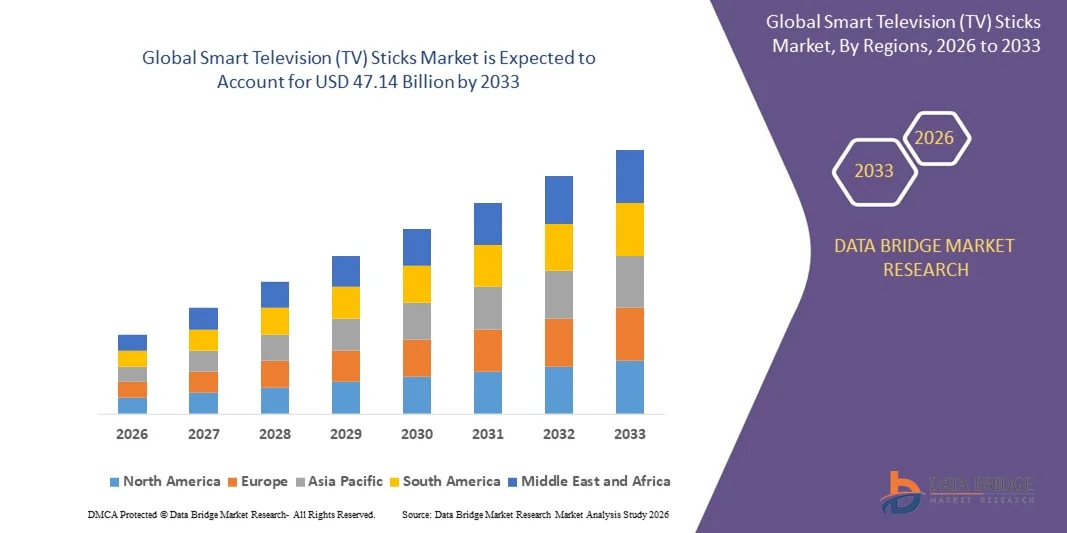
- The global smart television (TV) sticks market size was valued at USD 22.80 billion in 2025 and is expected to reach USD 47.14 billion by 2033, at a CAGR of 9.5% during the forecast period
- The market growth is largely fueled by the growing adoption of OTT platforms and increasing consumer demand for flexible, on-demand home entertainment solutions, leading to widespread integration of smart TV sticks in both residential and commercial settings
- Furthermore, rising consumer preference for high-definition content, user-friendly interfaces, and devices that seamlessly integrate with smart TVs and voice assistants is establishing smart TV sticks as a preferred choice for streaming and digital content consumption. These converging factors are accelerating the adoption of TV sticks, thereby significantly boosting the market's growth
Smart Television (TV) Sticks Market Analysis
- Smart TV sticks are compact streaming devices that enable users to access digital content, OTT platforms, and applications on televisions without the need for built-in smart TV functionality. These devices integrate with home Wi-Fi networks and often support voice commands, 4K resolution, and mobile app control, enhancing convenience, viewing quality, and personalized entertainment experiences
- The escalating demand for smart TV sticks is primarily driven by the increasing penetration of high-speed internet, rising smartphone and smart TV adoption, and growing consumer inclination toward affordable, portable streaming solutions that offer access to diverse content libraries
- North America dominated smart television (TV) sticks market with a share of 42.5% in 2025, due to increasing demand for streaming services, smart home entertainment solutions, and growing awareness of connected devices
- Asia-Pacific is expected to be the fastest growing region in the smart television (TV) sticks market during the forecast period due to rising urbanization, increasing disposable incomes, and the popularity of OTT content in countries such as China, India, and Japan
- 4k segment dominated the market with a market share of 58.5% in 2025, due to growing consumer demand for high-definition content and immersive viewing experiences. Streaming platforms such as Netflix and Amazon Prime Video increasingly offer 4K content, encouraging adoption of 4K-capable TV sticks. Consumers prefer 4K TV sticks for enhanced picture clarity, vibrant colors, and smoother motion, and compatibility with HDR and advanced audio formats strengthens their appeal
Report Scope and Smart Television (TV) Sticks Market Segmentation
|
Attributes |
Smart Television (TV) Sticks Key Market Insights |
|
Segments Covered |
|
|
Countries Covered |
North America
Europe
Asia-Pacific
Middle East and Africa
South America
|
|
Key Market Players |
|
|
Market Opportunities |
|
|
Value Added Data Infosets |
In addition to the insights on market scenarios such as market value, growth rate, segmentation, geographical coverage, and major players, the market reports curated by the Data Bridge Market Research also include in-depth expert analysis, pricing analysis, brand share analysis, consumer survey, demography analysis, supply chain analysis, value chain analysis, raw material/consumables overview, vendor selection criteria, PESTLE Analysis, Porter Analysis, and regulatory framework. |
Smart Television (TV) Sticks Market Trends
Rising Adoption of 4K and Above Streaming Solutions
- A significant trend in the smart television (TV) sticks market is the increasing adoption of 4K and higher-resolution streaming solutions, driven by consumer demand for enhanced picture quality, immersive viewing experiences, and access to premium content across OTT platforms. This trend is elevating the importance of TV sticks as essential devices for digital home entertainment, supporting both traditional and smart TV ecosystems
- For instance, Amazon’s Fire TV Stick 4K and Xiaomi’s Mi TV Stick 4K are widely adopted in North America, Europe, and Asia-Pacific, offering users ultra-HD resolution and HDR support, which strengthens engagement with streaming services such as Netflix, Prime Video, and Disney+. These devices enable seamless access to high-quality content without the need for built-in smart TV functionality, broadening consumer choices
- The increasing availability of 4K content from platforms such as Netflix, Hulu, and Disney+ is driving households to upgrade to 4K-capable TV sticks, encouraging adoption of devices that deliver smooth streaming, richer color depth, and faster response times
- The trend is also supported by advancements in Wi-Fi 6 technology and high-speed broadband, allowing uninterrupted high-definition streaming and reducing buffering issues. Consumers are increasingly prioritizing compatibility with voice assistants such as Alexa and Google Assistant, which further enhances the utility of 4K TV sticks
- Smart TV stick manufacturers are also focusing on portability, ease of installation, and compact design, making 4K-capable devices suitable for multi-TV households, rental apartments, and secondary screens
- This rising adoption of high-resolution TV sticks is positioning these devices as key enablers of the evolving digital home entertainment ecosystem, strengthening their demand across mature and emerging markets
Smart Television (TV) Sticks Market Dynamics
Driver
Increasing Demand for Affordable and Portable Home Entertainment Devices
- The growing preference for cost-effective, portable streaming solutions is driving the smart TV sticks market, as consumers seek access to OTT platforms without investing in high-priced smart TVs or cable subscriptions. These devices provide flexibility, mobility, and ease of use while supporting a wide range of applications and content
- For instance, Roku’s Streaming Stick and Xiaomi’s Mi TV Stick offer compact designs, 4K resolution, and voice control capabilities, appealing to budget-conscious households in the U.S., India, and Europe. Their affordability combined with high-performance streaming is accelerating adoption, particularly among first-time smart device users
- The rise in OTT platform subscriptions such as Netflix, Amazon Prime Video, Disney+, and Hulu is fueling demand for portable streaming devices that can deliver high-definition content to multiple screens within a household
- Smart TV sticks also support integration with mobile apps and voice assistants, enabling convenient navigation and content selection, which is highly valued by consumers seeking user-friendly home entertainment solutions
- As consumers increasingly seek flexible, plug-and-play options for streaming, these devices are becoming standard solutions for both residential and commercial settings, strengthening the market’s overall growth trajectory
Restraint/Challenge
Intense Competition and Rapid Technological Upgrades
- The smart TV sticks market faces challenges due to intense competition among key players and the rapid pace of technological upgrades, which can shorten product lifecycles and increase pressure on manufacturers to continuously innovate
- For instance, Amazon, Roku, Google, and Xiaomi frequently launch new models with improved processing power, higher resolution support, and enhanced connectivity features, which creates a dynamic but competitive environment that may limit profitability for smaller players
- Frequent updates in streaming protocols, integration with emerging smart home devices, and support for higher resolutions and audio standards require manufacturers to invest heavily in R&D, increasing operational costs
- The rapid technological evolution also poses a challenge for consumer adoption, as users may hesitate to invest in devices that risk becoming obsolete quickly
- Maintaining a balance between affordability, feature richness, and compatibility with multiple platforms remains a critical challenge for market participants seeking to sustain growth in this competitive landscape
Smart Television (TV) Sticks Market Scope
The market is segmented on the basis of video support and sales channels.
- By Video Support
On the basis of video support, the Smart TV Sticks market is segmented into Non-4K, 4K, and Above. The 4K segment dominated the largest market revenue share of 58.5% in 2025, driven by growing consumer demand for high-definition content and immersive viewing experiences. Streaming platforms such as Netflix and Amazon Prime Video increasingly offer 4K content, encouraging adoption of 4K-capable TV sticks. Consumers prefer 4K TV sticks for enhanced picture clarity, vibrant colors, and smoother motion, and compatibility with HDR and advanced audio formats strengthens their appeal. Partnerships between manufacturers and content providers reinforce 4K dominance, while ongoing price reductions make these devices more accessible.
The Non-4K segment is expected to witness the fastest growth from 2026 to 2033, fueled by budget-conscious consumers seeking affordable streaming solutions. Companies such as Roku and Amazon offer cost-effective Non-4K variants for households with older TVs or limited bandwidth. Their simplicity, ease of installation, and suitability as secondary devices in multi-TV homes contribute to rising adoption.
- By Sales Channels
On the basis of sales channels, the Smart TV Sticks market is segmented into Third Party Online Channels, Direct to Customer Online Channels, Franchised Electronics Outlets, Independent Electronics Outlets, and Modern Trade Channels. The Third Party Online Channels segment dominated the largest market revenue share in 2025, driven by e-commerce platforms such as Amazon, Flipkart, and Best Buy offering product variety, customer reviews, and convenient delivery. Frequent discounts, bundle deals, and return policies make online shopping preferred for smart TV stick purchases. Partnerships between brands and online platforms further enhance visibility and sales.
The Direct to Customer Online Channels segment is expected to witness the fastest CAGR from 2026 to 2033, driven by brands such as Amazon (Fire TV Stick) and Xiaomi (Mi TV Stick) selling directly through official websites. Direct channels allow brands to control pricing, offer exclusive bundles, ensure product authenticity, and provide dedicated support, attracting more consumers.
Smart Television (TV) Sticks Market Regional Analysis
- North America dominated the smart television (TV) sticks market with the largest revenue share of 42.5% in 2025, driven by increasing demand for streaming services, smart home entertainment solutions, and growing awareness of connected devices
- Consumers in the region highly value convenience, seamless streaming experiences, and integration with smart TVs and voice assistants such as Alexa and Google Assistant
- This widespread adoption is further supported by high disposable incomes, strong internet penetration, and a technology-savvy population, establishing TV sticks as a preferred solution for residential entertainment
U.S. Smart Television (TV) Sticks Market Insight
The U.S. market captured the largest revenue share in North America in 2025, fueled by rapid adoption of OTT platforms such as Netflix, Amazon Prime Video, and Disney+. Consumers are increasingly prioritizing cost-effective smart streaming solutions over traditional set-top boxes. The growing trend of home entertainment customization, combined with high adoption of voice-controlled TV sticks and mobile app integrations, further drives market growth. In addition, the increasing availability of 4K and above TV sticks with advanced features is significantly contributing to market expansion.
Europe Smart Television (TV) Sticks Market Insight
The Europe market is projected to expand at a substantial CAGR throughout the forecast period, driven by the rising penetration of smart TVs and demand for flexible content consumption. Increasing urbanization, high internet penetration, and government initiatives supporting digital entertainment adoption are fostering market growth. Consumers are attracted to features such as 4K streaming, mobile app integration, and voice control. The market is experiencing strong growth across residential and rental properties, as well as in hospitality sectors seeking to provide enhanced viewing experiences.
U.K. Smart Television (TV) Sticks Market Insight
The U.K. market is anticipated to grow at a noteworthy CAGR during the forecast period, driven by increasing home entertainment demands and a preference for on-demand streaming. Concerns regarding cable subscription costs encourage adoption of smart TV sticks for affordable access to OTT content. The U.K.’s robust e-commerce and retail infrastructure, alongside high consumer awareness of streaming platforms, continues to stimulate market growth.
Germany Smart Television (TV) Sticks Market Insight
The Germany market is expected to expand at a considerable CAGR during the forecast period, fueled by strong adoption of smart TVs and high-speed broadband networks. Consumers show a preference for devices offering 4K streaming, easy setup, and integration with voice assistants. Germany’s technology-friendly population, combined with interest in energy-efficient and smart home solutions, promotes the adoption of TV sticks across residential and hospitality sectors.
Asia-Pacific Smart Television (TV) Sticks Market Insight
The Asia-Pacific market is poised to grow at the fastest CAGR from 2026 to 2033, driven by rising urbanization, increasing disposable incomes, and the popularity of OTT content in countries such as China, India, and Japan. The region’s growing inclination toward smart home entertainment, supported by high smartphone penetration and affordable devices, is accelerating adoption. Furthermore, APAC’s strong manufacturing capabilities for TV stick components enhance accessibility and reduce costs for consumers.
Japan Smart Television (TV) Sticks Market Insight
The Japan market is gaining momentum due to high-tech adoption, rapid urbanization, and the desire for convenient home entertainment solutions. The market emphasizes high-quality streaming experiences, integration with smart TVs, and compatibility with voice assistants. Japan’s aging population also drives demand for user-friendly devices that simplify content access in both residential and commercial setups.
China Smart Television (TV) Sticks Market Insight
The China market accounted for the largest revenue share in Asia-Pacific in 2025, attributed to growing OTT platform subscriptions, rising middle-class income, and rapid internet adoption. Smart TV sticks are becoming popular across urban households, rental properties, and hospitality sectors. The push toward digital entertainment, coupled with the availability of affordable devices from domestic brands such as Xiaomi and Huawei, is propelling market growth in China.
Smart Television (TV) Sticks Market Share
The smart television (TV) sticks industry is primarily led by well-established companies, including:
- Amazon.com Inc. (U.S.)
- Roku Inc. (U.S.)
- Google LLC (U.S.)
- Apple Inc. (U.S.)
- Sky (U.K.)
- ASUSTeK Computer Inc. (Taiwan)
- Shenzhen Rikomagic Tech Corp., Ltd (China)
- Dongguan Sonicway Electrical Appliance Co., Ltd (China)
- Shenzhen Tomato Technology Co., Ltd. (China)
- CloudWalker Streaming Technologies Pvt. Ltd. (India)
- Google Chromecast 2 Media Streaming Device (U.S.)
- Xiaomi (China)
- DishSMRT Hub (U.S.)
- Alphabet Inc. (U.S.)
Latest Developments in Global Smart Television (TV) Sticks Market
- In January 2026, Amazon and Roku announced a strategic content partnership, making over 50 new free streaming channels from The Roku Channel available on Amazon Fire TV devices. This collaboration expands entertainment options without additional subscriptions, enhances the value proposition of Fire TV sticks, and is expected to drive higher adoption rates as consumers increasingly prioritize content variety and affordability in home streaming solutions
- In July 2025, Xiaomi launched the second-generation Xiaomi TV Stick 4K, upgrading its operating system from Android TV to Google TV and incorporating Wi-Fi 6 support. This launch significantly improves streaming quality, responsiveness, and access to premium apps, positioning Xiaomi as a strong competitor in both emerging and developed markets while catering to consumers seeking affordable, high-performance smart TV sticks
- In April 2025, Roku introduced new hardware models in its streaming stick lineup, including the Roku Streaming Stick and Roku Streaming Stick Plus, designed to replace older Express models. These devices provide more compact designs, faster processing, and enhanced connectivity options, reinforcing Roku’s competitiveness and appealing to users seeking portable and easy-to-install streaming solutions
- In April 2024, Roku announced plans to enhance its TV streaming service by introducing new features such as backdrops, Roku Smart Picture, and significant updates to content discovery and mobile application interfaces for all devices in the U.S. These enhancements aim to personalize the user experience, making content navigation more intuitive and engaging, which is expected to boost user retention and increase adoption of Roku TV sticks across households
- In September 2023, Amazon launched the Fire TV Stick 4K, equipped with a 1.7 GHz quad-core processor and Wi-Fi 6 support, offering faster performance and improved connectivity. The upgraded hardware allows users to stream high-definition and 4K content with minimal buffering, strengthening the Fire TV Stick’s position in the premium segment and attracting consumers looking for seamless home entertainment experiences

- Interactive Data Analysis Dashboard
- Company Analysis Dashboard for high growth potential opportunities
- Research Analyst Access for customization & queries
- Competitor Analysis with Interactive dashboard
- Latest News, Updates & Trend analysis
- Harness the Power of Benchmark Analysis for Comprehensive Competitor Tracking
Data collection and base year analysis are done using data collection modules with large sample sizes. The stage includes obtaining market information or related data through various sources and strategies. It includes examining and planning all the data acquired from the past in advance. It likewise envelops the examination of information inconsistencies seen across different information sources. The market data is analysed and estimated using market statistical and coherent models. Also, market share analysis and key trend analysis are the major success factors in the market report. To know more, please request an analyst call or drop down your inquiry.
The key research methodology used by DBMR research team is data triangulation which involves data mining, analysis of the impact of data variables on the market and primary (industry expert) validation. Data models include Vendor Positioning Grid, Market Time Line Analysis, Market Overview and Guide, Company Positioning Grid, Patent Analysis, Pricing Analysis, Company Market Share Analysis, Standards of Measurement, Global versus Regional and Vendor Share Analysis. To know more about the research methodology, drop in an inquiry to speak to our industry experts.
Data Bridge Market Research is a leader in advanced formative research. We take pride in servicing our existing and new customers with data and analysis that match and suits their goal. The report can be customized to include price trend analysis of target brands understanding the market for additional countries (ask for the list of countries), clinical trial results data, literature review, refurbished market and product base analysis. Market analysis of target competitors can be analyzed from technology-based analysis to market portfolio strategies. We can add as many competitors that you require data about in the format and data style you are looking for. Our team of analysts can also provide you data in crude raw excel files pivot tables (Fact book) or can assist you in creating presentations from the data sets available in the report.