


Smart Trash Bin Market Size
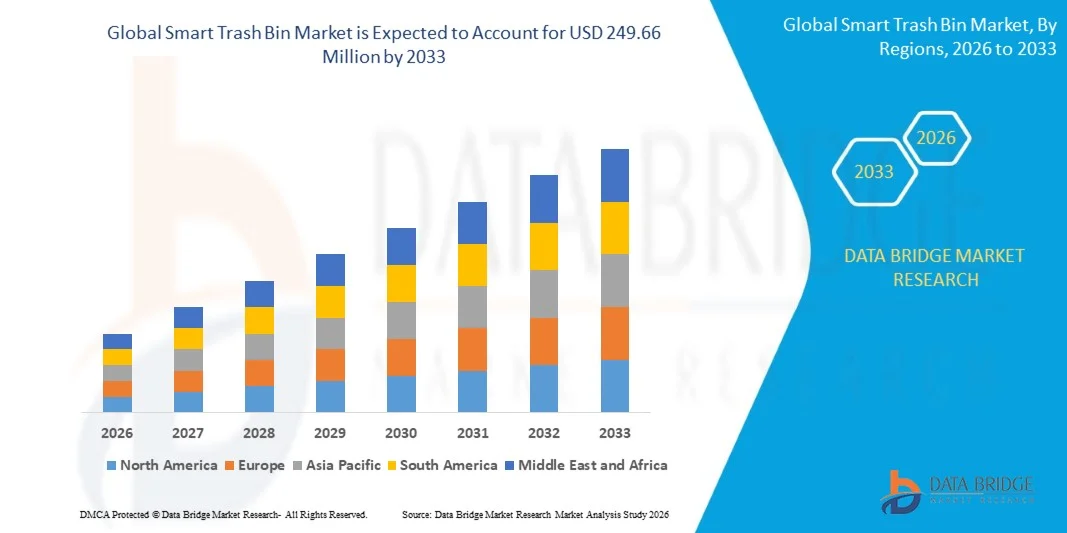
- The global smart trash bin market size was valued at USD 90.78 million in 2025 and is expected to reach USD 249.66 million by 2033, at a CAGR of 13.48% during the forecast period
- The market growth is largely fueled by the growing adoption and technological advancements in smart home devices and automation, leading to increased digitalization and convenience in waste management across residential and commercial settings
- Furthermore, rising consumer demand for hygienic, touchless, and sensor-based waste disposal solutions is establishing smart trash bins as a preferred choice for modern homes and businesses. These converging factors are accelerating the uptake of smart bins, thereby significantly boosting market growth
Smart Trash Bin Market Analysis
- Smart trash bins are intelligent waste management systems equipped with motion sensors, automated lids, odor control, and fill-level notifications. These systems integrate with smart home platforms, enhancing hygiene, convenience, and efficiency for both residential and commercial applications
- The escalating demand for smart trash bins is primarily fueled by increasing awareness of hygiene, sustainability, and environmental concerns, growing urbanization, and a rising preference for automated, touchless waste management solutions in homes, offices, and public spaces
- North America dominated the smart trash bin market with a share of 44.5% in 2025, due to growing consumer awareness of smart home technologies and hygiene-focused innovations
- Asia-Pacific is expected to be the fastest growing region in the smart trash bin market during the forecast period due to urbanization, rising disposable incomes, and technological advancements in countries such as China, Japan, and India
- Automatic segment dominated the market with a market share of around 60% in 2025, due to strong consumer preference for fully touchless waste disposal solutions. Automatic smart bins employ motion sensors and infrared technology to open lids without physical contact, providing hygiene, convenience, and modern appeal. Their compatibility with odor control mechanisms, fill-level notifications, and connectivity to smart home ecosystems enhances the perceived value
Report Scope and Smart Trash Bin Market Segmentation
|
Attributes |
Smart Trash Bin Key Market Insights |
|
Segments Covered |
|
|
Countries Covered |
North America
Europe
Asia-Pacific
Middle East and Africa
South America
|
|
Key Market Players |
|
|
Market Opportunities |
|
|
Value Added Data Infosets |
In addition to the insights on market scenarios such as market value, growth rate, segmentation, geographical coverage, and major players, the market reports curated by the Data Bridge Market Research also include in-depth expert analysis, geographically represented company-wise production and capacity, network layouts of distributors and partners, detailed and updated price trend analysis and deficit analysis of supply chain and demand. |
Smart Trash Bin Market Trends
“Growing Adoption of Automated and Touchless Waste Management Solutions”
- A significant trend in the smart trash bin market is the increasing adoption of automated and touchless waste management solutions, driven by rising consumer awareness of hygiene and convenience across residential and commercial environments. This trend is strengthening the role of smart bins as essential components of modern smart home and smart facility ecosystems
- For instance, Simplehuman offers sensor-based trash cans with motion detection and voice control features that enhance touchless operation and user convenience. Such innovations improve hygiene standards and encourage wider adoption of automated waste disposal systems in households and offices
- The integration of smart trash bins with IoT technologies is expanding, enabling features such as fill-level monitoring, odor control, and app-based notifications. This advancement is improving waste management efficiency and reducing the frequency of manual intervention in both residential and commercial spaces
- The growing focus on sustainability is driving demand for smart bins with waste segregation and recycling capabilities, supporting environmental initiatives and regulatory compliance. This is encouraging manufacturers to introduce multi-compartment and eco-friendly smart bin solutions
- Urban infrastructure development and smart city initiatives are further promoting the adoption of connected waste management systems that optimize collection routes and reduce operational costs. This is positioning smart trash bins as critical components in modern urban waste ecosystems
- The increasing preference for automation, hygiene, and efficient waste handling continues to reinforce this trend. The widespread adoption of smart trash bins is contributing to improved cleanliness standards, operational efficiency, and technological advancement in waste management systems
Smart Trash Bin Market Dynamics
Driver
“Rising Consumer Demand for Hygienic, Sensor-Based Smart Trash Bins”
- The rising consumer demand for hygienic and sensor-based waste management solutions is a major driver of the smart trash bin market, as individuals and businesses increasingly prioritize cleanliness and reduced physical contact. Smart bins offer touchless operation, minimizing exposure to germs and enhancing overall sanitation standards
- For instance, iTouchless Housewares & Products Inc. provides sensor-based trash cans with odor control systems that improve hygiene and convenience in residential kitchens and commercial environments. These solutions address consumer concerns related to cleanliness and ease of use, supporting market growth
- The increasing adoption of smart home technologies is encouraging consumers to invest in connected devices, including smart trash bins, that integrate seamlessly with home automation systems. This is enhancing user experience and driving demand for intelligent waste management solutions
- Growing urbanization and population density are increasing the need for efficient and hygienic waste disposal systems, particularly in apartments, offices, and public spaces. Smart bins help manage waste more effectively while maintaining cleanliness in high-traffic areas
- The continuous emphasis on hygiene, automation, and convenience is strengthening this driver. The demand for advanced, touchless waste management solutions is significantly contributing to the expansion of the smart trash bin market
Restraint/Challenge
“High Initial Cost and Maintenance of Smart Trash Bin Systems”
- The smart trash bin market faces challenges due to the high initial cost associated with advanced features such as motion sensors, IoT connectivity, and automated mechanisms. These costs can limit adoption among price-sensitive consumers and small businesses, particularly in emerging markets
- For instance, EKO USA offers premium sensor-enabled trash bins with stainless steel designs and deodorizing systems, which are priced higher than conventional bins. This pricing structure can restrict widespread adoption among cost-conscious users despite the added benefits
- Maintenance requirements, including battery replacement, sensor calibration, and potential technical issues, add to the overall cost of ownership. These factors can discourage long-term usage, especially in environments requiring continuous operation
- The complexity of integrating advanced technologies into waste bins increases production costs and limits the ability of manufacturers to offer affordable solutions. This creates a gap between premium and budget segments in the market
- The combination of high costs and maintenance concerns continues to restrain market growth. Addressing affordability and improving cost-efficiency will be essential for expanding adoption and achieving broader market reach
Smart Trash Bin Market Scope
The market is segmented on the basis of capacity, sales channel, end-user, operation, and compartment.
- By Capacity
On the basis of capacity, the smart trash bin market is segmented into 8 to 13 gallon, 14 to 23 gallon, and above 23 gallon. The 8 to 13 gallon segment dominated the largest market revenue share in 2025, driven by its suitability for residential kitchens and small offices where space optimization is crucial. Homeowners prefer this capacity for its ease of placement and daily waste management convenience. The segment also benefits from the availability of compact smart bins with automated lid mechanisms and odor control features, enhancing overall user experience. Smart bins in this range are compatible with smart home systems, offering notifications for fill levels and integration with waste management apps.
The 14 to 23 gallon segment is expected to witness the fastest growth from 2026 to 2033, fueled by increasing adoption in commercial spaces such as restaurants, hotels, and medium-sized offices. This capacity range offers a balance between storage efficiency and maintenance frequency, reducing the need for constant emptying while supporting automated and sensor-based functionalities. Businesses value these smart bins for hygiene, convenience, and compatibility with larger waste segregation and recycling initiatives, driving higher adoption rates.
- By Sales Channel
On the basis of sales channel, the smart trash bin market is segmented into online and offline. The offline segment dominated the largest market revenue share in 2025, driven by the preference of consumers to physically evaluate smart trash bins before purchase, particularly for their build quality, sensor accuracy, and aesthetic design. Retail stores, hypermarkets, and home appliance showrooms provide firsthand demonstrations of smart features such as motion-sensor lids, deodorizing mechanisms, and battery efficiency, building consumer confidence in the product.
The online segment is anticipated to witness the fastest growth from 2026 to 2033, fueled by the rising penetration of e-commerce platforms and digital marketplaces. Online channels offer convenience, competitive pricing, and home delivery, making them particularly attractive for tech-savvy residential consumers. Brands also leverage online platforms to provide detailed product information, virtual demos, and customer reviews, which aid in purchase decisions and drive adoption in both urban and semi-urban markets.
- By End-user
On the basis of end-user, the smart trash bin market is segmented into residential and commercial. The residential segment dominated the largest market revenue share in 2025, driven by growing awareness of hygienic waste management and home automation trends. Consumers increasingly adopt smart trash bins for features such as touchless operation, odor control, and connectivity with smart home systems. These bins offer convenience for daily household waste disposal while enhancing cleanliness and reducing human contact with waste. The integration of compact designs suitable for kitchens, bathrooms, and home offices also contributes to the dominance of this segment.
The commercial segment is expected to witness the fastest growth from 2026 to 2033, fueled by rising demand from hotels, restaurants, and corporate offices aiming to maintain hygiene and optimize operational efficiency. Smart trash bins in commercial spaces reduce labor-intensive maintenance, support waste segregation, and enhance the overall sanitation standards. Businesses increasingly invest in multi-compartment and large-capacity smart bins with automated lids to manage higher volumes of waste efficiently, driving the segment’s rapid growth.
- By Operation
On the basis of operation, the smart trash bin market is segmented into automatic and semi-automatic. The automatic segment dominated the largest market revenue share of around 60% in 2025, driven by strong consumer preference for fully touchless waste disposal solutions. Automatic smart bins employ motion sensors and infrared technology to open lids without physical contact, providing hygiene, convenience, and modern appeal. Their compatibility with odor control mechanisms, fill-level notifications, and connectivity to smart home ecosystems enhances the perceived value. Residential and commercial consumers alike prioritize automatic bins for efficiency, reliability, and reduced human effort.
The semi-automatic segment is expected to witness the fastest growth from 2026 to 2033, fueled by cost-effective alternatives to fully automated bins and growing demand in mid-sized commercial setups. Semi-automatic bins often combine manual lid operation with sensor assistance or pedal mechanisms, offering a practical balance between affordability and convenience. This segment appeals to consumers and businesses seeking enhanced functionality without the higher cost of fully automatic models, driving adoption across diverse end-users.
- By Compartment
On the basis of compartment, the smart trash bin market is segmented into single compartment and multi-compartment. The single compartment segment dominated the largest market revenue share in 2025, driven by simplicity, ease of use, and suitability for smaller households and offices. Consumers favor single compartment bins for general waste disposal where minimal sorting is required. These bins are widely available with automated lids, deodorizing features, and compact designs, making them a preferred choice for routine waste management.
The multi-compartment segment is expected to witness the fastest growth from 2026 to 2033, fueled by increasing awareness of waste segregation, recycling, and sustainability initiatives. Multi-compartment smart bins enable simultaneous separation of wet, dry, and recyclable waste, supporting environmentally responsible practices in residential and commercial spaces. Advanced sensors, notifications, and automated lid mechanisms in these bins enhance convenience while promoting proper waste sorting, driving rapid adoption globally.
Smart Trash Bin Market Regional Analysis
- North America dominated the smart trash bin market with the largest revenue share of 44.5% in 2025, driven by growing consumer awareness of smart home technologies and hygiene-focused innovations
- Consumers in the region highly value convenience, automated waste disposal, odor control, and integration with smart home ecosystems such as Alexa and Google Home. High disposable incomes, a tech-savvy population, and increasing adoption of automated household solutions further support market expansion
- The widespread preference for touchless and sensor-based waste management in both residential and commercial settings establishes smart trash bins as a favored solution across North America
U.S. Smart Trash Bin Market Insight
The U.S. smart trash bin market captured the largest revenue share in 2025 within North America, fueled by rapid adoption of connected devices and growing trends in home automation. Consumers increasingly prioritize hygiene, convenience, and efficiency in waste management, leading to demand for touchless and odor-controlled bins. The integration of smart trash bins with mobile apps for fill-level notifications and automated waste alerts further drives growth. In addition, strong e-commerce infrastructure and increasing interest in eco-friendly and sustainable waste solutions propel the market in the U.S.
Europe Smart Trash Bin Market Insight
The Europe smart trash bin market is projected to expand at a substantial CAGR during the forecast period, primarily driven by rising awareness of hygiene, sustainability, and eco-friendly waste management practices. The region’s increasing urbanization and adoption of smart home technologies support smart bin integration in residential and commercial settings. Consumers value convenience, hands-free operation, and efficient waste segregation, which is fostering adoption across homes, offices, and multi-family housing. Countries such as Germany, France, and Italy are witnessing steady demand due to government initiatives promoting smart cities and sustainable waste solutions.
U.K. Smart Trash Bin Market Insight
The U.K. smart trash bin market is anticipated to grow at a notable CAGR during the forecast period, driven by rising home automation trends and consumer focus on hygiene and convenience. Concerns regarding household cleanliness and waste management efficiency are encouraging both homeowners and businesses to adopt touchless and sensor-operated bins. Strong e-commerce infrastructure and increasing awareness about sustainable living are expected to further stimulate market growth in the U.K.
Germany Smart Trash Bin Market Insight
The Germany smart trash bin market is expected to expand at a considerable CAGR during the forecast period, fueled by high awareness of smart home solutions, sustainability initiatives, and technological innovation. Consumers increasingly prefer automated and sensor-based bins that reduce manual handling of waste while supporting recycling and odor control. Germany’s emphasis on eco-conscious living, combined with advanced infrastructure for smart homes, promotes adoption across both residential and commercial spaces.
Asia-Pacific Smart Trash Bin Market Insight
The Asia-Pacific smart trash bin market is poised to grow at the fastest CAGR during 2026–2033, driven by urbanization, rising disposable incomes, and technological advancements in countries such as China, Japan, and India. The region’s growing inclination towards smart homes and government initiatives promoting digital and sustainable solutions are boosting adoption. Affordable and locally manufactured smart bins, coupled with increasing awareness of hygiene and waste segregation, are expanding accessibility to a wider consumer base.
Japan Smart Trash Bin Market Insight
The Japan smart trash bin market is gaining momentum due to high-tech adoption, rapid urbanization, and a strong focus on convenience and hygiene. Japanese consumers prioritize ease of use, touchless operation, and integration with smart home ecosystems. The aging population and rising number of smart homes further drive demand for automated waste management solutions in both residential and commercial sectors.
China Smart Trash Bin Market Insight
The China smart trash bin market accounted for the largest market revenue share in Asia-Pacific in 2025, attributed to the country’s expanding middle class, urbanization, and high technology adoption. Rising awareness about hygiene, sustainability, and waste segregation is increasing the demand for touchless and multi-compartment smart bins. Government initiatives promoting smart cities, availability of affordable options, and strong domestic manufacturing further propel market growth across residential, commercial, and rental properties in China.
Smart Trash Bin Market Share
The smart trash bin industry is primarily led by well-established companies, including:
- BIG BELLY LLC (U.S.)
- EcubeLabs (South Korea)
- Home Depot Inc. (U.S.)
- iTouchless Housewares & Products Inc. (U.S.)
- Nine Stars Group Inc (U.S.)
- Ausko Pte Ltd (Singapore)
- HANGSHAU Houseware Co. Ltd. (China)
- Eko USA (U.S.)
- Binology LLC (U.S.)
- Simplehuman (U.S.)
- Honey Can Do International (U.S.)
- EvoEco (U.S.)
Latest Developments in Global Smart Trash Bin Market
- In January 2025, AETECH successfully commercialized AI-powered waste-sorting robots, achieving an industry-leading sorting accuracy of 99.3%. This advancement reinforces the automation and AI-driven waste management sector by significantly improving recycling efficiency and operational precision. The company’s Series A funding round of KRW 8.6 billion, aimed at developing an unmanned resource recovery center in South Korea, positions AETECH to expand into Southeast Asian markets. This development reflects the increasing demand for intelligent, automated solutions in municipal and industrial waste management, highlighting the strategic importance of AI in reducing labor costs and enhancing sustainability
- In January 2025, Eureka unveiled the J15 Max Ultra robot vacuum at CES 2025, equipped with infrared technology to detect and safely clean wet spills. Its innovative design, including a roller brush that lifts to avoid liquid damage and mopping pads for efficient cleaning, strengthens the residential robotic cleaning market. By addressing challenges in mixed-surface cleaning and spill management, Eureka is setting new standards for performance, reliability, and convenience, boosting consumer confidence and adoption in the home automation and smart cleaning segments
- In December 2024, Sensorita, in partnership with Ragn-Sells, deployed approximately 2,500 radar-based smart sensors across Norway to create digital twins of waste containers. This initiative advances the IoT-enabled smart waste infrastructure market by enabling real-time monitoring, reducing contamination, and optimizing collection efficiency. The deployment demonstrates how digital transformation in urban waste management can improve operational efficiency, reduce environmental impact, and provide municipalities with actionable data for smarter decision-making, accelerating adoption of connected smart city solutions
- In December 2022, researchers at Mendel University (MENDELU) in Brno developed GPS-enabled “smart bins” tailored for cities, governments, and businesses. These bins, equipped with sensors to detect fullness and monitor fires, represent a pioneering effort in municipal smart waste management. The project underlines the potential of sensor-driven waste solutions to enhance safety, efficiency, and resource allocation. By demonstrating practical applications in lab environments, it sets a foundation for future market adoption of smart waste solutions in urban and industrial settings

- Interactive Data Analysis Dashboard
- Company Analysis Dashboard for high growth potential opportunities
- Research Analyst Access for customization & queries
- Competitor Analysis with Interactive dashboard
- Latest News, Updates & Trend analysis
- Harness the Power of Benchmark Analysis for Comprehensive Competitor Tracking
Global Smart Trash Bin Market, Supply Chain Analysis and Ecosystem Framework
To support market growth and help clients navigate the impact of geopolitical shifts, DBMR has integrated in-depth supply chain analysis into its Global Smart Trash Bin Market research reports. This addition empowers clients to respond effectively to global changes affecting their industries. The supply chain analysis section includes detailed insights such as Global Smart Trash Bin Market consumption and production by country, price trend analysis, the impact of tariffs and geopolitical developments, and import and export trends by country and HSN code. It also highlights major suppliers with data on production capacity and company profiles, as well as key importers and exporters. In addition to research, DBMR offers specialized supply chain consulting services backed by over a decade of experience, providing solutions like supplier discovery, supplier risk assessment, price trend analysis, impact evaluation of inflation and trade route changes, and comprehensive market trend analysis.
Data collection and base year analysis are done using data collection modules with large sample sizes. The stage includes obtaining market information or related data through various sources and strategies. It includes examining and planning all the data acquired from the past in advance. It likewise envelops the examination of information inconsistencies seen across different information sources. The market data is analysed and estimated using market statistical and coherent models. Also, market share analysis and key trend analysis are the major success factors in the market report. To know more, please request an analyst call or drop down your inquiry.
The key research methodology used by DBMR research team is data triangulation which involves data mining, analysis of the impact of data variables on the market and primary (industry expert) validation. Data models include Vendor Positioning Grid, Market Time Line Analysis, Market Overview and Guide, Company Positioning Grid, Patent Analysis, Pricing Analysis, Company Market Share Analysis, Standards of Measurement, Global versus Regional and Vendor Share Analysis. To know more about the research methodology, drop in an inquiry to speak to our industry experts.
Data Bridge Market Research is a leader in advanced formative research. We take pride in servicing our existing and new customers with data and analysis that match and suits their goal. The report can be customized to include price trend analysis of target brands understanding the market for additional countries (ask for the list of countries), clinical trial results data, literature review, refurbished market and product base analysis. Market analysis of target competitors can be analyzed from technology-based analysis to market portfolio strategies. We can add as many competitors that you require data about in the format and data style you are looking for. Our team of analysts can also provide you data in crude raw excel files pivot tables (Fact book) or can assist you in creating presentations from the data sets available in the report.













