




Global Smart Water Management Market
Market Size in USD Billion
CAGR :
% 
 USD
20.50 Billion
USD
50.04 Billion
2025
2033
USD
20.50 Billion
USD
50.04 Billion
2025
2033
 Forecast Period Forecast Period |
2026 –2033 |
 Market Size (Base Year) Market Size (Base Year) |
USD 20.50 Billion |
 Market Size (Forecast Year) Market Size (Forecast Year) |
USD 50.04 Billion |
 CAGR CAGR |
% |
| Major Markets Players |
|
Smart Water Management Market Size
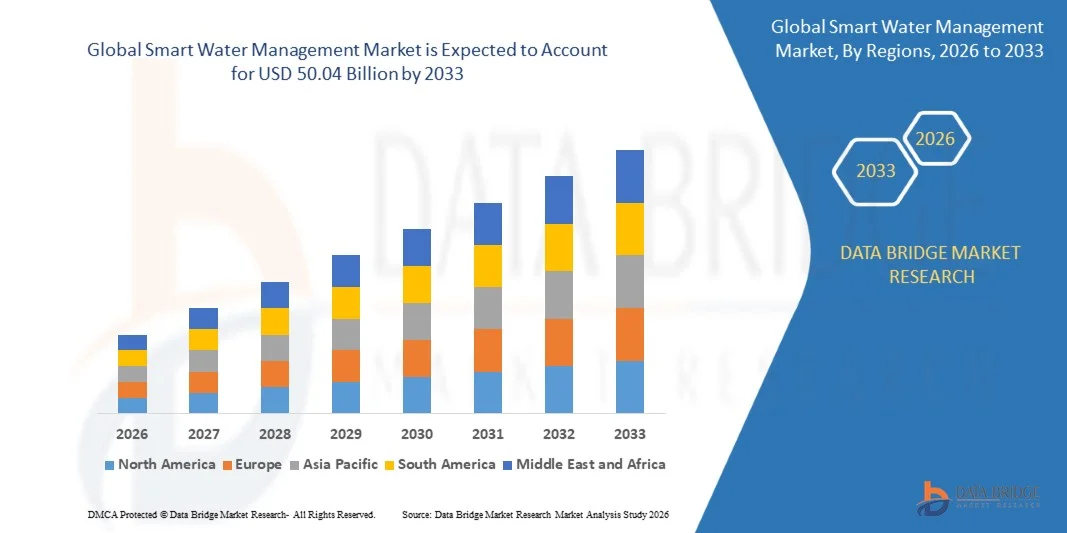
- The global smart water management market size was valued at USD 20.50 billion in 2025and is expected to reach USD 50.04 billion by 2033, at a CAGR of 11.80% during the forecast period
- The market growth is largely fuelled by the increasing global focus on water conservation, rising adoption of IoT-enabled monitoring systems, and growing demand for efficient water distribution infrastructure
- Expanding urbanization, aging water infrastructure, and government initiatives promoting digital water management solutions are accelerating investments in smart metering, leak detection, and advanced analytics technologies
Smart Water Management Market Analysis
- The market is witnessing strong growth due to rising concerns over water scarcity, increasing regulatory pressure for sustainable utility operations, and the need to modernize water supply systems with intelligent monitoring and automation solutions
- Governments and utility providers are actively investing in smart water networks, predictive maintenance systems, and real-time consumption analytics to improve water quality, operational transparency, and infrastructure resilience
- North America dominated the smart water management market with the largest revenue share in 2025, driven by increasing investments in aging water infrastructure modernization, widespread adoption of advanced metering technologies, and growing regulatory emphasis on sustainable water conservation
- Asia-Pacific region is expected to witness the highest growth rate in the global smart water management market, driven by increasing population growth, rising water scarcity concerns, large-scale infrastructure development, expanding industrialization, and strong government initiatives promoting smart city and digital utility transformation
- The AMI segment held the largest market revenue share in 2025 driven by the increasing deployment of advanced metering infrastructure that enables two-way communication, real-time monitoring, and automated billing systems. Utilities are prioritizing AMI adoption due to its ability to improve leak detection, optimize resource allocation, and enhance operational transparency. AMI systems also support predictive maintenance and customer engagement through detailed water consumption analytics. Government regulations encouraging smart infrastructure investments are further accelerating adoption globally
Report Scope and Smart Water Management Market Segmentation
|
Attributes |
Smart Water Management Key Market Insights |
|
Segments Covered |
· By Water Meter: AMR and AMI · By Advanced Water Meters: Meter Type and Meter Read Technology · By Solution: Enterprise Asset Management for Water and Waste water Utilities, Network Monitoring, Advanced Pressure Management, SCADA Systems for Water and Wastewater Utilities, Advanced Analytics, Meter Data Management (MDM) for Water, Residential Water Efficiency, and Smart Irrigation Management Systems · By Service: Professional Services, and Managed Services · By Automation Solution: Water Quality and Quantity Monitoring, Water Treatment and Automation, Pressure Control and Leakage Detection, and Analytics and Data Management · By End User: Commercial and Industrial, and Residential |
|
Countries Covered |
North America · U.S. · Canada · Mexico Europe · Germany · France · U.K. · Netherlands · Switzerland · Belgium · Russia · Italy · Spain · Turkey · Rest of Europe Asia-Pacific · China · Japan · India · South Korea · Singapore · Malaysia · Australia · Thailand · Indonesia · Philippines · Rest of Asia-Pacific Middle East and Africa · Saudi Arabia · U.A.E. · South Africa · Egypt · Israel · Rest of Middle East and Africa South America · Brazil · Argentina · Rest of South America |
|
Key Market Players |
• General Electric (U.S.) |
|
Market Opportunities |
• Expansion Of Smart Metering And Leak Detection Infrastructure |
|
Value Added Data Infosets |
In addition to the market insights such as market value, growth rate, market segments, geographical coverage, market players, and market scenario, the market report curated by the Data Bridge Market Research team includes in-depth expert analysis, import/export analysis, pricing analysis, production consumption analysis, and pestle analysis. |
Smart Water Management Market Trends
“Rising Adoption of IoT-Enabled Water Monitoring and Sustainable Resource Management”
- The growing global focus on water conservation, infrastructure modernization, and digital utility transformation is significantly shaping the smart water management market, as governments and industries increasingly prioritize intelligent systems for monitoring, controlling, and optimizing water resources. Smart water management solutions are gaining traction due to their ability to improve operational efficiency, reduce water losses, enhance leak detection, and support sustainable consumption. This trend is strengthening adoption across municipal, industrial, agricultural, and commercial sectors while encouraging technology providers to innovate with advanced analytics and automation platforms
- Increasing concerns regarding water scarcity, aging water infrastructure, and climate change are accelerating demand for smart metering, real-time monitoring, and predictive maintenance systems. Utility providers and municipalities are actively deploying IoT sensors, AI-based analytics, and cloud-connected platforms to improve water distribution, consumption visibility, and infrastructure resilience. This has also led to strategic collaborations between technology companies, utilities, and infrastructure developers to enhance system performance and long-term sustainability
- Digital transformation and sustainability priorities are influencing purchasing and infrastructure investment decisions, with organizations emphasizing efficient water usage, regulatory compliance, and reduced environmental impact. These factors are helping utility providers improve service quality, optimize operational costs, and strengthen resilience against water-related challenges. Companies are increasingly promoting smart water technologies through innovation initiatives, public-private partnerships, and sustainability-focused infrastructure projects
- For instance, in 2024, Xylem and Veolia expanded deployment of AI-enabled water monitoring platforms and smart metering solutions across municipal and industrial water systems to improve leak detection, consumption optimization, and water quality management. These initiatives were introduced in response to rising demand for sustainable infrastructure modernization and digital water management. The projects also strengthened operational efficiency, regulatory compliance, and long-term water security for participating organizations
- While demand for smart water management solutions is rapidly growing, sustained market expansion depends on infrastructure investment, cybersecurity protection, and cost-effective deployment of advanced digital systems. Companies are focusing on improving scalability, system interoperability, and data analytics capabilities to ensure broader adoption and long-term profitability
Smart Water Management Market Dynamics
Driver
“Growing Demand for Water Conservation, Infrastructure Modernization, and Digital Utility Solutions”
- Rising global concerns over water scarcity, non-revenue water losses, and aging infrastructure are major drivers for the smart water management market. Governments, utilities, and industries are increasingly adopting intelligent water technologies to optimize distribution networks, improve consumption efficiency, and enhance sustainability. Smart water management systems provide real-time monitoring, predictive maintenance, and automated control capabilities, enabling organizations to reduce operational waste and strengthen resource security
- Expanding applications across municipal utilities, industrial operations, agriculture, and commercial facilities are significantly influencing market growth. Smart water technologies support efficient resource allocation, leak prevention, water quality monitoring, and regulatory compliance, helping organizations improve performance while reducing environmental impact. Growing urbanization, population expansion, and climate resilience initiatives are further reinforcing market demand
- Technology providers, infrastructure developers, and water utilities are actively expanding smart water networks through product innovation, strategic partnerships, and large-scale infrastructure investments. These initiatives are supported by stronger environmental regulations, government funding programs, and increasing consumer awareness regarding sustainable resource management. They also encourage advancements in AI, IoT, and cloud-based water management systems
- For instance, in 2023, Suez and Siemens increased investments in digital water infrastructure solutions by expanding deployment of smart metering, remote monitoring, and predictive analytics systems for urban and industrial water networks. These developments followed increasing pressure to modernize infrastructure, improve efficiency, and address water scarcity challenges. Both companies also emphasized sustainability, operational transparency, and regulatory compliance to strengthen long-term market competitiveness
- Although rising sustainability concerns and infrastructure modernization strongly support growth, broader adoption depends on reducing deployment costs, improving system integration, and ensuring reliable digital security. Continued innovation in water analytics, infrastructure automation, and strategic policy support will be critical for long-term market expansion
Restraint/Challenge
“High Infrastructure Costs and Cybersecurity Risks in Digital Water Systems”
- The relatively high cost of implementing smart water management infrastructure remains a major challenge, particularly for developing economies and smaller utility providers. Deployment of advanced sensors, communication networks, analytics platforms, and automated control systems requires substantial capital investment. In addition, maintenance costs and system upgrades can further impact financial feasibility and market penetration
- Cybersecurity vulnerabilities and data privacy concerns remain significant barriers as water systems become increasingly digitized and interconnected. Smart water infrastructure relies heavily on real-time data exchange, cloud platforms, and networked devices, which may be exposed to cyber threats. These risks can discourage adoption among organizations concerned about operational disruptions and critical infrastructure security
- Integration challenges with existing legacy water infrastructure also impact market growth, as older systems may lack compatibility with advanced digital technologies. Retrofitting infrastructure can increase implementation complexity, operational downtime, and deployment expenses. Utilities must also invest in workforce training, system maintenance, and long-term digital resilience to maximize performance
- For instance, in 2024, several municipalities and industrial operators deploying advanced smart water systems reported delays and increased implementation costs due to cybersecurity compliance requirements, infrastructure compatibility issues, and capital expenditure constraints. These challenges affected deployment speed and highlighted the need for stronger investment strategies and digital security frameworks
- Overcoming these challenges will require cost-efficient technology solutions, enhanced cybersecurity protocols, expanded infrastructure funding, and stronger regulatory support. Collaboration between governments, utilities, and technology providers will be essential for unlocking the full long-term growth potential of the global smart water management market. Furthermore, improving system affordability, digital resilience, and infrastructure interoperability will be critical for widespread adoption
Smart Water Management Market Scope
The market is segmented on the basis of water meter, advanced water meters, solution, service, automation solution, and end user.
- By Water Meter
On the basis of water meter, the smart water management market is segmented into AMR and AMI. The AMI segment held the largest market revenue share in 2025 driven by the increasing deployment of advanced metering infrastructure that enables two-way communication, real-time monitoring, and automated billing systems. Utilities are prioritizing AMI adoption due to its ability to improve leak detection, optimize resource allocation, and enhance operational transparency. AMI systems also support predictive maintenance and customer engagement through detailed water consumption analytics. Government regulations encouraging smart infrastructure investments are further accelerating adoption globally.
The AMR segment is expected to witness steady growth from 2026 to 2033, driven by its cost-effectiveness and suitability for utilities transitioning from manual or conventional metering systems. AMR solutions improve meter reading efficiency, reduce labor costs, and provide foundational digitalization benefits without requiring full smart grid integration. Developing regions are increasingly adopting AMR systems to modernize water management infrastructure while balancing budget constraints. Continued utility modernization initiatives are expected to sustain long-term growth for this segment.
- By Advanced Water Meters
On the basis of advanced water meters, the smart water management market is segmented into Meter Type and Meter Read Technology. The Meter Read Technology segment accounted for the largest market revenue share in 2025 owing to rising demand for automated data collection, remote access, and enhanced infrastructure intelligence. Advanced reading technologies support efficient billing, operational optimization, and proactive maintenance strategies for utilities. Integration with cloud computing, IoT platforms, and AI analytics further strengthens their value proposition. Growing pressure to reduce water losses and improve service delivery is significantly supporting this segment’s expansion.
The Meter Type segment is projected to witness strong growth during the forecast period due to increasing innovation in digital metering technologies such as ultrasonic and electromagnetic meters. These advanced systems provide higher measurement accuracy, improved durability, and better adaptability to complex utility environments. Expanding smart city initiatives and water conservation programs are driving adoption. Manufacturers are also focusing on improving product efficiency and affordability to accelerate deployment across broader markets.
- By Solution
On the basis of solution, the smart water management market is segmented into Enterprise Asset Management for Water and Wastewater Utilities, Network Monitoring, Advanced Pressure Management, SCADA Systems for Water and Wastewater Utilities, Advanced Analytics, Meter Data Management (MDM) for Water, Residential Water Efficiency, and Smart Irrigation Management Systems. The Network Monitoring segment held the dominant market share in 2025 due to growing demand for real-time visibility into water distribution systems, rapid leak detection, and infrastructure optimization. Utilities increasingly rely on network monitoring to reduce non-revenue water losses and improve service reliability. The integration of IoT-enabled sensors and cloud platforms is enhancing system efficiency and operational decision-making. Rising concerns regarding aging infrastructure and water scarcity are further strengthening this segment.
The Advanced Analytics segment is anticipated to witness the fastest growth from 2026 to 2033 driven by increasing use of AI, machine learning, and predictive modeling technologies. These tools enable utilities to optimize resource allocation, forecast infrastructure failures, and improve long-term sustainability. Growing digital transformation strategies across municipal and industrial water sectors are accelerating investment. Advanced analytics is becoming critical for utilities seeking to improve resilience, regulatory compliance, and cost efficiency.
- By Service
On the basis of service, the smart water management market is segmented into Professional Services and Managed Services. The Professional Services segment held the largest market share in 2025 due to strong demand for consulting, infrastructure deployment, integration support, and technical expertise. Utilities and industries require professional services to effectively implement smart water technologies while ensuring system reliability and regulatory compliance. These services also support modernization of legacy infrastructure and optimization of operational performance. Increasing investments in water digitization projects are sustaining demand for specialized professional expertise.
The Managed Services segment is expected to witness rapid growth over the forecast period as utilities increasingly outsource operational monitoring, analytics management, and digital system maintenance. Managed services offer cost-effective scalability, continuous system optimization, and improved resource efficiency. Organizations are adopting these services to reduce operational complexity while maintaining high-performance digital infrastructure. Rising cloud adoption and remote monitoring trends are further strengthening this segment’s expansion.
- By Automation Solution
On the basis of automation solution, the smart water management market is segmented into Water Quality and Quantity Monitoring, Water Treatment and Automation, Pressure Control and Leakage Detection, and Analytics and Data Management. The Pressure Control and Leakage Detection segment dominated the market in 2025 driven by growing global concerns over water scarcity, aging utility infrastructure, and rising non-revenue water losses. These solutions help utilities rapidly detect leaks, optimize pressure systems, and reduce operational waste. Governments and utility operators are prioritizing deployment to improve sustainability and resource conservation. Technological advancements in sensor technologies and automation platforms are further accelerating market growth.
The Analytics and Data Management segment is projected to witness the fastest growth due to increasing adoption of AI-powered operational intelligence, cloud computing, and predictive maintenance solutions. Utilities are increasingly leveraging advanced data platforms to improve system performance, regulatory compliance, and infrastructure planning. Digital transformation initiatives and sustainability mandates are further driving this segment. Continuous innovation in big data analytics is expected to expand long-term opportunities.
- By End User
On the basis of end user, the smart water management market is segmented into Commercial and Industrial, and Residential. The Commercial and Industrial segment accounted for the largest market revenue share in 2025 owing to high water consumption levels, stringent sustainability regulations, and strong investment in infrastructure optimization. Industrial facilities, utilities, and commercial enterprises increasingly deploy smart water systems to reduce costs, improve compliance, and enhance resource efficiency. Advanced monitoring and automation solutions are essential for managing complex water usage environments. Rising environmental accountability is further supporting widespread adoption.
The Residential segment is expected to witness substantial growth from 2026 to 2033 driven by increasing smart home adoption, growing awareness regarding water conservation, and expanding deployment of intelligent metering systems. Consumers are increasingly investing in smart water technologies to monitor consumption, detect leaks, and reduce utility expenses. Urbanization, digital home ecosystems, and sustainability-focused consumer behavior are further strengthening market expansion. Continued technological innovation is expected to enhance residential adoption globally.
Smart Water Management Market Regional Analysis
- North America dominated the smart water management market with the largest revenue share in 2025, driven by increasing investments in aging water infrastructure modernization, widespread adoption of advanced metering technologies, and growing regulatory emphasis on sustainable water conservation
- Utilities and industries in the region highly prioritize operational efficiency, leak detection, and real-time water monitoring solutions to improve service delivery, reduce non-revenue water losses, and strengthen infrastructure resilience
- This widespread adoption is further supported by advanced digital infrastructure, strong government funding programs, and the growing integration of IoT, AI, and cloud-based analytics, establishing smart water management as a critical solution for municipal, industrial, and commercial sectors
U.S. Smart Water Management Market Insight
The U.S. smart water management market captured the largest revenue share in 2025 within North America, fueled by rising concerns regarding water scarcity, aging utility systems, and increasing investments in infrastructure digitization. Utilities are increasingly prioritizing advanced metering infrastructure, predictive maintenance, and AI-powered analytics to improve water distribution efficiency and regulatory compliance. The growing demand for smart city development, coupled with strong adoption of IoT-enabled water systems, is significantly driving market expansion. Moreover, increasing public and private investments in sustainable resource management are further strengthening the U.S. market.
Europe Smart Water Management Market Insight
The Europe smart water management market is expected to witness the fastest growth rate from 2026 to 2033, primarily driven by stringent environmental regulations, sustainability mandates, and growing demand for water conservation technologies. Increasing urbanization, climate resilience initiatives, and digital transformation strategies are accelerating the adoption of advanced water monitoring and automation systems. European utilities are actively modernizing infrastructure to improve efficiency, reduce water losses, and strengthen long-term sustainability. The region is also experiencing strong growth across municipal, agricultural, and industrial applications through smart water technology integration.
U.K. Smart Water Management Market Insight
The U.K. smart water management market is expected to witness the fastest growth rate from 2026 to 2033, driven by rising infrastructure modernization initiatives, increasing regulatory focus on water efficiency, and growing investments in digital utility systems. Concerns regarding water scarcity, leakage reduction, and climate adaptation are encouraging utilities and municipalities to implement advanced metering and analytics solutions. The country’s strong technological ecosystem and emphasis on sustainability are expected to further accelerate smart water management deployment.
Germany Smart Water Management Market Insight
The Germany smart water management market is expected to witness the fastest growth rate from 2026 to 2033, fueled by increasing awareness of sustainable water infrastructure, industrial efficiency, and advanced environmental technologies. Germany’s highly developed industrial base, combined with its focus on engineering excellence and digital transformation, is promoting widespread adoption of smart water systems across municipal and industrial sectors. The integration of IoT-enabled monitoring, advanced automation, and data analytics is becoming increasingly prevalent, aligning with Germany’s sustainability and infrastructure modernization priorities.
Asia-Pacific Smart Water Management Market Insight
The Asia-Pacific smart water management market is expected to witness the fastest growth rate from 2026 to 2033, driven by rapid urbanization, population growth, increasing water scarcity concerns, and expanding infrastructure development across major economies such as China, India, and Japan. Government-led smart city initiatives, industrial growth, and rising awareness regarding water conservation are significantly boosting market adoption. Furthermore, the region’s growing role as a manufacturing hub for digital infrastructure technologies is improving affordability and accelerating deployment across broader end-user sectors.
Japan Smart Water Management Market Insight
The Japan smart water management market is expected to witness the fastest growth rate from 2026 to 2033 due to the country’s advanced technological ecosystem, strong focus on infrastructure resilience, and increasing investments in water sustainability. Japan’s emphasis on precision engineering and digital innovation is driving adoption of intelligent metering, predictive analytics, and automated water quality monitoring systems. The integration of smart water technologies with broader urban infrastructure modernization projects is further fueling market growth. In addition, the country’s aging infrastructure and sustainability priorities are increasing long-term demand for efficient water management solutions.
China Smart Water Management Market Insight
The China smart water management market accounted for the largest market revenue share in Asia-Pacific in 2025, attributed to rapid urbanization, expanding industrialization, and strong government support for smart city infrastructure development. China represents one of the largest global markets for digital utility technologies, with smart water systems increasingly deployed across municipal, industrial, and agricultural sectors. The push toward sustainable urban development, large-scale infrastructure investments, and strong domestic technology manufacturing capabilities are key factors propelling China’s market leadership.
Smart Water Management Market Share
The Smart Water Management industry is primarily led by well-established companies, including:
- General Electric (U.S.)
- ABB Ltd. (Switzerland)
- Itron Inc. (U.S.)
- Schneider Electric SE (France)
- IBM Corporation (U.S.)
- Sensus USA Inc. (U.S.)
- Honeywell International Inc. (U.S.)
- Siemens AG (Germany)
- Neptune Technology Group Inc. (U.S.)
- Radius Synergies International Pvt Ltd. (India)
- Trimble Inc. (U.S.)
- TaKaDu Ltd. (Israel)
- SenzIoT (India)
- SUEZ SA (France)
- Oracle Corporation (U.S.)
i2O Water Ltd. (U.K.)
Latest Developments in Global Smart Water Management Market
- In April 2025, SUEZ, Strategic Partnership, partnered with the French National Centre for Scientific Research (CNRS) to advance sustainable water and waste management through innovation in smart water technologies. This collaboration is focused on developing advanced solutions for resource efficiency, pollution control, and real-time monitoring. The initiative strengthens SUEZ’s technological leadership, accelerates sustainable infrastructure development, and enhances the global smart water management market through research-driven advancements
- In March 2025, Honeywell International Inc., Technology Integration Partnership, integrated Verizon 5G connectivity into its smart utility meters to improve autonomous water and energy management capabilities. This development enhances operational efficiency, real-time monitoring, and utility infrastructure resilience. The partnership significantly strengthens digital utility modernization and supports broader adoption of advanced smart water management systems globally
- In January 2025, Siemens, Strategic Collaboration, partnered with KETOS to deliver integrated automation and real-time water analytics solutions for municipal and industrial water operators. This collaboration improves water quality monitoring, sustainability performance, and operational decision-making. The initiative expands smart water technology capabilities and strengthens global market competitiveness through enhanced digital infrastructure solutions
- In December 2024, Xylem, Acquisition, acquired Idrica to integrate advanced water data management and analytics capabilities into its digital water platform. This acquisition enhances Xylem’s smart water intelligence solutions, strengthens predictive analytics capabilities, and improves infrastructure optimization. The development reinforces market innovation and accelerates digital transformation in global water management systems
- In April 2024, SUEZ, Strategic Collaboration, partnered with Vodafone to accelerate remote water meter deployment through Narrowband IoT (NB-IoT) communication networks. This initiative improves utility connectivity, real-time monitoring, and operational scalability while expanding access to advanced metering infrastructure. The collaboration significantly supports global adoption of smart water technologies and infrastructure modernization
- In January 2024, ABB, Acquisition, acquired Real Tech to strengthen its smart water management portfolio through advanced optical sensor and water quality monitoring technologies. This development expands ABB’s capabilities in digital water infrastructure, improves water monitoring precision, and strengthens its competitive positioning in sustainable water technology markets
SKU-
Get online access to the report on the World's First Market Intelligence Cloud

- Interactive Data Analysis Dashboard
- Company Analysis Dashboard for high growth potential opportunities
- Research Analyst Access for customization & queries
- Competitor Analysis with Interactive dashboard
- Latest News, Updates & Trend analysis
- Harness the Power of Benchmark Analysis for Comprehensive Competitor Tracking
Research Methodology
Data collection and base year analysis are done using data collection modules with large sample sizes. The stage includes obtaining market information or related data through various sources and strategies. It includes examining and planning all the data acquired from the past in advance. It likewise envelops the examination of information inconsistencies seen across different information sources. The market data is analysed and estimated using market statistical and coherent models. Also, market share analysis and key trend analysis are the major success factors in the market report. To know more, please request an analyst call or drop down your inquiry.
The key research methodology used by DBMR research team is data triangulation which involves data mining, analysis of the impact of data variables on the market and primary (industry expert) validation. Data models include Vendor Positioning Grid, Market Time Line Analysis, Market Overview and Guide, Company Positioning Grid, Patent Analysis, Pricing Analysis, Company Market Share Analysis, Standards of Measurement, Global versus Regional and Vendor Share Analysis. To know more about the research methodology, drop in an inquiry to speak to our industry experts.
Customization Available
Data Bridge Market Research is a leader in advanced formative research. We take pride in servicing our existing and new customers with data and analysis that match and suits their goal. The report can be customized to include price trend analysis of target brands understanding the market for additional countries (ask for the list of countries), clinical trial results data, literature review, refurbished market and product base analysis. Market analysis of target competitors can be analyzed from technology-based analysis to market portfolio strategies. We can add as many competitors that you require data about in the format and data style you are looking for. Our team of analysts can also provide you data in crude raw excel files pivot tables (Fact book) or can assist you in creating presentations from the data sets available in the report.












