


What is Smart Wound Care Consumables Market Size and Overview ?
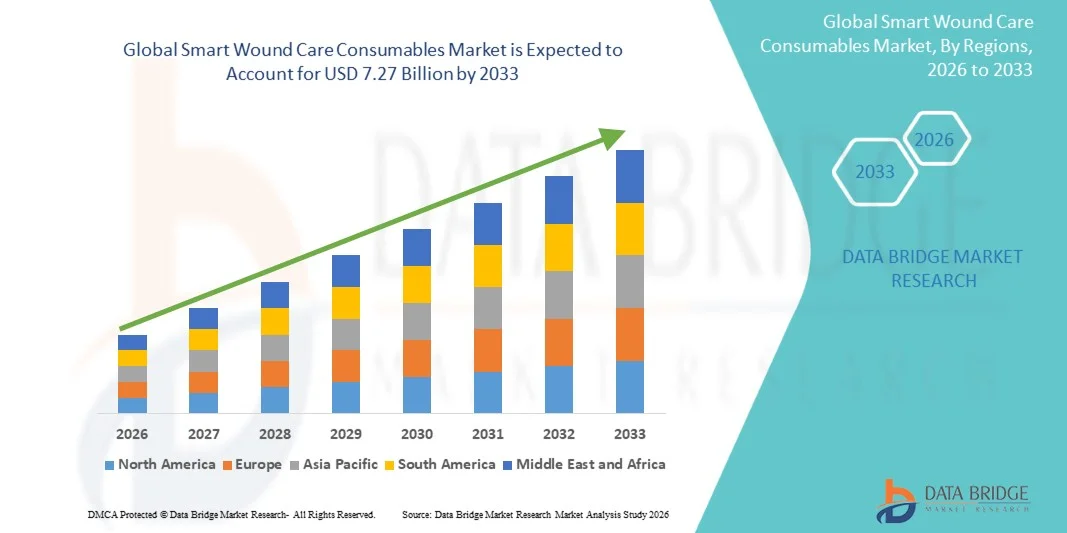
- The Smart Wound Care Consumables Market was valued at USD 1.96 billion in 2025 and is projected to reach USD 7.27 billion by 2033, growing at a CAGR of 17.80% from 2026 to 2033. The market is witnessing strong growth due to the rising prevalence of chronic wounds, increasing incidence of diabetes and obesity, growing elderly population, and continuous advancements in smart wound monitoring technologies.
- The increasing burden of diabetic foot ulcers, pressure ulcers, and surgical wounds, coupled with the demand for faster healing and infection prevention, is driving healthcare providers toward advanced smart wound care consumables. Sensor-enabled dressings, antimicrobial wound products, and AI-assisted wound monitoring solutions are increasingly replacing conventional wound care products by enabling real-time wound assessment, reducing hospitalization, and improving patient outcomes.
Market Size & Forecast
- Global Market Value (2025): USD 1.96 Billion
- Expected Market Value (2033): USD 7.27 Billion
- Forecast CAGR (2026–2033): 17.80%
- Leading Region in 2025: North America
- Fastest Growing Region: Asia-Pacific
Key Market Trends & Insights
- North America dominated the Smart Wound Care Consumables Market with the largest revenue share of 39.12% in 2025, supported by advanced healthcare infrastructure, high adoption of innovative wound care technologies, and favorable reimbursement policies.
- The Advanced Wound Dressings segment led the market with a 38.94% share in 2025, driven by increasing demand for effective wound healing, infection control, and moisture-balanced dressings.
- Asia-Pacific is expected to be the fastest-growing region at a CAGR of 17.98% from 2026 to 2033, fueled by rising healthcare expenditure, increasing diabetic population, expanding hospital infrastructure, and growing awareness of advanced wound management.
- Smart Bandages & Sensor-Integrated Dressings are the fastest-growing product segment, projected to register a CAGR of 18.2%, reflecting growing demand for continuous wound monitoring and personalized treatment.
- The Chronic Wounds segment dominates the wound type category with a 43.26% revenue share in 2025, led by the increasing prevalence of diabetic foot ulcers, venous leg ulcers, and pressure injuries.
- Hospitals account for 52.47% of the market, preferred due to the high volume of complex wound treatments, surgical procedures, and adoption of advanced wound care technologies.
- The Infection Detection Technology segment is the fastest-growing technology category, with a CAGR of 7.5%, driven by increasing focus on early infection diagnosis, reduced treatment costs, and improved patient outcomes.
Report Scope and Smart Wound Care Consumables Market Segmentation
|
Attributes |
Smart Wound Care Consumables Key Market Insights |
|
Segments Covered |
|
|
Countries Covered |
North America
Europe
Asia-Pacific
Middle East and Africa
South America
|
|
Key Market Players |
|
|
Market Opportunities |
|
|
Value Added Data Infosets |
In addition to the insights on market scenarios such as market value, growth rate, segmentation, geographical coverage, and major players, the market reports curated by the Data Bridge Market Research also include import export analysis, production capacity overview, production consumption analysis, price trend analysis, climate change scenario, supply chain analysis, value chain analysis, raw material/consumables overview, vendor selection criteria, PESTLE Analysis, Porter Analysis, and regulatory framework. |
What is the Key Trend in Smart Wound Care Consumables Market ?
Trend: Rising Adoption of Smart Sensor-Integrated Wound Dressings
Healthcare providers are increasingly adopting smart wound care consumables equipped with sensors capable of monitoring moisture levels, temperature, pH, and early signs of infection in real time. These advanced dressings reduce unnecessary dressing changes, improve healing outcomes, and enable clinicians to remotely monitor patients through connected digital health platforms. The growing integration of IoT, wearable technologies, and AI-driven wound analytics is transforming chronic wound management by enabling personalized treatment plans and reducing hospital readmissions.
Smart Wound Care Consumables Market Dynamics
Key Market Driver: Increasing Prevalence of Chronic Wounds and Diabetes
The growing global burden of chronic wounds, particularly diabetic foot ulcers, pressure ulcers, and venous leg ulcers, is significantly driving demand for smart wound care consumables. Rising diabetes prevalence, an expanding geriatric population, and increasing surgical procedures have accelerated the adoption of advanced wound dressings capable of monitoring healing progress and detecting infections at an early stage. Healthcare providers are increasingly utilizing smart consumables to reduce healing time, improve patient outcomes, and lower long-term treatment costs.
Key Restraint/Challenge: High Cost of Smart Wound Care Consumables
A major challenge for the Smart Wound Care Consumables Market is the relatively high cost associated with sensor-enabled wound dressings and digital monitoring technologies. These products incorporate advanced biosensors, wireless connectivity, and specialized materials that increase manufacturing costs compared with conventional wound dressings. Limited reimbursement coverage in several developing countries and budget constraints among healthcare facilities continue to restrict widespread adoption, particularly in cost-sensitive markets.
The commercialization of next-generation wireless wound monitoring systems during 2025 highlighted the increasing investment required for sensor technologies, cloud connectivity, and AI-enabled wound analytics, reflecting the financial barriers that smaller healthcare providers may face when transitioning from traditional wound care products.
Key Market Opportunity: Integration of AI and Autonomous Vehicle Validation Platforms
The integration of artificial intelligence with smart wound care consumables presents significant growth opportunities across the healthcare sector. AI-powered wound assessment platforms can automatically analyze wound dimensions, tissue composition, healing progression, and infection risk using data collected from intelligent dressings and mobile imaging solutions. Growing adoption of home healthcare, telemedicine, and remote patient monitoring, combined with cloud-connected wound management platforms, is expected to create substantial opportunities across North America, Europe, and rapidly developing healthcare markets in Asia-Pacific, Latin America, and the Middle East.
Smart Wound Care Consumables Market Scope
The smart wound care consumables market is segmented on the basis of product type, wound type, application, end user, technology, distribution channel, usage, deployment, and support & services.
- By Product Type
On the basis of product type, the Smart Wound Care Consumables Market is segmented into advanced wound dressings, antimicrobial dressings, hydrocolloid dressings, foam dressings, alginate dressings, hydrogel dressings, film dressings, collagen dressings, negative pressure wound therapy consumables, and smart bandages & sensor-integrated dressings. The advanced wound dressings segment dominated the market with a 38.94% share in 2025 due to their superior moisture management, faster healing capability, infection prevention, and widespread use in the treatment of chronic and post-surgical wounds. Increasing adoption by hospitals, specialty wound care clinics, and home healthcare providers, coupled with continuous product innovation, has strengthened the segment's leadership in the global market.
The smart bandages & sensor-integrated dressings segment is expected to witness the fastest CAGR of 18.2% from 2026 to 2033, driven by increasing adoption of real-time wound monitoring technologies, wireless connectivity, and AI-enabled wound assessment solutions. These advanced products enable continuous monitoring of wound conditions such as temperature, moisture, and infection biomarkers, supporting personalized treatment and reducing hospital readmissions.
- By Wound Type
On the basis of wound type, the Smart Wound Care Consumables Market is segmented into chronic wounds, acute wounds, surgical wounds, burns, and traumatic wounds. The chronic wounds segment dominated the market with a 43.26% share in 2025 due to the increasing prevalence of diabetic foot ulcers, pressure ulcers, and venous leg ulcers worldwide. Rising geriatric population, growing diabetes incidence, and the need for long-term wound management continue to drive demand for advanced smart wound care consumables.
The surgical wounds segment is anticipated to witness the fastest CAGR of 17.4% from 2026 to 2033, driven by the increasing number of surgical procedures globally, rising emphasis on preventing surgical site infections, and growing utilization of smart wound monitoring technologies that improve post-operative recovery and reduce healthcare costs.
- By Application
On the basis of application, the Smart Wound Care Consumables Market is segmented into diabetic foot ulcers, pressure ulcers, venous leg ulcers, arterial ulcers, surgical site infections, burns, and others. The diabetic foot ulcers segment dominated the market with a 31.88% share in 2025 due to the rapidly increasing diabetic population, growing awareness regarding early wound management, and high demand for advanced dressings capable of accelerating healing while minimizing infection risks. The adoption of sensor-enabled wound monitoring products and antimicrobial dressings has further strengthened the growth of this segment.
The surgical site infections segment is expected to witness the fastest CAGR of 18.6% from 2026 to 2033, driven by increasing surgical volumes, greater focus on infection prevention, and growing use of intelligent wound dressings capable of providing continuous monitoring and early detection of wound complications.
- By End User
On the basis of end user, the Smart Wound Care Consumables Market is segmented into hospitals, specialty wound care clinics, ambulatory surgical centers, home healthcare settings, and long-term care facilities. The hospitals segment dominated the market with a 52.47% share in 2025 due to the high volume of chronic wound treatments, trauma cases, and surgical procedures requiring advanced wound care products. Hospitals continue to invest in smart wound management technologies that improve clinical outcomes, reduce treatment duration, and minimize healthcare-associated infections.
The home healthcare settings segment is expected to witness the fastest CAGR of 18.8% from 2026 to 2033, driven by increasing preference for home-based treatment, expansion of remote patient monitoring services, rising healthcare costs, and growing availability of connected wound care solutions that enable clinicians to monitor patients remotely.
- By Technology
On the basis of technology, the Smart Wound Care Consumables Market is segmented into moisture monitoring, temperature monitoring, infection detection, pH monitoring, and drug delivery-enabled dressings. The moisture monitoring segment dominated the market with a 30.42% share in 2025 due to its critical role in maintaining an optimal wound healing environment and reducing unnecessary dressing changes. Healthcare providers increasingly utilize moisture-monitoring wound dressings to accelerate healing, reduce infection risks, and improve patient comfort across both acute and chronic wound care settings.
The infection detection segment is expected to witness the fastest CAGR of 18.5% from 2026 to 2033, driven by growing demand for early diagnosis of wound infections, integration of biosensors into wound dressings, and increasing emphasis on reducing hospital readmissions through proactive wound monitoring technologies.
- By Distribution Channel
On the basis of distribution channel, the Smart Wound Care Consumables Market is segmented into direct sales, medical device distributors, retail pharmacies, and online channels. The medical device distributors segment dominated the market with a 44.18% share in 2025 due to their extensive distribution networks, long-standing partnerships with hospitals and specialty wound care centers, and ability to ensure timely availability of advanced wound care consumables across developed and emerging markets. Their strong after-sales support, product accessibility, and inventory management capabilities continue to reinforce the dominance of this segment.
The online channels segment is expected to witness the fastest CAGR of 17.9% from 2026 to 2033, driven by the rapid growth of digital healthcare platforms, increasing adoption of e-commerce for medical supplies, expanding home healthcare services, and the convenience of direct-to-patient purchasing. Growing internet penetration and improved logistics infrastructure are further supporting segment growth globally.
- By Usage
On the basis of usage, the Smart Wound Care Consumables Market is segmented into single-use consumables and reusable components. The single-use consumables segment dominated the market with a 71.36% share in 2025 due to increasing emphasis on infection prevention, reduced cross-contamination risks, and strict regulatory guidelines supporting disposable wound care products. Hospitals and healthcare facilities continue to prefer single-use smart dressings and monitoring consumables to improve patient safety and minimize healthcare-associated infections.
The reusable components segment is expected to witness the fastest CAGR of 18.1% from 2026 to 2033, driven by technological advancements in reusable sensor platforms, increasing focus on cost optimization, and growing adoption of sustainable healthcare solutions. Improvements in sterilization technologies and reusable monitoring devices are expected to further accelerate market expansion.
- By Deployment
On the basis of deployment, the Smart Wound Care Consumables Market is segmented into hospital-based monitoring and remote patient monitoring. The hospital-based monitoring segment dominated the market with a 63.84% share in 2025 due to the high concentration of complex wound management procedures performed in hospitals, availability of specialized wound care professionals, and increasing investment in advanced digital wound monitoring systems. Hospitals continue to account for the largest utilization of smart wound care consumables for post-surgical care and chronic wound treatment.
The remote patient monitoring segment is expected to witness the fastest CAGR of 18.0% from 2026 to 2033, driven by increasing adoption of telemedicine, expansion of home healthcare, growing elderly populations, and rising demand for continuous wound monitoring outside hospital settings. Integration of connected wound dressings with cloud-based healthcare platforms is further supporting widespread adoption.
Smart Wound Care Consumables Market Regional Analysis
North America dominated the smart wound care consumables market and accounted for the largest revenue share of 39.12% in 2025, supported by advanced healthcare infrastructure, high prevalence of chronic wounds, favorable reimbursement policies, and widespread adoption of innovative wound care technologies. The region also benefits from strong investment in digital healthcare, increasing adoption of AI-enabled wound monitoring platforms, and the presence of leading wound care manufacturers. Growing demand for home healthcare and remote patient monitoring continues to strengthen North America's leadership in the global market.
U.S. Smart Wound Care Consumables Market Insight
The U.S. smart wound care consumables market is experiencing significant growth due to the increasing prevalence of diabetes, obesity, chronic wounds, and an aging population. Rising healthcare expenditure, growing adoption of connected wound monitoring systems, and increasing use of AI-enabled wound assessment technologies are driving demand across hospitals, ambulatory surgical centers, and home healthcare settings. In addition, favorable reimbursement policies and continuous technological innovation continue to accelerate market expansion.
Europe Smart Wound Care Consumables Market Insight
The Europe smart wound care consumables market remains a major contributor to global revenue, driven by advanced healthcare systems, increasing awareness regarding chronic wound management, and growing investments in innovative wound care technologies. Strong government initiatives supporting digital healthcare, combined with increasing adoption of sensor-enabled dressings and antimicrobial wound care products, continue to support regional market growth.
U.K. Smart Wound Care Consumables Market Insight
The U.K. smart wound care consumables market is witnessing steady growth due to rising incidence of chronic wounds, increasing healthcare digitization, and growing emphasis on reducing hospital admissions through advanced wound monitoring technologies. Expansion of community healthcare services, home-based wound care programs, and greater utilization of AI-supported wound assessment solutions are further contributing to market development.
Germany Smart Wound Care Consumables Market Insight
The Germany smart wound care consumables market is expanding steadily due to its advanced medical technology sector, strong healthcare infrastructure, and increasing investment in innovative wound management solutions. Hospitals and specialty wound care centers are increasingly adopting sensor-integrated dressings and digital wound monitoring technologies to improve treatment outcomes and reduce overall healthcare costs. Continuous product innovation and supportive healthcare policies are further driving market growth.
Asia-Pacific Smart Wound Care Consumables Market Insight
The Asia-Pacific smart wound care consumables market is expected to witness the fastest growth, driven by increasing healthcare expenditure, rapidly expanding diabetic population, improving healthcare infrastructure, and rising awareness regarding advanced wound care. Countries such as China, India, Japan, and South Korea are investing significantly in digital healthcare technologies, supporting increased adoption of smart wound care consumables across hospitals and home healthcare settings.
Japan Smart Wound Care Consumables Market Insight
The Japan smart wound care consumables market is witnessing consistent growth due to the country's rapidly aging population, increasing demand for advanced wound care products, and strong focus on healthcare innovation. Growing adoption of remote patient monitoring technologies, smart dressings, and AI-assisted wound management platforms is improving clinical outcomes while reducing hospitalization rates.
China Smart Wound Care Consumables Market Insight
The China smart wound care consumables market is growing rapidly due to increasing prevalence of diabetes, expanding healthcare infrastructure, and rising government investments in medical technology. Growing adoption of advanced wound dressings, connected wound monitoring solutions, and AI-enabled diagnostic platforms across hospitals and community healthcare centers is significantly boosting market demand. In addition, increasing healthcare awareness and rapid technological advancements are positioning China as one of the fastest-growing markets for smart wound care consumables globally.
Smart Wound Care Consumables Market Share
The Smart Wound Care Consumables industry is primarily led by well-established companies, including:
- Smith+Nephew plc (U.K.)
- Mölnlycke Health Care AB (Sweden)
- Convatec Group PLC (U.K.)
- Coloplast A/S (Denmark)
- 3M Company (U.S.)
- Medtronic plc (Ireland)
- Solventum Corporation (U.S.)
- Cardinal Health Inc. (U.S.)
- Paul Hartmann AG (Germany)
- Essity AB (Sweden)
- Braun SE (Germany)
- Lohmann & Rauscher GmbH & Co. KG (Germany)
- Integra LifeSciences Holdings Corporation (U.S.)
- Organogenesis Holdings Inc. (U.S.)
- MiMedx Group, Inc. (U.S.)
- Urgo Medical (France)
- Winner Medical Co., Ltd. (China)
- Advancis Medical Ltd. (U.K.)
- DeRoyal Industries, Inc. (U.S.)
- DermaRite Industries, LLC (U.S.)
- Hollister Incorporated (U.S.)
- Medline Industries, LP (U.S.)
- MedSkin Solutions Dr. Suwelack AG (Germany)
- Nitto Denko Corporation (Japan)
- Axio Biosolutions Pvt. Ltd. (India)
- PolyMedics Innovations GmbH (Germany)
- BioMonde (U.K.)
- Kerecis (Iceland)
- Shield Line (India)
- Zhejiang Longterm Medical Technology Co., Ltd. (China)
- Healthium Medtech Limited (India)
- Winner Medical Group (China)
- Advanced Medical Solutions Group plc (U.K.)
- Tissue Analytics (U.S.)
Latest Developments in Smart Wound Care Consumables Market
- In October 2025, Smith+Nephew plc launched an advanced generation of its smart wound management platform featuring sensor-enabled dressings capable of continuously monitoring wound moisture and temperature. The new solution enhances real-time wound assessment, supports remote patient monitoring, and enables clinicians to optimize treatment decisions. This development strengthens Smith+Nephew’s position in the smart wound care consumables market by improving healing outcomes, reducing unnecessary dressing changes, and advancing digital wound management.
- In August 2025, Mölnlycke Health Care AB expanded its portfolio of advanced antimicrobial wound care consumables by introducing next-generation foam dressings with enhanced exudate management and infection prevention capabilities. The products are designed for chronic wound treatment and home healthcare settings, improving patient comfort while reducing healthcare costs. The expansion reinforces the company's competitive position through continuous product innovation and broader clinical applications.
- In May 2025, Convatec Group PLC announced the expansion of its connected wound care ecosystem by integrating AI-powered wound assessment capabilities with its advanced dressing portfolio. The platform enables healthcare professionals to monitor wound progression remotely through digital imaging and predictive analytics, improving treatment accuracy and supporting value-based healthcare delivery. This innovation strengthens Convatec's leadership in digital wound care technologies.
- In November 2024, Solventum Corporation introduced an enhanced portfolio of antimicrobial wound dressings designed with improved moisture balance and infection control technologies. The upgraded consumables provide longer wear time, improved patient comfort, and reduced dressing replacement frequency. The product launch strengthens the company's advanced wound care offering while supporting healthcare providers in managing chronic and post-operative wounds more efficiently.
- In June 2023, Medtronic plc collaborated with leading healthcare institutions to evaluate next-generation remote wound monitoring technologies for chronic wound management. The initiative focused on integrating digital wound monitoring systems with connected healthcare platforms to improve patient outcomes, reduce hospital readmissions, and support home-based wound care. The collaboration highlights the growing importance of smart wound care consumables in modern digital healthcare ecosystems.

- Interactive Data Analysis Dashboard
- Company Analysis Dashboard for high growth potential opportunities
- Research Analyst Access for customization & queries
- Competitor Analysis with Interactive dashboard
- Latest News, Updates & Trend analysis
- Harness the Power of Benchmark Analysis for Comprehensive Competitor Tracking
Data collection and base year analysis are done using data collection modules with large sample sizes. The stage includes obtaining market information or related data through various sources and strategies. It includes examining and planning all the data acquired from the past in advance. It likewise envelops the examination of information inconsistencies seen across different information sources. The market data is analysed and estimated using market statistical and coherent models. Also, market share analysis and key trend analysis are the major success factors in the market report. To know more, please request an analyst call or drop down your inquiry.
The key research methodology used by DBMR research team is data triangulation which involves data mining, analysis of the impact of data variables on the market and primary (industry expert) validation. Data models include Vendor Positioning Grid, Market Time Line Analysis, Market Overview and Guide, Company Positioning Grid, Patent Analysis, Pricing Analysis, Company Market Share Analysis, Standards of Measurement, Global versus Regional and Vendor Share Analysis. To know more about the research methodology, drop in an inquiry to speak to our industry experts.
Data Bridge Market Research is a leader in advanced formative research. We take pride in servicing our existing and new customers with data and analysis that match and suits their goal. The report can be customized to include price trend analysis of target brands understanding the market for additional countries (ask for the list of countries), clinical trial results data, literature review, refurbished market and product base analysis. Market analysis of target competitors can be analyzed from technology-based analysis to market portfolio strategies. We can add as many competitors that you require data about in the format and data style you are looking for. Our team of analysts can also provide you data in crude raw excel files pivot tables (Fact book) or can assist you in creating presentations from the data sets available in the report.













