


Smartphone Sensors Market Size
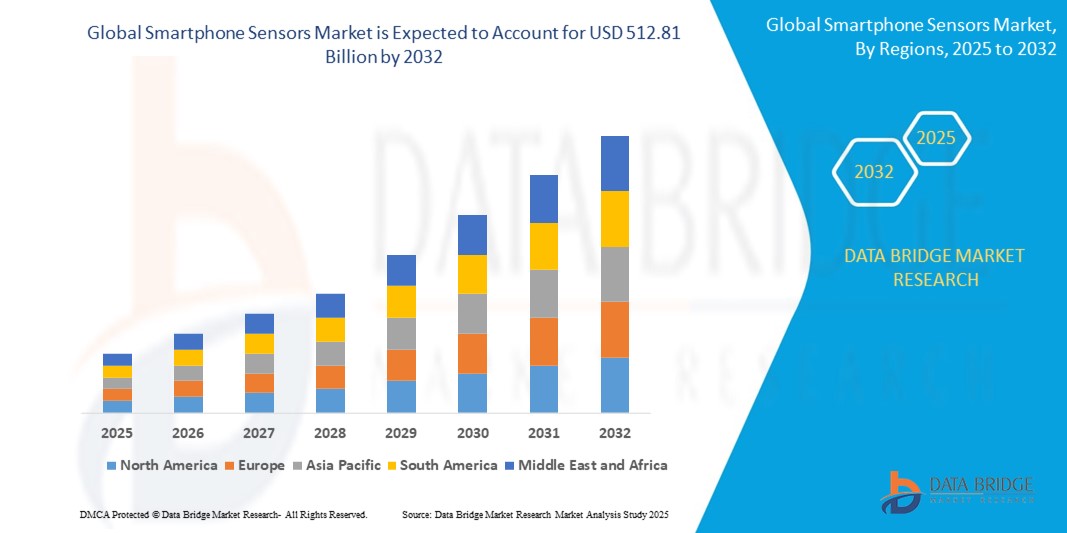
- The global Smartphone Sensors market size was valued at USD 145.54 billion in 2024 and is expected to reach USD 512.81 billion by 2032, at a CAGR of 17.05% during the forecast period
- The market’s robust growth is driven by increasing smartphone penetration, advancements in sensor technologies, and rising demand for enhanced user experiences in applications such as gaming, health monitoring, and augmented reality (AR).
- The integration of artificial intelligence (AI) and Internet of Things (IoT) in smartphones, coupled with growing investments in 5G-enabled devices, is significantly accelerating the adoption of advanced sensors, positioning the market as a critical component of the consumer electronics ecosystem.
Smartphone Sensors Market Analysis
- Smartphone sensors encompass a range of technologies, including biometric, image, and motion sensors, that enable functionalities like facial recognition, high-quality imaging, and motion detection, making them essential for modern smartphones and wearables.
- The escalating demand for smartphone sensors is fueled by their role in supporting AI-driven features, 5G connectivity, and health monitoring applications, alongside increasing investments in sensor miniaturization and energy efficiency.
- North America held the largest revenue share of approximately 35.20% in 2024, driven by a strong technological infrastructure, high smartphone adoption rates, and the presence of key players like Apple Inc. and Qualcomm Incorporated in the United States.
- The Asia-Pacific region is expected to register the fastest CAGR of 18.5% from 2025 to 2032, propelled by rapid smartphone penetration, government-backed 5G initiatives, and manufacturing hubs in countries like China, India, and South Korea.
- Among product types, image sensors dominated the market with a revenue share of over 39.11% in 2024, attributed to their critical role in enhancing camera capabilities for photography and video applications in smartphones.
Report Scope and Smartphone Sensors Market Segmentation
|
Attributes |
Smartphone Sensors Key Market Insights |
|
Segments Covered |
|
|
Countries Covered |
North America
Europe
Asia-Pacific
Middle East and Africa
South America
|
|
Key Market Players |
|
|
Market Opportunities |
|
|
Value Added Data Infosets |
In addition to the insights on market scenarios such as market value, growth rate, segmentation, geographical coverage, and major players, the market reports curated by the Data Bridge Market Research also include in-depth expert analysis, pricing analysis, brand share analysis, consumer survey, demography analysis, supply chain analysis, value chain analysis, raw material/consumables overview, vendor selection criteria, PESTLE Analysis, Porter Analysis, and regulatory framework. |
Smartphone Sensors Market Trends
“Advancements in AI-Driven and 5G-Enabled Sensor Technologies”
- A key trend in the global smartphone sensors market is the integration of AI and machine learning with sensors, enabling advanced features like real-time image processing, facial recognition, and environmental monitoring.
- For instance, in September 2023, Sony Corporation introduced a new range of CMOS image sensors with AI processing capabilities, enhancing smartphone camera performance for low-light conditions and AR applications.
- The adoption of 5G technology is driving demand for sensors that support high-speed data processing, such as GPS and motion sensors, to enable seamless connectivity and real-time applications.
- Advancements in biometric sensors, such as fingerprint and iris recognition, are enhancing security features in smartphones, with companies like Qualcomm launching advanced fingerprint scanning technologies in June 2018.
- This trend toward AI-driven, 5G-enabled, and miniaturized sensors is reshaping smartphone functionalities, particularly in high-end devices and wearables, with companies like Samsung and OmniVision developing tailored solutions for next-generation applications.
Smartphone Sensors Market Dynamics
Driver
“Growing Demand for Advanced Smartphone Features and Health Monitoring”
- The increasing consumer demand for enhanced smartphone functionalities, such as high-resolution imaging, AR/VR applications, and health monitoring, is a major driver of the smartphone sensors market.
- For example, in June 2024, Samsung launched ISOCELL JN5, HP9, and GNJ image sensors with improved light sensitivity and autofocus, catering to premium smartphone camera demands.
- The rise of 5G-enabled smartphones and IoT applications is driving the need for sensors like GPS and ambient light sensors to support real-time data processing and connectivity.
- Supportive government initiatives, such as India’s PLI scheme for electronics manufacturing, are facilitating increased smartphone production and sensor integration in the Asia-Pacific region.
Restraint/Challenge
“High Development Costs and Regulatory Complexities”
- High computational and development costs for advanced sensors, particularly those integrating AI and 5G capabilities, pose challenges to widespread adoption, especially in cost-sensitive markets.
- The presence of counterfeit sensors, used for generating fake fingerprints or facial recognition, can undermine consumer trust and hinder market growth.
- Regulatory restrictions on data privacy and environmental concerns related to sensor production, such as the use of raw materials like silicon, can increase costs and delay project implementation.
- Addressing these challenges through cost-effective sensor designs, standardized regulations, and robust supply chain management is critical for sustained market growth.
Smartphone Sensors Market Scope
The global Smartphone Sensors Market is segmented on the basis of product type, component, and application.
- By Product Type
The market is segmented into biometric sensors, image sensors, accelerometer, gyroscope, magnetometer, GPS, ambient light sensor, and others. The image sensors segment dominated with a revenue share of over 39.11% in 2024, driven by their critical role in enhancing smartphone camera capabilities for photography and AR applications.
The biometric sensors segment is anticipated to witness the fastest CAGR of 19.2% from 2025 to 2032, fueled by increasing demand for secure authentication in smartphones and wearables.
- By Component
On the basis of component, the market is segmented into hardware, software, and services. The hardware segment held the largest revenue share in 2024, driven by the widespread use of sensors like accelerometers and image sensors in smartphones.
The services segment is expected to witness the fastest CAGR from 2025 to 2032, propelled by growing demand for sensor integration and calibration services in consumer electronics.
By Application
On the basis of application, the market is segmented into high-end smartphones, mid-range smartphones, low-end smartphones, wearables, and others. The high-end smartphones segment accounted for the largest revenue share of over 45.22% in 2024, driven by the integration of advanced sensors in premium devices.
The wearables segment is expected to witness the fastest CAGR from 2025 to 2032, fueled by growing demand for health and fitness monitoring applications.
Smartphone Sensors Market Regional Analysis
North America
North America held the largest revenue share of approximately 35.20% in 2024, driven by high smartphone penetration, robust technological infrastructure, and the presence of key players like Apple and Qualcomm. The high-end smartphones segment accounted for the largest revenue share of over 46.01% in 2024, fueled by demand for advanced imaging and biometric sensors. The wearables segment is expected to witness the fastest CAGR from 2025 to 2032, driven by increasing adoption of smartwatches and fitness trackers.
U.S. Smartphone Sensors Market Insight
The U.S. captured the largest revenue share of approximately 75.02% within North America in 2024, driven by rapid adoption of 5G-enabled smartphones and increasing demand for AI-driven sensor technologies. The presence of major players like Apple and Qualcomm, along with supportive government funding for IoT and 5G initiatives, is propelling market growth. The growing preference for health monitoring and AR applications further accelerates demand for advanced sensors.
Europe Smartphone Sensors Market Insight
The Europe Smartphone Sensors market is projected to expand at a substantial CAGR throughout the forecast period, primarily driven by stringent standards for geospatial data and the escalating need for advanced 3D modeling tools in construction and cultural heritage preservation. The increase in research funding, coupled with the demand for innovative technologies, is fostering the adoption of photogrammetry across academic, industrial, and public sector applications. European professionals are also drawn to the efficiency and accuracy benefits offered by photogrammetry, with significant growth observed in archaeology and urban planning initiatives.
U.K. Smartphone Sensors Market Insight
The U.K. market is anticipated to grow at a noteworthy CAGR, driven by rising smartphone penetration and demand for advanced sensors in health monitoring and gaming applications. The integration of sensors in smart city initiatives and the growing focus on 5G technology are key growth drivers. The U.K.’s strong technological ecosystem supports innovation in sensor development.
Germany Smartphone Sensors Market Insight
The Germany is expected to expand at a considerable CAGR, fueled by its advanced manufacturing sector and increasing adoption of sensors in automotive and consumer electronics applications. The integration of AI-driven sensors and the focus on sustainable production practices are driving market growth. Germany’s emphasis on precision engineering further supports the adoption of high-accuracy sensors.
Asia-Pacific Smartphone Sensors Market Insight
The Asia-Pacific region is poised to grow at the fastest CAGR of approximately 18.5% from 2025 to 2032, driven by rapid smartphone penetration, government-backed 5G initiatives, and manufacturing hubs in China, India, and South Korea. The region’s focus on affordable smartphones and wearables is expanding sensor adoption across diverse applications.
Japan Smartphone Sensors Market Insight
The Japan’s market is gaining momentum due to its advanced technology sector and high demand for premium smartphones with cutting-edge sensors. The integration of sensors in health monitoring and AR applications, coupled with Japan’s leadership in 5G technology, is driving market growth. Domestic players like Sony Corporation are key contributors to market expansion.
China Smartphone Sensors Market Insight
The China accounted for the largest revenue share in Asia-Pacific in 2024, driven by its massive smartphone manufacturing industry and government support for 5G and IoT technologies. The presence of local players like DYNA IMAGE Corporation and high smartphone penetration rates are key growth drivers. China’s focus on affordable, sensor-rich devices further propels the market.
Smartphone Sensors Market Share
The Smartphone Sensors industry is primarily led by well-established companies, including:
- Sony Corporation (Japan)
- STMicroelectronics (Switzerland)
- ams AG (Austria)
- Infineon Technologies AG (Germany)
- Bosch Sensortec (Germany)
- TDK Corporation (Japan)
- Broadcom Inc. (U.S.)
- NXP Semiconductors (Netherlands)
- Texas Instruments Incorporated (U.S.)
- OmniVision Technologies, Inc. (U.S.)
Latest Developments in Global Smartphone Sensors Market
- In September 2023, Sony Corporation launched a new range of CMOS image sensors with AI processing capabilities, enhancing smartphone camera performance for low-light conditions and AR applications, strengthening its position in the image sensor market.
- In June 2024, Samsung introduced ISOCELL JN5, HP9, and GNJ image sensors with improved light sensitivity and autofocus, catering to premium smartphone camera demands and driving market growth.
- In January 2023, OmniVision launched OV50H, a 50MP image sensor with Dual Conversion Gain technology, offering enhanced low-light performance and dynamic range for smartphone applications.
- In October 2022, TDK Corporation announced ultrasonic Time-of-Flight (ToF) sensors with MEMS technology, enabling precise motion detection for smartphones and wearables, improving user experience in gaming and navigation.
- In June 2018, Qualcomm Technologies, Inc. introduced advanced fingerprint scanning technology, enabling underwater fingerprint matching and gesture detection, enhancing biometric sensor capabilities in smartphones.

- Interactive Data Analysis Dashboard
- Company Analysis Dashboard for high growth potential opportunities
- Research Analyst Access for customization & queries
- Competitor Analysis with Interactive dashboard
- Latest News, Updates & Trend analysis
- Harness the Power of Benchmark Analysis for Comprehensive Competitor Tracking
Global Smartphones Sensors Market, Supply Chain Analysis and Ecosystem Framework
To support market growth and help clients navigate the impact of geopolitical shifts, DBMR has integrated in-depth supply chain analysis into its Global Smartphones Sensors Market research reports. This addition empowers clients to respond effectively to global changes affecting their industries. The supply chain analysis section includes detailed insights such as Global Smartphones Sensors Market consumption and production by country, price trend analysis, the impact of tariffs and geopolitical developments, and import and export trends by country and HSN code. It also highlights major suppliers with data on production capacity and company profiles, as well as key importers and exporters. In addition to research, DBMR offers specialized supply chain consulting services backed by over a decade of experience, providing solutions like supplier discovery, supplier risk assessment, price trend analysis, impact evaluation of inflation and trade route changes, and comprehensive market trend analysis.
Data collection and base year analysis are done using data collection modules with large sample sizes. The stage includes obtaining market information or related data through various sources and strategies. It includes examining and planning all the data acquired from the past in advance. It likewise envelops the examination of information inconsistencies seen across different information sources. The market data is analysed and estimated using market statistical and coherent models. Also, market share analysis and key trend analysis are the major success factors in the market report. To know more, please request an analyst call or drop down your inquiry.
The key research methodology used by DBMR research team is data triangulation which involves data mining, analysis of the impact of data variables on the market and primary (industry expert) validation. Data models include Vendor Positioning Grid, Market Time Line Analysis, Market Overview and Guide, Company Positioning Grid, Patent Analysis, Pricing Analysis, Company Market Share Analysis, Standards of Measurement, Global versus Regional and Vendor Share Analysis. To know more about the research methodology, drop in an inquiry to speak to our industry experts.
Data Bridge Market Research is a leader in advanced formative research. We take pride in servicing our existing and new customers with data and analysis that match and suits their goal. The report can be customized to include price trend analysis of target brands understanding the market for additional countries (ask for the list of countries), clinical trial results data, literature review, refurbished market and product base analysis. Market analysis of target competitors can be analyzed from technology-based analysis to market portfolio strategies. We can add as many competitors that you require data about in the format and data style you are looking for. Our team of analysts can also provide you data in crude raw excel files pivot tables (Fact book) or can assist you in creating presentations from the data sets available in the report.













