


Smith-Magenis Syndrome Drug Market Size
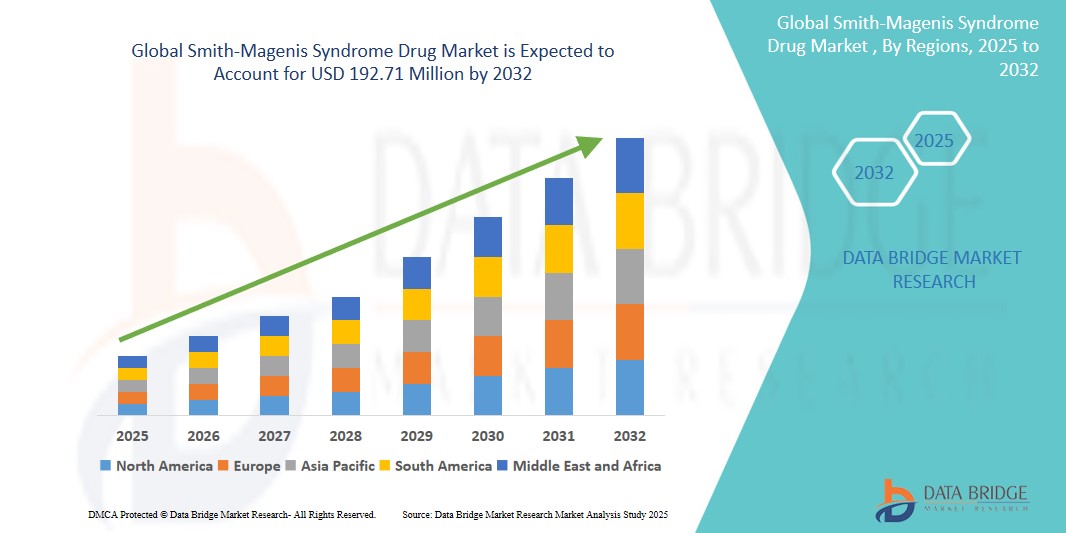
- The Global Smith-Magenis Syndrome Drug Market size was valued at USD 120 million in 2024 and is expected to reach USD 192.71 million by 2032, at a CAGR of 6.1% during the forecast period
- This growth is driven by factors such as increasing diagnosis rates of Smith-Magenis Syndrome, rising awareness among healthcare professionals and caregivers
Smith-Magenis Syndrome Drug Market Analysis
-
Smith-Magenis syndrome is a type of developmental disorder which usually affects the various parts of the body. The main features of this condition consist of mild to moderate intellectual disability, idiosyncratic facial features, sleep disturbances, delayed speech and language skills and behavioral problems
-
The demand for Smith-Magenis Syndrome (SMS) drugs is primarily driven by the rising prevalence of the disorder, increased awareness through genetic screening initiatives, and advancements in diagnostic and therapeutic technologies.
- North America is projected to lead the global SMS drug market, accounting for 36.4% of the market share. This dominance is attributed to its advanced healthcare infrastructure, high adoption of innovative treatment options, and strong presence of key pharmaceutical players.
- Asia-Pacific is expected to witness the fastest growth during the forecast period, fueled by expanding healthcare facilities, rising awareness of rare genetic disorders, and increasing diagnostic rates.
- The Anti-Convulsants segment is anticipated to hold the largest market share at 34.5%, owing to its widespread clinical use, cost-effectiveness, and familiarity among healthcare providers. While newer treatment approaches are emerging, anti-convulsants remain a mainstay due to their established efficacy and ease of integration into existing treatment protocols.
Report Scope and Smith-Magenis Syndrome Drug Market Segmentation
|
Attributes |
Smith-Magenis Syndrome Drug Key Market Insights |
|
Segments Covered |
|
|
Countries Covered |
North America
Europe
Asia-Pacific
Middle East and Africa
South America
|
|
Key Market Players |
|
|
Market Opportunities |
|
|
Value Added Data Infosets |
In addition to the insights on market scenarios such as market value, growth rate, segmentation, geographical coverage, and major players, the market reports curated by the Data Bridge Market Research also include import export analysis, production capacity overview, production consumption analysis, price trend analysis, climate change scenario, supply chain analysis, value chain analysis, raw material/consumables overview, vendor selection criteria, PESTLE Analysis, Porter Analysis, and regulatory framework. |
Smith-Magenis Syndrome Drug Market Trends
“Growing Focus on Targeted Therapies and Personalized Medicine for Rare Genetic Disorders”
-
One prominent trend in the Smith-Magenis Syndrome Drug market is the growing focus on targeted therapies and personalized medicine for rare genetic disorders.
- This approach emphasizes the development of treatments tailored to the unique genetic and biological profile of each patient, aiming to improve efficacy and reduce adverse effects. In the case of Smith-Magenis Syndrome (SMS), where standard treatment options are limited, targeted drug development offers a promising path forward
- For instance, companies like Rhythm Pharmaceuticals are investing in precision therapies that modulate neuroendocrine signaling pathways—specifically targeting behavioral and metabolic symptoms associated with SMS
- This trend is significantly transforming the rare disease landscape by enabling more individualized treatment plans, improving patient outcomes, and attracting greater research funding and regulatory incentives under orphan drug programs.
- The Smith-Magenis Syndrome Drug market is poised for growth as biotechnology advances, genomic sequencing becomes more accessible, and pharmaceutical companies increase their commitment to developing innovative therapies for underserved rare disease populations.
Smith-Magenis Syndrome Drug Market Dynamics
Driver
“Increasing Diagnosis Rates Through Advancements in Genetic Testing Technologies”
- The increasing diagnosis rates through advancements in genetic testing technologies are significantly driving the demand for Smith-Magenis Syndrome (SMS) drug therapies
- Modern genetic screening techniques, such as chromosomal microarray analysis (CMA) and next-generation sequencing (NGS), have greatly enhanced the ability to detect rare genetic disorders like SMS with higher accuracy and at earlier stages
- With improved accessibility and reduced costs of genetic testing, more patients are being accurately diagnosed, leading to earlier intervention and more targeted treatment plans. This shift is particularly important in managing complex, behaviorally and cognitively challenging syndromes such as SMS
- Early and precise diagnosis not only enables better disease management but also supports the development of personalized therapies, expanding market opportunities for drug developers focused on rare neurodevelopmental conditions
For instance,
- The use of CMA and NGS panels in pediatric neurology and developmental clinics has led to a noticeable increase in SMS diagnoses, prompting pharmaceutical companies to intensify efforts in drug research tailored to the syndrome’s unique genetic profile
- As awareness and accessibility of advanced genetic diagnostics continue to grow, the global SMS drug market is expected to benefit from a larger patient pool, greater demand for symptom-targeted therapies, and increased support from public health initiatives focused on rare disease management
Opportunity
“Expansion of Orphan Drug Incentives and Regulatory Support for Rare Diseases”
- The expansion of orphan drug incentives and growing regulatory support for rare diseases are creating significant growth opportunities in the Smith-Magenis Syndrome (SMS) Drug market
- Regulatory bodies such as the U.S. FDA and the European Medicines Agency (EMA) offer benefits like market exclusivity, tax credits, reduced fees, and accelerated approval pathways to encourage drug development for rare conditions such as SMS
- These incentives reduce development costs and risks for pharmaceutical companies, making the SMS drug market more attractive for investment and innovation. As a result, more biotech firms are entering the space with novel therapeutic candidates specifically targeting the symptoms of SM
For instance,
- VANDA Pharmaceuticals received orphan drug designation from the U.S. FDA for tasimelteon, a treatment targeting sleep disturbances in SMS patients—an important symptom of the syndrome. This designation provides market exclusivity and regulatory support, accelerating its development and availability
- The continued expansion of orphan drug frameworks globally is expected to drive research, attract funding, and increase the availability of specialized treatments for SMS, ultimately improving patient care and supporting market growth
Restraint/Challenge
“Limited Awareness and Delayed Diagnosis of Rare Genetic Disorders”
- Limited awareness and delayed diagnosis of rare genetic disorders like Smith-Magenis Syndrome (SMS) pose a significant restraint on market growth.
- SMS is a complex neurodevelopmental condition that often goes undiagnosed or misdiagnosed for years due to overlapping symptoms with other disorders and a general lack of awareness among healthcare professionals.
- The rarity of the syndrome, combined with limited access to specialized genetic testing in many regions, means that many patients remain undiagnosed or are diagnosed late, delaying appropriate treatment and reducing the immediate demand for SMS-specific therapies
For instance,
- In many low- and middle-income countries, a lack of trained geneticists and limited integration of genetic screening in pediatric care results in SMS being misclassified as general developmental delay or autism spectrum disorder, delaying accurate diagnosis and targeted treatment
- This diagnostic gap limits the potential patient pool for pharmaceutical companies, reducing commercial incentives to develop and market SMS-specific drugs and thus slowing the overall growth of the Smith-Magenis Syndrome Drug market.
Smith-Magenis Syndrome Drug Market Scope
The market is segmented on the basis of drug class, drugs, diagnosis, therapy, treatment, route of administration, end user and distribution channel.
|
Segmentation |
Sub-Segmentation |
|
By Drug Class |
|
|
By Drug |
|
|
By Diagnosis |
|
|
By Therapy |
|
|
By Treatment |
|
|
By Route of Administration |
|
|
By End User |
|
|
By Distribution Channel |
|
In 2025, the intoanti-convulsants is projected to dominate the market with a largest share in drug class segment
The intoanti-convulsants segment is expected to dominate the Smith-Magenis Syndrome Drug market with the largest share of 34.5% in 2025 due to the segment’s widespread clinical adoption in managing the neurological and behavioral symptoms commonly associated with Smith-Magenis Syndrome (SMS), including sleep disturbances, irritability, and aggression. Anti-convulsants are favored due to their cost-effectiveness, established safety profile, and familiarity among neurologists and pediatric specialists. Despite ongoing research into novel therapeutic approaches and targeted treatments, anti-convulsants remain a frontline option in many healthcare settings, thanks to their proven efficacy and ease of integration into current treatment protocols. Their continued clinical relevance supports their leading position in the SMS drug market.
The trazodone is expected to account for the largest share during the forecast period in drug segment
In 2025, the trazodone segment is expected to dominate the market due to its growing use in managing sleep disturbances—a core symptom of Smith-Magenis Syndrome (SMS). Trazodone is increasingly favored for its effectiveness in promoting better sleep quality without the dependency risks associated with traditional sedative-hypnotics. Its favorable safety profile, non-stimulant mechanism, and compatibility with long-term use in pediatric populations make it a preferred option among clinicians. The rising demand for symptom-targeted, well-tolerated therapies, combined with ongoing clinical research and supportive regulatory guidance for off-label use in rare neurodevelopmental disorders, is further accelerating the adoption of trazodone in the SMS treatment landscape.
Smith-Magenis Syndrome Drug Market Regional Analysis
“North America Holds the Largest Share in the Smith-Magenis Syndrome Drug Market”
-
North America dominates the Smith-Magenis Syndrome Drug market with a share of 36.4%, driven by its advanced healthcare infrastructure, strong focus on rare disease management, and the presence of major pharmaceutical and biotechnology companies actively engaged in orphan drug development
- The U.S. holds a significant portion of this regional market—approximately 78.3%—due to high awareness levels, robust genetic screening programs, and increasing diagnosis rates of Smith-Magenis Syndrome (SMS). The country's emphasis on early intervention and personalized treatment options further fuels demand for effective SMS therapies.
- The presence of leading companies such as Rhythm Pharmaceuticals, Vanda Pharmaceuticals, and Johnson & Johnson, along with consistent investment in rare disease R&D, continues to drive innovation in SMS treatment options. Supportive regulatory frameworks and orphan drug incentives also enhance the region's attractiveness for drug developers.
- Additionally, rising public and clinical awareness of SMS, increasing genetic testing adoption, and a growing emphasis on symptom-targeted therapies contribute to market growth. As healthcare systems across North America continue to prioritize rare disease treatment, the region is expected to maintain its dominant position in the SMS drug market.
“Asia-Pacific is Projected to Register the Highest CAGR in the Smith-Magenis Syndrome Drug Market”
-
The Asia-Pacific region is expected to witness the highest growth rate in the Smith-Magenis Syndrome Drug market, driven by rapid expansion in healthcare infrastructure, growing awareness of rare genetic disorders, and increasing access to genetic diagnostics.
- Countries such as China, India, and Japan are emerging as key markets due to their large populations, rising healthcare investments, and enhanced focus on pediatric and neurological care. The growing availability of genetic testing services in these countries is enabling earlier and more accurate diagnosis of SMS, supporting the demand for targeted therapies.
- Japan, with its advanced medical infrastructure and strong emphasis on rare disease management, remains a critical market in the region. The country's proactive regulatory environment and commitment to precision medicine are accelerating the adoption of innovative treatments for conditions like SMS.
- As regional healthcare systems continue to evolve, the increased focus on rare disease awareness, early intervention, and personalized care is expected to fuel the growth of the SMS drug market in Asia-Pacific, positioning it as the fastest-growing region globally
Smith-Magenis Syndrome Drug Market Share
The market competitive landscape provides details by competitor. Details included are company overview, company financials, revenue generated, market potential, investment in research and development, new market initiatives, global presence, production sites and facilities, production capacities, company strengths and weaknesses, product launch, product width and breadth, application dominance. The above data points provided are only related to the companies' focus related to market.
The Major Market Leaders Operating in the Market Are:
- Rhythm Pharmaceuticals, Inc. (U.S.)
- VANDA PHARMACEUTICALS (U.S.
- Neurim Pharmaceuticals, Inc. (Israel)
- Novartis AG (Switzerland)
- Takeda Pharmaceutical Company Limited (Japan)
- Sanofi (France)
- Johnson & Johnson Services, Inc. (U.S.)
- Eisai Co., Ltd. (Japan)
- Teva Pharmaceutical Industries Ltd. (Israel)
- Boehringer Ingelheim International GmbH (Germany)
- Allergan (U.S.)
- F. Hoffmann-La Roche Ltd (Switzerland)
- Purdue Pharma L.P. (U.S.)

- Interactive Data Analysis Dashboard
- Company Analysis Dashboard for high growth potential opportunities
- Research Analyst Access for customization & queries
- Competitor Analysis with Interactive dashboard
- Latest News, Updates & Trend analysis
- Harness the Power of Benchmark Analysis for Comprehensive Competitor Tracking
Data collection and base year analysis are done using data collection modules with large sample sizes. The stage includes obtaining market information or related data through various sources and strategies. It includes examining and planning all the data acquired from the past in advance. It likewise envelops the examination of information inconsistencies seen across different information sources. The market data is analysed and estimated using market statistical and coherent models. Also, market share analysis and key trend analysis are the major success factors in the market report. To know more, please request an analyst call or drop down your inquiry.
The key research methodology used by DBMR research team is data triangulation which involves data mining, analysis of the impact of data variables on the market and primary (industry expert) validation. Data models include Vendor Positioning Grid, Market Time Line Analysis, Market Overview and Guide, Company Positioning Grid, Patent Analysis, Pricing Analysis, Company Market Share Analysis, Standards of Measurement, Global versus Regional and Vendor Share Analysis. To know more about the research methodology, drop in an inquiry to speak to our industry experts.
Data Bridge Market Research is a leader in advanced formative research. We take pride in servicing our existing and new customers with data and analysis that match and suits their goal. The report can be customized to include price trend analysis of target brands understanding the market for additional countries (ask for the list of countries), clinical trial results data, literature review, refurbished market and product base analysis. Market analysis of target competitors can be analyzed from technology-based analysis to market portfolio strategies. We can add as many competitors that you require data about in the format and data style you are looking for. Our team of analysts can also provide you data in crude raw excel files pivot tables (Fact book) or can assist you in creating presentations from the data sets available in the report.












