


Smoke Detection System Market Overview
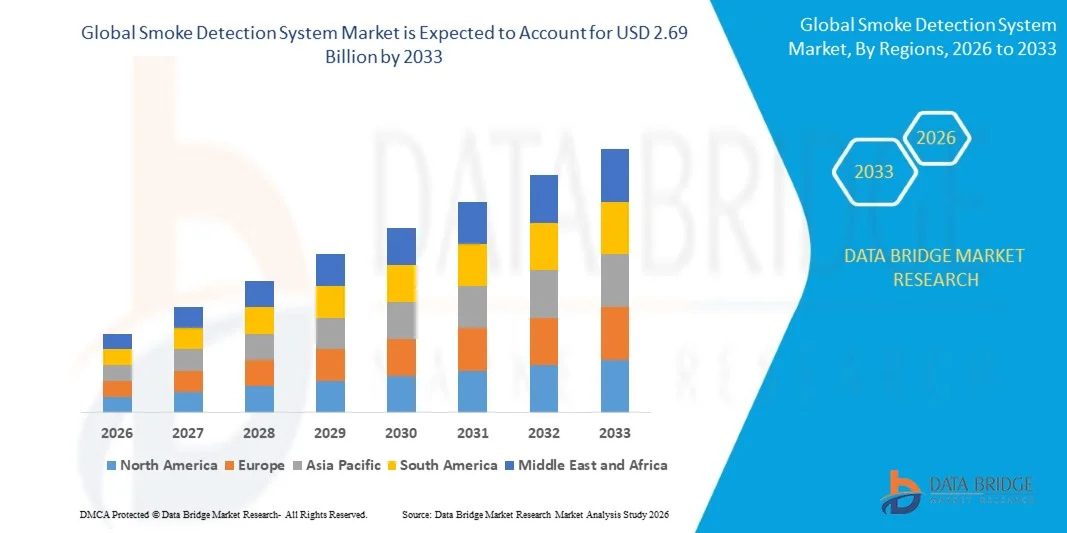
The Smoke Detection System Market was valued at USD 1.44 Billion in 2025 and is projected to reach USD 2.69 Billion by 2033, growing at a CAGR of 8.15% from 2026 to 2033. The market is experiencing consistent growth driven by increasing fire safety regulations, rising adoption of smart building infrastructure, and growing demand for advanced early-warning fire detection technologies across residential, commercial, and industrial sectors. Rapid urbanization and large-scale construction activities are further accelerating deployment of modern smoke detection systems globally.
The increasing emphasis on occupant safety, asset protection, and regulatory compliance, combined with rising integration of IoT-enabled and AI-based fire detection solutions, is significantly driving market growth. Growing investments in smart cities and intelligent building automation systems are further enhancing adoption of connected smoke detection technologies, enabling real-time monitoring, faster emergency response, and improved fire risk management across diverse end-use environments.
Key Market Trends & Insights
- North America dominated the Smoke Detection System Market with the largest revenue share of 39.5% in 2025, supported by stringent fire safety regulations, widespread adoption of advanced building safety technologies, and strong investments in residential, commercial, and industrial fire protection infrastructure
- The photo-electric segment led the market with a 41.6% share in 2025, driven by its superior capability to detect slow-smoldering fires that commonly occur in residential, commercial, and institutional environments
- Asia-Pacific is expected to be the fastest-growing region at a CAGR of 9.3% from 2026 to 2033, fueled by rapid urbanization, expanding construction activities, and increasing awareness regarding fire safety across developing economies
- Marine is the fastest-growing end-user industry type, projected to register a CAGR of 11.7% from 2026 to 2033, supported by increasing emphasis on onboard fire safety across commercial vessels, cruise ships, naval fleets, and offshore installations
- Industrial accounted for 34.8% of the market in 2025, preferred by extensive implementation of fire detection solutions across manufacturing facilities, energy plants, warehouses, mining operations, and processing industries
- The aspirating segment is the fastest-growing type category, with a CAGR of 10.9% from 2026 to 2033, driven by rising demand for ultra-early smoke detection in mission-critical environments
Market Size & Forecast
- Global Market Value (2025): USD 1.44 Billion
- Expected Market Value (2033): USD 2.69 Billion
- Forecast CAGR (2026–2033): 8.15%
- Leading Region in 2025: North America
- Fastest Growing Region: Asia-Pacific
Report Scope and Smoke Detection System Market Segmentation
|
Attributes |
Smoke Detection System Key Market Insights |
|
Segments Covered |
|
|
Countries Covered |
North America · U.S. · Canada · Mexico Europe · Germany · France · U.K. · Netherlands · Switzerland · Belgium · Russia · Italy · Spain · Turkey · Rest of Europe Asia-Pacific · China · Japan · India · South Korea · Singapore · Malaysia · Australia · Thailand · Indonesia · Philippines · Rest of Asia-Pacific Middle East and Africa · Saudi Arabia · U.A.E. · South Africa · Egypt · Israel · Rest of Middle East and Africa South America · Brazil · Argentina · Rest of South America |
|
Key Market Players |
· Emerson Electric Co. (U.S.) · Honeywell International Inc. (U.S.) · Spectrex (U.S.) · Detector Electronics Corporation (U.S.) · Apollo Fire Detectors Ltd. (U.K.) · System Sensor (U.S.) · Schneider Electric (France) · Siemens AG (Germany) · United Technologies Corporation (U.S.) · TROX GmbH (Germany) · Johnson Controls International plc (Ireland) · Hochiki Europe Ltd. (U.K.) · Secom Plc (U.K.) · Nedis B.V. (Netherlands) · TELUS Corporation (Canada) · Safeguard Industries (India) · Geesys Technologies (India) Private Limited (India) |
|
Market Opportunities |
· Integration of AI-Based Predictive Fire Detection Technologies · Expansion of Smart City and Intelligent Building Projects · Rising Demand for Wireless and Battery-Operated Smoke Detection Systems |
|
Value Added Data Infosets |
In addition to the insights on market scenarios such as market value, growth rate, segmentation, geographical coverage, and major players, the market reports curated by the Data Bridge Market Research also include in-depth expert analysis, geographically represented company-wise production and capacity, network layouts of distributors and partners, detailed and updated price trend analysis and deficit analysis of supply chain and demand. |
Smoke Detection System Market Trends
Trend: IoT Enabled Smart Smoke Detection Adoption
The smoke detection system market is witnessing a strong shift toward IoT enabled and connected fire safety solutions that enable real time monitoring, remote diagnostics, and faster emergency response. These advanced systems are increasingly deployed in smart buildings, commercial complexes, and industrial facilities to improve fire safety efficiency and reduce response time during emergencies. Integration with building management systems and cloud based platforms is further enhancing predictive maintenance and operational reliability.
Companies such as Honeywell International Inc. and Siemens AG are actively advancing connected fire safety ecosystems, with solutions such as Honeywell’s connected building technologies and Siemens’ Cerberus and Sinteso fire detection platforms widely used in commercial infrastructure for intelligent smoke detection and monitoring.
Smoke Detection System Market Dynamics
Key Market Driver: Strict Fire Safety Regulations
The growing enforcement of stringent fire safety standards across residential, commercial, and industrial infrastructure is a major driver for smoke detection system adoption. Regulatory bodies such as the National Fire Protection Association (NFPA) in the U.S. and European fire safety directives require mandatory installation of advanced smoke detection systems in public and private buildings. This is increasing replacement demand for outdated systems with advanced photoelectric and addressable detectors.
Companies such as System Sensor and Hochiki Europe Ltd are widely supplying compliant fire detection solutions used across hospitals, airports, and commercial buildings to meet regulatory safety standards.
Key Restraint/Challenge: High Installation and Maintenance Costs
The high cost associated with installation, calibration, and ongoing maintenance of advanced smoke detection systems remains a key challenge limiting widespread adoption, particularly in cost-sensitive regions and small-scale facilities. Advanced systems such as aspirating and multi-sensor detectors require specialized installation, periodic servicing, and skilled technical support, increasing total ownership costs. Integration with smart building infrastructure further adds to implementation complexity and expenses.
Large-scale deployments such as Siemens AG’s advanced fire detection installations in smart commercial buildings highlight the significant infrastructure and maintenance investment required for high-performance smoke detection systems.
Key Market Opportunity: Smart City Infrastructure Expansion
Rapid expansion of smart city projects and intelligent building infrastructure is creating strong growth opportunities for the smoke detection system market. Governments are increasingly investing in smart urban infrastructure with integrated safety systems, including automated fire detection, emergency response connectivity, and centralized monitoring platforms. These developments are driving demand for IoT enabled and cloud connected smoke detection solutions across public infrastructure, transport hubs, and commercial buildings.
Projects such as India’s Smart Cities Mission and deployments by Schneider Electric in intelligent building safety systems are supporting the integration of advanced smoke detection technologies into large-scale urban infrastructure developments.
Smoke Detection System Market Scope
The smoke detection system market is segmented on the basis of type and end-user industry.
- By Type
On the basis of type, the Smoke Detection System Market is segmented into Ionization, Photo-Electric, Projected Beam, Aspirating, Video, Carbon Monoxide Detector, and Others. The Photo-Electric segment dominated the market with the largest share of 41.6% in 2025, driven by its superior capability to detect slow-smoldering fires that commonly occur in residential, commercial, and institutional environments. Growing adoption of photo-electric detectors across office buildings, healthcare facilities, educational institutions, and hospitality establishments continues to support segment growth. These systems offer lower false alarm rates compared to conventional ionization detectors, improving operational reliability and user confidence. Increasing regulatory emphasis on advanced fire safety compliance is further accelerating deployment. Continuous replacement of aging fire detection infrastructure with more efficient technologies reinforces the segment’s leadership position.
The Aspirating segment is projected to register the fastest growth at a CAGR of 10.9% from 2026 to 2033, driven by rising demand for ultra-early smoke detection in mission-critical environments. Aspirating systems are increasingly deployed in data centers, telecommunication facilities, clean rooms, transportation hubs, and industrial plants where even minor fire incidents can cause significant operational disruptions. Their ability to detect smoke particles at very early stages enables rapid intervention and minimizes asset damage. Advancements in sensor sensitivity, intelligent monitoring capabilities, and network integration are improving system effectiveness. Growing investments in high-value infrastructure protection and stringent safety standards are further accelerating adoption across developed and emerging markets.
- By End-User Industry
On the basis of end-user industry, the Smoke Detection System Market is segmented into Domestic Heating Systems, Marine, Industrial, and Others. The Industrial segment dominated the market with the largest share of 34.8% in 2025, supported by extensive implementation of fire detection solutions across manufacturing facilities, energy plants, warehouses, mining operations, and processing industries. Industrial environments often involve combustible materials, heavy machinery, and high-temperature processes, creating strong demand for reliable smoke monitoring systems. Regulatory requirements related to worker safety and facility protection continue to encourage large-scale deployment. Increasing automation and expansion of industrial infrastructure are further strengthening adoption. Ongoing investments in smart safety systems and integrated fire protection networks reinforce the segment’s dominant position.
The Marine segment is projected to register the fastest growth at a CAGR of 11.7% from 2026 to 2033, driven by increasing emphasis on onboard fire safety across commercial vessels, cruise ships, naval fleets, and offshore installations. Smoke detection systems are becoming essential components of maritime safety frameworks due to the high risks associated with confined environments and remote operations. Growing international maritime regulations are encouraging vessel operators to upgrade existing fire detection infrastructure. Technological advancements in corrosion-resistant sensors, wireless monitoring, and intelligent alarm systems are improving reliability in harsh marine conditions. Rising investments in shipbuilding activities and offshore energy projects are further supporting strong growth across the segment.
Smoke Detection System Market Regional Analysis
North America dominated the smoke detection system market and accounted for the largest revenue share of 39.5% in 2025, driven by stringent fire safety regulations, widespread adoption of advanced building safety technologies, and strong investments in residential, commercial, and industrial fire protection infrastructure. The region benefits from well-established safety standards that mandate installation of smoke detection systems across various end-use sectors. Growing modernization of commercial buildings and increasing deployment of smart connected fire detection solutions are further supporting market expansion. Rising awareness regarding life safety and property protection continues to encourage adoption of advanced smoke monitoring technologies. In addition, the presence of major fire safety equipment manufacturers and robust regulatory enforcement strengthens North America’s leadership position in the global market.
U.S. Smoke Detection System Market Insight
The U.S. Smoke Detection System market is experiencing strong growth driven by increasing investments in smart building technologies, strict compliance with fire safety regulations, and growing adoption of intelligent fire detection systems. Commercial facilities, healthcare institutions, educational campuses, and industrial sites are actively upgrading fire protection infrastructure to improve safety standards. The country’s strong focus on building automation is encouraging integration of smoke detectors with IoT-enabled monitoring platforms. Rising renovation activities across aging infrastructure are further supporting replacement demand. In addition, advancements in wireless detection technologies and remote monitoring capabilities are accelerating market growth across the U.S.
Canada Smoke Detection System Market Insight
The Canada Smoke Detection System market is witnessing steady growth supported by increasing awareness regarding fire prevention, expanding construction activities, and rising implementation of building safety regulations. Residential and commercial property owners are increasingly adopting advanced smoke detection solutions to enhance occupant safety and regulatory compliance. Growing investments in smart homes and connected building technologies are creating new opportunities for market expansion. The country’s emphasis on public safety standards continues to drive installation of reliable fire detection systems. In addition, increasing modernization of healthcare, educational, and public infrastructure facilities is contributing to sustained market growth in Canada.
Europe Smoke Detection System Market Insight
The Europe Smoke Detection System market is expanding steadily due to stringent fire protection regulations, increasing adoption of smart building solutions, and growing investments in infrastructure modernization projects. The region benefits from strong regulatory frameworks that promote deployment of advanced fire detection and alarm systems across residential, commercial, and industrial sectors. Rising demand for integrated safety systems capable of real-time monitoring and early warning capabilities is supporting market expansion. Building owners are increasingly focusing on improving fire resilience and occupant safety through technology upgrades. Continuous advancements in sensor technologies and automation platforms further contribute to regional growth.
U.K. Smoke Detection System Market Insight
The U.K. Smoke Detection System market is growing steadily, driven by strict building safety requirements, increasing investments in fire prevention technologies, and rising awareness regarding residential and commercial fire risks. Property developers and facility managers are actively deploying advanced smoke detection systems to comply with evolving safety standards. Growing adoption of wireless and interconnected fire alarm solutions is improving operational efficiency and emergency response capabilities. The country’s focus on building refurbishment and modernization projects is creating additional demand for upgraded fire safety systems. In addition, expanding smart building adoption is supporting long-term market growth in the U.K.
Germany Smoke Detection System Market Insight
The Germany Smoke Detection System market is expanding due to strong industrial safety standards, increasing deployment of intelligent building technologies, and growing emphasis on workplace fire protection. Manufacturing facilities, logistics centers, and commercial establishments are increasingly investing in advanced smoke detection solutions to ensure operational safety and regulatory compliance. The country’s robust industrial base continues to generate substantial demand for sophisticated fire monitoring systems. Rising adoption of automated building management platforms is further supporting integration of advanced detection technologies. In addition, continuous investments in infrastructure development are accelerating market expansion in Germany.
Asia-Pacific Smoke Detection System Market Insight
The Asia-Pacific Smoke Detection System market is expected to register the fastest growth with a CAGR of 9.3% from 2026 to 2033, driven by rapid urbanization, expanding construction activities, and increasing awareness regarding fire safety across developing economies. Rising investments in commercial buildings, industrial facilities, transportation infrastructure, and residential housing projects are significantly boosting demand for smoke detection systems. Countries such as China, India, Japan, and South Korea are witnessing increased implementation of modern fire protection regulations and safety standards. Growing adoption of smart cities and connected building technologies is further accelerating deployment. In addition, expanding industrialization and infrastructure development projects continue to support strong regional market growth.
Japan Smoke Detection System Market Insight
The Japan Smoke Detection System market is witnessing steady growth supported by stringent safety regulations, advanced technology adoption, and increasing investments in disaster preparedness infrastructure. Building owners and industrial operators are increasingly deploying highly reliable smoke detection systems to improve emergency response capabilities and minimize fire-related risks. The country’s mature construction sector and strong focus on public safety are supporting consistent market demand. Growing integration of intelligent sensors and automated monitoring technologies is further enhancing system efficiency. In addition, rising modernization of commercial and transportation infrastructure is strengthening market growth in Japan.
China Smoke Detection System Market Insight
The China Smoke Detection System market is growing rapidly due to large-scale urban development, increasing industrial expansion, and rising enforcement of fire safety regulations. Commercial complexes, manufacturing facilities, residential projects, and public infrastructure developments are driving substantial demand for advanced smoke detection solutions. The country’s growing adoption of smart building technologies is encouraging integration of intelligent fire monitoring systems. Government initiatives aimed at improving public safety standards are further supporting widespread deployment. In addition, continuous investments in industrial and infrastructure projects are accelerating market growth across China.
Smoke Detection System Market Share
The smoke detection system industry is primarily led by well-established companies, including:
- Emerson Electric Co. (U.S.)
- Honeywell International Inc. (U.S.)
- Spectrex (U.S.)
- Detector Electronics Corporation (U.S.)
- Apollo Fire Detectors Ltd. (U.K.)
- System Sensor (U.S.)
- Schneider Electric (France)
- Siemens AG (Germany)
- United Technologies Corporation (U.S.)
- TROX GmbH (Germany)
- Johnson Controls International plc (Ireland)
- Hochiki Europe Ltd. (U.K.)
- Secom Plc (U.K.)
- Nedis B.V. (Netherlands)
- TELUS Corporation (Canada)
- Safeguard Industries (India)
- Geesys Technologies (India) Private Limited (India)
Latest Developments in Smoke Detection System Market
- In March 2026, Siemens launched its next-generation Sinteso Nova and Cerberus Nova fire detection platforms featuring cloud connectivity, predictive maintenance, continuous self-testing, and enhanced monitoring capabilities. This development is expected to accelerate the adoption of intelligent smoke detection systems by enabling more efficient building safety management, reducing maintenance costs, and supporting the growing demand for smart and autonomous building infrastructure across commercial and industrial sectors
- In October 2024, Johnson Controls introduced the ANSUL CHECKFIRE 210 Quad Infrared (QIR) Detector for harsh industrial and mining environments. The launch strengthens the market by expanding the availability of advanced fire and smoke detection technologies capable of operating in challenging conditions, helping industrial operators improve safety compliance and reduce fire-related operational risks
- In September 2024, Johnson Controls expanded its fire safety portfolio through the introduction of advanced digitally connected fire protection technologies and strategic ecosystem collaborations. This development is contributing to market growth by enhancing integrated building safety capabilities, supporting real-time monitoring, and increasing demand for connected smoke detection solutions across commercial and institutional facilities
- In September 2024, Johnson Controls launched SafeLINC, a cloud-based platform that enables remote monitoring, diagnostics, and management of fire alarm and smoke detection systems. The introduction of this platform is driving market expansion by improving operational efficiency, enabling predictive maintenance, and increasing adoption of cloud-enabled fire safety systems among building owners and facility managers
- In June 2024, Halma strengthened its fire safety business through the acquisition of Global Fire Equipment via its Ampac division. This acquisition is enhancing the company's fire detection and alarm system portfolio while expanding its international market presence, supporting greater innovation and competition within the Smoke Detection System Market

- Interactive Data Analysis Dashboard
- Company Analysis Dashboard for high growth potential opportunities
- Research Analyst Access for customization & queries
- Competitor Analysis with Interactive dashboard
- Latest News, Updates & Trend analysis
- Harness the Power of Benchmark Analysis for Comprehensive Competitor Tracking
Global Smoke Detection System Market, Supply Chain Analysis and Ecosystem Framework
To support market growth and help clients navigate the impact of geopolitical shifts, DBMR has integrated in-depth supply chain analysis into its Global Smoke Detection System Market research reports. This addition empowers clients to respond effectively to global changes affecting their industries. The supply chain analysis section includes detailed insights such as Global Smoke Detection System Market consumption and production by country, price trend analysis, the impact of tariffs and geopolitical developments, and import and export trends by country and HSN code. It also highlights major suppliers with data on production capacity and company profiles, as well as key importers and exporters. In addition to research, DBMR offers specialized supply chain consulting services backed by over a decade of experience, providing solutions like supplier discovery, supplier risk assessment, price trend analysis, impact evaluation of inflation and trade route changes, and comprehensive market trend analysis.
Data collection and base year analysis are done using data collection modules with large sample sizes. The stage includes obtaining market information or related data through various sources and strategies. It includes examining and planning all the data acquired from the past in advance. It likewise envelops the examination of information inconsistencies seen across different information sources. The market data is analysed and estimated using market statistical and coherent models. Also, market share analysis and key trend analysis are the major success factors in the market report. To know more, please request an analyst call or drop down your inquiry.
The key research methodology used by DBMR research team is data triangulation which involves data mining, analysis of the impact of data variables on the market and primary (industry expert) validation. Data models include Vendor Positioning Grid, Market Time Line Analysis, Market Overview and Guide, Company Positioning Grid, Patent Analysis, Pricing Analysis, Company Market Share Analysis, Standards of Measurement, Global versus Regional and Vendor Share Analysis. To know more about the research methodology, drop in an inquiry to speak to our industry experts.
Data Bridge Market Research is a leader in advanced formative research. We take pride in servicing our existing and new customers with data and analysis that match and suits their goal. The report can be customized to include price trend analysis of target brands understanding the market for additional countries (ask for the list of countries), clinical trial results data, literature review, refurbished market and product base analysis. Market analysis of target competitors can be analyzed from technology-based analysis to market portfolio strategies. We can add as many competitors that you require data about in the format and data style you are looking for. Our team of analysts can also provide you data in crude raw excel files pivot tables (Fact book) or can assist you in creating presentations from the data sets available in the report.













