


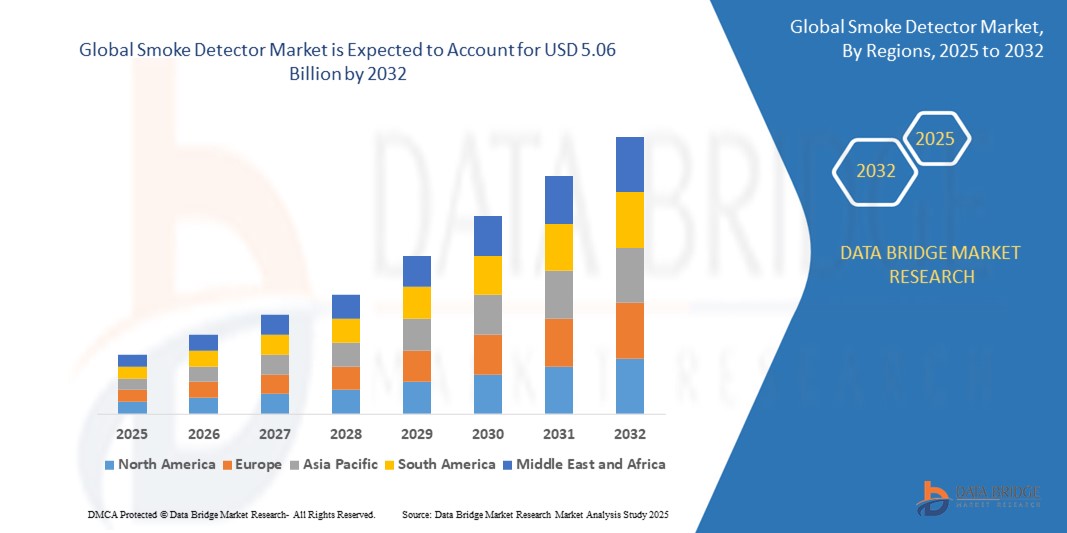
Smoke Detector Market Size
- The global smoke detector market size was valued at USD 2.60 billion in 2024 and is expected to reach USD 5.06 billion by 2032, at a CAGR of 8.70% during the forecast period
- This growth is driven by factors such as stringent fire safety regulations, rising awareness about fire prevention, and increased fire incidents globally
Smoke Detector Market Analysis
- Smoke detectors are essential safety devices designed to detect the presence of smoke, serving as a critical component in early fire detection systems to help prevent property damage and save lives across residential, commercial, and industrial environments
- The smoke detector market is experiencing steady growth, driven by rising fire safety awareness, strict regulatory mandates, increasing construction activities, technological advancements in detection systems, and growing demand for smart and connected safety solutions globally
- North America is expected to dominate the smoke detector market with a share of 31.3% due to high incidence of fire accidents and related fatalities, which has heightened awareness and regulatory pressure for improved fire safety infrastructure
- Asia-Pacific is expected to be the fastest growing region in the smoke detector market during the forecast period due to rapid urbanization, infrastructure development, and growing awareness of fire safety standards across residential and commercial sectors
- Photoelectric smoke detector segment is expected to dominate the market with a market share of 52.5% due to its superior performance in detecting slow-smoldering fires, which are typically caused by materials such as upholstery or wiring. These detectors use a light-sensing mechanism that allows for faster and more reliable detection of smoke particles, making them more effective in preventing fire-related fatalities
Report Scope and Smoke Detector Market Segmentation
|
Attributes |
Smoke Detector Key Market Insights |
|
Segments Covered |
|
|
Countries Covered |
North America
Europe
Asia-Pacific
Middle East and Africa
South America
|
|
Key Market Players |
|
|
Market Opportunities |
|
|
Value Added Data Infosets |
In addition to the market insights such as market value, growth rate, market segments, geographical coverage, market players, and market scenario, the market report curated by the Data Bridge Market Research team includes in-depth expert analysis, import/export analysis, pricing analysis, production consumption analysis, and pestle analysis. |
Smoke Detector Market Trends
“Increasing Fire Safety Regulations”
- One prominent trend in the global smoke detector market is the increasing fire safety regulations
- This trend is driven by the increasing fire incidents, growing public safety concerns, and government efforts to enforce stricter building codes and safety standards mandating the installation of smoke detection systems
- For instance, regulatory bodies in the U.S., U.K., and parts of Asia-Pacific have introduced updated fire safety legislation requiring smoke detectors in new constructions, rental properties, and public buildings
- The impact of these regulations is evident in both developed markets, such as North America and Europe, and emerging economies, where urban development and infrastructure upgrades are driving compliance
- As fire prevention remains a top priority for policymakers and property developers alike, the enforcement of fire safety regulations is expected to continue as a key trend shaping the growth of the smoke detector market
Smoke Detector Market Dynamics
Driver
“Integration with Home Automation Systems”
- The growing integration of smoke detectors with home automation systems is a significant driver for the smoke detector market, as consumers increasingly seek smart safety solutions that align with modern living environments
- This shift is gaining momentum globally, with rising adoption of connected homes prompting demand for smoke detectors that can seamlessly interact with security systems, smart assistants, and mobile devices for real-time alerts and remote monitoring.
- As residential and commercial users prioritize convenience and enhanced protection, there is a growing emphasis on intelligent smoke detection systems that support wireless connectivity, voice control, and centralized management
- Leading companies are actively innovating to offer smart smoke detectors with features such as app integration, cloud connectivity, and automation triggers, enabling more responsive and customized fire safety solutions
- Furthermore, the proliferation of IoT devices, increasing smart home investments, and consumer preference for integrated systems are amplifying the demand for advanced smoke detection technologies
For instance,
- Google’s Nest Protect and Amazon’s Ring Alarm Smoke & CO Listener are examples of smoke detectors designed to integrate with broader smart home ecosystems, offering enhanced functionality and user convenience
- Honeywell and Bosch are also developing interconnected fire safety devices tailored to smart building environments, reinforcing their role in driving market growth
- As smart living continues to reshape consumer expectations, integration with home automation systems will remain a key driver propelling the growth of the smoke detector market
Opportunity
“Growing Urbanization and Construction Activities”
- The rapid growth of urbanization and ongoing construction activities presents a significant opportunity for the smoke detector market, offering manufacturers a broader consumer base as new buildings and residential complexes require fire safety systems
- Industry players are capitalizing on this trend by expanding their offerings to cater to both residential and commercial sectors, focusing on innovative and reliable smoke detection solutions to meet safety standards in newly developed properties
- This opportunity aligns with the broader shift toward urban development and smart city initiatives, as increasing urbanization accelerates the demand for advanced fire protection systems in both high-rise buildings and smart homes
For instance,
- Companies such as Honeywell and Bosch are providing integrated fire safety solutions designed for large-scale construction projects, offering both smoke detection and automation capabilities
- Siemens has introduced advanced smoke detection technologies tailored for commercial and residential real estate developments, addressing growing regulatory requirements and safety concerns
- As urbanization continues to expand, particularly in emerging markets where infrastructure development is booming, the smoke detector market is poised to benefit from increased demand, regulatory compliance, and a heightened focus on safety standards
Restraint/Challenge
“High Cost of Manufacturing”
- The high cost of manufacturing smoke detectors presents a significant challenge for the market, as manufacturers face pressure to balance product quality with cost efficiency while maintaining safety standards
- Developing advanced smoke detection technologies that offer greater reliability, longer lifespan, and seamless integration with other systems is complex and requires substantial investment in research, development, and manufacturing processes
- This challenge is further compounded by the need to meet strict regulatory standards, ensure product durability across diverse environments, and maintain affordability for both consumers and businesses
For instance,
- Major companies such as Honeywell and Siemens are investing heavily in next-generation smoke detectors, incorporating smart features and advanced sensors, but face challenges in keeping production costs competitive while adhering to safety regulations
- Without cost-effective solutions that do not compromise on performance and safety, manufacturers may struggle to expand their market share, potentially hindering widespread adoption, especially in price-sensitive regions and segments
Smoke Detector Market Scope
The market is segmented on the basis of power source, product type, service, and end use.
|
Segmentation |
Sub-Segmentation |
|
By Power Source |
|
|
By Product Type |
|
|
By Service |
|
|
By End Use
|
|
In 2025, the photoelectric smoke detector is projected to dominate the market with a largest share in product type segment
The photoelectric smoke detector segment is expected to dominate the smoke detector market with the largest share of 52.5% in 2025 due to its superior performance in detecting slow-smoldering fires, which are typically caused by materials such as upholstery or wiring. These detectors use a light-sensing mechanism that allows for faster and more reliable detection of smoke particles, making them more effective in preventing fire-related fatalities.
The dual sensor smoke detector is expected to account for the largest share during the forecast period in product type segment
In 2025, the dual sensor smoke detector segment is expected to dominate the market due to its combined use of both ionization and photoelectric technologies, offering enhanced sensitivity to a wider range of fire types, including both fast-flaming and slow-smoldering fires. This comprehensive detection capability increases safety and reliability, making dual sensor models a preferred choice for residential, commercial, and industrial applications where early and accurate fire detection is critical.
Smoke Detector Market Regional Analysis
“North America Holds the Largest Share in the Smoke detector Market”
- North America dominates the smoke detector market with a share of 31.3%, driven by the high incidence of fire accidents and related fatalities, which has heightened awareness and regulatory pressure for improved fire safety infrastructure
- U.S. holds a significant share due to its stringent fire safety codes, widespread installation mandates in residential and commercial buildings, and strong investments in advanced fire detection technologies
- Regional dominance is further reinforced by ongoing technological advancements, such as the integration of IoT-enabled smart detectors, and the presence of leading manufacturers offering cutting-edge safety solutions
- With increased focus on fire prevention, rising adoption of smart home systems, and consistent upgrades to public safety regulations, North America is projected to maintain its leading position in the global smoke detector market through 2032
“Asia-Pacific is Projected to Register the Highest CAGR in the Smoke detector Market”
- Asia-Pacific is expected to witness the highest growth rate in the smoke detector market, driven by rapid urbanization, infrastructure development, and growing awareness of fire safety standards across residential and commercial sectors
- China holds a significant share due to its large-scale manufacturing base, increasing government initiatives on building safety, and fast-paced adoption of smart and connected smoke detectors
- The region’s expansion is further supported by rising investments in smart city projects, increased construction activities, and the introduction of stringent fire safety regulations in emerging economies such as India and Southeast Asia
- With a growing emphasis on safety compliance, technological innovation, and expanding distribution channels, Asia-Pacific is poised to emerge as the fastest-growing region in the global smoke detector market over the forecast period
Smoke Detector Market Share
The market competitive landscape provides details by competitor. Details included are company overview, company financials, revenue generated, market potential, investment in research and development, new market initiatives, global presence, production sites and facilities, production capacities, company strengths and weaknesses, product launch, product width and breadth, application dominance. The above data points provided are only related to the companies' focus related to market.
The Major Market Leaders Operating in the Market Are:
- Honeywell International, Inc. (U.S.)
- Siemens (Germany)
- ABB (Switzerland)
- Schneider Electric (France)
- Carrier (U.S.)
- Analog Devices, Inc. (U.S.)
- Emerson Electric Co. (U.S.)
- Robert Bosch GmbH (Germany)
- Apollo Fire Detectors Ltd. (U.K.)
- Mircom Group of Companies (Canada)
- BRK Brands, Inc. (U.S.)
- Johnson Controls (Ireland)
- HOCHIKI Corporation (Japan)
- SECOM CO., LTD (Japan)
- Protec Fire & Security Group Ltd (U.K.)
- ADT INC (U.S.)
- Securiton AG (Switzerland)
Latest Developments in Global Smoke Detector Market
- In January 2025, Amazon's Ring announced a partnership with fire safety product manufacturer Kidde to launch a connected smoke alarm at the Consumer Electronics Show in Las Vegas. This collaboration is expected to enhance Ring's presence in the smart home safety market by integrating advanced fire detection features, thereby driving demand for connected fire safety solutions and strengthening competition in the growing IoT-enabled smoke detector segment
- In July 2023, Hikvision India launched a new range of standalone smoke and gas detectors, including two models in the Photoelectric Smoke Detector category—HF-S2E Eco and NP-FY200. In addition, the company introduced the HF-GM100 Carbon Monoxide Gas Detector for the Indian market. This move is expected to strengthen Hikvision's position in the Indian fire safety sector by offering advanced, cost-effective solutions that cater to growing safety concerns and regulatory demands, thus increasing market penetration and consumer trust
- In January 2023, Siemens launched two new aspirating smoke detectors (ASD), FDA261 and FDA262, designed for challenging fire safety environments such as large data centers, e-commerce warehouses, and industrial manufacturing sites. These detectors offer an impressive coverage area of up to 6,700 m², the largest currently available on the market. Their ability to cover up to 2,000 m² in Class A installations with high sensitivity further positions Siemens as a leader in providing advanced fire detection solutions, enhancing their market share in sectors requiring large-scale, high-performance systems
- In April 2021, Siemens AG's Smart Infrastructure segment launched Cerberus FIT, enhancing fire safety in small to medium-sized buildings. This addition to the smoke detector market expands functionality and ease of installation, ensuring swift deployment and maintenance, thus bolstering building defense capabilities
- In March 2021, Johnson introduced the 700 Series, its inaugural microprocessor-based conventional fire detector, revolutionizing the smoke detector market. Designed for small commercial buildings, this detector employs advanced algorithms for precise fire condition monitoring, offering superior detection performance and false alarm mitigation, akin to its latest counterparts

- Interactive Data Analysis Dashboard
- Company Analysis Dashboard for high growth potential opportunities
- Research Analyst Access for customization & queries
- Competitor Analysis with Interactive dashboard
- Latest News, Updates & Trend analysis
- Harness the Power of Benchmark Analysis for Comprehensive Competitor Tracking
Data collection and base year analysis are done using data collection modules with large sample sizes. The stage includes obtaining market information or related data through various sources and strategies. It includes examining and planning all the data acquired from the past in advance. It likewise envelops the examination of information inconsistencies seen across different information sources. The market data is analysed and estimated using market statistical and coherent models. Also, market share analysis and key trend analysis are the major success factors in the market report. To know more, please request an analyst call or drop down your inquiry.
The key research methodology used by DBMR research team is data triangulation which involves data mining, analysis of the impact of data variables on the market and primary (industry expert) validation. Data models include Vendor Positioning Grid, Market Time Line Analysis, Market Overview and Guide, Company Positioning Grid, Patent Analysis, Pricing Analysis, Company Market Share Analysis, Standards of Measurement, Global versus Regional and Vendor Share Analysis. To know more about the research methodology, drop in an inquiry to speak to our industry experts.
Data Bridge Market Research is a leader in advanced formative research. We take pride in servicing our existing and new customers with data and analysis that match and suits their goal. The report can be customized to include price trend analysis of target brands understanding the market for additional countries (ask for the list of countries), clinical trial results data, literature review, refurbished market and product base analysis. Market analysis of target competitors can be analyzed from technology-based analysis to market portfolio strategies. We can add as many competitors that you require data about in the format and data style you are looking for. Our team of analysts can also provide you data in crude raw excel files pivot tables (Fact book) or can assist you in creating presentations from the data sets available in the report.













