


What is the Snack Pellet Equipment Market Size and Growth Rate?
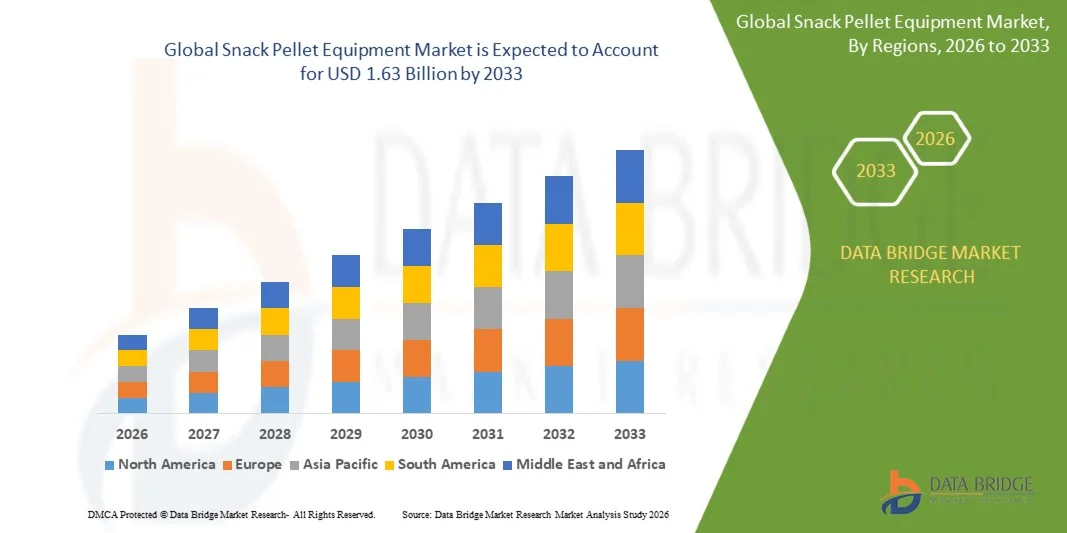
- As per Data Bridge Market Research analysis the snack pellet equipment market was valued at USD 1.03 billion in 2025 and is projected to reach USD 1.63 billion by 2033, growing at a CAGR of 5.90% from 2026 to 2033.
- The market is experiencing steady growth driven by increasing demand for processed and convenience snack products, rising investments in automated food processing equipment, and continuous advancements in extrusion and pellet production technologies.
- The growing preference for innovative snack formats, coupled with expanding food manufacturing capacities and the rising adoption of energy-efficient and high-capacity processing equipment, is encouraging snack manufacturers to invest in advanced snack pellet production systems.
Market Size & Forecast
- Market Value (2025): USD 1.03 Billion
- Expected Market Value (2033): USD 1.63 Billion
- Forecast CAGR (2026–2033): 5.90%
- Leading Region in 2025: North America
- Fastest Growing Region: Asia-Pacific
What are the Major Takeaways of the Snack Pellet Equipment Market?
- North America dominated the snack pellet equipment market with the largest revenue share in 2025, supported by the presence of well-established snack food manufacturers, increasing demand for convenience and ready-to-eat snacks, and continuous investments in automated food processing technologies.
- Asia-Pacific snack pellet equipment market is expected to witness the fastest growth rate from 2026 to 2033, supported by rapid urbanization, rising disposable incomes, expanding packaged food industries, and increasing investments in food processing infrastructure across China, India, Japan, and Southeast Asia.
- The potato-based segment held the largest market revenue share of approximately 35% in 2025, driven by the widespread production of potato snack pellets for expanded snacks, chips, and extruded snack products. Potato starch offers excellent expansion characteristics, consistent texture, and high consumer acceptance, making it the preferred raw material for snack pellet manufacturers globally.
- The multigrain-based segment is projected to register the fastest growth at a CAGR from 2026 to 2033, driven by increasing consumer demand for healthier, high-fiber, and nutrient-rich snack products. Growing investments in functional snacks, clean-label formulations, and whole-grain products are encouraging manufacturers to install flexible pellet processing equipment capable of handling multiple grain blends.
- The 2D segment held the largest market revenue share of approximately 41.5% in 2025, driven by its high production efficiency, lower manufacturing complexity, and extensive use in traditional snack pellet applications. Two-dimensional pellets remain the preferred choice for large-scale manufacturers due to their consistent expansion performance and compatibility with conventional frying and hot-air expansion processes.
- The tridimensional segment is projected to register the fastest growth at a CAGR from 2026 to 2033, driven by increasing demand for premium and visually differentiated snack products. Advancements in extrusion technology and consumer preference for innovative snack shapes are encouraging manufacturers to invest in equipment capable of producing complex three-dimensional pellet designs.
Report Scope and Snack Pellet Equipment Market Segmentation
|
Attributes |
Snack Pellet Equipment Key Market Insights |
|
Segments Covered |
|
|
Countries Covered |
North America
Europe
Asia-Pacific
Middle East and Africa
South America
|
|
Key Market Players |
|
|
Market Opportunities |
|
|
Value Added Data Infosets |
In addition to the insights on market scenarios such as market value, growth rate, segmentation, geographical coverage, and major players, the market reports curated by the Data Bridge Market Research also include in-depth expert analysis, pricing analysis, brand share analysis, consumer survey, demography analysis, supply chain analysis, value chain analysis, raw material/consumables overview, vendor selection criteria, PESTLE Analysis, Porter Analysis, and regulatory framework. |
What is the Key Trend in the Snack Pellet Equipment Market?
- Food manufacturers are increasingly adopting advanced extrusion-based snack pellet equipment with automated process control, recipe management, and energy-efficient drying technologies to produce innovative pellet shapes, healthier formulations, and premium snack products while improving production efficiency.
- For instance, in May 2026, Bühler Group introduced its Nutrex 7 Series extrusion platform featuring enhanced hygienic design, integrated intelligence, modular configuration, and improved Overall Equipment Efficiency (OEE), enabling snack manufacturers to optimize pellet production while reducing downtime and maintenance requirements.
- Equipment manufacturers are integrating intelligent extrusion, precision shaping, and flexible processing technologies that enable the production of multigrain, gluten-free, high-protein, and customized snack pellets using a wide variety of raw materials.
- For instance, in March 2025, GEA showcased its latest snack pellet processing technologies at SNAXPO 2025, highlighting complete processing lines with advanced forming, conveying, packaging, and automation solutions for snack manufacturers.
- As snack manufacturers continue to prioritize production flexibility, product innovation, and operational efficiency, the adoption of intelligent snack pellet equipment is expected to accelerate, reinforcing advanced extrusion technology as a core component of modern snack manufacturing.
What are the Key Drivers of the Snack Pellet Equipment Market?
- The growing global demand for convenience snacks, healthier formulations, and innovative snack shapes has significantly increased investments in advanced snack pellet production equipment capable of delivering higher productivity, consistent quality, and flexible manufacturing capabilities.
- For instance, GEA continues to expand its snack pellet processing portfolio with extrusion, drying, and shaping technologies that enable manufacturers to produce a broad range of 2D, 3D, laminated, and die-cut snack pellets while supporting multigrain, gluten-free, and reduced-oil formulations.
- Food manufacturers are increasingly modernizing production facilities by deploying automated extrusion systems that reduce waste, improve process consistency, and accelerate new product development while lowering operating costs.
- For instance, Bühler provides integrated extrusion lines supported by global Research and Training Centers, enabling manufacturers to develop, validate, and commercialize new snack pellet formulations before full-scale production.
- As snack producers continue expanding production capacity and introducing value-added snack products, demand for advanced snack pellet equipment is expected to remain strong throughout the forecast period.
Which Factors are Challenging the Growth of the Snack Pellet Equipment Market?
- Advanced snack pellet equipment requires substantial capital investment due to the integration of sophisticated extrusion systems, automated controls, precision drying technologies, and complete processing lines.
- These high installation and maintenance costs limit adoption among small and medium-sized snack manufacturers, particularly in developing economies with limited capital investment capabilities.
- For instance, modern integrated extrusion systems offered by leading manufacturers such as Bühler and GEA incorporate advanced hygienic designs, intelligent automation, precision process control, and complete production lines, resulting in higher acquisition and lifecycle costs compared with conventional processing equipment.
- The significant capital expenditure, installation complexity, and ongoing maintenance requirements associated with advanced snack pellet equipment continue to restrict adoption among smaller processors and new market entrants, slowing technology penetration in price-sensitive regions despite growing demand for processed snack products.
How is the Snack Pellet Equipment Market Segmented?
The market is segmented on the basis of product type, form, and equipment type.
- By Product Type
On the basis of product type, the snack pellet equipment market is segmented into potato-based, corn-based, rice-based, tapioca-based, multigrain-based, cereal grains, legumes, and vegetables. The potato-based segment held the largest market revenue share of approximately 35% in 2025, driven by the widespread production of potato snack pellets for expanded snacks, chips, and extruded snack products. Potato starch offers excellent expansion characteristics, consistent texture, and high consumer acceptance, making it the preferred raw material for snack pellet manufacturers globally.
The multigrain-based segment is projected to register the fastest growth at a CAGR from 2026 to 2033, driven by increasing consumer demand for healthier, high-fiber, and nutrient-rich snack products. Growing investments in functional snacks, clean-label formulations, and whole-grain products are encouraging manufacturers to install flexible pellet processing equipment capable of handling multiple grain blends.
- By Form
On the basis of form, the snack pellet equipment market is segmented into 2D, tridimensional, and die-faced. The 2D segment held the largest market revenue share of approximately 41.5% in 2025, driven by its high production efficiency, lower manufacturing complexity, and extensive use in traditional snack pellet applications. Two-dimensional pellets remain the preferred choice for large-scale manufacturers due to their consistent expansion performance and compatibility with conventional frying and hot-air expansion processes.
The tridimensional segment is projected to register the fastest growth at a CAGR from 2026 to 2033, driven by increasing demand for premium and visually differentiated snack products. Advancements in extrusion technology and consumer preference for innovative snack shapes are encouraging manufacturers to invest in equipment capable of producing complex three-dimensional pellet designs.
- By Equipment Type
On the basis of equipment type, the snack pellet equipment market is segmented into extrusion, mixing, cutting, drying, frying, and seasoning. The extrusion segment held the largest market revenue share of approximately 38.5% in 2025, driven by its critical role in determining pellet shape, texture, density, and overall product quality. Continuous technological advancements in twin-screw extrusion systems, higher production capacities, and improved energy efficiency continue to strengthen demand for extrusion equipment across snack manufacturing facilities.
The seasoning segment is projected to register the fastest growth at a CAGR from 2026 to 2033, driven by rising consumer preference for flavored, premium, and customized snack products. Increasing adoption of precision seasoning systems, automated coating technologies, and advanced flavor application equipment is supporting the rapid expansion of this segment.
Which Region Holds the Largest Share of the Snack Pellet Equipment Market?
- North America dominated the snack pellet equipment market with the largest revenue share in 2025, supported by the presence of well-established snack food manufacturers, increasing demand for convenience and ready-to-eat snacks, and continuous investments in automated food processing technologies.
- Food processors across the region are adopting advanced extrusion and pellet production equipment to improve production efficiency, reduce operating costs, and manufacture premium snack products. Strong investments in food processing innovation and modernization continue to strengthen the regional market.
U.S. Snack Pellet Equipment Market Insight
The U.S. snack pellet equipment market captured the largest revenue share in 2025 within North America, fueled by the country's large packaged snack industry and growing demand for healthier and innovative snack products. Manufacturers are increasingly investing in automated extrusion, drying, seasoning, and pellet processing systems to improve production flexibility and meet changing consumer preferences. Rising investments in clean-label snacks, protein-enriched products, and multigrain formulations continue to support equipment demand.
Europe Snack Pellet Equipment Market Insight
The Europe snack pellet equipment market is expected to witness the fastest growth rate from 2026 to 2033, primarily driven by increasing demand for premium snack products, continuous technological advancements in food processing machinery, and strong investments in sustainable manufacturing. Growing consumer preference for baked, low-fat, and clean-label snacks is encouraging manufacturers to upgrade processing facilities with advanced extrusion and pellet production equipment. The region also benefits from the presence of leading food processing equipment manufacturers.
Germany Snack Pellet Equipment Market Insight
The Germany snack pellet equipment market is expected to witness the fastest growth rate from 2026 to 2033, fueled by its strong food processing machinery industry, high level of manufacturing automation, and growing demand for premium snack products. German manufacturers continue to invest in energy-efficient extrusion systems, intelligent process automation, and sustainable food production technologies, strengthening the country's position as a leading supplier of advanced snack processing equipment.
Asia-Pacific Snack Pellet Equipment Market Insight
The Asia-Pacific snack pellet equipment market is expected to witness the fastest growth rate from 2026 to 2033, supported by rapid urbanization, rising disposable incomes, expanding packaged food industries, and increasing investments in food processing infrastructure across China, India, Japan, and Southeast Asia. The growing popularity of convenience foods and western-style snack products is encouraging manufacturers to expand production capacities and adopt modern snack pellet equipment throughout the region.
Japan Snack Pellet Equipment Market Insight
The Japan snack pellet equipment market is expected to witness the fastest growth rate from 2026 to 2033 due to the country's advanced food processing industry, strong emphasis on manufacturing automation, and growing demand for premium, healthier snack products. Japanese manufacturers are increasingly adopting precision extrusion technologies and energy-efficient processing equipment to improve product quality, reduce waste, and support continuous product innovation.
China Snack Pellet Equipment Market Insight
The China snack pellet equipment market accounted for the largest market revenue share in Asia-Pacific in 2025, attributed to the country's large snack food manufacturing industry, rapidly expanding processed food sector, and increasing investments in modern food production facilities. The presence of large-scale snack manufacturers, rising domestic consumption of convenience foods, and government support for food manufacturing modernization continue to accelerate the adoption of advanced snack pellet equipment across the country.
Which are the Top Companies in Snack Pellet Equipment Market?
The snack pellet equipment industry is primarily led by well-established companies, including:
- Marel (Iceland)
- GEA Group (Germany)
- Bühler (Switzerland)
- JBT (U.S.)
- The Middleby Corporation (U.S.)
- Heat and Control, Inc. (U.S.)
- Alfa Laval (Sweden)
- TNA Australia Pty Ltd. (Australia)
- Bucher Industries (Switzerland)
- Equipamientos Cárnicos, S.L (Spain)
- Clextral (France)
- SPX FLOW (U.S.)
- Bigtem Makine (Turkey)
- FENCO Food Machinery (Italy)
- Krones Group (Germany)
- Finis Potato Based Snack Pellet Equipment B.V. (Netherlands)
- Bettcher Industries, Inc. (U.S.)
- Anko Food Machine Co. Ltd. (Taiwan)
- Heat and Control, Inc. (U.S.)
- BAADER (Germany)
- Dover Corporation (U.S.)
What are Latest Developments in Snack Pellet Equipment Market?
- In January 2025, Bühler AG, acquisition, acquired CEREX's cutting-edge puffing technology to expand its portfolio across snack, breakfast cereal, confectionery, dairy, pet food, and feed applications. The technology delivers grain yields of over 95% while reducing energy consumption by up to 50% compared with similar systems, enabling manufacturers to improve production efficiency, lower operating costs, and accelerate product innovation. The acquisition further strengthens Bühler's leadership in advanced snack processing equipment and supports the growing demand for healthier and value-added snack products.
- In 2022, GEA Group, product innovation, expanded its digital food processing capabilities through AI-enabled OptiPartner solutions, integrating industrial artificial intelligence, automation, and predictive process optimization across its food processing equipment portfolio. The solution enables real-time process control, predictive maintenance, improved equipment uptime, and higher production efficiency while reducing energy consumption and operating costs. This development supports the increasing adoption of intelligent processing technologies across snack manufacturing facilities and strengthens the market for digitally connected snack pellet equipment.

- Interactive Data Analysis Dashboard
- Company Analysis Dashboard for high growth potential opportunities
- Research Analyst Access for customization & queries
- Competitor Analysis with Interactive dashboard
- Latest News, Updates & Trend analysis
- Harness the Power of Benchmark Analysis for Comprehensive Competitor Tracking
Global Snack Pellet Equipment Market, Supply Chain Analysis and Ecosystem Framework
To support market growth and help clients navigate the impact of geopolitical shifts, DBMR has integrated in-depth supply chain analysis into its Global Snack Pellet Equipment Market research reports. This addition empowers clients to respond effectively to global changes affecting their industries. The supply chain analysis section includes detailed insights such as Global Snack Pellet Equipment Market consumption and production by country, price trend analysis, the impact of tariffs and geopolitical developments, and import and export trends by country and HSN code. It also highlights major suppliers with data on production capacity and company profiles, as well as key importers and exporters. In addition to research, DBMR offers specialized supply chain consulting services backed by over a decade of experience, providing solutions like supplier discovery, supplier risk assessment, price trend analysis, impact evaluation of inflation and trade route changes, and comprehensive market trend analysis.
Data collection and base year analysis are done using data collection modules with large sample sizes. The stage includes obtaining market information or related data through various sources and strategies. It includes examining and planning all the data acquired from the past in advance. It likewise envelops the examination of information inconsistencies seen across different information sources. The market data is analysed and estimated using market statistical and coherent models. Also, market share analysis and key trend analysis are the major success factors in the market report. To know more, please request an analyst call or drop down your inquiry.
The key research methodology used by DBMR research team is data triangulation which involves data mining, analysis of the impact of data variables on the market and primary (industry expert) validation. Data models include Vendor Positioning Grid, Market Time Line Analysis, Market Overview and Guide, Company Positioning Grid, Patent Analysis, Pricing Analysis, Company Market Share Analysis, Standards of Measurement, Global versus Regional and Vendor Share Analysis. To know more about the research methodology, drop in an inquiry to speak to our industry experts.
Data Bridge Market Research is a leader in advanced formative research. We take pride in servicing our existing and new customers with data and analysis that match and suits their goal. The report can be customized to include price trend analysis of target brands understanding the market for additional countries (ask for the list of countries), clinical trial results data, literature review, refurbished market and product base analysis. Market analysis of target competitors can be analyzed from technology-based analysis to market portfolio strategies. We can add as many competitors that you require data about in the format and data style you are looking for. Our team of analysts can also provide you data in crude raw excel files pivot tables (Fact book) or can assist you in creating presentations from the data sets available in the report.













