


Social and Emotional Learning (SEL) Market Size
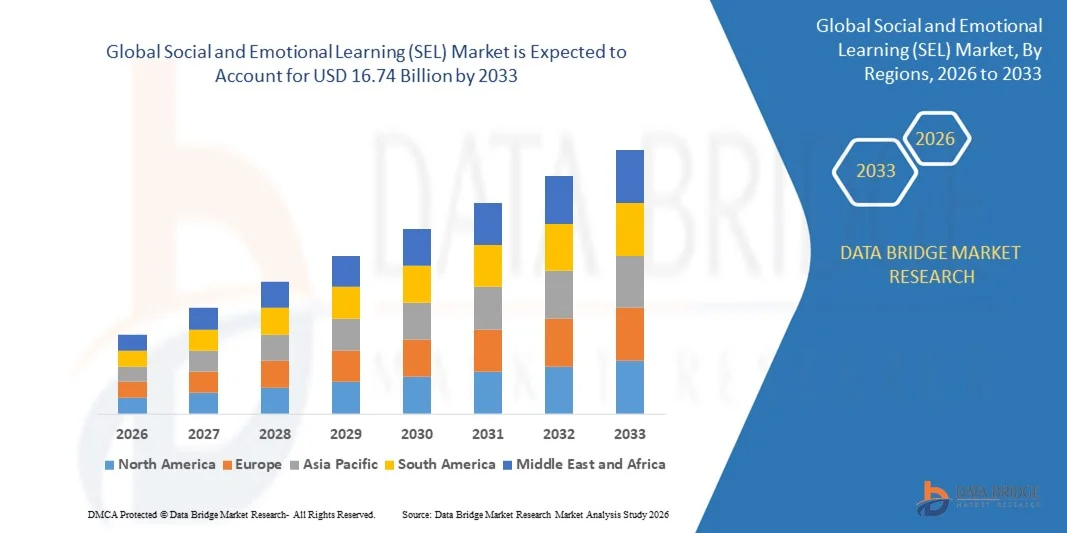
- The global Social and Emotional Learning (SEL) market size was valued at USD 4.22 billion in 2025 and is expected to reach USD 16.74 billion by 2033, at a CAGR of 18.77% during the forecast period
- The market growth is largely driven by the increasing emphasis on holistic education and mental wellbeing, alongside the rising integration of social and emotional learning programs across academic institutions and corporate environments
- Furthermore, growing awareness of emotional intelligence, behavioral development, and the need for supportive learning environments is positioning Social and Emotional Learning (SEL) as a critical component of modern education and workforce training. These combined factors are accelerating the adoption of Social and Emotional Learning (SEL) solutions, thereby significantly strengthening overall market growth
Social and Emotional Learning (SEL) Market Analysis
- Social and emotional learning solutions, which focus on developing self-awareness, emotional regulation, social skills, and responsible decision-making, are becoming essential across Pre-K to higher education and professional development settings due to their positive impact on academic outcomes, wellbeing, and long-term personal development
- The rising demand for Social and Emotional Learning (SEL) solutions is primarily fueled by increasing mental health concerns, supportive education policies, and the growing use of digital learning platforms that enable scalable, measurable, and structured implementation of Social and Emotional Learning (SEL) programs
- North America dominated the Social and Emotional Learning (SEL) market with a share of 39.7% in 2025, due to strong institutional adoption of Social and Emotional Learning (SEL) programs across K–12 education systems and higher education institutions, along with increasing emphasis on student mental health and holistic development
- Asia-Pacific is expected to be the fastest growing region in the Social and Emotional Learning (SEL) market during the forecast period due to expanding education infrastructure, rising awareness of student mental wellbeing, and increasing digitalization of learning environments
- Solutions segment dominated the market with a market share of 73.3% in 2025, due to the widespread adoption of structured Social and Emotional Learning (SEL) curricula, digital platforms, and assessment tools across educational institutions. Schools and organizations increasingly rely on comprehensive Social and Emotional Learning (SEL) solutions to deliver standardized content, monitor student progress, and align programs with academic outcomes. The availability of scalable, curriculum-aligned, and data-driven platforms supports strong demand for solution offerings across K–12 and higher education settings
Report Scope and Social and Emotional Learning (SEL) Market Segmentation
|
Attributes |
Social and Emotional Learning (SEL) Key Market Insights |
|
Segments Covered |
|
|
Countries Covered |
North America
Europe
Asia-Pacific
Middle East and Africa
South America
|
|
Key Market Players |
|
|
Market Opportunities |
|
|
Value Added Data Infosets |
In addition to the market insights such as market value, growth rate, market segments, geographical coverage, market players, and market scenario, the market report curated by the Data Bridge Market Research team includes in-depth expert analysis, import/export analysis, pricing analysis, production consumption analysis, and pestle analysis. |
Social and Emotional Learning (SEL) Market Trends
Digitalization of Social and Emotional Learning Programs
- A prominent trend in the Social and Emotional Learning (SEL) market is the rapid digitalization of Social and Emotional Learning (SEL) programs through web-based and application-driven platforms, enabling structured and scalable delivery across educational and organizational settings. Digital Social and Emotional Learning (SEL) solutions are increasingly adopted by schools and districts to ensure consistency in curriculum implementation, real-time progress tracking, and data-driven insights into student behavior and emotional development
- For instance, Panorama Education provides digital Social and Emotional Learning (SEL) assessment and analytics platforms that are widely used by school districts to measure student wellbeing, school climate, and social-emotional competencies. These platforms support evidence-based decision-making and help educators align Social and Emotional Learning (SEL) strategies with academic and behavioral goals
- The growing availability of interactive digital content is enhancing student engagement by incorporating videos, activities, and scenario-based learning that reinforce emotional awareness and relationship skills. This shift is enabling Social and Emotional Learning (SEL) programs to move beyond traditional classroom instruction into more dynamic and personalized learning experiences
- Educational publishers and edtech providers are increasingly integrating Social and Emotional Learning (SEL) modules into broader digital learning ecosystems, allowing seamless alignment with academic curricula. Companies such as Nearpod embed Social and Emotional Learning (SEL) lessons within interactive classroom tools, supporting real-time participation and social-emotional skill development
- The adoption of cloud-based Social and Emotional Learning (SEL) platforms is improving accessibility for educators, students, and families by enabling anytime access across devices. This is strengthening continuity of Social and Emotional Learning (SEL) instruction across in-school and at-home learning environments
- As digital learning infrastructure continues to expand globally, the digitalization of Social and Emotional Learning (SEL) programs is reinforcing their role as core components of modern education systems. This trend is supporting wider adoption, improved outcome measurement, and long-term integration of Social and Emotional Learning (SEL) into formal and informal learning frameworks
Social and Emotional Learning (SEL) Market Dynamics
Driver
Rising Focus on Student Mental Health and Emotional Wellbeing
- The increasing focus on student mental health and emotional wellbeing is a key driver propelling growth in the Social and Emotional Learning (SEL) market. Educational institutions are prioritizing Social and Emotional Learning (SEL) to address rising concerns related to anxiety, behavioral challenges, absenteeism, and overall student resilience
- For instance, the Collaborative for Academic, Social, and Emotional Learning (CASEL) actively promotes Social and Emotional Learning (SEL) frameworks that are adopted by thousands of school districts to support mental health and positive youth development. These frameworks guide structured implementation and reinforce the credibility of Social and Emotional Learning (SEL) programs
- Schools are increasingly recognizing the strong link between emotional wellbeing and academic performance, which is driving sustained investment in Social and Emotional Learning (SEL) curricula and assessment tools. This focus is encouraging districts to integrate Social and Emotional Learning (SEL) into core instructional models rather than treating it as a supplemental program
- Government agencies and education departments are supporting mental health initiatives that indirectly strengthen Social and Emotional Learning (SEL) adoption through funding, policy guidance, and curriculum recommendations. This institutional backing is expanding the reach of Social and Emotional Learning (SEL) programs across public education systems
- As mental health awareness continues to rise globally, the emphasis on emotional wellbeing is establishing Social and Emotional Learning (SEL) as a foundational element of education reform. This sustained focus is driving long-term market growth and strengthening the role of Social and Emotional Learning (SEL) across diverse learning environments
Restraint/Challenge
Inconsistent Funding and Policy Support Across Education Systems
- The Social and Emotional Learning (SEL) market faces challenges due to inconsistent funding availability and varying policy support across regions and education systems. Differences in government priorities and budget allocations can limit the continuity and scale of Social and Emotional Learning (SEL) program implementation
- For instance, changes in federal education funding priorities by the U.S. Department of Education have led to reduced support for certain SEL-focused initiatives, creating uncertainty for schools and solution providers that rely on public funding. This variability affects procurement decisions and long-term planning
- Many schools struggle to sustain Social and Emotional Learning (SEL) programs beyond initial pilot phases due to limited financial resources, particularly in underfunded districts. This constraint can slow adoption and reduce the depth of program implementation
- Policy inconsistencies across states and countries create fragmented adoption patterns, making it challenging for Social and Emotional Learning (SEL) providers to standardize offerings and scale efficiently. Vendors often need to adapt solutions to meet diverse regulatory and curriculum requirements
- These funding and policy-related challenges collectively restrain market growth by limiting consistent adoption and long-term program sustainability. Addressing these constraints remains critical for ensuring broader and more stable expansion of the Social and Emotional Learning (SEL) market globally
Social and Emotional Learning (SEL) Market Scope
The market is segmented on the basis of component, end-use, type, and core competencies.
- By Component
On the basis of component, the Social and Emotional Learning (SEL) market is segmented into solutions and services. The solutions segment dominated the market with the largest share of 73.3% in 2025, driven by the widespread adoption of structured Social and Emotional Learning (SEL) curricula, digital platforms, and assessment tools across educational institutions. Schools and organizations increasingly rely on comprehensive Social and Emotional Learning (SEL) solutions to deliver standardized content, monitor student progress, and align programs with academic outcomes. The availability of scalable, curriculum-aligned, and data-driven platforms supports strong demand for solution offerings across K–12 and higher education settings.
The services segment is projected to register the fastest growth from 2026 to 2033, supported by rising demand for consulting, training, and implementation support. Institutions seek expert guidance to integrate Social and Emotional Learning (SEL) programs effectively, customize content to local needs, and train educators for long-term impact. Ongoing professional development and evaluation services further accelerate the adoption of Social and Emotional Learning (SEL) services across schools and corporate environments.
- By End-use
On the basis of end-use, the Social and Emotional Learning (SEL) market is categorized into Pre-K, elementary schools, middle & high schools, and corporate. Elementary schools accounted for the largest revenue share in 2025, owing to early intervention initiatives and strong emphasis on foundational emotional and social skill development. Education systems prioritize Social and Emotional Learning (SEL) at the elementary level to improve classroom behavior, learning engagement, and long-term academic performance. The integration of Social and Emotional Learning (SEL) into daily classroom activities reinforces consistent adoption at this stage.
The corporate segment is expected to witness the fastest growth during the forecast period, driven by increasing focus on employee wellbeing, leadership development, and workplace culture. Organizations adopt Social and Emotional Learning (SEL) programs to enhance emotional intelligence, teamwork, and decision-making capabilities among employees. The growing alignment of Social and Emotional Learning (SEL) with diversity, equity, and inclusion initiatives further supports rapid adoption in corporate settings.
- By Type
On the basis of type, the Social and Emotional Learning (SEL) market is segmented into web-based and application-based platforms. Web-based platforms dominated the market in 2025, supported by ease of deployment, centralized content management, and compatibility with school IT infrastructures. Educational institutions favor web-based solutions for their ability to support large user bases, integrate with learning management systems, and enable real-time reporting. These platforms also facilitate district-wide implementation with minimal hardware dependency.
Application-based platforms are anticipated to grow at the fastest rate from 2026 to 2033, driven by increasing smartphone and tablet usage among students and educators. Mobile applications offer personalized learning experiences, interactive activities, and on-demand access to Social and Emotional Learning (SEL) resources. The flexibility and user-friendly nature of applications enhance engagement and support continuous Social and Emotional Learning (SEL) practice beyond classroom environments.
- By Core Competencies
On the basis of core competencies, the Social and Emotional Learning (SEL) market includes self-awareness, self-management, social awareness, relationship skills, and responsible decision-making. Self-management held the largest market share in 2025, as programs increasingly focus on emotional regulation, stress management, and goal-setting skills. Schools and organizations emphasize self-management competencies to improve behavioral outcomes, resilience, and overall performance. The measurable impact of these skills supports sustained investment in related Social and Emotional Learning (SEL) programs.
Responsible decision-making is projected to experience the fastest growth over the forecast period, driven by rising emphasis on ethical reasoning, problem-solving, and long-term consequence evaluation. Educational institutions and employers recognize the importance of decision-making skills in academic success, leadership development, and workforce readiness. This growing relevance accelerates the adoption of Social and Emotional Learning (SEL) solutions centered on responsible decision-making competencies.
Social and Emotional Learning (SEL) Market Regional Analysis
- North America dominated the Social and Emotional Learning (SEL) market with the largest revenue share of 39.7% in 2025, driven by strong institutional adoption of Social and Emotional Learning (SEL) programs across K–12 education systems and higher education institutions, along with increasing emphasis on student mental health and holistic development
- Educators and policymakers in the region highly value evidence-based Social and Emotional Learning (SEL) frameworks, digital delivery platforms, and outcome-driven assessment tools that support emotional intelligence, behavioral improvement, and academic performance
- This widespread adoption is further supported by favorable education policies, high education spending, early integration of technology in classrooms, and growing corporate focus on workforce wellbeing, establishing North America as a leading region for Social and Emotional Learning (SEL) implementation across academic and organizational environments
U.S. Social and Emotional Learning Market Insight
The U.S. Social and Emotional Learning (SEL) market captured the largest revenue share within North America in 2025, fueled by nationwide initiatives promoting mental health awareness and social–emotional development in schools. School districts are increasingly embedding Social and Emotional Learning (SEL) into core curricula to address issues related to student behavior, emotional regulation, and academic engagement. The presence of established Social and Emotional Learning (SEL) solution providers, coupled with federal and state-level funding for student wellness programs, continues to strengthen market growth. In addition, rising adoption of Social and Emotional Learning (SEL) platforms in corporate training and leadership development programs further expands the U.S. market landscape.
Europe Social and Emotional Learning Market Insight
The Europe Social and Emotional Learning (SEL) market is projected to expand at a substantial CAGR during the forecast period, driven by increasing focus on inclusive education, student wellbeing, and social integration. European education systems are progressively adopting Social and Emotional Learning (SEL) frameworks to support multicultural classrooms and address emotional and behavioral challenges among students. The growing use of digital learning tools and government-backed education reforms across multiple countries is fostering the integration of Social and Emotional Learning (SEL) into formal education. Adoption is also gaining traction in workplace training programs focused on emotional intelligence and collaboration.
U.K. Social and Emotional Learning Market Insight
The U.K. Social and Emotional Learning (SEL) market is anticipated to grow at a noteworthy CAGR over the forecast period, supported by rising awareness of mental health in schools and workplaces. Educational institutions are increasingly prioritizing Social and Emotional Learning (SEL) to improve student resilience, classroom engagement, and long-term wellbeing. National initiatives emphasizing emotional wellbeing, combined with growing acceptance of digital learning platforms, are driving Social and Emotional Learning (SEL) adoption. The expanding use of Social and Emotional Learning (SEL) in corporate environments for leadership development and employee wellbeing further supports market growth in the U.K.
Germany Social and Emotional Learning Market Insight
The Germany Social and Emotional Learning (SEL) market is expected to expand at a considerable CAGR, driven by strong emphasis on structured education systems and social development programs. German schools are increasingly integrating Social and Emotional Learning (SEL) concepts to promote emotional awareness, social responsibility, and collaborative learning. The country’s focus on quality education, combined with rising adoption of digital education platforms, supports steady growth of Social and Emotional Learning (SEL) solutions. In addition, Social and Emotional Learning (SEL) adoption in corporate training programs aimed at improving workplace communication and decision-making is contributing to market expansion.
Asia-Pacific Social and Emotional Learning Market Insight
The Asia-Pacific Social and Emotional Learning (SEL) market is poised to grow at the fastest CAGR during the forecast period, driven by expanding education infrastructure, rising awareness of student mental wellbeing, and increasing digitalization of learning environments. Rapid urbanization and growing investments in education technology across emerging economies are accelerating the adoption of Social and Emotional Learning (SEL) platforms. Governments and private institutions are increasingly recognizing the role of Social and Emotional Learning (SEL) in improving academic outcomes and workforce readiness. The scalability and affordability of digital Social and Emotional Learning (SEL) solutions are further enhancing market penetration across the region.
Japan Social and Emotional Learning Market Insight
The Japan Social and Emotional Learning (SEL) market is gaining momentum due to growing emphasis on emotional wellbeing, social harmony, and character education. Japanese schools are increasingly adopting Social and Emotional Learning (SEL) approaches to address stress management, peer relationships, and emotional resilience among students. The integration of Social and Emotional Learning (SEL) with digital learning tools aligns well with Japan’s advanced education technology ecosystem. In addition, the use of Social and Emotional Learning (SEL) programs in corporate settings to enhance teamwork, leadership, and workplace wellbeing is supporting steady market growth.
China Social and Emotional Learning Market Insight
The China Social and Emotional Learning (SEL) market accounted for a significant revenue share in Asia-Pacific in 2025, driven by rapid expansion of the education sector and increasing focus on holistic student development. Educational institutions are gradually incorporating Social and Emotional Learning (SEL) concepts to support emotional regulation, social skills, and behavioral development alongside academic learning. Strong government investment in digital education infrastructure and the growing presence of domestic edtech providers are facilitating wider adoption of Social and Emotional Learning (SEL) platforms. The rising emphasis on workforce soft skills and emotional intelligence is also contributing to Social and Emotional Learning (SEL) adoption in corporate training programs across China.
Social and Emotional Learning (SEL) Market Share
The Social and Emotional Learning (SEL) industry is primarily led by well-established companies, including:
- Panorama Education, LLC (U.S.)
- Peekapak Inc. (Canada)
- Houghton Mifflin Harcourt Publishing Company (U.S.)
- BASE Educational Services Pvt. Ltd. (India)
- Nearpod Inc. (U.S.)
- Second Step – Committee for Children (U.S.)
- Playworks Digital Ltd. (U.K.)
- Rethink ED (U.S.)
- EVERFI Inc. (U.S.)
- 7 Mindsets Ltd. (U.S.)
- Aperture Education LLC (U.S.)
- Move This World (U.S.)
- Purpose Prep. – Weld North LLC (U.S.)
- Emotional ABCs Inc. (U.S.)
- Kickboard Inc. (U.S.)
- The Social Express Inc. (U.S.)
- CharacterStrong LLC (U.S.)
- Taproot Learning (U.S.)
- Everyday Speech (U.S.)
- Evolution Labs, Inc. (U.S.)
Latest Developments in Global Social and Emotional Learning (SEL) Market
- In September 2025, the U.S. Department of Education redirected competitive grant funding toward patriotic education priorities, resulting in reduced financial support for certain Social and Emotional Learning (SEL) initiatives across public school systems. This shift has created a more challenging funding environment for Social and Emotional Learning (SEL) vendors that rely heavily on federal education grants, prompting providers to refine pricing models, demonstrate stronger academic and behavioral outcomes, and pursue alternative funding channels. As a result, the market is experiencing increased emphasis on measurable impact, private partnerships, and state-level or international expansion strategies to maintain growth momentum
- In June 2025, Smart Education entered into an MOU with South Korea’s Cellbig to jointly develop AI-enabled Social and Emotional Learning (SEL) content tailored for the Japanese market, highlighting the growing role of artificial intelligence in personalized emotional learning. This collaboration is accelerating innovation in adaptive Social and Emotional Learning (SEL) platforms by enabling real-time emotional insights, customized learning pathways, and culturally relevant content delivery. The initiative strengthens Asia-Pacific’s position as a high-growth region and encourages wider adoption of advanced, technology-driven Social and Emotional Learning (SEL) solutions among schools and corporate training programs
- In February 2025, FullBloom’s acquisition of CharacterStrong significantly expanded its integrated student support ecosystem by combining Social and Emotional Learning (SEL) curricula with broader mental health and behavioral intervention services. This consolidation enhances FullBloom’s ability to offer holistic, multi-tiered solutions that address emotional wellbeing, behavior management, and academic success within a single platform. The move is reshaping competitive dynamics by increasing demand for comprehensive Social and Emotional Learning (SEL) offerings and pushing smaller vendors to pursue partnerships or platform expansion to remain competitive
- In September 2024, Riverside Insights’ acquisition of Aperture Education merged Social and Emotional Learning (SEL) assessment tools with advanced cognitive and behavioral analytics, strengthening the focus on data-driven decision-making in the Social and Emotional Learning (SEL) market. Schools and districts increasingly prioritize solutions that provide measurable insights into student progress, program effectiveness, and long-term outcomes. This development is driving demand for integrated assessment-led Social and Emotional Learning (SEL) platforms, reinforcing the importance of evidence-based validation in procurement decisions and long-term adoption
- In March 2024, Positive Action, Inc. launched Pasela, a fully digital and interactive SaaS platform designed to enable seamless implementation of its evidence-based Social and Emotional Learning (SEL) curriculum across Pre-K through high school. By offering over 2,000 scientifically validated lessons through a unified web interface, the platform significantly improves scalability, accessibility, and consistency of Social and Emotional Learning (SEL) delivery. This launch addresses key adoption barriers related to implementation complexity and educator workload, thereby expanding Positive Action’s market reach and supporting broader digital transformation within the Social and Emotional Learning (SEL) market

- Interactive Data Analysis Dashboard
- Company Analysis Dashboard for high growth potential opportunities
- Research Analyst Access for customization & queries
- Competitor Analysis with Interactive dashboard
- Latest News, Updates & Trend analysis
- Harness the Power of Benchmark Analysis for Comprehensive Competitor Tracking
Data collection and base year analysis are done using data collection modules with large sample sizes. The stage includes obtaining market information or related data through various sources and strategies. It includes examining and planning all the data acquired from the past in advance. It likewise envelops the examination of information inconsistencies seen across different information sources. The market data is analysed and estimated using market statistical and coherent models. Also, market share analysis and key trend analysis are the major success factors in the market report. To know more, please request an analyst call or drop down your inquiry.
The key research methodology used by DBMR research team is data triangulation which involves data mining, analysis of the impact of data variables on the market and primary (industry expert) validation. Data models include Vendor Positioning Grid, Market Time Line Analysis, Market Overview and Guide, Company Positioning Grid, Patent Analysis, Pricing Analysis, Company Market Share Analysis, Standards of Measurement, Global versus Regional and Vendor Share Analysis. To know more about the research methodology, drop in an inquiry to speak to our industry experts.
Data Bridge Market Research is a leader in advanced formative research. We take pride in servicing our existing and new customers with data and analysis that match and suits their goal. The report can be customized to include price trend analysis of target brands understanding the market for additional countries (ask for the list of countries), clinical trial results data, literature review, refurbished market and product base analysis. Market analysis of target competitors can be analyzed from technology-based analysis to market portfolio strategies. We can add as many competitors that you require data about in the format and data style you are looking for. Our team of analysts can also provide you data in crude raw excel files pivot tables (Fact book) or can assist you in creating presentations from the data sets available in the report.













