


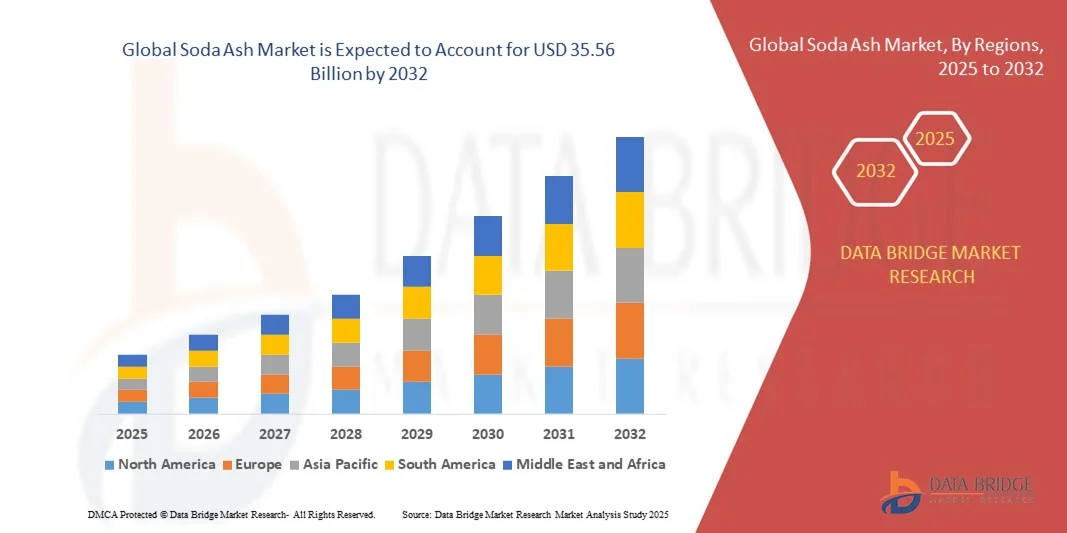
Soda Ash Market Size
- The global soda ash market size was valued at USD 23.89 billion in 2024 and is expected to reach USD 35.56 billion by 2032, at a CAGR of 5.10% during the forecast period
- The market growth is largely fueled by the expanding demand from key end-use industries, including glass, chemicals, detergents, and water treatment, where soda ash serves as a critical raw material. Increasing industrialization, urbanization, and infrastructure development in emerging economies are driving higher consumption across these sectors, thereby supporting sustained market expansion
- Furthermore, rising focus on sustainable and high-purity soda ash production, coupled with technological advancements in both synthetic and natural soda ash manufacturing processes, is enhancing efficiency and reducing environmental impact. These converging factors are encouraging producers to scale operations and innovate, thereby significantly boosting the industry’s growth
Soda Ash Market Analysis
- Soda ash, primarily used in glass manufacturing, chemicals, soaps and detergents, metallurgy, water treatment, pharmaceuticals, and pulp and paper, is an essential industrial chemical whose consistent quality and high purity are critical for product performance. Growing global industrial output and rising demand for soda ash-intensive products are underpinning market growth
- The escalating demand for soda ash is primarily fueled by the expansion of the glass and chemical industries, increased detergent consumption, and the need for efficient water treatment solutions. In addition, rising awareness of sustainability and the adoption of lower-carbon production technologies are driving investment in both natural and synthetic soda ash production, further accelerating market adoption
- Asia-Pacific dominated the soda ash market in 2024, due to expanding glass manufacturing, rising chemical production, and a strong presence of industrial hubs
- North America is expected to be the fastest growing region in the soda ash market during the forecast period due to rising demand for soda ash in glass, chemicals, and detergents
- Synthetic segment dominated the market with a market share of 61.9% in 2024, due to its consistent quality, large-scale production capabilities, and widespread availability across industrial sectors. Industries favor synthetic soda ash due to its high purity levels, predictable chemical composition, and cost-effectiveness compared with naturally mined soda ash. The dominance of synthetic soda ash is further supported by its extensive use in glass manufacturing, chemicals, and detergents, where precise formulations are critical. In addition, continuous technological advancements in synthetic soda ash production processes, such as the Solvay method, contribute to its leading position in the market
Report Scope and Soda Ash Market Segmentation
|
Attributes |
Soda Ash Key Market Insights |
|
Segments Covered |
|
|
Countries Covered |
North America
Europe
Asia-Pacific
Middle East and Africa
South America
|
|
Key Market Players |
|
|
Market Opportunities |
|
|
Value Added Data Infosets |
In addition to the insights on market scenarios such as market value, growth rate, segmentation, geographical coverage, and major players, the market reports curated by the Data Bridge Market Research also include import export analysis, production capacity overview, production consumption analysis, price trend analysis, climate change scenario, supply chain analysis, value chain analysis, raw material/consumables overview, vendor selection criteria, PESTLE Analysis, Porter Analysis, and regulatory framework. |
Soda Ash Market Trends
Adoption of Low-Carbon Soda Ash Production
- The global soda ash market is undergoing a major transformation driven by the growing shift toward low-carbon and sustainable production methods. The increasing pressure to reduce CO2 emissions and energy consumption in industrial processes is prompting manufacturers to adopt environmentally friendly technologies for soda ash production
- For instance, Solvay SA and Tata Chemicals Limited have initiated low-carbon production projects focused on carbon capture, utilization, and storage (CCUS) technologies. These initiatives aim to minimize greenhouse gas emissions from their traditional Solvay process units while maintaining high product output and quality
- The demand for sustainable soda ash is rising steadily across end-use industries such as glass, detergents, and paper, as downstream manufacturers also face growing expectations to comply with environmental standards. As a result, companies are actively pursuing innovative process routes that incorporate renewable energy and waste minimization strategies
- In addition, several producers are investing in naturally derived soda ash (trona-based) sources to reduce reliance on synthetic production paths. This approach cuts energy intensity and enhances scalability for large-volume consumers across global markets
- Governmental incentives promoting industrial decarbonization and carbon neutrality are further accelerating the adoption of green manufacturing technologies. Strategic partnerships between technology providers and soda ash manufacturers are supporting the commercialization of cleaner, more efficient process models
- The industry’s gradual transition toward low-carbon production is expected to define its competitive dynamics in the next decade. By focusing on process optimization, emission control, and energy management, companies are aligning long-term growth strategies with global sustainability objectives
Soda Ash Market Dynamics
Driver
Rising Demand from Glass and Chemical Industries
- The growing consumption of soda ash in glass and chemical manufacturing remains a significant driver of market expansion. Soda ash plays a vital role in reducing melting temperatures and enhancing process efficiency, making it indispensable in various production applications
- For instance, Ciner Resources and Sisecam Group have expanded their soda ash capacities to meet the rising demand from the construction and automotive glass sectors. The increasing use of flat glass and container glass for buildings, solar panels, and vehicles has established soda ash as a foundational material in industrial production
- The robust growth of detergent, pulp and paper, and water treatment industries is further fueling the need for high-quality soda ash as a pH adjuster and cleaning agent base. These downstream sectors rely on consistent supply to maintain product performance and compliance with international manufacturing standards
- In addition, the accelerating global focus on renewable energy infrastructure, such as solar power projects, is boosting the consumption of soda ash in solar glass manufacturing. This expanding application base underscores the material’s essential role in achieving global energy transition targets
- As industrial production scales up worldwide, the demand for high-purity soda ash from glass and chemical industries is projected to remain a key growth pillar. Continuous capacity expansions and technological advancements are supporting long-term market sustainability
Restraint/Challenge
Fluctuating Raw Material Supply
- The soda ash market faces ongoing challenges due to the volatile supply and pricing of key raw materials such as limestone, trona ore, and energy sources. Fluctuations in raw material availability directly influence production stability and forward pricing strategies for manufacturers
- For instance, producers in China and the United States have experienced intermittent supply disruptions caused by mining restrictions and energy shortages, leading to price instability across global markets. Major producers such as Ciner Resources and Solvay SA are expanding resource security initiatives to mitigate supply volatility
- Rising fuel and energy costs add additional financial pressure, as soda ash production, particularly through the Solvay process, is highly energy-intensive. These costs can significantly impact operating margins and competitiveness, especially for producers dependent on fossil energy sources
- Furthermore, logistical constraints in transporting bulky raw materials across regions with limited infrastructure can reduce production efficiency and lead to delivery bottlenecks. Climate and environmental regulations governing mining and waste disposal further compound the issue by tightening supply chains
- To address these challenges, companies are increasingly diversifying sourcing networks and investing in efficiency-focused technologies such as waste heat recovery and renewable power integration. Enhancing supply chain flexibility and securing raw material resilience will be essential for ensuring stable production and sustained market growth in the soda ash sector
Soda Ash Market Scope
The market is segmented on the basis of type and application.
- By Type
On the basis of type, the soda ash market is segmented into natural and synthetic. The synthetic segment dominated the market with the largest market revenue share of 61.9% in 2024, driven by its consistent quality, large-scale production capabilities, and widespread availability across industrial sectors. Industries favor synthetic soda ash due to its high purity levels, predictable chemical composition, and cost-effectiveness compared with naturally mined soda ash. The dominance of synthetic soda ash is further supported by its extensive use in glass manufacturing, chemicals, and detergents, where precise formulations are critical. In addition, continuous technological advancements in synthetic soda ash production processes, such as the Solvay method, contribute to its leading position in the market.
The natural soda ash segment is anticipated to witness the fastest growth rate from 2025 to 2032, fueled by increasing demand for eco-friendly and sustainable raw materials. For instance, companies are exploring natural soda ash from trona deposits as a lower-carbon alternative to synthetic processes. Natural soda ash is preferred in niche applications where minimal chemical processing and environmental sustainability are prioritized. Growing awareness of green manufacturing practices in developed regions is driving adoption, particularly in glass and chemical industries. Moreover, the cost-efficiency of extraction in certain geographies provides additional growth potential for the natural soda ash segment.
- By Application
On the basis of application, the soda ash market is segmented into glass, chemicals, soaps and detergents, metallurgy, water treatment, pharmaceuticals, and pulp and paper. The glass segment dominated the market with the largest market revenue share of 47.8% in 2024, driven by its critical role as a fluxing agent in soda-lime glass production. Soda ash lowers the melting point of silica, enabling energy-efficient glass manufacturing and improved product quality. Glass manufacturers prioritize soda ash with consistent purity levels to ensure clarity, durability, and resistance to thermal stress. Rising construction and automotive industries, which rely heavily on glass, further strengthen demand for soda ash in this segment. In addition, ongoing innovations in specialty glass applications, such as smart glass and architectural panels, support the sustained dominance of the glass application segment.
The chemicals segment is anticipated to witness the fastest growth rate from 2025 to 2032, fueled by the rising use of soda ash in producing sodium-based chemicals and industrial compounds. For instance, companies are increasingly leveraging soda ash in sodium bicarbonate, sodium silicate, and other chemical intermediates for diverse applications. Rapid industrialization in emerging economies is expanding demand for chemical intermediates, driving soda ash consumption in the chemicals sector. Furthermore, the versatility of soda ash in various chemical reactions enhances its adoption in both large-scale and specialty chemical manufacturing. The increasing focus on chemical process efficiency and quality consistency continues to accelerate growth in this segment.
Soda Ash Market Regional Analysis
- Asia-Pacific dominated the soda ash market with the largest revenue share in 2024, driven by expanding glass manufacturing, rising chemical production, and a strong presence of industrial hubs
- The region’s cost-effective manufacturing landscape, growing investments in chemical and detergent production, and increasing exports of soda ash are accelerating market expansion
- Availability of skilled labor, supportive government policies, and rapid industrialization across developing economies are contributing to increased consumption of soda ash in both industrial and commercial sectors
China Soda Ash Market Insight
China held the largest share in the Asia-Pacific soda ash market in 2024, owing to its position as a global leader in glass and chemical manufacturing. The country’s extensive industrial base, favorable government policies supporting mineral extraction and chemical production, and strong export capabilities are major growth drivers. Demand is further bolstered by ongoing investments in water treatment, detergents, and specialty chemicals for domestic and international markets.
India Soda Ash Market Insight
India is witnessing the fastest growth in the Asia-Pacific region, fueled by rapid industrialization, increasing glass and chemical manufacturing, and growing detergent production. Government initiatives promoting self-reliance in industrial raw materials and increasing foreign investment in chemical infrastructure are strengthening demand. Rising exports of soda ash and expanding application in water treatment and pharmaceuticals are contributing to robust market expansion.
Europe Soda Ash Market Insight
The Europe soda ash market is expanding steadily, supported by stringent environmental regulations, high demand for high-purity soda ash in chemicals and glass, and growing investments in sustainable production processes. The region emphasizes quality, energy efficiency, and advanced formulations for industrial applications. Increasing adoption in specialty glass and detergents further enhances market growth.
Germany Soda Ash Market Insight
Germany’s soda ash market is driven by its leadership in precision glass and chemical manufacturing, strong industrial heritage, and export-oriented production model. Well-established R&D networks and collaborations between academic institutions and chemical producers foster continuous innovation in soda ash applications. Demand is particularly strong in high-purity chemicals, specialty glass, and detergents.
U.K. Soda Ash Market Insight
The U.K. market is supported by a mature industrial chemicals sector, increasing focus on sustainable manufacturing, and growing adoption in glass and detergent production. Investments in R&D, partnerships between chemical producers and academic institutions, and emphasis on eco-friendly processes continue to strengthen the market. Rising demand for high-quality soda ash in pharmaceuticals and water treatment is also boosting consumption.
North America Soda Ash Market Insight
North America is projected to grow at the fastest CAGR from 2025 to 2032, driven by rising demand for soda ash in glass, chemicals, and detergents. Increasing industrial production, focus on high-purity chemical inputs, and reshoring of manufacturing activities are boosting market growth. The expanding pharmaceutical and water treatment sectors further support soda ash consumption.
U.S. Soda Ash Market Insight
The U.S. accounted for the largest share in the North America soda ash market in 2024, underpinned by its strong glass and chemical industries, advanced R&D infrastructure, and significant investment in specialty chemical production. Emphasis on innovation, regulatory compliance, and sustainability is encouraging the use of high-purity soda ash in industrial applications. Presence of key players and a mature distribution network further solidify the U.S.’s leading position in the region.
Soda Ash Market Share
The soda ash industry is primarily led by well-established companies, including:
- Solvay (Belgium)
- Tata Chemicals Ltd (India)
- Searles Valley Minerals Inc. (U.S.)
- Tronox Holdings plc (U.K.)
- FMC Corporation (U.S.)
- NIRMA (India)
- SHANDONG OCEAN CHEMICAL CO., LTD (China)
- Beroil Energy Group (U.S.)
- Ciner Resources Corporation (Turkey)
- General Chemical Corp (U.S.)
- GHCL Limited (India)
- ANSAC (U.S.)
- DCW Ltd (India)
- Weifang Haizhiyuan Chemistry and Industry Co., Ltd. (China)
- Merck KGaA (Germany)
- Eti Soda Elektrik (Turkey)
- Soda Genesis Energy, LP (U.S.)
- ANDRITZ (Austria)
- OCI COMPANY Ltd. (South Korea)
- CIECH S.A. (Poland)
Latest Developments in Global Soda Ash Market
- In September 2024, WE Soda achieved record exports of natural soda ash to Asian markets, reflecting a surge in demand from high-growth economies seeking quality trona-based soda ash. This milestone underscores the shifting dynamics of global supply chains, with producers in the U.S. and Turkey increasingly focusing on export-oriented growth. By expanding trade flows to Asia, WE Soda is strengthening its market footprint and supporting a more resilient global distribution network. The development is expected to enhance revenue generation, improve operational scalability, and position the company to capitalize on rising industrial demand in glass, chemicals, and detergents sectors
- In December 2023, Solvay launched its groundbreaking “e.Solvay” soda ash production process, designed to reduce CO₂ emissions by 50 %, cut energy, water, and salt consumption by 20 %, and lower limestone usage and production residues by 30 %. This innovation represents a major step toward sustainable production in the soda ash industry, offering both environmental and cost advantages. By minimizing resource consumption and emissions, Solvay sets a new benchmark for eco-friendly manufacturing, enhancing its competitive positioning. The technology is likely to influence industry standards, encourage adoption of green production methods across the sector, and attract environmentally conscious industrial clients seeking low-carbon soda ash solutions
- In June 2023, Tata Chemicals announced a USD 968 million capital expenditure plan, which includes a 380 kT salt capacity expansion in the U.K. and Mithapur, India, raising its global salt capacity to 2.3 MT and India’s to 1.8 MT. This strategic investment is aimed at securing raw material availability for soda ash and related chemical products, ensuring uninterrupted production for key markets. The expansion supports scaling of soda ash production, reinforces the company’s supply chain resilience, and positions Tata Chemicals to meet increasing demand across glass, detergents, and water treatment applications. In addition, the investment reflects a long-term commitment to sustainable growth and operational efficiency, enhancing competitiveness in both domestic and international markets
- In March 2023, Şişecam and Ciner Group committed to major investments in port infrastructure in California, U.S., to support their expanding natural soda ash operations. This development significantly improves logistics efficiency and export capacity, enabling faster and more cost-effective distribution of soda ash to North American and international markets. The investment strengthens the companies’ market reach, enhances supply-chain reliability, and supports growing demand from industrial sectors, particularly glass, chemicals, and detergents. By bolstering port capabilities, the companies can better respond to fluctuations in global demand and capitalize on export-led growth opportunities
- In May 202,: Solvay acquired the remaining 20 % minority stake from AGC in its Green River, Wyoming soda ash joint venture for USD 120 million, becoming the sole owner. This consolidation provides Solvay with full control over a key trona-based production facility, enabling optimization of operations, increased production flexibility, and improved access to lower carbon-intensive soda ash. The move strengthens Solvay’s leadership in the global soda ash market, aligns with its sustainability objectives, and enhances its ability to meet rising industrial demand. With full ownership, the company can implement strategic initiatives more effectively, drive innovation in production processes, and capture greater market share across glass, chemicals, and detergent applications

- Interactive Data Analysis Dashboard
- Company Analysis Dashboard for high growth potential opportunities
- Research Analyst Access for customization & queries
- Competitor Analysis with Interactive dashboard
- Latest News, Updates & Trend analysis
- Harness the Power of Benchmark Analysis for Comprehensive Competitor Tracking
Global Soda Ash Market, Supply Chain Analysis and Ecosystem Framework
To support market growth and help clients navigate the impact of geopolitical shifts, DBMR has integrated in-depth supply chain analysis into its Global Soda Ash Market research reports. This addition empowers clients to respond effectively to global changes affecting their industries. The supply chain analysis section includes detailed insights such as Global Soda Ash Market consumption and production by country, price trend analysis, the impact of tariffs and geopolitical developments, and import and export trends by country and HSN code. It also highlights major suppliers with data on production capacity and company profiles, as well as key importers and exporters. In addition to research, DBMR offers specialized supply chain consulting services backed by over a decade of experience, providing solutions like supplier discovery, supplier risk assessment, price trend analysis, impact evaluation of inflation and trade route changes, and comprehensive market trend analysis.
Data collection and base year analysis are done using data collection modules with large sample sizes. The stage includes obtaining market information or related data through various sources and strategies. It includes examining and planning all the data acquired from the past in advance. It likewise envelops the examination of information inconsistencies seen across different information sources. The market data is analysed and estimated using market statistical and coherent models. Also, market share analysis and key trend analysis are the major success factors in the market report. To know more, please request an analyst call or drop down your inquiry.
The key research methodology used by DBMR research team is data triangulation which involves data mining, analysis of the impact of data variables on the market and primary (industry expert) validation. Data models include Vendor Positioning Grid, Market Time Line Analysis, Market Overview and Guide, Company Positioning Grid, Patent Analysis, Pricing Analysis, Company Market Share Analysis, Standards of Measurement, Global versus Regional and Vendor Share Analysis. To know more about the research methodology, drop in an inquiry to speak to our industry experts.
Data Bridge Market Research is a leader in advanced formative research. We take pride in servicing our existing and new customers with data and analysis that match and suits their goal. The report can be customized to include price trend analysis of target brands understanding the market for additional countries (ask for the list of countries), clinical trial results data, literature review, refurbished market and product base analysis. Market analysis of target competitors can be analyzed from technology-based analysis to market portfolio strategies. We can add as many competitors that you require data about in the format and data style you are looking for. Our team of analysts can also provide you data in crude raw excel files pivot tables (Fact book) or can assist you in creating presentations from the data sets available in the report.













