


What is the Sodium Benzoate Market Size and Growth Rate?
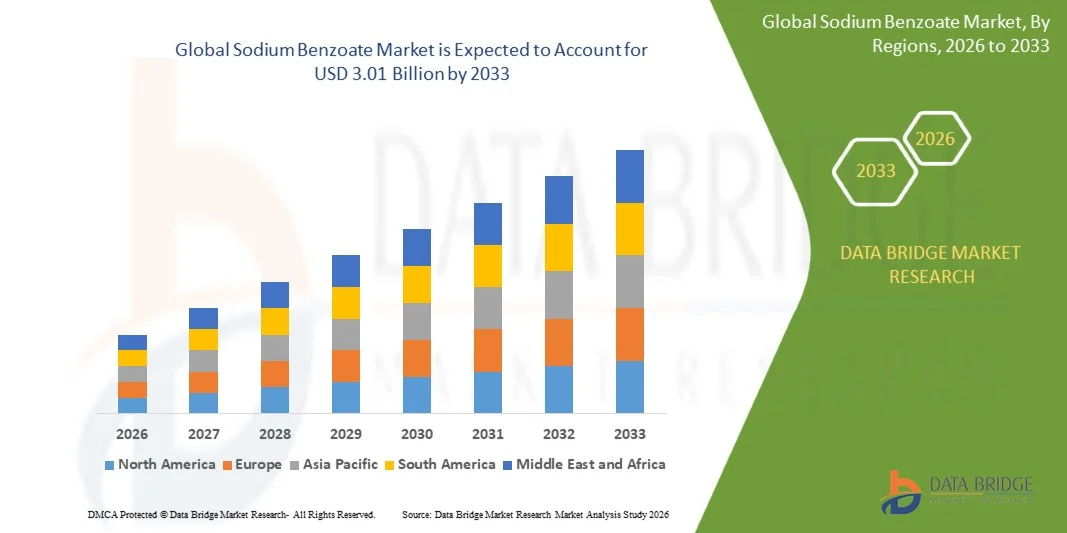
- As per Data Bridge Market Research analysis, the sodium benzoate market was valued at USD 1.76 billion in 2025 and is projected to reach USD 3.01billion by 2033, growing at a CAGR of 5.41% from 2026 to 2033.
- The market is experiencing consistent growth driven by rising consumption of processed and packaged food products, expanding carbonated and non-carbonated beverage industries, and increasing use of sodium benzoate as a cost-effective antimicrobial preservative across pharmaceutical and personal care formulations.
- The growing demand for extended shelf-life food products, combined with expanding food processing infrastructure across emerging economies, is compelling manufacturers to adopt sodium benzoate as a preferred preservative. Food-grade sodium benzoate is increasingly used in sauces, pickles, fruit juices, and carbonated soft drinks, offering an economical and effective alternative to costlier natural preservative systems.
Market Size & Forecast
- Global Market Value (2025): USD 1.76 Billion
- Expected Market Value (2033): USD 3.01Billion
- Forecast CAGR (2026–2033): 5.41%
- Leading Region in 2025: Asia-Pacific
- Fastest Growing Region: North America
What are the Major Takeaways of the Sodium Benzoate Market?
- Asia-Pacific dominated the global sodium benzoate market with the largest revenue share of 38.46% in 2025, supported by large-scale manufacturing capacity, low production costs, and rising processed food consumption in China and India.
- North America is expected to be the fastest-growing region at a CAGR of 6.8% from 2026 to 2033, fueled by growing demand for functional and preserved beverages and increasing pharmaceutical formulation activity.
- The food grade segment led the market with a 54.72% share in 2025, driven by extensive use in beverages, sauces, and packaged food preservation.
- The pharmaceutical grade segment is the fastest-growing grade category, projected to register a CAGR of 6.5%, reflecting rising use of sodium benzoate as an excipient and preservative in liquid medications.
- The food preservatives application dominated the market with a 43.18% revenue share in 2025, led by widespread use in acidic food products requiring antimicrobial protection.
- The powder form accounted for 61.34% of the market share in 2025, preferred for its ease of handling, storage stability, and compatibility with dry-mix formulations.
- The personal care & cosmetics segment is the fastest-growing end-use category, with a CAGR of 6.9%, driven by rising use of sodium benzoate as a preservative in lotions, shampoos, and skincare formulations.
Report Scope and Sodium Benzoate Market Segmentation
|
Attributes |
Sodium Benzoate Key Market Insights |
|
Segments Covered |
|
|
Countries Covered |
North America
Europe
Asia-Pacific
Middle East and Africa
South America
|
|
Key Market Players |
|
|
Market Opportunities |
|
|
Value Added Data Infosets |
In addition to the insights on market scenarios such as market value, growth rate, segmentation, geographical coverage, and major players, the market reports curated by the Data Bridge Market Research also include in-depth expert analysis, pricing analysis, brand share analysis, consumer survey, demography analysis, supply chain analysis, value chain analysis, raw material/consumables overview, vendor selection criteria, PESTLE Analysis, Porter Analysis, and regulatory framework. |
What is the Key Trend in the Sodium Benzoate Market?
- Food and beverage manufacturers are increasingly optimizing sodium benzoate usage levels to comply with global food safety regulations while maintaining antimicrobial efficacy and minimizing the potential formation of benzene in formulations containing ascorbic acid.
- Growing sustainability initiatives are encouraging preservative manufacturers to introduce lower-carbon and renewable sodium benzoate solutions without compromising product performance or regulatory compliance.
- Consumer demand for clean-label and environmentally friendly products is driving manufacturers to incorporate sodium benzoate into biodegradable and certified sustainable formulations, particularly in home care and personal care applications.
- Personal care manufacturers are increasingly adopting high-purity sodium benzoate as a preservative alternative because of its favorable environmental profile, biodegradability, and acceptance under multiple green certification programs.
- For instance, in January 2024, LANXESS introduced Kalaguard® SB Scopeblue®, the world's first ISCC PLUS-certified renewable sodium benzoate preservative for the cleaning products industry. The product enables manufacturers to reduce the carbon footprint of cleaning formulations while maintaining the same preservative performance and product specifications.
- As sustainability, regulatory compliance, and clean-label product development continue to shape the preservatives industry, sodium benzoate is expected to remain an essential ingredient across food, beverage, pharmaceutical, and personal care applications.
What are the Key Drivers of the Sodium Benzoate Market?
- The continued expansion of the global processed food, beverage, pharmaceutical, and personal care industries is driving demand for effective, economical, and broad-spectrum preservatives capable of extending product shelf life.
- Increasing regulatory emphasis on product safety and microbial protection is encouraging manufacturers to use high-quality preservative systems that comply with international food and cosmetic standards.
- Growing demand for sustainable ingredients is accelerating investments in renewable and low-carbon sodium benzoate production technologies.
- Manufacturers are increasingly selecting sodium benzoate because of its proven antimicrobial efficacy, compatibility with acidic formulations, and broad global regulatory acceptance.
- For instance, in September 2024, LANXESS showcased Purox® S Scopeblue®, a climate-friendly sodium benzoate manufactured using renewable raw materials and green electricity. The product provides up to a 100% lower product carbon footprint while maintaining identical technical performance, allowing customers to switch without reformulating existing products.
- Increasing investment in sustainable preservative technologies is expected to strengthen long-term demand for sodium benzoate across industrial and consumer applications.
Which Factors are Challenging the Growth of the Sodium Benzoate Market?
- Sodium benzoate continues to face regulatory scrutiny because it may form benzene when combined with ascorbic acid under certain storage conditions involving heat and light exposure.
- Rising consumer preference for natural preservatives and clean-label food products is encouraging manufacturers to evaluate alternative preservation systems, particularly in premium food and beverage segments.
- Compliance with evolving food additive regulations and labeling requirements continues to increase formulation and testing costs for manufacturers.
- Fluctuations in benzoic acid raw material prices and growing competition from naturally derived antimicrobial ingredients remain key challenges for market participants.
- For instance, in July 2026, the European Commission imposed provisional anti-dumping duties on sodium benzoate imports from China after determining that exporters were selling the product at unfairly low prices. The measure highlighted increasing regulatory and trade pressures affecting the global sodium benzoate supply chain and sourcing strategies for downstream manufacturers.
- As regulatory oversight, sustainability expectations, and consumer preference for natural ingredients continue to evolve, manufacturers will need to balance product performance with compliance and environmental objectives.
How is the Sodium Benzoate Market Segmented?
The sodium benzoate market is segmented on the basis of grade, form, application, function, end-use industry, purity level, packaging type, and distribution channel.
- By Grade
On the basis of grade, the global sodium benzoate market is segmented into food grade, pharmaceutical grade, and technical/industrial grade. The food grade segment dominated the market with a 54.72% share in 2025, owing to its extensive use as an antimicrobial preservative in beverages, sauces, pickles, and packaged food products across global food processing industries.
The pharmaceutical grade segment is projected to register the fastest growth at a CAGR of 6.5% from 2026 to 2033, driven by rising demand for high-purity preservative excipients in oral liquid medications, syrups, and topical formulations.
- By Form
On the basis of form, the market is segmented into powder, granules, and liquid/solution. The powder segment led the market with a 61.34% share in 2025, supported by its ease of handling, longer shelf stability, and compatibility with dry-blend food and industrial formulations.
The liquid/solution segment is expected to experience the fastest growth at a CAGR of 6.2% from 2026 to 2033, driven by increasing adoption in beverage manufacturing where pre-dissolved preservative solutions improve production-line efficiency.
- By Application
On the basis of application, the market is segmented into food preservatives, beverages, pharmaceuticals, personal care & cosmetics, animal feed, and industrial applications. The food preservatives segment dominated the market with a share of 43.18% in 2025 due to its widespread use in extending the shelf life of acidic food products, growing global processed food consumption, and increasing demand for cost-effective antimicrobial solutions. Additionally, rising focus on reducing food spoilage and waste further supports strong adoption of sodium benzoate in this application.
The personal care & cosmetics segment is anticipated to witness the fastest CAGR of 6.9% from 2026 to 2033, driven by growing use of sodium benzoate as a paraben alternative in lotions, shampoos, and skincare products, along with rising consumer demand for effectively preserved personal care formulations.
- By Function
On the basis of function, the market is segmented into antimicrobial agent, antifungal agent, corrosion inhibitor, and flavoring adjunct. The antimicrobial agent segment dominated the market with a share of 58.90% in 2025 due to its broad-spectrum effectiveness against bacteria and yeast in acidic food and beverage products, well-established regulatory approval across major markets, and cost advantages over alternative preservation systems.
The corrosion inhibitor segment is expected to witness the fastest CAGR of 6.1% from 2026 to 2033, driven by rising use of sodium benzoate in automotive coolants and industrial water-treatment systems requiring effective, low-toxicity corrosion protection.
- By End-Use Industry
On the basis of end-use industry, the market is segmented into food & beverage, pharmaceuticals, personal care, automotive, and others. The food & beverage segment dominated the market with a share of 61.15% in 2025 due to extensive use of sodium benzoate across carbonated drinks, sauces, and packaged foods, rising global processed food demand, and increasing preference for economical preservation solutions among manufacturers. Additionally, growing beverage industry expansion in emerging economies further reinforces this segment's leading position.
The personal care segment is expected to witness the fastest CAGR of 6.7% from 2026 to 2033, driven by increasing formulation of preserved skincare and haircare products, rising demand for paraben-free alternatives, and expanding personal care manufacturing in Asia-Pacific and Latin America.
- By Distribution Channel
On the basis of distribution channel, the market is segmented into direct sales, distributors & wholesalers, and online/e-commerce. The distributors & wholesalers segment dominated the market with a share of 55.28% in 2025 due to established regional networks, faster order fulfillment, and strong relationships with small and mid-sized food and pharmaceutical manufacturers.
The online/e-commerce segment is expected to witness the fastest CAGR of 7.0% from 2026 to 2033, driven by increasing digitization of chemical procurement and growing preference among small-scale buyers for streamlined ordering platforms.
Which Region Holds the Largest Share of the Sodium Benzoate Market?
- Asia-Pacific dominated the sodium benzoate market and accounted for the largest revenue share of 38.46% in 2025, supported by large-scale chemical manufacturing capacity, low production costs, and rising processed food and beverage consumption across China and India.
- The region also benefits from expanding pharmaceutical and personal care manufacturing bases, growing export activity to North America and Europe, and increasing investment in food processing infrastructure. Continued growth in packaged food consumption and beverage manufacturing continues to strengthen Asia-Pacific's leadership position in the global market.
China Sodium Benzoate Market Insight
China represents the largest producer and exporter of sodium benzoate globally, supported by its well-established benzoic acid manufacturing base, abundant chemical production capacity, and cost-competitive raw material supply. The country accounts for a significant share of global sodium benzoate exports, supplying food-grade, pharmaceutical-grade, and industrial-grade products to more than 100 countries across Asia, Europe, North America, Latin America, and the Middle East. Major manufacturing clusters are concentrated in Shandong, Jiangsu, Zhejiang, Hebei, and Henan provinces, where integrated chemical complexes ensure large-scale production and export competitiveness.
Government initiatives supporting advanced chemical manufacturing under the 14th Five-Year Plan, together with increasing adoption of international food safety standards such as HACCP, FSSC 22000, ISO 22000, and GMP, are encouraging manufacturers to improve product quality and expand exports. Furthermore, rising demand for packaged foods, convenience products, processed meat, bakery items, beverages, and personal care products is expected to sustain steady growth in domestic sodium benzoate consumption over the forecast period. China is therefore expected to remain both the largest production hub and one of the fastest-growing consumption markets for sodium benzoate in Asia-Pacific.
India Sodium Benzoate Market Insight
The India sodium benzoate market is witnessing consistent growth due to rising processed food consumption, expanding pharmaceutical formulation activity, and growing domestic chemical manufacturing capabilities. Food and beverage companies, pharmaceutical formulators, and personal care manufacturers are increasingly adopting sodium benzoate for its cost-efficiency and regulatory acceptance. Moreover, increasing government support for domestic specialty chemical production is further contributing to market growth.
U.S. Sodium Benzoate Market Insight
The U.S. sodium benzoate market is experiencing steady growth, supported by rising demand for shelf-stable beverages, functional foods, and preserved personal care products. Increasing reformulation activity to meet evolving food safety guidelines and growing pharmaceutical liquid formulation demand are contributing to market growth. Furthermore, ongoing research into optimized dosage levels to minimize benzene-formation risk is shaping product development in the U.S. market.
Germany Sodium Benzoate Market Insight
The Germany sodium benzoate market is expanding due to the country's well-established food processing and pharmaceutical manufacturing base, along with strong regulatory oversight ensuring safe preservative usage levels. Beverage manufacturers and pharmaceutical companies are increasingly relying on certified, high-purity sodium benzoate to meet stringent European food safety standards. Continued emphasis on quality assurance and traceability is further supporting steady market growth in Germany.
Brazil Sodium Benzoate Market Insight
The Brazil sodium benzoate market is growing steadily, driven by expanding processed food and beverage production, rising urbanization, and increasing demand for cost-effective preservation solutions among domestic manufacturers. Growing adoption of sodium benzoate across sauces, juices, and carbonated beverages is supporting regional demand. Additionally, rising investment in food processing infrastructure is further contributing to market expansion across Brazil and the broader South American region.
Which are the Top Companies in Sodium Benzoate Market?
The sodium benzoate industry is primarily led by well-established companies, including:
- Foodchem International Corporation (China)
- Avantor Inc. (U.S.)
- Merck KGaA (Germany)
- Ganesh Benzoplast Ltd. (India)
- Spectrum Chemicals (U.S.)
- Wuhan Youji Industries Co., Ltd. (China)
- FBC Industries, Inc. (U.S.)
- Tengzhou Tenglong Chemical Co., Ltd. (China)
- CellMark AB (Sweden)
- A.M. Food Chemical Co. Limited (Thailand)
- Hugestone Enterprise Co., Ltd. (China)
- PENTA CHEMICALS (Czech Republic)
- DuPont de Nemours, Inc. (U.S.)
- Tulstar Products, Inc. (U.S.)
- Lanxess AG (Germany)
What are Latest Developments in Sodium Benzoate Market?
- In August 2021, LANXESS completed the acquisition of Emerald Kalama Chemical, expanding its food preservatives portfolio with sodium and potassium benzoates sold under the Kalama®, Purox®, and Kalaguard® brands. The acquisition strengthened LANXESS's position in food, beverage, household, and personal care preservatives.
- In August 2021, LANXESS signed an agreement to acquire the microbial control business of IFF, adding a leading portfolio of antimicrobial active ingredients and preservative solutions for material protection, disinfectants, and personal care applications, thereby strengthening its specialty chemicals busines.
- In 2024 Wuhan Youji Holdings reported expanded sales of its benzoic acid and sodium benzoate product portfolio, driven by higher utilization rates and strong export demand, particularly for high-value spherical sodium benzoate products. The company also increased market share by leveraging reduced overseas supply capacity.
- In July 2022, LANXESS completed the acquisition of IFF's Microbial Control business, significantly expanding its global portfolio of antimicrobial ingredients, preservatives, and biocidal products while strengthening its Consumer Protection segment.

- Interactive Data Analysis Dashboard
- Company Analysis Dashboard for high growth potential opportunities
- Research Analyst Access for customization & queries
- Competitor Analysis with Interactive dashboard
- Latest News, Updates & Trend analysis
- Harness the Power of Benchmark Analysis for Comprehensive Competitor Tracking
Global Sodium Benzoate Market, Supply Chain Analysis and Ecosystem Framework
To support market growth and help clients navigate the impact of geopolitical shifts, DBMR has integrated in-depth supply chain analysis into its Global Sodium Benzoate Market research reports. This addition empowers clients to respond effectively to global changes affecting their industries. The supply chain analysis section includes detailed insights such as Global Sodium Benzoate Market consumption and production by country, price trend analysis, the impact of tariffs and geopolitical developments, and import and export trends by country and HSN code. It also highlights major suppliers with data on production capacity and company profiles, as well as key importers and exporters. In addition to research, DBMR offers specialized supply chain consulting services backed by over a decade of experience, providing solutions like supplier discovery, supplier risk assessment, price trend analysis, impact evaluation of inflation and trade route changes, and comprehensive market trend analysis.
Data collection and base year analysis are done using data collection modules with large sample sizes. The stage includes obtaining market information or related data through various sources and strategies. It includes examining and planning all the data acquired from the past in advance. It likewise envelops the examination of information inconsistencies seen across different information sources. The market data is analysed and estimated using market statistical and coherent models. Also, market share analysis and key trend analysis are the major success factors in the market report. To know more, please request an analyst call or drop down your inquiry.
The key research methodology used by DBMR research team is data triangulation which involves data mining, analysis of the impact of data variables on the market and primary (industry expert) validation. Data models include Vendor Positioning Grid, Market Time Line Analysis, Market Overview and Guide, Company Positioning Grid, Patent Analysis, Pricing Analysis, Company Market Share Analysis, Standards of Measurement, Global versus Regional and Vendor Share Analysis. To know more about the research methodology, drop in an inquiry to speak to our industry experts.
Data Bridge Market Research is a leader in advanced formative research. We take pride in servicing our existing and new customers with data and analysis that match and suits their goal. The report can be customized to include price trend analysis of target brands understanding the market for additional countries (ask for the list of countries), clinical trial results data, literature review, refurbished market and product base analysis. Market analysis of target competitors can be analyzed from technology-based analysis to market portfolio strategies. We can add as many competitors that you require data about in the format and data style you are looking for. Our team of analysts can also provide you data in crude raw excel files pivot tables (Fact book) or can assist you in creating presentations from the data sets available in the report.













