


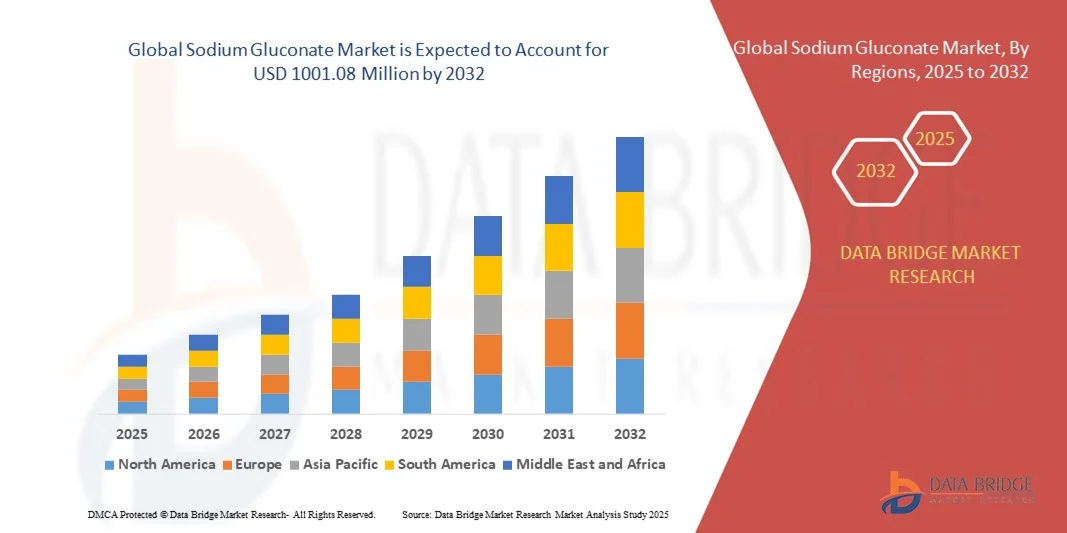
Global Sodium Gluconate Market Size
- The global Sodium Gluconate Market size was valued at USD 652.30 million in 2024 and is projected to reach USD 1001.08 million by 2032, growing at a CAGR of 5.50% during the forecast period.
- Market expansion is primarily driven by increasing demand across industries such as construction, pharmaceuticals, and food & beverages, where Sodium Gluconate is used as a chelating agent, cleaning additive, and stabilizer.
- Additionally, advancements in manufacturing processes and growing environmental regulations promoting eco-friendly chemicals are further fueling the adoption of Sodium Gluconate, supporting sustained market growth over the coming years.
Global Sodium Gluconate Market Analysis
- Sodium Gluconate, widely used as a chelating agent, concrete admixture, and cleaning additive, plays a critical role across industries including construction, pharmaceuticals, and food & beverages, contributing to its growing demand in both industrial and commercial applications.
- The rising need for environmentally friendly and non-toxic additives in various manufacturing processes is driving the increased adoption of Sodium Gluconate, supported by advancements in production technologies and stringent regulatory frameworks.
- Asia-Pacific dominated the Global Sodium Gluconate Market with the largest revenue share of 33.4% in 2024, driven by a mature chemical industry, strong demand from construction and pharmaceutical sectors, and the presence of major key players investing in product innovation and sustainable solutions.
- Europe is projected to be the fastest-growing region in the Global Sodium Gluconate Market during the forecast period, fueled by rapid industrialization, expanding construction activities, and rising awareness of eco-friendly chemical alternatives in countries like China and India.
- The industrial grade segment dominated the market with the largest revenue share of 49.8% in 2024, owing to its extensive use in construction, water treatment, and metal surface cleaning applications
Report Scope and Global Sodium Gluconate Market Segmentation
|
Attributes |
Sodium Gluconate Key Market Insights |
|
Segments Covered |
|
|
Countries Covered |
North America
Europe
Asia-Pacific
Middle East and Africa
South America
|
|
Key Market Players |
|
|
Market Opportunities |
|
|
Value Added Data Infosets |
In addition to the insights on market scenarios such as market value, growth rate, segmentation, geographical coverage, and major players, the market reports curated by the Data Bridge Market Research also include import export analysis, production capacity overview, production consumption analysis, price trend analysis, climate change scenario, supply chain analysis, value chain analysis, raw material/consumables overview, vendor selection criteria, PESTLE Analysis, Porter Analysis, and regulatory framework. |
Global Sodium Gluconate Market Trends
Rising Focus on Sustainable and Biodegradable Chelating Agents
- A significant and accelerating trend in the Global Sodium Gluconate Market is the rising preference for environmentally friendly and biodegradable chelating agents across various industries such as construction, water treatment, food processing, and pharmaceuticals. Sodium gluconate, derived from glucose, is gaining attention as a non-toxic, readily biodegradable alternative to traditional complexing agents like EDTA and NTA.
- For Instance, in the construction sector, sodium gluconate is increasingly being used in eco-conscious concrete admixtures due to its non-corrosive and biodegradable nature. Similarly, in water treatment, sodium gluconate provides effective scale and corrosion control while aligning with increasingly strict environmental discharge regulations.
- In the food and pharmaceutical sectors, the use of sodium gluconate is growing as a safe additive that meets clean-label requirements. Its ability to stabilize products, enhance mineral absorption, and maintain pH balance makes it a preferred choice in formulations aiming for regulatory compliance and consumer health safety.
- Regulatory bodies such as the European Chemicals Agency (ECHA) and the U.S. Environmental Protection Agency (EPA) are supporting the shift toward sustainable chemicals, which is accelerating adoption of sodium gluconate in industrial cleaning, metal surface treatment, and textile processing applications.
- This trend is encouraging major manufacturers to invest in greener production technologies and R&D for bio-based chemical solutions. Companies like Jungbunzlauer Suisse AG and Shandong Fuyang Bio-Tech Co. Ltd are actively expanding their sodium gluconate product lines to cater to rising global demand for eco-safe and sustainable ingredients.
- The growing emphasis on green chemistry, supported by both government regulations and consumer demand for sustainable products, is reshaping market dynamics. As a result, sodium gluconate is emerging as a strategic ingredient across industries aiming to reduce environmental impact and promote safer alternatives to conventional chemical agents.
Global Sodium Gluconate Market Dynamics
Driver
Growing Demand Driven by Industrial Expansion and Eco-Friendly Chemical Adoption
- The rapid expansion of industries such as construction, water treatment, food & beverage, and pharmaceuticals is significantly driving the demand for sodium gluconate, particularly due to its non-toxic, biodegradable, and environmentally friendly profile.
- For instance, in the construction sector, sodium gluconate is being increasingly used as a concrete admixture to improve workability and delay setting time, especially in large infrastructure projects where temperature and time control are crucial. Its chelating properties also make it valuable in water treatment and metal surface cleaning.
- The shift towards green chemistry and stricter environmental regulations globally—such as REACH in the European Union and EPA guidelines in the U.S.—are pushing industries to adopt safer, sustainable alternatives, with sodium gluconate emerging as a preferred solution over synthetic chelating agents like EDTA.
- Moreover, increasing awareness around food safety and health-conscious consumption trends is boosting the use of sodium gluconate in food and pharmaceutical applications, where it serves as a stabilizer, acidity regulator, and mineral carrier, especially for calcium and iron.
- Countries in Asia-Pacific, particularly China and India, are experiencing a surge in demand due to urbanization, industrial growth, and rising investments in water infrastructure, further strengthening the global market outlook.
Restraint/Challenge
Price Instability and Limited Awareness in Emerging Applications
- A significant challenge facing the Global Sodium Gluconate Market is the price instability of key raw materials such as glucose, which is primarily derived from corn or starch. Market fluctuations in agricultural commodities, driven by seasonal supply shifts, regional shortages, and trade disruptions, can impact the production cost and profitability of sodium gluconate manufacturers.
- For instance, fluctuations in global corn prices—due to droughts, export bans, or shifting biofuel policies—can directly affect the cost of glucose-based products, including sodium gluconate. These unpredictable pricing trends can make it difficult for manufacturers to offer competitive and stable pricing, especially in highly cost-sensitive markets.
- Additionally, limited awareness and technical understanding of sodium gluconate’s advantages in certain emerging applications—such as in pharmaceutical formulations, textile processing, and high-performance cleaning agents—pose a barrier to wider adoption. In some cases, industries continue to rely on older, synthetic chelating agents like EDTA and phosphonates due to habit, availability, or perceived cost-effectiveness, despite their lower environmental compatibility.
- To overcome this, market players must focus on educating customers about the environmental and performance benefits of sodium gluconate through technical support, case studies, and demonstration projects. Companies like Jungbunzlauer Suisse AG and Shandong Fuyang Bio-Tech Co. Ltd are investing in knowledge-sharing initiatives and sustainability marketing to bridge this awareness gap and promote sodium gluconate as a green alternative.
- Furthermore, logistics and storage challenges—such as maintaining product stability under humid conditions or ensuring consistent quality across international shipments—can also impact supply chain efficiency, especially in developing regions lacking infrastructure.
- Addressing these challenges through strategic sourcing, supply chain resilience, and collaborations with industry end-users and regulators will be essential for building long-term demand. Investments in local production facilities and the development of cost-efficient, high-purity sodium gluconate formulations can also help mitigate raw material risks and improve market accessibility across diverse geographies.
Global Sodium Gluconate Market Scope
The sodium gluconate market is segmented on the basis of type and application
- By Type
On the basis of type, the Global Sodium Gluconate Market is segmented into Industrial Grade, Food Grade, Pharma Grade, and Others. The industrial grade segment dominated the market with the largest revenue share of 49.8% in 2024, owing to its extensive use in construction, water treatment, and metal surface cleaning applications. Industrial-grade sodium gluconate is widely preferred as a high-performance concrete admixture and corrosion inhibitor due to its chelating and dispersing properties. Demand is further driven by large-scale infrastructure projects and increased environmental regulations promoting the use of biodegradable chemicals.
The pharma grade segment is expected to witness the fastest growth rate from 2025 to 2032, fueled by its increasing application in mineral supplements and intravenous medications. Pharma-grade sodium gluconate offers high purity and safety standards, making it ideal for calcium and iron gluconate formulations. The rising demand for clean-label and bio-compatible pharmaceutical ingredients is contributing to its accelerated growth.
- By Application
On the basis of application, the Global Sodium Gluconate Market is segmented into Food, Pharmaceutical, Water Quality Stabilizers, and Others. The food segment held the largest market revenue share of 38.4% in 2024, driven by the increasing demand for clean-label food additives and mineral fortification in processed foods and beverages. Sodium gluconate is used as a sequestrant, stabilizer, and acidity regulator, offering excellent safety and functionality. The growing trend of health-conscious consumption and regulatory approval across major regions support its usage in dairy products, meats, and canned vegetables.
The water quality stabilizers segment is projected to register the fastest CAGR from 2025 to 2032, owing to rising environmental concerns and stringent regulations for water treatment. Sodium gluconate’s strong chelating ability and biodegradability make it an ideal alternative to conventional water treatment chemicals. Its effectiveness in controlling scale and corrosion in industrial cooling systems, boilers, and wastewater applications is driving increased adoption globally.
Global Sodium Gluconate Market Regional Analysis
- Asia-Pacific dominated the Global Sodium Gluconate Market with the largest revenue share of 33.4% in 2024, driven by strong demand across construction, food processing, and water treatment sectors, as well as a growing shift towards environmentally sustainable and biodegradable chemicals.
- Industries in the region are increasingly adopting sodium gluconate as a safe and effective alternative to synthetic chelating agents, aligning with stringent environmental regulations imposed by agencies such as the U.S. Environmental Protection Agency (EPA).
- The region benefits from well-established industrial infrastructure, high awareness of green chemistry solutions, and the presence of key market players such as PMP Fermentation Products, Inc., who continue to invest in product innovation and capacity expansion. Additionally, the food and pharmaceutical industries in the U.S. and Canada are accelerating the use of sodium gluconate in mineral supplements and as a food stabilizer, contributing to the market’s sustained growth.
U.S. Sodium Gluconate Market Insight
The U.S. sodium gluconate market captured the largest revenue share of 78% in 2024 within North America, driven by increasing demand for sustainable and biodegradable chemical solutions across construction, water treatment, and food processing industries. The country’s strict environmental regulations—enforced by agencies like the EPA—have led to a noticeable shift from synthetic chelating agents to eco-friendly alternatives such as sodium gluconate. Additionally, the growing focus on clean-label ingredients in the food and pharmaceutical sectors is supporting the compound’s broader adoption. Robust infrastructure development and rising investment in green building initiatives also contribute to continued demand in concrete admixtures.
Europe Sodium Gluconate Market Insight
The Europe sodium gluconate market is projected to grow at a substantial CAGR during the forecast period, supported by strict environmental regulations, strong sustainability mandates, and increasing adoption in water treatment and industrial cleaning applications. The European market is also benefitting from the food and pharmaceutical industries’ preference for naturally derived, non-toxic additives. Sodium gluconate is being increasingly used in food products for mineral fortification and as a stabilizer, while the chemical sector uses it as a safe and effective chelating agent. EU-backed initiatives promoting biodegradable and non-hazardous chemicals further enhance regional demand.
U.K. Sodium Gluconate Market Insight
The U.K. sodium gluconate market is anticipated to grow at a noteworthy CAGR over the forecast period, fueled by the country’s focus on green chemistry and environmentally compliant construction practices. The demand for sodium gluconate is increasing in concrete admixtures for both residential and infrastructure development. Additionally, food manufacturers in the U.K. are adopting sodium gluconate to meet clean-label trends and consumer preferences for non-GMO, vegan, and allergy-friendly ingredients. The government’s focus on carbon reduction and circular economy strategies is further encouraging industries to opt for biodegradable chemicals, supporting market expansion.
Germany Sodium Gluconate Market Insight
The Germany sodium gluconate market is expected to expand at a considerable CAGR during the forecast period, driven by the country’s emphasis on sustainability, advanced manufacturing, and green building certifications. Germany’s industrial sector is increasingly adopting sodium gluconate for metal cleaning, electroplating, and wastewater treatment due to its effective chelation properties and non-toxic profile. Additionally, the country’s food and pharma sectors, known for strict quality and safety standards, are integrating sodium gluconate in various formulations. Germany's leadership in the EU for clean technologies makes it a critical growth hub for eco-friendly chemicals like sodium gluconate.
Asia-Pacific Sodium Gluconate Market Insight
The Asia-Pacific sodium gluconate market is poised to grow at the fastest CAGR of 24% from 2025 to 2032, driven by rapid industrialization, urbanization, and rising environmental awareness in key economies such as China, India, and Japan. Government regulations encouraging the use of sustainable materials in construction and manufacturing are contributing to a surge in demand. The compound's affordability and versatility in water treatment, construction, and food sectors further accelerate adoption. Additionally, expanding pharmaceutical production and investments in water infrastructure projects across the region are enhancing the sodium gluconate market's growth trajectory.
Japan Sodium Gluconate Market Insight
The Japan sodium gluconate market is gaining momentum, supported by the country’s emphasis on quality, safety, and innovation in industrial and consumer applications. Japan’s food and pharma sectors are adopting sodium gluconate for its high purity and clean-label compatibility, while construction and water treatment industries are using it as a biodegradable, high-performance additive. The demand is also being driven by Japan's eco-conscious population and government-led sustainability initiatives. Moreover, Japan’s aging infrastructure is undergoing renovation, where sodium gluconate is being used in eco-friendly concrete admixtures, further supporting market growth.
China Sodium Gluconate Market Insight
The China sodium gluconate market accounted for the largest revenue share in Asia Pacific in 2024, driven by the country’s massive construction activity, booming food industry, and strong domestic production capacity. As one of the top global producers and exporters of sodium gluconate, China benefits from economies of scale and an expanding industrial base. Rapid urbanization, growing demand for high-quality concrete additives, and increasing investment in water treatment solutions are propelling usage across sectors. Additionally, local manufacturers are focusing on product innovation and export growth, strengthening China’s position as a leading force in the global market.
Global Sodium Gluconate Market Share
The industry is primarily led by well-established companies, including:
- Shandong Fuyang Bio-Tech Co. Ltd (China)
- PMP Fermentation Products, Inc. (U.S.)
- Jungbunzlauer Suisse AG (Switzerland)
- Zhucheng Dongxiao Biotechnology Co., Ltd (China)
- Shandong Qilu Bio-Technology Group Co., Ltd. (China)
- Weifang Honghai (China)
- Shandong Kaison (China)
- Qingdao Kehai (China)
- Henan Kingsun Chemical Co., Ltd. (China)
- PCIPL (India)
- MUHU (China) Construction Materials Co., Ltd. (China)
- Sakshi Chem Sciences Pvt. Ltd. (India)
- JIAAN BIOTECH (India)
- JAY DINESH CHEMICALS (India)
What are the Recent Developments in Global Sodium Gluconate Market?
- In April 2023, Jungbunzlauer Suisse AG, a global leader in biodegradable ingredients, announced the expansion of its production capacity for sodium gluconate at its facility in Austria. This strategic move aims to meet the surging demand for eco-friendly chelating agents across Europe and North America, particularly in the construction, food, and water treatment sectors. The expansion reinforces Jungbunzlauer’s commitment to sustainability and strengthens its position as a key supplier in the global sodium gluconate market.
- In March 2023, Shandong Fuyang Bio-Tech Co., Ltd., one of China’s leading sodium gluconate manufacturers, unveiled a new fermentation technology designed to improve production efficiency and reduce carbon emissions. This innovation allows for higher yield and purity levels in industrial-grade sodium gluconate, aligning with China’s push for green manufacturing and boosting the company’s competitiveness in both domestic and international markets.
- In March 2023, PMP Fermentation Products, Inc., based in the U.S., announced a strategic collaboration with a major North American construction materials supplier to promote sodium gluconate as a sustainable concrete admixture. The initiative includes joint R&D efforts and distribution expansion to meet growing demand for environmentally responsible building solutions. This partnership underscores PMP’s focus on industrial applications and commitment to long-term market growth through innovation and collaboration.
- In February 2023, Zhucheng Dongxiao Biotechnology Co., Ltd., a prominent Chinese producer, introduced a new food-grade sodium gluconate line targeting global food manufacturers seeking clean-label, non-GMO ingredients. The new product is designed to cater to growing consumer preferences for transparent labeling and safer food additives, especially in the U.S., Europe, and Southeast Asia. The company aims to capture greater market share by enhancing quality standards and broadening export reach.
- In January 2023, Weifang Honghai Chemical Co., Ltd., a key player in the sodium gluconate market, announced a sustainability roadmap that includes solar-powered manufacturing and waste reduction measures across its facilities in China. This environmental initiative is part of a broader ESG strategy aimed at meeting international sustainability benchmarks and attracting global clients focused on green procurement. It reflects a growing trend of Chinese chemical producers embracing eco-conscious practices to stay competitive in the global market.

- Interactive Data Analysis Dashboard
- Company Analysis Dashboard for high growth potential opportunities
- Research Analyst Access for customization & queries
- Competitor Analysis with Interactive dashboard
- Latest News, Updates & Trend analysis
- Harness the Power of Benchmark Analysis for Comprehensive Competitor Tracking
Global Sodium Gluconate Market, Supply Chain Analysis and Ecosystem Framework
To support market growth and help clients navigate the impact of geopolitical shifts, DBMR has integrated in-depth supply chain analysis into its Global Sodium Gluconate Market research reports. This addition empowers clients to respond effectively to global changes affecting their industries. The supply chain analysis section includes detailed insights such as Global Sodium Gluconate Market consumption and production by country, price trend analysis, the impact of tariffs and geopolitical developments, and import and export trends by country and HSN code. It also highlights major suppliers with data on production capacity and company profiles, as well as key importers and exporters. In addition to research, DBMR offers specialized supply chain consulting services backed by over a decade of experience, providing solutions like supplier discovery, supplier risk assessment, price trend analysis, impact evaluation of inflation and trade route changes, and comprehensive market trend analysis.
Data collection and base year analysis are done using data collection modules with large sample sizes. The stage includes obtaining market information or related data through various sources and strategies. It includes examining and planning all the data acquired from the past in advance. It likewise envelops the examination of information inconsistencies seen across different information sources. The market data is analysed and estimated using market statistical and coherent models. Also, market share analysis and key trend analysis are the major success factors in the market report. To know more, please request an analyst call or drop down your inquiry.
The key research methodology used by DBMR research team is data triangulation which involves data mining, analysis of the impact of data variables on the market and primary (industry expert) validation. Data models include Vendor Positioning Grid, Market Time Line Analysis, Market Overview and Guide, Company Positioning Grid, Patent Analysis, Pricing Analysis, Company Market Share Analysis, Standards of Measurement, Global versus Regional and Vendor Share Analysis. To know more about the research methodology, drop in an inquiry to speak to our industry experts.
Data Bridge Market Research is a leader in advanced formative research. We take pride in servicing our existing and new customers with data and analysis that match and suits their goal. The report can be customized to include price trend analysis of target brands understanding the market for additional countries (ask for the list of countries), clinical trial results data, literature review, refurbished market and product base analysis. Market analysis of target competitors can be analyzed from technology-based analysis to market portfolio strategies. We can add as many competitors that you require data about in the format and data style you are looking for. Our team of analysts can also provide you data in crude raw excel files pivot tables (Fact book) or can assist you in creating presentations from the data sets available in the report.













