


Sodium Hypophosphite Market Size
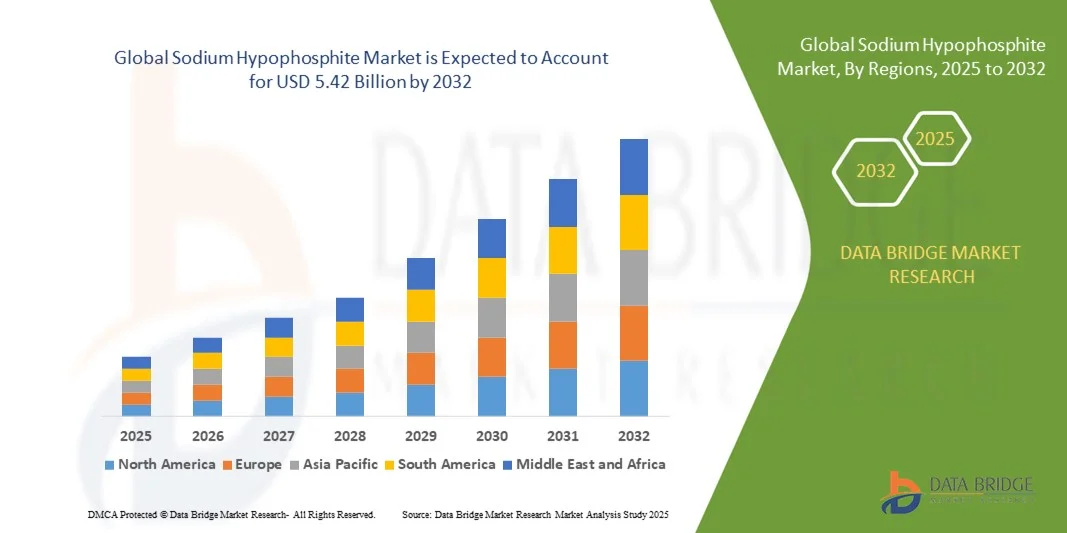
- The global sodium hypophosphite market size was valued at USD 3.70 billion in 2024 and is expected to reach USD 5.42 billion by 2032, at a CAGR of 4.9% during the forecast period
- The market growth is largely fueled by the expanding applications of sodium hypophosphite in electroplating, water treatment, and specialty chemical manufacturing, driven by rising industrialization and technological advancements in chemical processes
- Furthermore, increasing demand for high-purity chemical intermediates, efficient reducing agents, and environmentally friendly production methods is accelerating the adoption of sodium hypophosphite across key industries, thereby significantly boosting the overall market growth
Sodium Hypophosphite Market Analysis
- Sodium hypophosphite, used as a reducing agent, stabilizer, and chemical intermediate, is becoming increasingly vital in modern industrial and chemical processes due to its ability to enhance reaction efficiency, improve product quality, and support sustainable manufacturing practices
- The escalating demand for sodium hypophosphite is primarily fueled by growth in automotive, electronics, pharmaceuticals, and specialty chemical sectors, rising awareness of process optimization, and the need for corrosion-resistant coatings and high-performance materials
- Asia-Pacific dominated the sodium hypophosphite market in 2024, due to expanding manufacturing sectors, growing demand for electroplating and specialty chemicals, and a strong presence of chemical production hubs
- North America is expected to be the fastest growing region in the sodium hypophosphite market during the forecast period due to robust demand for sodium hypophosphite in electroplating, water treatment, and specialty chemical production
- Industrial segment dominated the market with a market share of 61.8% in 2024, due to its extensive use across water treatment, electroplating, and chemical processing industries. Industrial-grade sodium hypophosphite is preferred for bulk applications due to its cost-effectiveness, ease of handling, and consistent performance in large-scale processes. Growing industrialization and the expansion of manufacturing hubs in Asia-Pacific and other emerging regions further support its market leadership
Report Scope and Sodium Hypophosphite Market Segmentation
|
Attributes |
Sodium Hypophosphite Key Market Insights |
|
Segments Covered |
|
|
Countries Covered |
North America
Europe
Asia-Pacific
Middle East and Africa
South America
|
|
Key Market Players |
|
|
Market Opportunities |
|
|
Value Added Data Infosets |
In addition to the insights on market scenarios such as market value, growth rate, segmentation, geographical coverage, and major players, the market reports curated by the Data Bridge Market Research also include in-depth expert analysis, pricing analysis, brand share analysis, consumer survey, demography analysis, supply chain analysis, value chain analysis, raw material/consumables overview, vendor selection criteria, PESTLE Analysis, Porter Analysis, and regulatory framework. |
Sodium Hypophosphite Market Trends
Increasing Use in Electroplating and Specialty Chemicals
- The sodium hypophosphite market is experiencing notable growth driven by its expanding application in electroplating processes and specialty chemical production. As a reducing agent, sodium hypophosphite plays a crucial role in electroless nickel plating, which is widely adopted across automotive, electronics, and industrial machinery sectors for enhanced corrosion resistance and surface hardness
- For instance, DuPont de Nemours, Inc. offers high-purity sodium hypophosphite solutions tailored for precision electroplating applications in advanced electronics and automotive components. The company’s focus on process reliability and chemical consistency underscores the importance of sodium hypophosphite in achieving exact surface specifications and long-lasting material performance
- Electroless nickel plating enabled by sodium hypophosphite is being increasingly favored over traditional electroplating methods due to its ability to produce uniform coatings on complex geometries and non-conductive substrates. This trend is driving adoption across industries prioritizing precision manufacturing and extended product life cycles
- In addition, sodium hypophosphite’s versatility in specialty chemical synthesis—such as in pharmaceuticals, catalysts, and flame retardants—has broadened its demand base. Its function as a reducing agent in targeted reactions supports high-value industrial processes requiring chemically stable and dependable inputs
- The integration of sodium hypophosphite into advanced material treatments aligns with global manufacturing needs for high-performance, wear-resistant, and chemically stable surfaces. Innovations in nickel-phosphorus coatings, particularly in high-tech applications, are further enhancing market relevance and technical demand
- As industries continue to prioritize quality, durability, and performance consistency, sodium hypophosphite is expected to remain a vital industrial chemical. Its expanding role in high-precision electroplating and specialty formulations is positioning it as a key contributor to advanced material engineering across several manufacturing domains
Sodium Hypophosphite Market Dynamics
Driver
Rising Demand for High-Purity Chemical Intermediates
- The global push toward advanced manufacturing processes has intensified demand for high-purity chemical intermediates, with sodium hypophosphite emerging as a critical ingredient in multiple precision applications. High levels of purity are essential to ensure consistency, stability, and optimal functionality in processes such as surface finishing and specialty formulation development
- For instance, Arkema S.A. has scaled production of high-grade sodium hypophosphite to meet the growing needs of electronics and automotive industries dependent on precise electroless nickel plating performance. This strategic focus illustrates how producers are aligning with industrial requirements for purer, more controlled chemical inputs
- High-purity sodium hypophosphite reduces variability in chemical reactions, improves product yield, and enhances surface treatment quality, making it indispensable in sectors where optimal performance parameters are mandatory. From wear-resistant coatings to pharmaceutical-grade synthesis, its controlled composition benefits multiple high-value end uses
- In addition, manufacturers active in specialty chemicals rely on sodium hypophosphite’s capacity to function effectively in catalytic and reductive processes without introducing impurities that could impact final product quality. Its reliability strengthens the supply chain for high-precision manufacturing environments
- As industrial operations increasingly prioritize quality assurance and regulatory compliance, high-purity intermediates such as sodium hypophosphite are gaining prominence. Ongoing advancements in purification technologies and raw material processing are set to further increase its demand across technical industries globally
Restraint/Challenge
Strict Environmental Regulations
- Stringent environmental regulations surrounding chemical manufacturing and waste disposal present major challenges for sodium hypophosphite producers. Given its role in industrial plating processes, controlling effluent discharge and reducing the environmental footprint requires substantial investment in treatment facilities and compliance systems
- For instance, BASF SE has implemented advanced wastewater management and emission control measures in facilities producing and distributing sodium hypophosphite, ensuring adherence to environmental standards such as the European REACH Regulation. This reflects the operational pressures on manufacturers to adapt to evolving compliance requirements across regions
- Regulatory restrictions on phosphorus-based compounds and plating by-products increase production complexity and costs for chemical manufacturers. Compliance often involves continuous monitoring, upgraded filtration systems, and eco-friendly technology integration to meet legal thresholds on emissions and residues
- In addition, varying regional environmental laws create challenges in harmonizing production methods for global supply. Manufacturers serving multiple markets must navigate differences in permissible levels of phosphorus compounds and waste treatments, adding administrative and operational burdens
- Addressing these environmental challenges requires coordinated efforts toward cleaner production technologies, closed-loop systems, and sustainable chemical alternatives. Investments into eco-compliant innovation mitigate regulatory risks and also strengthen long-term market positioning for sodium hypophosphite producers
Sodium Hypophosphite Market Scope
The market is segmented on the basis of function, grade, and application.
- By Function
On the basis of function, the sodium hypophosphite market is segmented into catalysts & stabilizers, reducing agents, and chemical intermediates. The reducing agents segment dominated the market with the largest revenue share in 2024, driven by its widespread use in electroless nickel plating and other reduction-based chemical processes. Industries prefer sodium hypophosphite as a reducing agent due to its high efficiency, stability, and ability to deliver consistent results in metal finishing and specialty chemical production. The segment’s dominance is further supported by increasing industrial automation and growing demand for corrosion-resistant coatings in automotive, electronics, and engineering sectors.
The catalysts & stabilizers segment is anticipated to witness the fastest growth rate from 2025 to 2032, fueled by rising applications in specialty polymers and fine chemical synthesis. Sodium hypophosphite functions effectively as a catalyst and stabilizer, enhancing reaction efficiency and product quality in chemical formulations. Its adoption is expanding in emerging economies due to increasing investments in chemical manufacturing and innovations in polymer and resin technologies.
- By Grade
On the basis of grade, the sodium hypophosphite market is segmented into electrical and industrial grades. The industrial grade segment dominated the market with a share of 61.8% in 2024, driven by its extensive use across water treatment, electroplating, and chemical processing industries. Industrial-grade sodium hypophosphite is preferred for bulk applications due to its cost-effectiveness, ease of handling, and consistent performance in large-scale processes. Growing industrialization and the expansion of manufacturing hubs in Asia-Pacific and other emerging regions further support its market leadership.
The electrical grade segment is expected to witness the fastest CAGR from 2025 to 2032, owing to rising demand in specialized electronic applications and high-purity chemical processes. Electrical-grade sodium hypophosphite offers superior purity and performance, making it suitable for sensitive electronic components and advanced materials. Increased investments in electronics manufacturing and innovations in energy storage and conductive materials are driving growth in this segment.
- By Application
On the basis of application, the sodium hypophosphite market is segmented into water treatment, electroplating, and chemicals & pharmaceuticals. The electroplating segment dominated the market in 2024, driven by strong demand for corrosion-resistant coatings in automotive, aerospace, and electronics industries. Sodium hypophosphite is widely used in electroless nickel plating, ensuring uniform deposition and enhanced durability of metal surfaces. Its compatibility with advanced plating technologies and increasing adoption in industrial manufacturing processes further reinforce the segment’s leading position.
The chemicals & pharmaceuticals segment is anticipated to witness the fastest growth rate from 2025 to 2032, fueled by rising use as an intermediate in specialty chemicals and pharmaceutical synthesis. Its efficiency in facilitating reduction reactions and stabilizing sensitive compounds makes it increasingly important in chemical R&D and production. Expanding pharmaceutical manufacturing and growing focus on high-value specialty chemicals are driving adoption in this segment.
Sodium Hypophosphite Market Regional Analysis
- Asia-Pacific dominated the sodium hypophosphite market with the largest revenue share in 2024, driven by expanding manufacturing sectors, growing demand for electroplating and specialty chemicals, and a strong presence of chemical production hubs
- The region’s cost-effective manufacturing landscape, rising investments in chemical intermediates, and growing exports of industrial chemicals are accelerating market expansion
- The availability of skilled labor, supportive government policies, and rapid industrialization across developing economies are contributing to increased consumption of sodium hypophosphite in both chemical and industrial sectors
China Sodium Hypophosphite Market Insight
China held the largest share in the Asia-Pacific sodium hypophosphite market in 2024, owing to its global leadership in chemical manufacturing and electroplating operations. The country’s strong industrial base, favorable government initiatives supporting chemical sector growth, and extensive export capabilities for industrial chemicals are major growth drivers. Demand is further bolstered by continuous investments in specialty chemicals and intermediates for both domestic and international markets.
India Sodium Hypophosphite Market Insight
India is witnessing the fastest growth in the Asia-Pacific region, fueled by a rapidly expanding manufacturing sector, growing electroplating and water treatment industries, and rising investments in specialty chemical infrastructure. Government initiatives supporting chemical production and self-reliance in industrial intermediates are strengthening demand. In addition, increasing exports of industrial chemicals and development of R&D facilities for specialty applications are contributing to robust market expansion.
Europe Sodium Hypophosphite Market Insight
The Europe sodium hypophosphite market is expanding steadily, supported by stringent regulatory standards, rising demand for high-purity chemical intermediates, and investments in sustainable and specialty chemical production. The region emphasizes environmental compliance, quality control, and advanced formulations, particularly in electroplating and pharmaceutical applications. Growing adoption in fine chemicals and water treatment processes is further enhancing market growth.
Germany Sodium Hypophosphite Market Insight
Germany’s sodium hypophosphite market is driven by its leadership in precision chemical manufacturing, strong industrial heritage, and export-focused production model. Well-established R&D networks and collaboration between academia and chemical manufacturers foster continuous innovation in chemical intermediates. Demand is particularly strong for use in electroplating, specialty chemicals, and industrial water treatment applications.
U.K. Sodium Hypophosphite Market Insight
The U.K. market is supported by a mature pharmaceutical and chemical industry, growing efforts to localize specialty chemical production, and increasing demand for high-purity intermediates. With rising focus on R&D, collaboration between industry and academic institutions, and investments in niche chemical production, the U.K. continues to play a significant role in specialty chemical markets.
North America Sodium Hypophosphite Market Insight
North America is projected to grow at the fastest CAGR from 2025 to 2032, driven by robust demand for sodium hypophosphite in electroplating, water treatment, and specialty chemical production. Strong focus on industrial automation, high-purity intermediates, and advancements in material science are boosting demand. In addition, reshoring of chemical manufacturing and strategic collaborations between industrial chemical companies are supporting market expansion.
U.S. Sodium Hypophosphite Market Insight
The U.S. accounted for the largest share in the North America market in 2024, underpinned by its expansive industrial base, strong R&D infrastructure, and significant investment in specialty chemical production. The country’s focus on innovation, regulatory compliance, and high-purity chemical intermediates is driving adoption across electroplating, water treatment, and industrial applications. Presence of key manufacturers and a mature supply chain further solidify the U.S.'s leading position in the region.
Sodium Hypophosphite Market Share
The sodium hypophosphite industry is primarily led by well-established companies, including:
- Arkema Group (France)
- Changshu New-Tech Chemicals Co., Ltd. (China)
- Huanggang Quanwang Chemical Co., Ltd. (China)
- Hubei Sky Lake Chemical Co., Ltd. (China)
- Hubei Xingfa Chemicals Group Co., Ltd. (China)
- Jiangsu Danai Chemical Co., Ltd. (China)
- Jiangsu Kangxiang Industrial Group Co., Ltd. (China)
- Jiangxi Fuerxin Medicine Chemical Co., Ltd. (China)
- Nippon Chemical Industrial Co., Ltd. (Japan)
- Merck KGaA (Germany)
- Solvay (Belgium)
- Febex SA (Switzerland)
Latest Developments in Global Sodium Hypophosphite Market
- In March 2025, Nippon Chemical Industrial Co., Ltd. established a strategic partnership with a leading electronics manufacturer to develop advanced sodium hypophosphite-based solutions for electroless nickel plating applications. This collaboration aims to enhance the performance and efficiency of electroplating processes, catering to the growing demand in the electronics industry. The partnership is expected to strengthen Nippon Chemical's position in the market by leveraging its expertise and the manufacturer's technological capabilities
- In February 2025, Jiangxi Fuerxin Pharmaceutical Co., Ltd. announced the expansion of its industrial-grade sodium hypophosphite production capacity to meet the increasing demand from various industries, including electroplating and water treatment. The expansion is expected to enhance the company's market share and provide a reliable supply of high-quality sodium hypophosphite to its customers. This move aligns with the projected growth of the industrial-grade segment, which is estimated to reach USD 600 million by 2033
- In January 2025, Jiangsu Fuerxin Pharmaceutical Co., Ltd. launched a high-purity sodium hypophosphite product tailored for the electronics industry. This product is designed to meet the stringent requirements of semiconductor and PCB manufacturing processes. The introduction of this specialized product is expected to cater to the growing demand for high-quality reducing agents in the electronics sector, thereby expanding the company's footprint in this niche market
- In December 2024, Arkema, a global manufacturer of specialty materials, completed the acquisition of Ashland's performance adhesives business. This acquisition marks a significant step for Arkema to strengthen its segment of adhesive solutions and aligns with its aim of becoming a pure specialty material player by 2024. The move is expected to enhance Arkema's product portfolio and market presence in the specialty chemicals sector
- In November 2024, Hubei Lianxing Chemical Co., Ltd. announced a significant investment in sustainable sodium hypophosphite production technologies. The investment focuses on developing eco-friendly production methods to reduce environmental impact and meet the growing demand for sustainable chemical solutions. This initiative is expected to position the company as a leader in sustainable chemical manufacturing and cater to the increasing consumer preference for environmentally friendly products

- Interactive Data Analysis Dashboard
- Company Analysis Dashboard for high growth potential opportunities
- Research Analyst Access for customization & queries
- Competitor Analysis with Interactive dashboard
- Latest News, Updates & Trend analysis
- Harness the Power of Benchmark Analysis for Comprehensive Competitor Tracking
Global Sodium Hypophosphite Market, Supply Chain Analysis and Ecosystem Framework
To support market growth and help clients navigate the impact of geopolitical shifts, DBMR has integrated in-depth supply chain analysis into its Global Sodium Hypophosphite Market research reports. This addition empowers clients to respond effectively to global changes affecting their industries. The supply chain analysis section includes detailed insights such as Global Sodium Hypophosphite Market consumption and production by country, price trend analysis, the impact of tariffs and geopolitical developments, and import and export trends by country and HSN code. It also highlights major suppliers with data on production capacity and company profiles, as well as key importers and exporters. In addition to research, DBMR offers specialized supply chain consulting services backed by over a decade of experience, providing solutions like supplier discovery, supplier risk assessment, price trend analysis, impact evaluation of inflation and trade route changes, and comprehensive market trend analysis.
Data collection and base year analysis are done using data collection modules with large sample sizes. The stage includes obtaining market information or related data through various sources and strategies. It includes examining and planning all the data acquired from the past in advance. It likewise envelops the examination of information inconsistencies seen across different information sources. The market data is analysed and estimated using market statistical and coherent models. Also, market share analysis and key trend analysis are the major success factors in the market report. To know more, please request an analyst call or drop down your inquiry.
The key research methodology used by DBMR research team is data triangulation which involves data mining, analysis of the impact of data variables on the market and primary (industry expert) validation. Data models include Vendor Positioning Grid, Market Time Line Analysis, Market Overview and Guide, Company Positioning Grid, Patent Analysis, Pricing Analysis, Company Market Share Analysis, Standards of Measurement, Global versus Regional and Vendor Share Analysis. To know more about the research methodology, drop in an inquiry to speak to our industry experts.
Data Bridge Market Research is a leader in advanced formative research. We take pride in servicing our existing and new customers with data and analysis that match and suits their goal. The report can be customized to include price trend analysis of target brands understanding the market for additional countries (ask for the list of countries), clinical trial results data, literature review, refurbished market and product base analysis. Market analysis of target competitors can be analyzed from technology-based analysis to market portfolio strategies. We can add as many competitors that you require data about in the format and data style you are looking for. Our team of analysts can also provide you data in crude raw excel files pivot tables (Fact book) or can assist you in creating presentations from the data sets available in the report.













