




Global Sodium Silicate Market
Market Size in USD Billion
CAGR :
% 
 USD
7.78 Billion
USD
10.40 Billion
2025
2033
USD
7.78 Billion
USD
10.40 Billion
2025
2033
 Forecast Period Forecast Period |
2026 –2033 |
 Market Size (Base Year) Market Size (Base Year) |
USD 7.78 Billion |
 Market Size (Forecast Year) Market Size (Forecast Year) |
USD 10.40 Billion |
 CAGR CAGR |
% |
| Major Markets Players |
|
Sodium Silicate Market Size
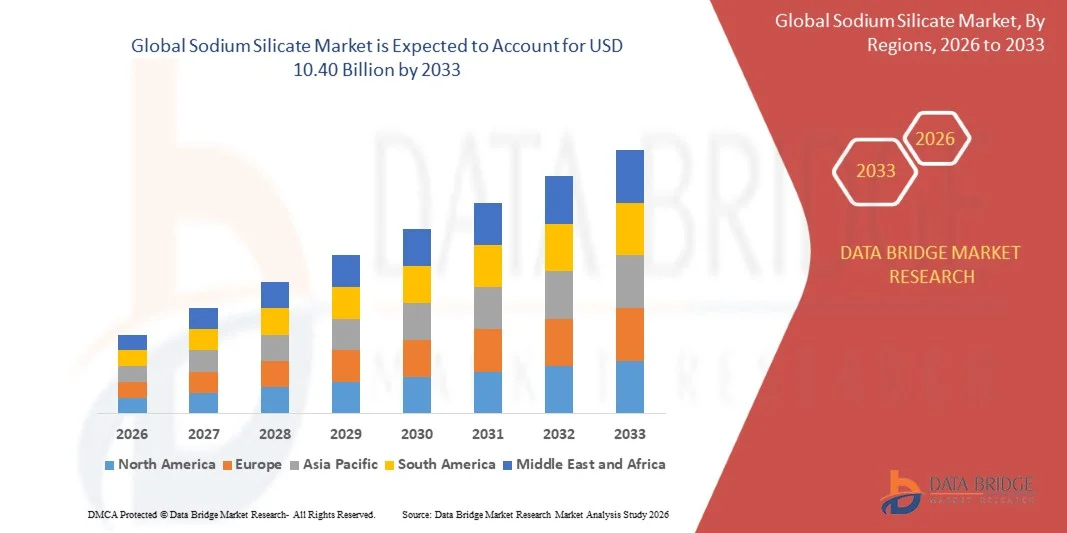
- The global sodium silicate market size was valued at USD 7.78 billion in 2025 and is expected to reach USD 10.40 billion by 2033, at a CAGR of 3.7% during the forecast period
- The market growth is largely fueled by the expanding demand from detergents, construction, and water treatment industries, driven by increasing urbanization and industrialization across emerging economies. The versatile chemical properties of sodium silicate, including binding, sealing, and cleaning capabilities, are enhancing its adoption across a wide range of industrial applications, thereby supporting consistent market expansion
- Furthermore, rising emphasis on sustainable and eco-friendly chemical solutions, along with increasing investments in infrastructure and industrial development, is strengthening the demand for sodium silicate globally. These combined factors are accelerating its utilization in applications such as precipitated silica, cement, and water purification, thereby significantly boosting the industry's growth
Sodium Silicate Market Analysis
- Sodium silicate is an inorganic compound widely used as an adhesive, binder, and deflocculant across industries such as detergents, construction, pulp and paper, and water treatment. It plays a critical role in enhancing product performance, durability, and chemical stability, making it an essential material in both industrial and commercial applications
- The escalating demand for sodium silicate is primarily driven by its extensive usage in detergent formulations, increasing need for sustainable construction materials, and growing focus on efficient water treatment solutions. Rising industrial activities and expanding applications in automotive and chemical manufacturing sectors are further contributing to the steady growth of the market
- Asia-Pacific dominated the sodium silicate market with a share of 47.7% in 2025, due to strong demand from detergents, construction, and water treatment industries along with the presence of large-scale chemical manufacturing hubs across the region
- North America is expected to be the fastest growing region in the sodium silicate market during the forecast period due to increasing demand in detergents, construction, and water treatment applications
- Liquid sodium silicate segment dominated the market with a market share of 63% in 2025, due to its widespread usage across detergents, water treatment, and chemical processing applications. Its ease of handling, uniform composition, and direct applicability in liquid formulations make it highly preferred in industrial operations. Liquid form also ensures better mixing efficiency and process control, which enhances its adoption across large-scale manufacturing units
Report Scope and Sodium Silicate Market Segmentation
|
Attributes |
Sodium Silicate Key Market Insights |
|
Segments Covered |
|
|
Countries Covered |
North America
Europe
Asia-Pacific
Middle East and Africa
South America
|
|
Key Market Players |
|
|
Market Opportunities |
|
|
Value Added Data Infosets |
In addition to the insights on market scenarios such as market value, growth rate, segmentation, geographical coverage, and major players, the market reports curated by the Data Bridge Market Research also include import export analysis, production capacity overview, production consumption analysis, price trend analysis, climate change scenario, supply chain analysis, value chain analysis, raw material/consumables overview, vendor selection criteria, PESTLE Analysis, Porter Analysis, and regulatory framework. |
Sodium Silicate Market Trends
“Rising Adoption of Sustainable and Eco-Friendly Silicate Solutions”
- A significant trend in the sodium silicate market is the increasing shift toward sustainable and eco-friendly chemical solutions, driven by stricter environmental regulations and the growing need to reduce carbon emissions across industrial processes. This transition is elevating the role of sodium silicate as a safer and more environmentally compatible alternative in applications such as detergents, construction, and water treatment
- For instance, Evonik Industries AG has developed sustainable silica solutions derived from rice husk ash under its Ultrasil brand, supporting circular economy initiatives and reducing dependence on conventional raw materials. Such innovations are strengthening the environmental profile of sodium silicate and expanding its application scope in green products
- The construction sector is increasingly utilizing sodium silicate in eco-friendly cement and sealing applications where it enhances durability and reduces environmental impact. This is positioning sodium silicate as an important material in sustainable infrastructure development aligned with green building standards
- Water treatment industries are expanding the use of sodium silicate due to its non-toxic nature and effectiveness in corrosion control and stabilization processes. This trend is supporting the development of safer water management systems and improving operational efficiency in municipal and industrial treatment facilities
- The detergent industry is also shifting toward phosphate-free formulations, where sodium silicate serves as an effective substitute that maintains cleaning efficiency while minimizing environmental harm. This is driving consistent demand for sodium silicate in household and industrial cleaning products
- The increasing alignment of industries with sustainability goals and regulatory compliance requirements is reinforcing the long-term adoption of sodium silicate. This trend is shaping a more environmentally responsible chemical market and supporting steady growth across global applications
Sodium Silicate Market Dynamics
Driver
“Increasing Demand from Detergents and Construction Industries”
- The rising demand from detergents and construction industries is a key driver of the sodium silicate market, supported by its multifunctional properties such as binding, sealing, and cleaning enhancement. These industries rely heavily on sodium silicate to improve product performance, durability, and cost efficiency in large-scale applications
- For instance, PQ Corporation supplies sodium silicate for detergent formulations and construction materials, enabling manufacturers to enhance cleaning performance and structural strength. This strong industrial reliance is contributing significantly to sustained market demand
- In the detergent sector, sodium silicate acts as a builder and corrosion inhibitor, improving washing efficiency and extending the lifespan of appliances. The growing consumption of cleaning products, driven by hygiene awareness and urbanization, is further strengthening demand
- The construction industry is utilizing sodium silicate in cement, concrete sealing, and fireproofing applications where it enhances durability and resistance to environmental factors. Increasing infrastructure development and urban expansion are accelerating its adoption in this sector
- The continuous expansion of these end-use industries and the essential functional benefits of sodium silicate are driving consistent market growth. This driver is expected to remain strong as industrial activities and construction investments continue to rise globally
Restraint/Challenge
“Volatility in Raw Material Prices and Energy Costs”
- The sodium silicate market faces challenges due to fluctuations in raw material prices and high energy consumption associated with its production process. Key inputs such as soda ash and silica sand, along with energy-intensive furnace operations, contribute to unstable production costs
- For instance, Solvay has experienced fluctuations in soda ash pricing due to changing energy costs and supply chain disruptions, impacting the overall cost structure of sodium silicate production. These variations create pricing pressures for manufacturers and affect profit margins
- The production of sodium silicate requires high-temperature processing, making it heavily dependent on energy availability and cost stability. Rising energy prices are increasing operational expenses and limiting cost competitiveness for manufacturers
- Supply chain disruptions and geopolitical factors are further influencing the availability and pricing of raw materials, creating uncertainty in production planning and procurement strategies. This adds complexity to maintaining stable supply and pricing structures
- The ongoing volatility in input costs and energy prices continues to act as a constraint on market growth. Addressing these challenges requires strategic sourcing, process optimization, and investment in energy-efficient technologies to sustain long-term competitiveness
Sodium Silicate Market Scope
The market is segmented on the basis of type, form, grade, application, and end use industry.
• By Type
On the basis of type, the sodium silicate market is segmented into solid sodium silicate and liquid sodium silicate. The liquid sodium silicate segment dominated the largest market revenue share of 63% in 2025, driven by its widespread usage across detergents, water treatment, and chemical processing applications. Its ease of handling, uniform composition, and direct applicability in liquid formulations make it highly preferred in industrial operations. Liquid form also ensures better mixing efficiency and process control, which enhances its adoption across large-scale manufacturing units. Furthermore, its compatibility with automated dosing systems and continuous processing technologies strengthens its dominance in the market.
The solid sodium silicate segment is anticipated to witness the fastest growth rate from 2026 to 2033, fueled by its advantages in storage stability and transportation efficiency. Solid forms reduce risks associated with spillage and offer longer shelf life, making them suitable for remote or export-oriented applications. Increasing demand from construction and refractory applications is further driving its growth, as solid silicates are often preferred in cement and binder formulations. The flexibility to dissolve and customize concentration as per application requirements is also supporting its expanding adoption.
• By Form
On the basis of form, the sodium silicate market is segmented into crystalline and anhydrous. The crystalline segment dominated the largest market revenue share in 2025, driven by its extensive use in detergents, adhesives, and water treatment processes. Crystalline sodium silicate provides consistent chemical properties and ease of storage, making it suitable for bulk industrial consumption. Its structured composition enhances solubility control and ensures reliable performance across multiple applications. In addition, its cost-effectiveness and wide availability contribute to its strong demand across developing and developed markets.
The anhydrous segment is expected to witness the fastest CAGR from 2026 to 2033, driven by increasing demand for high-purity and moisture-free chemical formulations. Anhydrous sodium silicate is preferred in specialized industrial processes where water content must be minimized to maintain product stability. Its use in advanced coatings, catalysts, and precision chemical manufacturing is gaining traction. Growing focus on high-performance materials and specialty chemicals is further accelerating the adoption of anhydrous forms in niche applications.
• By Grade
On the basis of grade, the sodium silicate market is segmented into neutral and alkaline. The alkaline segment dominated the largest market revenue share in 2025, driven by its strong chemical reactivity and wide applicability in detergents, pulp and paper, and water treatment industries. Alkaline sodium silicate enhances cleaning efficiency, corrosion resistance, and binding properties, making it essential in multiple industrial formulations. Its effectiveness in removing grease and stabilizing bleaching agents further supports its high consumption. Moreover, its cost-efficiency and functional versatility strengthen its leading position in the market.
The neutral segment is anticipated to witness the fastest growth rate from 2026 to 2033, fueled by rising demand for controlled pH applications and environmentally sensitive processes. Neutral grades are increasingly used in specialty formulations where excessive alkalinity may impact product performance or safety. Growth in food processing, pharmaceuticals, and advanced material applications is supporting the demand for neutral sodium silicate. In addition, regulatory focus on safer chemical usage is encouraging industries to adopt balanced and less corrosive grades.
• By Application
On the basis of application, the sodium silicate market is segmented into detergents, precipitated silica, construction, pulp and paper, water treatment, metal casting, food preservation, and others. The detergents segment dominated the largest market revenue share in 2025, driven by its role as a builder, emulsifier, and corrosion inhibitor in cleaning formulations. Sodium silicate improves cleaning performance and stabilizes washing compounds, making it essential in both household and industrial detergents. The rising demand for cleaning products, supported by hygiene awareness and urbanization, is further boosting this segment. Its cost-effectiveness and multifunctional properties enhance its widespread usage across global markets.
The precipitated silica segment is expected to witness the fastest CAGR from 2026 to 2033, driven by growing demand in tire manufacturing, rubber processing, and personal care products. Sodium silicate serves as a key raw material in the production of precipitated silica, which enhances product performance and durability. Increasing automotive production and the shift toward green tires are significantly contributing to this growth. In addition, expanding applications in oral care and cosmetics are further accelerating demand in this segment.
• By End Use Industry
On the basis of end use industry, the sodium silicate market is segmented into building and construction, automotive, food and beverage, oil and gas, and others. The building and construction segment dominated the largest market revenue share in 2025, driven by extensive use of sodium silicate in cement, concrete sealing, and fireproofing applications. It enhances durability, chemical resistance, and structural integrity, making it highly valuable in infrastructure projects. Rapid urbanization and increasing investments in residential and commercial construction are further strengthening demand. Its role in sustainable construction materials also supports its widespread adoption.
The automotive segment is anticipated to witness the fastest growth rate from 2026 to 2033, fueled by rising use of sodium silicate in metal casting, coatings, and advanced material applications. The growth of electric vehicles and lightweight components is increasing demand for high-performance materials where sodium silicate plays a supporting role. Its application in tire manufacturing through precipitated silica production further boosts its relevance in the automotive sector. Expanding global vehicle production and innovation in automotive materials are accelerating growth in this segment.
Sodium Silicate Market Regional Analysis
- Asia-Pacific dominated the sodium silicate market with the largest revenue share of 47.7% in 2025, driven by strong demand from detergents, construction, and water treatment industries along with the presence of large-scale chemical manufacturing hubs across the region
- The region’s cost-effective production capabilities, abundant raw material availability, and increasing industrial activities are accelerating market expansion across key economies
- Rapid urbanization, infrastructure development, and supportive government initiatives promoting industrial growth are contributing to increased consumption of sodium silicate in multiple end-use sectors
China Sodium Silicate Market Insight
China held the largest share in the Asia-Pacific sodium silicate market in 2025, owing to its dominant position in chemical manufacturing and extensive production capacity. The country benefits from low-cost raw materials, strong domestic demand, and large-scale exports of sodium silicate for detergents, construction, and industrial applications. Continuous investments in infrastructure and industrial expansion further strengthen market growth.
India Sodium Silicate Market Insight
India is witnessing the fastest growth in the Asia-Pacific region, fueled by rapid industrialization, expanding detergent production, and increasing investments in construction and water treatment sectors. Government initiatives supporting manufacturing growth and infrastructure development are boosting demand. Rising consumption across textile, pulp and paper, and chemical industries is further driving market expansion.
Europe Sodium Silicate Market Insight
The Europe sodium silicate market is expanding steadily, supported by strong demand for eco-friendly detergents, sustainable construction materials, and advanced water treatment solutions. The region emphasizes environmental regulations and high-quality production standards, encouraging the use of sodium silicate in green applications. Increasing focus on circular economy practices is also contributing to market growth.
Germany Sodium Silicate Market Insight
Germany’s sodium silicate market is driven by its advanced industrial base, strong presence in specialty chemicals, and high demand from automotive and construction sectors. The country’s focus on sustainable materials and energy-efficient production processes supports the adoption of sodium silicate in various applications. Continuous innovation and technological advancements further enhance market growth.
U.K. Sodium Silicate Market Insight
The U.K. market is supported by growing demand for water treatment solutions, increasing use in detergents, and expanding construction activities. The country’s focus on environmental sustainability and regulatory compliance is encouraging the adoption of sodium silicate in eco-friendly formulations. Rising investments in infrastructure and industrial applications are also contributing to steady growth.
North America Sodium Silicate Market Insight
North America is projected to grow at the fastest CAGR from 2026 to 2033, driven by increasing demand in detergents, construction, and water treatment applications. Technological advancements, rising focus on sustainable chemicals, and growing investments in infrastructure are supporting market expansion. In addition, increasing adoption in automotive and industrial applications is further boosting demand.
U.S. Sodium Silicate Market Insight
The U.S. accounted for the largest share in the North America market in 2025, underpinned by strong demand from construction, detergents, and water treatment industries. The country’s advanced manufacturing capabilities, focus on innovation, and increasing adoption of sustainable chemical solutions are key growth drivers. Presence of major manufacturers and continuous investment in infrastructure further strengthen its market position.
Sodium Silicate Market Share
The sodium silicate industry is primarily led by well-established companies, including:
- Siedziba CIECH S.A. (Poland)
- PPG Industries, Inc. (U.S.)
- Malpro Silica Pvt Ltd. (India)
- PQ Corporation (U.S.)
- BASF SE (Germany)
- Oriental Silicas Corporation (India)
- Kiran Global Chem Limited (India)
- Silica Gel Co. Ltd. (China)
- Shayona Land Corporation (India)
- Coogee Chemicals (Australia)
- Tokuyama Corporation (Japan)
- Solvay (Belgium)
- Silmaco NV (Belgium)
- Occidental Petroleum Corporation (U.S.)
- Z. Ch. Rudniki S.A. (Poland)
- Nippon Chemical Industrial Co., Ltd. (Japan)
- Sahajanand Industries (India)
Latest Developments in Global Sodium Silicate Market
- In January 2025, Evonik Industries AG announced the planned closure of its silica production plants in Waterford, New York and Havre de Grace, Maryland as part of a strategic network optimization initiative, which is expected to enhance cost efficiency and streamline its global manufacturing footprint. This move allows the company to reallocate resources toward more advanced and efficient facilities, improving overall productivity and strengthening its competitiveness in the sodium silicate and downstream silica market
- In January 2025, PQ Corporation completed the construction of a new high-efficiency sodium silicate furnace at its Augusta, Georgia facility, which is anticipated to significantly boost production capacity while reducing energy consumption and emissions. The development supports the increasing demand for sustainable silicate solutions and positions the company to better serve key industries such as detergents, construction, and water treatment across North America
- In January 2025, PQ Corporation finalized the acquisition of Sibelco Group's specialty silicate business in Sweden, significantly expanding its presence in the European market and strengthening its portfolio of high-value silicate products. This acquisition enables enhanced access to advanced technologies and specialized applications, improving the company’s ability to cater to diverse industrial requirements and increasing its competitive advantage
- In March 2024, Tokuyama Corporation announced the expansion of its sodium silicate production capacity in Asia, which is expected to address rising demand from rapidly growing industries such as construction, automotive, and chemicals. The expansion improves regional supply capabilities, reduces dependency on imports, and strengthens the company’s position in the competitive global sodium silicate market
- In September 2022, Evonik Industries partnered with Poerner Group and Phichit Bio Power Co. to develop sustainable silica from rice husk ash under the Ultrasil brand, which is contributing to circular economy initiatives and reducing reliance on conventional raw materials. This collaboration is enhancing the company’s sustainability profile while creating new growth opportunities in eco-friendly applications, particularly in tire and rubber industries
SKU-
Get online access to the report on the World's First Market Intelligence Cloud

- Interactive Data Analysis Dashboard
- Company Analysis Dashboard for high growth potential opportunities
- Research Analyst Access for customization & queries
- Competitor Analysis with Interactive dashboard
- Latest News, Updates & Trend analysis
- Harness the Power of Benchmark Analysis for Comprehensive Competitor Tracking
Global Sodium Silicate Market, Supply Chain Analysis and Ecosystem Framework
To support market growth and help clients navigate the impact of geopolitical shifts, DBMR has integrated in-depth supply chain analysis into its Global Sodium Silicate Market research reports. This addition empowers clients to respond effectively to global changes affecting their industries. The supply chain analysis section includes detailed insights such as Global Sodium Silicate Market consumption and production by country, price trend analysis, the impact of tariffs and geopolitical developments, and import and export trends by country and HSN code. It also highlights major suppliers with data on production capacity and company profiles, as well as key importers and exporters. In addition to research, DBMR offers specialized supply chain consulting services backed by over a decade of experience, providing solutions like supplier discovery, supplier risk assessment, price trend analysis, impact evaluation of inflation and trade route changes, and comprehensive market trend analysis.
Research Methodology
Data collection and base year analysis are done using data collection modules with large sample sizes. The stage includes obtaining market information or related data through various sources and strategies. It includes examining and planning all the data acquired from the past in advance. It likewise envelops the examination of information inconsistencies seen across different information sources. The market data is analysed and estimated using market statistical and coherent models. Also, market share analysis and key trend analysis are the major success factors in the market report. To know more, please request an analyst call or drop down your inquiry.
The key research methodology used by DBMR research team is data triangulation which involves data mining, analysis of the impact of data variables on the market and primary (industry expert) validation. Data models include Vendor Positioning Grid, Market Time Line Analysis, Market Overview and Guide, Company Positioning Grid, Patent Analysis, Pricing Analysis, Company Market Share Analysis, Standards of Measurement, Global versus Regional and Vendor Share Analysis. To know more about the research methodology, drop in an inquiry to speak to our industry experts.
Customization Available
Data Bridge Market Research is a leader in advanced formative research. We take pride in servicing our existing and new customers with data and analysis that match and suits their goal. The report can be customized to include price trend analysis of target brands understanding the market for additional countries (ask for the list of countries), clinical trial results data, literature review, refurbished market and product base analysis. Market analysis of target competitors can be analyzed from technology-based analysis to market portfolio strategies. We can add as many competitors that you require data about in the format and data style you are looking for. Our team of analysts can also provide you data in crude raw excel files pivot tables (Fact book) or can assist you in creating presentations from the data sets available in the report.












