


Global Soft Exoskeleton Market Size
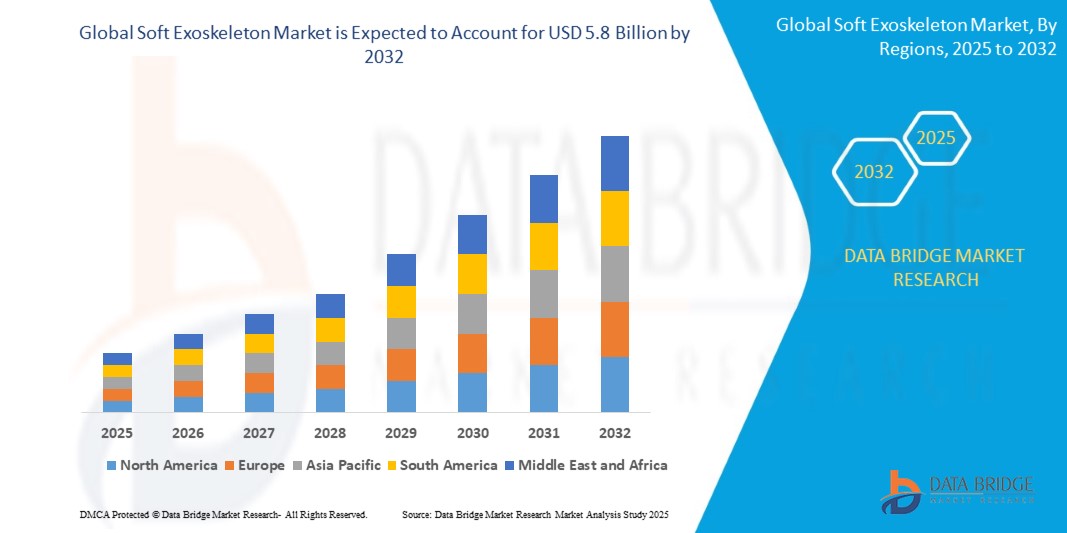
- The Global Soft Exoskeleton Market Size was valued at USD 2 Billion in 2024 and is expected to reach USD 5.8 Billion by 2032, at a CAGR of 16.4% during the forecast period
- The growth of the Global Soft Exoskeleton Market is fueled by increasing demand for wearable mobility aids, rising workplace injury prevention initiatives, advancements in soft robotics, and expanding applications in healthcare, industrial, and military sectors.
Global Soft Exoskeleton Market Analysis
The Global Soft Exoskeleton Market is experiencing rapid expansion as industries across healthcare, industrial, military, and consumer sectors prioritize mobility assistance, injury prevention, and operational efficiency. The increasing incidence of musculoskeletal disorders, aging populations, and workplace injuries has made soft exoskeletons a valuable tool for rehabilitation, support, and performance enhancement.
A primary driver of market growth is the advancement of wearable robotics technologies and material sciences. Innovations in soft actuators, lightweight textiles, artificial muscles, and flexible sensors have made soft exoskeletons more practical, affordable, and comfortable for real-world use. As these solutions become more ergonomic and user-friendly, adoption is accelerating across diverse end-user segments.
The growing demand for labor augmentation in physically demanding industries such as construction, logistics, automotive, and manufacturing is reshaping the landscape. Soft exoskeletons offer fatigue reduction and injury prevention, making them an attractive investment for companies seeking to improve worker safety and productivity. Additionally, healthcare providers are increasingly leveraging soft exosuits for physical therapy, stroke rehabilitation, and mobility enhancement for the elderly and disabled.
Military and defense organizations are also adopting soft exoskeletons to enhance soldier endurance and reduce musculoskeletal strain during long missions. The integration of smart sensors, IoT connectivity, and AI-driven motion assistance is enabling real-time feedback, adaptive support, and data analytics capabilities, thereby improving both performance and safety.
Despite strong momentum, the market faces challenges. These include high development costs, limited mass production capabilities, regulatory hurdles, and the need for user training. Comfort, battery life, and long-term durability are also concerns that manufacturers continue to address. Furthermore, market fragmentation and the lack of standardized performance metrics can slow down adoption in certain regions.
Nevertheless, the outlook remains highly promising. Growing investments in assistive technologies, increased funding for rehabilitation robotics, and government-backed aging-in-place initiatives are expected to create significant opportunities. As awareness and affordability improve, the soft exoskeleton market is poised for sustained growth in the coming years.
Report Scope and Global Soft Exoskeleton Market Segmentation
|
Attributes |
Global Soft Exoskeleton Market Insights |
|
Segments Covered |
|
|
Countries Covered |
North America
Europe
Asia-Pacific
Middle East and Africa
South America
|
|
Key Market Players |
|
|
Market Opportunities |
|
|
Value Added Data Infosets |
In addition to the insights on market scenarios such as market value, growth rate, segmentation, geographical coverage, and major players, the market reports curated by the Data Bridge Market Research also include in-depth expert analysis, pricing analysis, brand share analysis, consumer survey, demography analysis, supply chain analysis, value chain analysis, raw material/consumables overview, vendor selection criteria, PESTLE Analysis, Porter Analysis, and regulatory framework. |
Global Soft Exoskeleton Market Trends
“Innovation and Integration: Enhancing Mobility and Human Augmentation Through Smart Wearable Technologies”
- A significant and accelerating trend in the Global Soft Exoskeleton Market is the integration of smart technologies such as artificial intelligence (AI), machine learning (ML), and sensor fusion to enable adaptive motion assistance, real-time user feedback, and predictive support customization. These innovations are transforming how wearable exosuits respond to individual user needs in healthcare, industrial, and military applications.
- Enterprises are increasingly adopting lightweight, textile-based soft exoskeletons in industrial settings to reduce worker fatigue, prevent injuries, and boost productivity. This trend supports the evolving demands of ergonomics, workforce aging, and automation in sectors like manufacturing, logistics, and construction.
- The use of cloud-connected exoskeletons and IoT-enabled platforms is rising, allowing for remote monitoring, performance tracking, and AI-driven rehabilitation plans. These features are expanding the use of soft exosuits in home-based therapy and decentralized care models.
- The convergence of biomechanical design, wearable robotics, and human-centric ergonomics is gaining traction merging comfort, usability, and assistive function into a single, user-friendly solution. This trend is driving greater adoption in eldercare, sports rehabilitation, and personal mobility support.
Global Soft Exoskeleton Market Dynamics
Driver
“Rising Demand for Mobility Enhancement, Workforce Safety, and Rehabilitation Solutions”
- The increasing prevalence of musculoskeletal disorders, workplace injuries, and age-related mobility impairments is driving demand for soft exoskeletons across healthcare, industrial, and eldercare sectors. These wearable devices offer non-invasive support for physical rehabilitation, gait correction, and daily mobility enhancement.
- In industrial environments such as logistics, automotive, and manufacturing, employers are investing in wearable assistive technologies to reduce worker fatigue, prevent injuries, and enhance productivity especially in tasks involving repetitive motion or heavy lifting.
- The aging global population, particularly in developed nations, is accelerating demand for assistive devices that allow older adults to maintain independence and reduce reliance on caregivers. Soft exosuits offer a lightweight, ergonomic alternative to rigid exoskeletons.
- Advancements in soft robotics, flexible materials, and AI-powered motion assistance have enabled the development of more comfortable, adaptive, and efficient exosuits, driving adoption in clinical rehabilitation and personal mobility use cases.
- Growing interest from military and defense sectors is also fueling market growth, as soft exoskeletons are explored for enhancing soldier endurance, reducing fatigue, and mitigating the risk of long-term musculoskeletal damage in physically demanding missions.
Restraint/Challenge
“High Costs, Technical Limitations, and Market Fragmentation in Emerging Regions”
- The high initial cost of soft exoskeleton systems including R&D, customization, and training remains a key barrier to adoption, especially among small rehabilitation centers, SMEs in industrial sectors, and underfunded healthcare facilities in developing regions.
- Many soft exoskeletons require complex calibration, integration with existing therapy protocols or industrial workflows, and ongoing technical support. These factors contribute to longer deployment timelines and added operational costs.
- Battery life, device durability, and long-term comfort continue to present engineering challenges. In physically demanding environments, the performance limitations of current soft exosuit technologies can restrict their utility and require frequent maintenance or upgrades.
- A shortage of skilled practitioners and technicians trained to operate and maintain soft exoskeletons particularly in rural or emerging markets hampers large-scale deployment and user confidence.
- Market fragmentation and the absence of standardized clinical and industrial benchmarks make it difficult to compare product efficacy, gain regulatory approvals, and ensure consistent reimbursement models across geographies. This slows commercialization and hinders global scalability.
Global Soft Exoskeleton Market Scope
The market is segmented on the basis of Component, Application and Body part Assisted.
|
Segmentation |
Sub-Segmentation |
|
By Component |
|
|
By Application |
|
|
By Body Part Assisted |
|
- By Component
The Global Soft Exoskeleton Market, by component, is segmented into soft actuators, sensors, controllers, power sources, and textile-based materials. Soft actuators are critical for enabling flexible, human-like motion using technologies such as pneumatic systems or smart materials. Sensors including motion, pressure, and EMG sensors provide real-time data for interpreting user intent and enhancing movement precision. Controllers process sensor inputs and coordinate actuator responses to deliver smooth, adaptive assistance. Power sources, primarily lightweight and rechargeable batteries, supply energy to the system, while ongoing innovations aim to improve energy efficiency and portability. Textile-based materials form the wearable structure of soft exosuits, offering comfort, breathability, and durability, which are essential for extended use in both clinical and industrial settings.
- By Application
The Global Soft Exoskeleton Market, by application, is segmented into healthcare, industrial, military and defense, and sports and fitness. In the healthcare sector, soft exoskeletons are widely used for rehabilitation, mobility assistance, and gait training, particularly for patients recovering from stroke, spinal cord injuries, or age-related mobility impairments. The industrial segment leverages soft exosuits to reduce physical strain, prevent musculoskeletal injuries, and enhance worker productivity in sectors like manufacturing, logistics, and construction. In military and defense, these devices are being adopted to improve soldier endurance, reduce fatigue, and support load-bearing activities during missions. The sports and fitness application is an emerging area where soft exoskeletons assist athletes in performance enhancement, injury prevention, and recovery training through adaptive and real-time movement support.
- By Body part Assisted
The Global Soft Exoskeleton Market, by body part assisted, is categorized into upper body, lower body, and full body. Upper body soft exoskeletons are designed to support the arms, shoulders, and back, primarily used in industrial and rehabilitation settings to reduce fatigue, prevent injuries, and aid in upper limb recovery. Lower body exosuits assist the hips, knees, and ankles, widely utilized in medical rehabilitation, eldercare, and mobility enhancement for individuals with walking impairments or neuromuscular disorders. Full body soft exoskeletons offer comprehensive support across both upper and lower limbs, commonly applied in military, logistics, and specialized clinical scenarios where full-body augmentation or assistance is required for strength, endurance, or recovery.
Global Soft Exoskeleton Market Regional Analysis
- North America dominates the global soft exoskeleton market, accounting for the largest market share due to its early adoption of advanced rehabilitation and industrial safety technologies. The presence of major exoskeleton manufacturers, significant investment in R&D, and robust healthcare systems support the region’s leadership. The United States, in particular, leads in clinical deployment of soft exosuits for patients with mobility impairments and in industrial applications aimed at reducing workplace injuries. Additionally, strong collaboration between government agencies and private companies, especially in defense and veteran rehabilitation programs, continues to drive innovation and implementation.
- Europe holds the second-largest market share, propelled by strong regulatory frameworks that emphasize worker safety and assistive technologies. The region's aging population is fueling demand for mobility support and rehabilitation devices in healthcare, while industries such as automotive and logistics are incorporating soft exosuits to reduce employee fatigue and enhance productivity. Countries like Germany, France, the U.K., and the Netherlands are investing heavily in wearable robotics research, and public healthcare systems are increasingly integrating exoskeletons into physical therapy protocols.
- Asia-Pacific is the fastest-growing region in the soft exoskeleton market, backed by rapid industrialization, expanding geriatric populations, and increased healthcare spending. Countries such as China, Japan, South Korea, and India are leading in the adoption of wearable robotic systems for both medical and industrial uses. Government-backed initiatives promoting innovation in assistive technologies, combined with rising workplace automation, are contributing to the market’s strong regional growth. In Japan and South Korea, exosuits are also being used in eldercare and nursing, where worker shortages are a critical issue.
- Latin America, though a smaller market in comparison, is witnessing steady growth due to rising healthcare modernization and growing awareness of workplace ergonomics. Brazil and Mexico are at the forefront, with investments in rehabilitation robotics and pilot programs in industries like warehousing and construction. As economic conditions improve and healthcare access expands, the adoption of soft exoskeletons in both clinical and industrial sectors is expected to accelerate.
- The Middle East and Africa represent an emerging segment of the soft exoskeleton market. Growth is being driven by increasing defense budgets in countries such as the UAE and Saudi Arabia, where wearable robotics are being tested for enhancing soldier performance and reducing fatigue. In the healthcare sector, modernization efforts and government-backed digital health initiatives are laying the groundwork for broader adoption. Although infrastructural limitations and low awareness pose challenges, the region is expected to grow steadily as pilot deployments demonstrate impact and value.
North America Soft Exoskeleton Market Insight
The North America Soft Exoskeleton Market holds a dominant position globally, driven by advanced healthcare systems, high levels of technological innovation, and strong government and private sector investments. The region has witnessed early adoption of soft exoskeletons in rehabilitation, mobility support, and workplace injury prevention, particularly in the United States. Healthcare providers are increasingly integrating soft exosuits into treatment plans for patients with neurological or musculoskeletal disorders, while industries such as automotive, logistics, and manufacturing are using them to enhance worker safety and productivity. Additionally, the defense sector is a key contributor, with exoskeletons being explored to support soldier endurance and recovery. Canada and Mexico are also expanding their adoption through healthcare modernization and industrial safety initiatives. Overall, North America's market growth is supported by a favorable regulatory environment, strong research capabilities, and rising awareness of the benefits of wearable assistive technologies.
Europe Soft Exoskeleton Market Insight
The Europe soft exoskeleton market is mature and innovation-driven, supported by strong healthcare systems, workplace safety regulations, and a rapidly aging population. Countries like Germany, the U.K., and France are leading adoption integrating soft wearable suits into clinical rehabilitation protocols and industrial ergonomics initiatives. Ongoing collaborations between public healthcare bodies, defense agencies, and private manufacturers are advancing use cases from medical mobility assistance to fatigue reduction in manufacturing and logistics sectors. R&D investments and supportive regulatory frameworks continue to foster new product development, while cross-sector partnerships are accelerating pilot deployments and commercial rollouts, positioning Europe as a hub for soft exoskeleton innovation
Asia Pacific Soft Exoskeleton Market Insight
The Asia-Pacific soft exoskeleton market is emerging as the fastest-growing regional segment globally, driven by rapid industrialization, increasing demand for healthcare innovation, and government-led initiatives in assistive technology development. Countries such as China, Japan, South Korea, and India are leading adoption, with applications expanding across rehabilitation, eldercare, industrial safety, and military use. Japan and South Korea are integrating soft exoskeletons in eldercare facilities and nursing environments to support overburdened staff and aging populations. China is investing heavily in both medical and industrial exosuits, supported by domestic manufacturing and innovation capabilities. Meanwhile, India and Southeast Asian countries are beginning to explore pilot deployments in healthcare and logistics. The region's strong focus on robotics, combined with a growing awareness of workplace ergonomics and the rising prevalence of mobility-related health issues, is accelerating demand. Overall, Asia-Pacific is expected to maintain its upward momentum as affordability improves and technological advancements make soft exoskeletons more accessible and effective.
Latin America Soft Exoskeleton Market Insight
The Latin American soft exoskeleton market, while smaller than those in North America or Europe, is gaining momentum thanks to growing investments in healthcare modernization and increasing focus on workplace safety. Countries like Brazil and Mexico are at the forefront, initiating pilot projects across rehabilitation centers and industrial sites that demonstrate the value of exosuits in improving mobility and reducing physical strain. Economic growth and improving healthcare access are enabling broader trials, while logistical and construction sectors across the region are exploring wearable robotics to support worker well-being. As awareness spreads and costs decline, Latin America is poised for steady growth—making it an increasingly attractive market for manufacturers and technology partners focused on both clinical and industrial applications.
Middle East and Africa Soft Exoskeleton Market Insight
The Middle East and Africa soft exoskeleton market is in its early stages but shows strong promise, particularly within the defense and healthcare sectors. Countries like the UAE and Saudi Arabia have begun exploring wearable robotics to boost soldier endurance, support rehabilitation efforts, and address workforce efficiency in construction and industrial projects. These initiatives are often government-led, aligned with broader efforts to modernize defense capabilities and healthcare infrastructure. While deployment challenges persist such as limited local manufacturing, infrastructure gaps, and low market awareness public‑private partnerships and pilot programs are laying a foundation for expansion. As more successful case studies emerge and regional investments in healthcare and defense continue, the MEA market is positioned for steady growth, attracting both innovation and investment in wearable assistive technologies.
Global Soft Exoskeleton Market Share
The Global Soft Exoskeleton industry is primarily led by well-established companies, including:
- ReWalk Robotics Ltd.
- SuitX (Ottobock)
- Ekso Bionics Holdings Inc.
- Roam Robotics
- Myomo Inc.
- Harvard Wyss Institute
- Innophys Co., Ltd.
- Seismic
- Verve Motion
- Gobio Robot (GOGOA)
- HeroWear
- BioServo Technologies
- ATOUN
- Auxivo AG
Latest Developments in Global Soft Exoskeleton Market
- In June 2025, North Carolina State University researchers created an AI-trained robotic exoskeleton designed to improve human movements in activities like running, walking, and stair climbing, with future applications for individuals with disabilities in industrial and military settings.
- In May 2025, German Bionic launched a comprehensive 360° Human Augmentation Exoskeleton Platform at VivaTech, aimed at improving everyday life by enhancing safety, ease, and comfort for individuals.
- In April 2025, Maxon Group launched a new drive systems portfolio designed for modern robotics applications, including mobile manipulators, exoskeletons, quadrupeds, and humanoids.
- In October 2024, the House of Commons Library reported that approximately 16.1 million people in the UK had a disability in 2022/23, making up 24% of the total populace, highlighting the growing demand for assistive devices like exoskeletons.
- In July 2024, Arc'teryx and Skip launched $5000 exoskeleton hiking pants inspired by mountain goats, indicating a diversification of soft exoskeleton applications into consumer and recreational markets.
- In June 2024, researchers from Seoul National University made a breakthrough in recovery robotics, developing a wearable robot that assists individuals with spinal cord injuries to breathe, cough, and even sing professionally by applying pressure to their diaphragm and mimicking natural exhalation.
- In June 2024, a study demonstrated the potential of newly designed sensory robots with e-skin and artificial muscle layers for medical implants, including a robotic cuff for blood pressure monitoring, an ingestible robot for pH sensing and drug delivery, a robotic gripper for bladder volume measurement, and a robotic patch for cardiac function assessment and electrotherapy.
- In May 2024, researchers at Chung-Ang University developed a wearable robot to aid individuals with muscle weakness and walking difficulties, showing improvements in balance and reduced energy expenditure during walking trials.
- In March 2024, a collaboration between Harvard and Boston University researchers developed a soft wearable robot that assists people with Parkinson's Disease in walking without freezing episodes, by providing external support and gentle pushes.
- In December 2023, German Bionic, an innovator in electrically powered exoskeletons, secured over USD 16.3 million in an extended Series A funding round, aiming to enhance collaboration and scale production for better market deployment, particularly for models like Apogee and Apogee+ in logistics, retail, and healthcare.
- In November 2023, ReWalk Robotics successfully demonstrated its AI-enabled exoskeleton, developed under the Israel Innovation Authority's Human Robot Interaction (HRI) Consortium, marking a significant step forward in intelligent assistive devices.

- Interactive Data Analysis Dashboard
- Company Analysis Dashboard for high growth potential opportunities
- Research Analyst Access for customization & queries
- Competitor Analysis with Interactive dashboard
- Latest News, Updates & Trend analysis
- Harness the Power of Benchmark Analysis for Comprehensive Competitor Tracking
Global Soft Exoskeleton Market, Supply Chain Analysis and Ecosystem Framework
To support market growth and help clients navigate the impact of geopolitical shifts, DBMR has integrated in-depth supply chain analysis into its Global Soft Exoskeleton Market research reports. This addition empowers clients to respond effectively to global changes affecting their industries. The supply chain analysis section includes detailed insights such as Global Soft Exoskeleton Market consumption and production by country, price trend analysis, the impact of tariffs and geopolitical developments, and import and export trends by country and HSN code. It also highlights major suppliers with data on production capacity and company profiles, as well as key importers and exporters. In addition to research, DBMR offers specialized supply chain consulting services backed by over a decade of experience, providing solutions like supplier discovery, supplier risk assessment, price trend analysis, impact evaluation of inflation and trade route changes, and comprehensive market trend analysis.
Data collection and base year analysis are done using data collection modules with large sample sizes. The stage includes obtaining market information or related data through various sources and strategies. It includes examining and planning all the data acquired from the past in advance. It likewise envelops the examination of information inconsistencies seen across different information sources. The market data is analysed and estimated using market statistical and coherent models. Also, market share analysis and key trend analysis are the major success factors in the market report. To know more, please request an analyst call or drop down your inquiry.
The key research methodology used by DBMR research team is data triangulation which involves data mining, analysis of the impact of data variables on the market and primary (industry expert) validation. Data models include Vendor Positioning Grid, Market Time Line Analysis, Market Overview and Guide, Company Positioning Grid, Patent Analysis, Pricing Analysis, Company Market Share Analysis, Standards of Measurement, Global versus Regional and Vendor Share Analysis. To know more about the research methodology, drop in an inquiry to speak to our industry experts.
Data Bridge Market Research is a leader in advanced formative research. We take pride in servicing our existing and new customers with data and analysis that match and suits their goal. The report can be customized to include price trend analysis of target brands understanding the market for additional countries (ask for the list of countries), clinical trial results data, literature review, refurbished market and product base analysis. Market analysis of target competitors can be analyzed from technology-based analysis to market portfolio strategies. We can add as many competitors that you require data about in the format and data style you are looking for. Our team of analysts can also provide you data in crude raw excel files pivot tables (Fact book) or can assist you in creating presentations from the data sets available in the report.













