


What is the Soft Grippers Robotics Market Size and Growth Rate?
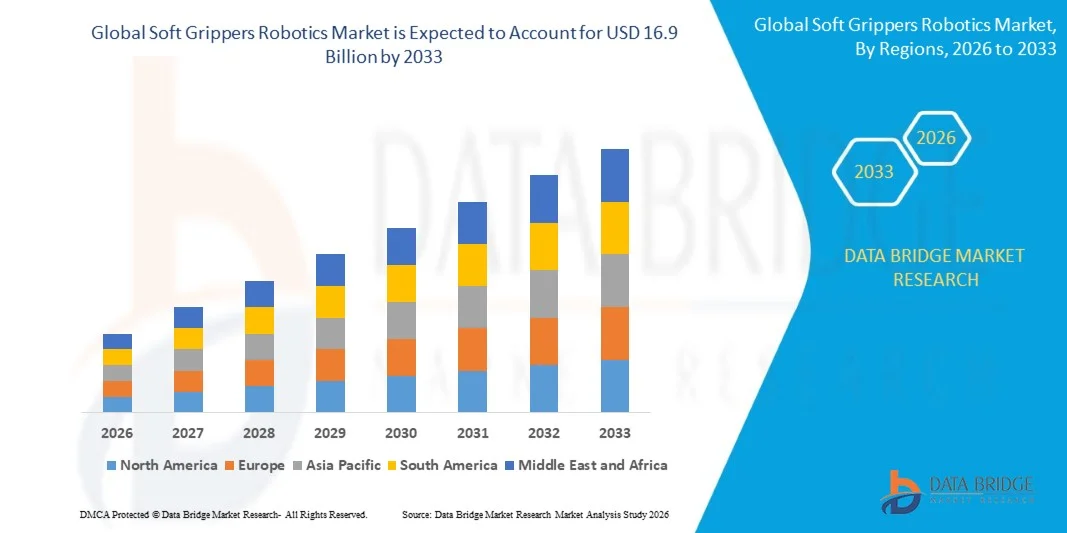
- As per market analysis, the Global Soft Grippers Robotics market was valued at approximately USD 0.9 billion in 2025 and is projected to reach USD 16.9 billion by 2033, growing at a CAGR of 35.1% from 2026 to 2033.
- The market is witnessing growth driven by increasing adoption of automation, rising demand for flexible and adaptive robotic gripping solutions, and growing applications across food and beverages, logistics, manufacturing, electronics, and other industries. Soft grippers enable robots to handle fragile, irregularly shaped, and delicate objects while supporting safer human-robot interaction.
- Increasing adoption of collaborative robots, advancements in soft materials and sensing technologies, and growing demand for automated handling solutions are creating further growth opportunities. Manufacturers are also focusing on developing lightweight, flexible, sensor-integrated, and highly adaptable grippers that can improve robotic dexterity and expand automation across diverse industrial applications.
Market Size & Forecast
- Market Value (2025): USD 0.9 billion
- Expected Market Value (2033): USD 16.9 Million
- Forecast CAGR (2026–2033): 35.1%
- Leading Region in 2025: North America
- Fastest Growing Region: Asia-Pacific
What are the Major Takeaways of the Soft Grippers Robotics Market?
- North America dominated the global soft robotics market with a market share of 41.5% in 2025, supported by early adoption of advanced robotics, significant research and development investments, and the presence of established robotics companies. Strong adoption across healthcare, automotive, food processing, logistics, and manufacturing applications is further supporting regional market development.
- Asia-Pacific is expected to witness the fastest growth in the global soft robotics market during the forecast period of 6.35% of 2026 to 2033, supported by rapid industrialization, increasing automation in manufacturing, rising investments in robotics, and expanding applications across China, Japan, India, and other Asian economies. Growing government support for smart manufacturing and increasing adoption of flexible automation solutions are further contributing to regional expansion.
- Soft Grippers represent a key type segment of the global soft robotics market with market share of 34.34% in 2025, supported by their ability to handle delicate, irregularly shaped, and flexible objects with greater adaptability than conventional rigid gripping systems. Increasing adoption across logistics, food and beverages, manufacturing, healthcare, and automated material-handling applications is creating opportunities for soft gripper technologies.
- The Wearable Robots segment dominated the global soft robotics market with a market share of 35.01% in 2025, driven by increasing adoption in healthcare, rehabilitation, assistive technologies, and packaging applications. The segment benefits from growing demand for robotic systems that support human capabilities while improving safety and operational efficiency.
- The Hardware segment is expected to hold the largest market revenue share of 60.23% in 2025, supported by the critical role of flexible materials, actuators, sensors, and other physical components in enabling soft robotic movement, gripping, adaptability, and interaction. Increasing development of advanced actuators and sensing technologies is further supporting hardware demand.
- The Co-Robots segment is expected to witness the fastest growth of 5.34% from 2026 to 2033, driven by their ability to safely collaborate with humans in shared workspaces while improving productivity and flexibility across manufacturing, logistics, and healthcare. Advancements in artificial intelligence and sensor technologies are further accelerating adoption of collaborative soft robotics solutions.
Report Scope Soft Grippers Robotics Market Segmentation
|
Attributes |
Soft Grippers Robotics Key Market Insights |
|
Segments Covered |
|
|
Countries Covered |
North America
Europe
Asia-Pacific
Middle East and Africa
South America
|
|
Key Market Players |
|
|
Market Opportunities |
|
|
Value Added Data Infosets |
In addition to the insights on market scenarios such as market value, growth rate, segmentation, geographical coverage, and major players, the market reports curated by the Data Bridge Market Research also include in-depth expert analysis, geographically represented company-wise production and capacity, network layouts of distributors and partners, detailed and updated price trend analysis and deficit analysis of supply chain and demand. |
What is the Key Trend in the Soft Grippers Robotics Market?
- Soft gripper manufacturers are increasingly focusing on adaptive grasping, multimodal sensing, and intelligent control technologies that enable robots to handle objects with different shapes, sizes, weights, textures, and levels of fragility. The integration of soft materials with tactile sensing, machine vision, and learning-based control is improving the ability of robotic grippers to automatically adjust gripping force and movement according to real-time object characteristics.
- The development of AI-enabled and sensor-integrated soft grippers is gaining traction, as manufacturers and researchers seek to improve autonomous handling in unstructured and high-mix environments. Multimodal perception combining visual, tactile, force, and positional information is supporting more precise grasp planning, object recognition, and real-time force adjustment, particularly for delicate products and irregularly shaped objects.
- For instance, on June 8, 2026, Festo introduced GripperAI, an AI-powered software solution designed to enable robots to handle mixed, unfamiliar, and randomly positioned products without extensive programming or predefined templates. The system identifies suitable gripping points and selects an appropriate gripper for the handling task, demonstrating the industry's shift toward intelligent and flexible robotic gripping systems.
- The integration of soft grippers with advanced tactile sensing and closed-loop control is also supporting applications that require non-destructive and precision handling.
What are the Key Drivers of the Soft Grippers Robotics Market?
- Soft gripper manufacturers are increasingly focusing on flexible, adaptive, and lightweight gripping technologies that can safely handle fragile, irregularly shaped, and deformable objects. The ability of soft grippers to conform to different object geometries with reduced gripping force is supporting their adoption across food and beverage, packaging, pharmaceuticals, electronics, logistics, and other applications where conventional rigid grippers may cause product damage.
- The integration of artificial intelligence, machine vision, advanced sensing, and modular robotic technologies is accelerating the development of intelligent soft grippers. These technologies enable robots to identify object characteristics, adjust gripping forces, and perform more precise pick-and-place operations. The growing development of physical AI and robotic manipulation systems is further increasing demand for adaptable end-of-arm tooling capable of operating in variable and unstructured environments.
- For instance, in June 2026, research published in Results in Engineering demonstrated a grasp strategy-driven approach for designing soft robotic grippers for food-industry applications. The study reported that 3D-printed soft fingers achieved a 97% match to recorded human motion trajectories, while the modular gripper design could be swapped in five minutes, highlighting the potential for flexible and high-mix food automation.
- The expansion of food and beverage automation is also driving demand for hygienic and adaptable soft gripping solutions. OnRobot's Soft Gripper is designed with interchangeable silicone cups for handling irregular and delicate products and is certified for food-handling applications.
Which Factors are Challenging the Growth of the Soft Grippers Robotics Market?
- Soft gripper manufacturers are increasingly focusing on improving durability, payload capacity, and mechanical reliability, as the flexible materials used in soft grippers can face wear, deformation, and performance limitations during repeated industrial operations. The requirement to maintain flexibility while achieving sufficient stiffness and load-bearing capability remains a key engineering challenge for applications involving heavier or irregular objects.
- The development of precise sensing and control technologies remains challenging, as the compliant nature of soft grippers makes their deformation and gripping behavior more difficult to model and control than conventional rigid grippers. Manufacturers and researchers are therefore focusing on integrated force, pressure, and tactile sensing technologies to improve grip-force regulation, object recognition, and manipulation accuracy.
- For instance, in January 2026, researchers published a study on a new SMART gripper with soft fingers and integrated force sensors for adaptive robotic tasks. The system was designed to regulate contact force and improve the handling of objects that can be damaged by excessive gripping force, highlighting the industry's continued focus on overcoming sensing and precise force-control limitations.
- The integration of soft grippers into high-mix industrial environments remains challenging because different products can have substantially different shapes, textures, weights, and levels of fragility. Many pneumatic, hydraulic, or cable-driven soft grippers require pumps, valves, tubing, or other supporting components, increasing system complexity and potentially limiting deployment where compact, lightweight, and untethered robotic end-effectors are required.
How is the Soft Grippers Robotics Market Segmented?
The market is segmented on the basis of type, components, and end user.
- By Type
On the basis of type, the soft grippers robotics market is segmented into Welding Guns, Grippers, Tool Changers, Suction Cups, Clamps, and Others. The Grippers segment is dominating the segment with market share of 43.13% in 2025, supported by the ability of soft gripping technologies to handle fragile, irregularly shaped, and deformable objects with greater flexibility than conventional rigid end-effectors. The increasing adoption of automation across food and beverages, logistics, manufacturing, and other handling applications is supporting demand for flexible gripping solutions.
The Grippers segment is expected to witness strong growth during the forecast period of 4.24% in 2026 to 2033, supported by increasing requirements for adaptive object handling, rising automation across industrial operations, and growing adoption of robotic systems capable of handling delicate products.
- By Components
On the basis of components, the soft grippers robotics market is segmented into Hardware and Software. The Hardware segment is dominating segment with market share of 65.23% in 2025, includes the physical gripping and robotic components required for object manipulation, while the Software segment supports control, programming, sensing, and automation functions. Increasing integration of robotics into automated production and material-handling environments is supporting demand for both hardware and software components.
The Hardware segment is expected to maintain strong demand to forecast period of 5.34% 2026 to 2033, as manufacturers increasingly deploy robotic end-effectors for automated handling, picking, sorting, and manipulation tasks.
- By End User
On the basis of end user, the soft grippers robotics market is segmented into Medical and Healthcare, Food and Beverages, Logistics, Entertainment and Gaming, Automotive, Survey and Exploration, and Others. The Food and Beverages segment dominate the segment with market share of 54.23% due to an important application area, supported by the ability of soft grippers to handle fragile and delicate products while supporting automated processing and material handling.
The Logistics segment is expected to witness strong growth during the forecast period of 6.35% of 2026 to 2033, driven by increasing warehouse automation, demand for automated picking and handling, and the need to manipulate products with different shapes, sizes, and surface characteristics.
Which Region Holds the Largest Share of the Soft Grippers Robotics Market?
- North America dominated the Soft Grippers Robotics Market is domaining the region with market share of 41.5% in 2025 supported by the presence of major robotics and automation companies, availability of technically skilled personnel, and increasing adoption of advanced robotic systems across food and beverages, logistics, healthcare, automotive, and manufacturing applications. The region's established automation infrastructure and strong focus on industrial modernization further support the adoption of soft grippers for handling fragile, irregularly shaped, and delicate products.
- Asia-Pacific is expected to witness significant growth during the forecast period of 6.25 of 2026 to 2033, supported by the rising number of automated manufacturing units, expansion of warehouses and distribution channels, increasing industrial automation, and growing adoption of robotics across China, Japan, South Korea, India, and other emerging economies. The increasing need for automated handling solutions across manufacturing, food processing, logistics, and automotive applications
U.S. Soft Grippers Robotics Market Insight
The U.S. soft grippers robotics market is expanding with increasing adoption of robotic automation across healthcare, manufacturing, logistics, food and beverages, and other industries. Demand is supported by investments in advanced robotics, collaborative automation, and flexible handling technologies capable of manipulating fragile and irregularly shaped products. The country also benefits from a strong robotics research ecosystem and continued development of soft actuators, sensing, and intelligent control technologies. Growing warehouse automation and the use of soft grippers for delicate product handling are further supporting market expansion.
Europe Soft Grippers Robotics Market Insight
The Europe soft grippers robotics market is witnessing increasing adoption as manufacturers across automotive, food and beverages, logistics, electronics, and healthcare industries accelerate automation and flexible robotic handling. The region's strong industrial automation ecosystem, emphasis on workplace efficiency, and growing deployment of collaborative robots are supporting demand for soft grippers capable of handling delicate, irregularly shaped, and sensitive products. Germany, France, Italy, and the United Kingdom are emerging as important markets due to established manufacturing capabilities, increasing investment in robotics, and the growing need for adaptable and precise automated material-handling solutions.
U.K. Soft Grippers Robotics Market Insight
The U.K. soft grippers robotics market is supported by increasing adoption of automation, collaborative robotics, and advanced end-of-arm tooling across manufacturing, food and beverages, logistics, healthcare, and automotive industries. Demand for flexible gripping solutions is rising as manufacturers seek to automate the handling of fragile, irregularly shaped, and variable products while minimizing product damage. The expansion of warehouse automation and investments in smart manufacturing are further supporting market development. Growing integration of artificial intelligence, machine vision, tactile sensing, and adaptive control technologies is also creating opportunities for advanced soft gripper deployment across diverse industrial applications.
Germany Soft Grippers Robotics Market Insight
The germany soft grippers robotics market is witnessing increasing adoption as manufacturers accelerate industrial automation, smart manufacturing, and flexible robotic handling across diverse production environments. The country’s strong automotive, food and beverage, electronics, and industrial machinery sectors are creating demand for soft grippers capable of handling delicate, irregularly shaped, and deformable objects with improved flexibility. Growing deployment of collaborative robots and advanced robotic end-effectors is further supporting market development. In addition, Germany’s established robotics ecosystem, focus on Industry 4.0, and continuous investment in intelligent automation technologies are expected to create opportunities for soft gripper manufacturers across industrial and logistics applications.
Asia-Pacific Soft Grippers Robotics Market Insight
The Asia-Pacific soft grippers robotics market is experiencing increasing adoption, driven by rapid industrial automation, expanding manufacturing capabilities, and growing investments in robotics across China, Japan, South Korea, and India. Rising demand for automated handling solutions in food and beverages, logistics, automotive, electronics, and healthcare is supporting market expansion. The region’s growing warehouse infrastructure and increasing deployment of collaborative robots are further creating opportunities for flexible gripping technologies. Advancements in soft materials, sensing technologies, and adaptive gripping mechanisms are expected to strengthen the adoption of soft grippers for handling fragile, irregularly shaped, and diverse products across industrial applications.
Japan Soft Grippers Robotics Market Insight
The Japan soft grippers robotics market is witnessing increasing adoption as manufacturers seek flexible automation solutions to address labor shortages, improve productivity, and safely handle delicate and irregularly shaped products. Japan's established robotics ecosystem, advanced manufacturing capabilities, and strong expertise in precision engineering support the development and deployment of soft gripping technologies across automotive, food and beverages, logistics, healthcare, and manufacturing applications. The growing use of robotics in warehouses and food-handling operations is further creating opportunities for soft grippers, particularly where conventional rigid grippers face challenges in handling variable products.
China Soft Grippers Robotics Market Insight
China's soft grippers robotics market is expanding as manufacturers increasingly adopt automation, intelligent robotics, and flexible handling solutions across food and beverages, automotive, electronics, and logistics applications. Rising investments in industrial automation and technological advancements in soft gripping systems are supporting market development, while China's manufacturing scale creates opportunities for high-volume robotic deployment. Domestic companies are also advancing machine vision and flexible gripping technologies for irregular and delicate products. For instance, SRT demonstrated an intelligent flexible handling solution in 2025 that integrates machine vision and soft robotic technologies for packaging and inspection applications, highlighting the growing application of soft grippers in China's automated manufacturing environment.
Which are the Top Companies in Soft Grippers Robotics market?
The Soft Grippers Robotics market industry is primarily led by well-established companies, including:
- Schmalz GmbH (Germany)
- Soft Robotics Inc. (U.S.)
- Festo SE & Co. KG (Germany)
- SCHUNK SE & Co. KG (Germany)
- OnRobot A/S (Denmark)
- SMC Corporation (Japan)
- Piab AB (Sweden)
- Zimmer Group (Germany)
- Robotiq Inc. (Canada)
- SoftGripping GmbH (Germany)
- SRT / Soft Robot Technology Co., Ltd. (China)
- ROCHU Soft Robotic Gripper Group (China)
- RightHand Robotics, Inc. (U.S.)
- Nitta Corporation (Osaka, Japan)
- DESTACO (U.S.)
What are Latest Developments in Soft Grippers Robotics Market?
- In August 2024, Schmalz acquired the mGrip product family from Soft Robotics Inc., including soft finger-gripper configurations, patents, and associated know-how. The acquisition expanded Schmalz's gripper portfolio and strengthened its position in automated food-product handling applications.
- In August 2024, Soft Robotics Inc. announced the divestiture of its gripper business to Schmalz and transitioned its focus toward vision inspection and defect detection technologies. The move resulted in the mGrip soft-gripper portfolio being incorporated into Schmalz's end-of-arm tooling business.
- In 2025, research and development activities increasingly focused on integrating tactile sensing with soft robotic grippers. A 2025 review highlighted commercial soft grippers for industrial sorting and Schmalz's mGrip series, while research continued toward adaptive designs capable of handling irregularly shaped objects and improving manipulation performance.
- In October 2025, researchers reported a hybrid soft gripper finger using inflatable silicone pockets to enable in-grasp friction modulation. The design was developed to handle heavy, slippery, fragile, and deformable objects by adjusting friction rather than relying only on high gripping forces, supporting applications requiring gentle and adaptive manipulation.
- In February 2026, researchers introduced a conditional-flow-matching approach for grasp synthesis with soft robotic grippers. The technology was designed to transfer grasp strategies from rigid grippers to soft Fin-Ray grippers using depth-image information, addressing the challenge of generating stable grasp poses for compliant robotic systems.

- Interactive Data Analysis Dashboard
- Company Analysis Dashboard for high growth potential opportunities
- Research Analyst Access for customization & queries
- Competitor Analysis with Interactive dashboard
- Latest News, Updates & Trend analysis
- Harness the Power of Benchmark Analysis for Comprehensive Competitor Tracking
Global Soft Grippers Robotics Market, Supply Chain Analysis and Ecosystem Framework
To support market growth and help clients navigate the impact of geopolitical shifts, DBMR has integrated in-depth supply chain analysis into its Global Soft Grippers Robotics Market research reports. This addition empowers clients to respond effectively to global changes affecting their industries. The supply chain analysis section includes detailed insights such as Global Soft Grippers Robotics Market consumption and production by country, price trend analysis, the impact of tariffs and geopolitical developments, and import and export trends by country and HSN code. It also highlights major suppliers with data on production capacity and company profiles, as well as key importers and exporters. In addition to research, DBMR offers specialized supply chain consulting services backed by over a decade of experience, providing solutions like supplier discovery, supplier risk assessment, price trend analysis, impact evaluation of inflation and trade route changes, and comprehensive market trend analysis.
Data collection and base year analysis are done using data collection modules with large sample sizes. The stage includes obtaining market information or related data through various sources and strategies. It includes examining and planning all the data acquired from the past in advance. It likewise envelops the examination of information inconsistencies seen across different information sources. The market data is analysed and estimated using market statistical and coherent models. Also, market share analysis and key trend analysis are the major success factors in the market report. To know more, please request an analyst call or drop down your inquiry.
The key research methodology used by DBMR research team is data triangulation which involves data mining, analysis of the impact of data variables on the market and primary (industry expert) validation. Data models include Vendor Positioning Grid, Market Time Line Analysis, Market Overview and Guide, Company Positioning Grid, Patent Analysis, Pricing Analysis, Company Market Share Analysis, Standards of Measurement, Global versus Regional and Vendor Share Analysis. To know more about the research methodology, drop in an inquiry to speak to our industry experts.
Data Bridge Market Research is a leader in advanced formative research. We take pride in servicing our existing and new customers with data and analysis that match and suits their goal. The report can be customized to include price trend analysis of target brands understanding the market for additional countries (ask for the list of countries), clinical trial results data, literature review, refurbished market and product base analysis. Market analysis of target competitors can be analyzed from technology-based analysis to market portfolio strategies. We can add as many competitors that you require data about in the format and data style you are looking for. Our team of analysts can also provide you data in crude raw excel files pivot tables (Fact book) or can assist you in creating presentations from the data sets available in the report.













