


Soft Magnetic Material Market Overview
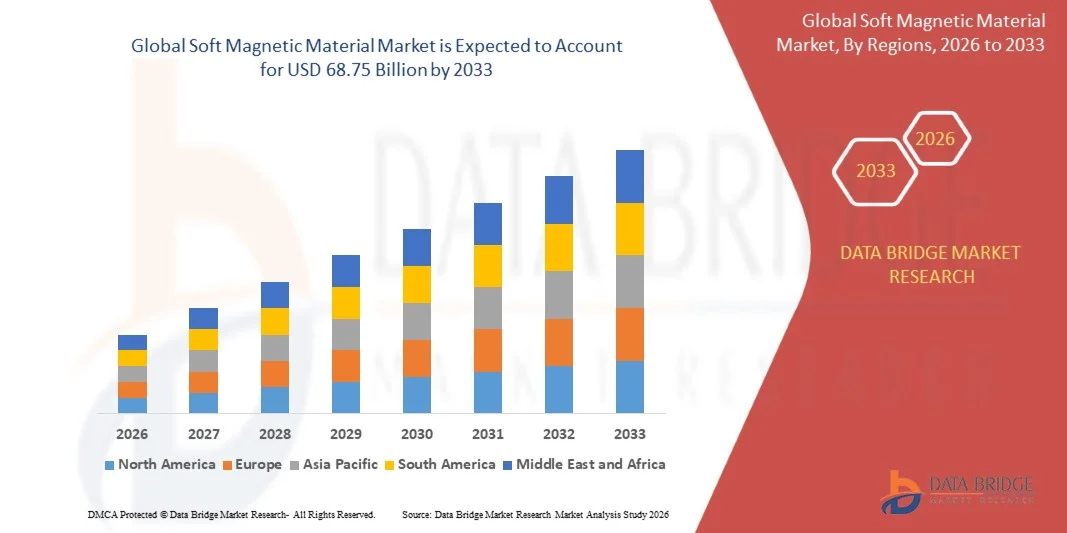
The Soft Magnetic Material Market was valued at USD 39.42 billion in 2025 and is projected to reach USD 68.75 billion by 2033, growing at a CAGR of 7.20% from 2026 to 2033. The Soft Magnetic Material Market is experiencing consistent growth driven by rising demand for energy-efficient electrical components, rapid advancements in power electronics and electromagnetic technologies, and expanding applications across automotive, renewable energy, consumer electronics, and industrial sectors. Soft magnetic materials such as ferrites, electrical steels, and amorphous alloys play a critical role in improving the performance and efficiency of transformers, motors, inductors, and electronic devices.
The increasing adoption of electric vehicles (EVs), growing investments in renewable energy systems, and rising demand for miniaturized and high-performance electronic components are compelling manufacturers to develop advanced soft magnetic materials with improved magnetic properties, lower energy losses, and enhanced thermal performance. The expansion of smart grids, charging infrastructure, and power conversion technologies is further accelerating the adoption of soft magnetic materials across global markets.
Key Market Trends & Insights
- North America dominated the Soft Magnetic Material Market with the largest revenue share of 33.6% in 2025, supported by strong demand from the automotive, electrical & power, aerospace, and industrial manufacturing sectors. The region benefits from advanced manufacturing capabilities, high adoption of electric vehicles, increasing investments in renewable energy infrastructure, and the presence of major material and technology providers. Growing deployment of transformers, motors, power electronics, and electromagnetic components across the U.S. and Canada is further strengthening regional market growth.
- The cold rolling & annealing segment dominated the market with a 45.6% share in 2025, due to its extensive usage in producing electrical steel sheets and strips required for transformers, motors, and generators.
- Asia-Pacific is expected to be the fastest-growing region at a CAGR of 7.5% from 2026 to 2033, fueled by rapid industrialization, expansion of electronics manufacturing, increasing electric vehicle production, and rising investments in renewable energy projects. Countries such as China, India, Japan, and South Korea are witnessing strong demand for soft magnetic materials in transformers, sensors, motors, and consumer electronics applications. Government initiatives supporting electrification and clean energy development are further accelerating regional growth.
- The cores & core types segment dominated the product type category with a 42.7% revenue share in 2025, supported by widespread adoption in transformers, inductors, electric motors, and power conversion equipment. Soft magnetic cores provide efficient magnetic flux control, reduced energy losses, and improved electromagnetic performance, making them critical components in electrical and electronic systems. Increasing demand for compact and high-efficiency power devices is reinforcing segment expansion.
Market Size & Forecast
- Global Market Value (2025): USD 39.42 Billion
- Expected Market Value (2033): USD 68.75 Billion
- Forecast CAGR (2026–2033): 7.20%
- Leading Region in 2025: North America
- Fastest Growing Region: Asia-Pacific
Report Scope and Soft Magnetic Material Market Segmentation
|
Attributes |
Soft Magnetic Material Key Market Insights |
|
Segments Covered |
|
|
Countries Covered |
North America · U.S. · Canada · Mexico Europe · Germany · France · U.K. · Netherlands · Switzerland · Belgium · Russia · Italy · Spain · Turkey · Rest of Europe Asia-Pacific · China · Japan · India · South Korea · Singapore · Malaysia · Australia · Thailand · Indonesia · Philippines · Rest of Asia-Pacific Middle East and Africa · Saudi Arabia · U.A.E. · South Africa · Egypt · Israel · Rest of Middle East and Africa South America · Brazil · Argentina · Rest of South America |
|
Key Market Players |
• VACUUMSCHMELZE GmbH & Co. KG (Germany) |
|
Market Opportunities |
· Growing Adoption of Electric Vehicles and Advanced Automotive Electronics · Expansion of Renewable Energy and Power Infrastructure · Increasing Demand for Miniaturized and High-Performance Electronic Devices |
|
Value Added Data Infosets |
In addition to the insights on market scenarios such as market value, growth rate, segmentation, geographical coverage, and major players, the market reports curated by the Data Bridge Market Research also include in-depth expert analysis, geographically represented company-wise production and capacity, network layouts of distributors and partners, detailed and updated price trend analysis and deficit analysis of supply chain and demand. |
Soft Magnetic Material Market Trends
Trend: Growth in Electrification, Renewable Energy & Advanced Power Electronics Applications
The Soft Magnetic Material Market is witnessing increasing adoption due to the rapid expansion of electric vehicles, renewable energy systems, and high-efficiency power electronics. Manufacturers are focusing on developing advanced electrical steels, amorphous alloys, nanocrystalline materials, and soft ferrites to improve energy efficiency, reduce power losses, and enhance electromagnetic performance. Soft magnetic materials are becoming essential components in electric motors, transformers, inductors, sensors, and power conversion systems used across automotive, industrial, and energy applications. For instance, in 2024, companies such as VACUUMSCHMELZE and TDK Corporation continued expanding their advanced magnetic material solutions for EV powertrains, charging systems, and energy-efficient electronic components. The growing transition toward vehicle electrification, smart grids, and renewable energy integration is accelerating demand for high-performance soft magnetic materials with improved magnetic permeability and lower energy losses.
Soft Magnetic Material Market Dynamics
Key Market Driver: Rising Demand for Electric Vehicles & Energy-Efficient Electrical Systems
The rapid growth of electric mobility, renewable energy infrastructure, and industrial automation is significantly increasing demand for soft magnetic materials used in motors, transformers, generators, and power electronics. Automotive manufacturers are integrating advanced magnetic materials into electric vehicle motors and charging systems to improve efficiency, reduce weight, and enhance vehicle performance. In addition, the expansion of renewable energy projects, including wind and solar power systems, is driving demand for efficient transformers, converters, and energy management equipment that rely on soft magnetic components. According to industry trends, global EV production continues to increase significantly, creating strong opportunities for manufacturers of electrical steel, ferrite materials, and nanocrystalline alloys. The growing focus on energy conservation, grid modernization, and high-efficiency electrical devices is further supporting market growth.
Key Restraint/ChallengeHigh Manufacturing Costs & Raw Material Price Volatility
A major challenge affecting the Soft Magnetic Material Market is the high production cost associated with advanced magnetic materials and fluctuations in raw material prices. Manufacturing processes such as melt spinning, precision alloy development, and specialized coating technologies require significant investment in equipment and technical expertise. In addition, the availability and pricing of materials such as silicon steel, cobalt, nickel, and rare-earth-related inputs can impact production costs and supply stability. The development of advanced materials such as amorphous and nanocrystalline alloys also involves complex manufacturing processes, which can limit adoption among cost-sensitive industries. Furthermore, increasing demand for customized magnetic components requires continuous research and development investments, adding pressure on manufacturers to maintain competitive pricing.
Key Market Opportunity: Expansion of EV, Renewable Energy & Smart Grid Technologies
The increasing adoption of electric vehicles, renewable energy systems, and next-generation power electronics presents significant growth opportunities for soft magnetic material manufacturers. Advanced materials such as nanocrystalline alloys and soft ferrites are gaining importance due to their superior magnetic properties, lower energy losses, and suitability for compact electronic systems. For instance, in 2025, leading automotive and electronics manufacturers continued investing in EV powertrain technologies, battery charging infrastructure, and high-efficiency power conversion systems, creating new demand for advanced magnetic components. The integration of soft magnetic materials into smart grid systems, energy storage solutions, industrial automation equipment, and high-frequency electronic devices is expected to further expand market opportunities. In addition, increasing investments in clean energy projects across Asia-Pacific, Europe, and North America are expected to drive long-term demand for efficient magnetic materials.
Soft Magnetic Material Market Scope
The soft magnetic materials market is segmented on the basis of product type, material type, manufacturing process, application, end user, and distribution channel.
- By Product Type
On the basis of product type, the global Soft Magnetic Materials market is segmented into sheet & strips, cores & core types, ribbons & foils, powder & granules, assembled components, ingots, and others. The Cores & Core Types segment dominated the market with a 42.7% share in 2025, owing to their extensive utilization across transformers, electric motors, generators, inductors, and power electronic devices. Soft magnetic cores provide high magnetic permeability, low hysteresis losses, improved energy efficiency, and enhanced electromagnetic performance, making them essential components in modern electrical systems. Increasing adoption of electric vehicles, renewable energy infrastructure, industrial automation, and smart grid technologies is significantly driving demand for advanced magnetic core materials. The growing need for compact, efficient, and high-performance electrical components across automotive and industrial applications is further supporting segment growth. In addition, rising investments in power transmission networks, energy-efficient equipment, and electrification projects are strengthening the leading position of this segment in the global market.
The Ribbons & Foils segment is expected to witness the fastest growth at a CAGR of 8.0% from 2026 to 2033, driven by increasing demand for advanced magnetic materials used in high-frequency electronic applications, transformers, sensors, and power conversion systems. Amorphous and nanocrystalline ribbons provide superior magnetic properties, lower energy losses, and improved efficiency compared with conventional materials. The rising adoption of electric vehicles, renewable energy converters, and miniaturized electronic devices is accelerating the use of ribbon-based magnetic materials. Furthermore, increasing focus on lightweight, energy-efficient, and high-performance components is encouraging manufacturers to invest in advanced ribbon and foil technologies. Continuous innovation in material processing and growing demand for next-generation power electronics are expected to further support segment expansion.
- By Material Type
On the basis of material type, the global Soft Magnetic Materials market is segmented into electrical steel (Fe-Si), amorphous & nanocrystalline alloys, soft ferrites, powdered iron & metal powders, soft magnetic coatings, thin films & magnetic coatings, and others. The Electrical Steel (Fe-Si) segment dominated the market with a 38.9% share in 2025, supported by its widespread application in transformers, motors, generators, and electrical power equipment. Electrical steel offers excellent magnetic permeability, reduced core losses, and improved energy efficiency, making it highly suitable for large-scale electrical applications. The increasing deployment of electric motors, industrial machinery, renewable energy systems, and power distribution equipment is driving demand for electrical steel. Automotive manufacturers are also increasingly adopting electrical steel in EV motors to improve efficiency and reduce energy consumption. In addition, growing investments in grid modernization and energy-efficient technologies are reinforcing the dominance of this segment.
The Amorphous & Nanocrystalline Alloys segment is projected to register the fastest CAGR of 8.3% from 2026 to 2033, driven by rising adoption of high-efficiency magnetic materials in electric vehicles, renewable energy systems, and advanced power electronics. These materials offer lower magnetic losses, improved thermal performance, and superior efficiency compared with traditional magnetic materials. Increasing demand for compact transformers, high-frequency inductors, and energy conversion devices is creating strong growth opportunities. In addition, growing emphasis on reducing energy consumption and improving electrical system performance is encouraging industries to adopt amorphous and nanocrystalline alloys. Advancements in manufacturing processes and increasing investments in sustainable technologies are further accelerating segment growth.
- By Manufacturing Process
On the basis of manufacturing process, the global Soft Magnetic Materials market is segmented into cold rolling & annealing, melt spinning, powder metallurgy, and others. The Cold Rolling & Annealing segment dominated the market with a 45.6% share in 2025, due to its extensive usage in producing electrical steel sheets and strips required for transformers, motors, and generators. This manufacturing process improves magnetic properties, enhances mechanical strength, and reduces energy losses, making it suitable for high-efficiency electrical applications. The widespread adoption of electrical steel across automotive, industrial, and power utility sectors is supporting market expansion. Increasing demand for energy-efficient motors and transformers is further driving the utilization of cold rolling and annealing technologies. Established manufacturing infrastructure, cost efficiency, and large-scale production capabilities continue to support segment dominance.
The Melt Spinning segment is expected to witness the fastest growth at a CAGR of 8.5% from 2026 to 2033, driven by increasing demand for amorphous and nanocrystalline magnetic materials in advanced electrical applications. Melt spinning enables the production of thin magnetic ribbons with improved magnetic efficiency, reduced core losses, and enhanced high-frequency performance. Growing adoption of EV charging systems, renewable energy converters, and high-performance transformers is accelerating demand for this process. Furthermore, increasing investments in advanced material technologies and the development of next-generation power electronics are creating new growth opportunities for melt spinning manufacturing methods.
- By Application
On the basis of application, the global soft magnetic materials market is segmented into electromagnetic induction, electromagnetic energy conversion, magnetic shielding, electromagnetic sensing and detection, power conditioning and conversion, signal processing and noise suppression, energy storage and transfer, magnetic recording and data storage, magnetization & demagnetization systems, and others. The Power Conditioning and Conversion segment dominated the market with a 29.4% share in 2025, driven by increasing demand for efficient power electronics, renewable energy systems, electric vehicle charging infrastructure, and energy management solutions. Soft magnetic materials are widely used in transformers, inductors, and converters to improve efficiency and minimize power losses. Expansion of smart grid infrastructure and increasing electrification across industries are significantly supporting segment growth. The growing adoption of energy-efficient devices and advanced power systems is further increasing demand for soft magnetic components in conversion applications.
The electromagnetic energy conversion segment is expected to witness the fastest CAGR of 8.2% from 2026 to 2033, driven by increasing demand for electric motors, generators, and renewable energy technologies. Soft magnetic materials play an important role in improving energy conversion efficiency and reducing operational losses in electrical systems. The rapid growth of electric vehicles, industrial automation, and clean energy projects is creating strong demand for efficient magnetic components. In addition, increasing focus on improving motor performance and reducing energy consumption is accelerating adoption in energy conversion applications.
- By End User
On the basis of end user, the global soft magnetic materials market is segmented into automotive industry, electrical & power utilities, consumer electronics, IT & telecommunications, industrial manufacturing, aerospace & defence, healthcare & medical, renewable energy, construction industry, and others. The electrical & power utilities segment dominated the market with a 31.5% share in 2025, supported by extensive application of soft magnetic materials in transformers, generators, transmission equipment, and power distribution systems. The increasing need for reliable electricity infrastructure, grid expansion, and renewable energy integration is driving demand across utilities. In addition, modernization of power networks and increasing focus on energy efficiency are encouraging adoption of advanced magnetic materials. Growing investments in smart grids and electricity transmission projects are further strengthening the position of this segment.
The automotive industry segment is expected to register the fastest CAGR of 8.7% from 2026 to 2033, driven by rapid growth in electric vehicles, hybrid vehicles, and advanced automotive electronics. Soft magnetic materials are essential in EV motors, charging systems, sensors, and power management components due to their high efficiency and magnetic performance. Increasing investments by automotive manufacturers in electrification and sustainable mobility solutions are accelerating market growth. Furthermore, rising demand for lightweight, efficient, and high-performance vehicle components is creating significant opportunities for magnetic material suppliers.
- By Distribution Channel
On the basis of distribution channel, the global soft magnetic materials market is segmented into direct sales and indirect sales. The direct sales segment dominated the market with a 56.8% share in 2025, due to strong relationships between manufacturers and large industrial customers requiring customized magnetic material solutions. Direct sales enable technical collaboration, bulk procurement, quality control, and long-term supply agreements with automotive companies, electrical equipment manufacturers, and power utilities. The increasing demand for application-specific magnetic materials is encouraging manufacturers to maintain direct partnerships with end users. In addition, direct distribution provides better after-sales support and customization capabilities, further strengthening segment growth.
The indirect sales segment is expected to witness the fastest CAGR of 7.6% from 2026 to 2033, driven by expanding distributor networks, increasing accessibility of magnetic materials, and rising demand from small and medium-sized manufacturers. Indirect channels help manufacturers reach emerging markets and diverse industrial customers across electronics, automotive, and industrial sectors. The growth of regional suppliers and distributors is improving product availability and supporting wider adoption. In addition, increasing industrialization and electronics manufacturing in developing economies are expected to create new opportunities for indirect sales channels.
Soft Magnetic Material Market Regional Analysis
North America dominated the Soft Magnetic Material Market and accounted for the largest revenue share of 33.6% in 2025, supported by strong demand from the automotive, electrical & power, aerospace, and industrial manufacturing sectors. The region benefits from advanced manufacturing capabilities, high adoption of electric vehicles, increasing investments in renewable energy infrastructure, and the presence of major material and technology providers. Growing deployment of transformers, motors, power electronics, and electromagnetic components across the U.S. and Canada is further strengthening regional market growth. Increasing focus on energy efficiency, advanced electrical systems, and next-generation mobility solutions continues to drive demand for high-performance soft magnetic materials across various industries.
U.S. Soft Magnetic Material Market Insight
The U.S. soft magnetic material market is witnessing strong growth due to increasing adoption of electric vehicles, expansion of renewable energy systems, and rising demand for advanced power electronics. The country’s strong automotive, aerospace, semiconductor, and industrial manufacturing sectors are driving the use of soft magnetic materials in motors, transformers, inductors, and electromagnetic components. In addition, growing investments in smart grid infrastructure, energy-efficient technologies, and advanced manufacturing processes are accelerating market expansion across multiple applications.
Europe Soft Magnetic Material Market Insight
The Europe soft magnetic material market remains a major contributor to global revenue, driven by strong automotive manufacturing capabilities, increasing electrification initiatives, and growing demand for energy-efficient technologies. The region’s focus on reducing carbon emissions and expanding renewable energy infrastructure is supporting the adoption of soft magnetic materials in electric motors, power conversion systems, and electrical equipment. Increasing investments in advanced materials, industrial automation, and sustainable technologies continue to enhance market growth across Europe.
U.K. Soft Magnetic Material Market Insight
The U.K. soft magnetic material market is experiencing steady growth, supported by increasing investments in renewable energy, electric mobility, and advanced electrical systems. Growing demand for efficient power management solutions, electromagnetic components, and industrial automation technologies is driving the adoption of soft magnetic materials. Furthermore, government initiatives supporting clean energy transition and electrification are creating new opportunities for market expansion in automotive, energy, and industrial applications.
Germany Soft Magnetic Material Market Insight
The Germany soft magnetic material market is expanding steadily due to the country’s strong automotive industry, advanced engineering capabilities, and focus on electric mobility and industrial innovation. Automotive manufacturers and industrial companies are increasingly utilizing soft magnetic materials in electric vehicle motors, charging systems, power electronics, and energy-efficient equipment. Continuous advancements in material technology, renewable energy integration, and high-performance electrical components are further supporting market growth in Germany.
Asia-Pacific Soft Magnetic Material Market Insight
The Asia-Pacific soft magnetic material market is expected to be the fastest-growing region at a CAGR of 7.5% from 2026 to 2033, fueled by rapid industrialization, expansion of electronics manufacturing, increasing electric vehicle production, and rising investments in renewable energy projects. Countries such as China, India, Japan, and South Korea are witnessing strong demand for soft magnetic materials in transformers, sensors, motors, power electronics, and consumer electronics applications. Government initiatives supporting electrification, clean energy development, and advanced manufacturing are further accelerating regional market growth.
Japan Soft Magnetic Material Market Insight
The Japan soft magnetic material market is witnessing consistent growth due to rising demand for advanced electronic components, electric vehicles, and energy-efficient technologies. The country’s strong automotive and electronics industries are driving the adoption of soft magnetic materials in motors, sensors, transformers, and power conversion systems. In addition, increasing investments in renewable energy, automation, and next-generation electrical technologies are supporting market expansion in Japan.
China Soft Magnetic Material Market Insight
The China Soft Magnetic Material market is growing rapidly, driven by expanding electronics manufacturing, increasing electric vehicle production, and large-scale investments in renewable energy infrastructure. The country’s strong industrial base and growing demand for transformers, motors, sensors, and power electronics are significantly boosting market adoption. Furthermore, government initiatives supporting clean energy, vehicle electrification, and advanced manufacturing technologies are positioning China as one of the fastest-growing markets for Soft Magnetic Material globally.
Soft Magnetic Material Market Share
The Soft Magnetic Material industry is primarily led by well-established companies, including:
- VACUUMSCHMELZE GmbH & Co. KG (Germany)
- Hitachi Metals, Ltd. (Japan)
- TDK Corporation (Japan)
- Mitsubishi Materials Corporation (Japan)
- Höganäs AB (Sweden)
- Nippon Steel Corporation (Japan)
- POSCO (South Korea)
- JFE Steel Corporation (Japan)
- China Steel Corporation (Taiwan)
- Arnold Magnetic Technologies (U.S.)
- Laird Performance Materials (U.S.)
- Magnetics, Inc. (U.S.)
- Ferroxcube International Holding B.V. (Netherlands)
- TDG Holding Co., Ltd. (China)
- DMEGC Magnetics Co., Ltd. (China)
- Toshiba Materials Co., Ltd. (Japan)
- Sumitomo Metal Mining Co., Ltd. (Japan)
- Daido Steel Co., Ltd. (Japan)
- Yageo Corporation (Taiwan)
- KEMET Corporation (U.S.)
- Littelfuse, Inc. (U.S.)
- Advanced Technology & Materials Co., Ltd. (China)
- Zhejiang Zhongke Magnetic Industry Co., Ltd. (China)
- Tokin Corporation (Japan)
- Hitachi Astemo, Ltd. (Japan)
- Schneider Electric SE (France)
- Siemens AG (Germany)
- ABB Ltd. (Switzerland)
Latest Developments in Soft Magnetic Material Market
- In March 2024, researchers at Songshan Lake Materials Laboratory announced the development of new amorphous soft magnetic composites (ASMCs) designed for high-frequency applications. The newly developed materials were focused on improving energy efficiency and reducing power losses in advanced electronic systems, supporting applications such as high-frequency power electronics, electric vehicles, and next-generation energy conversion devices. This development highlights the growing focus on advanced soft magnetic materials with improved performance for modern electrical and electronic applications
- In March 2024, the National Institute for Materials Science (NIMS) and Nagoya University announced a breakthrough in transforming iron-based amorphous soft magnetic alloys into advanced thermoelectric conversion materials through short heat-treatment processes. The research demonstrated new possibilities for widely used soft magnetic materials in transformers and motors, expanding their potential applications in energy conversion technologies and advanced electronic systems
- In June 2025, Xtalic Corporation announced the launch of XENERGY®, a nanostructured soft magnetic alloy designed for wireless power and high-frequency inductive applications. The nickel-iron-cobalt alloy was developed to improve magnetic efficiency, increase inductance, and reduce resistance in compact electronic components. The launch supports growing demand for advanced soft magnetic materials in wireless charging, power electronics, and miniaturized electrical devices
- In April 2025, Shougang Group introduced two new oriented soft magnetic material products, 23SQGD080DCR and 20SQGD070LN, at its Soft Magnetic Material User Technology Seminar. The newly launched products were developed to meet increasing demand for high-performance electrical steel materials used in transformers, power equipment, and energy-efficient electrical systems. The development reflects continued innovation in low-loss magnetic materials for modern power infrastructure
- In September 2025, researchers from the National Institute for Materials Science (NIMS), Tohoku University, and the National Institute of Advanced Industrial Science and Technology (AIST) announced a breakthrough in iron-based soft magnetic materials with significantly reduced core loss. The developed material used controlled nanostructure and magnetic domain engineering to achieve more than a 50% reduction in core loss compared with conventional amorphous materials, supporting future applications in high-frequency transformers, EV power systems, and energy-efficient electrical machines

- Interactive Data Analysis Dashboard
- Company Analysis Dashboard for high growth potential opportunities
- Research Analyst Access for customization & queries
- Competitor Analysis with Interactive dashboard
- Latest News, Updates & Trend analysis
- Harness the Power of Benchmark Analysis for Comprehensive Competitor Tracking
Global Soft Magnetic Materials Market, Supply Chain Analysis and Ecosystem Framework
To support market growth and help clients navigate the impact of geopolitical shifts, DBMR has integrated in-depth supply chain analysis into its Global Soft Magnetic Materials Market research reports. This addition empowers clients to respond effectively to global changes affecting their industries. The supply chain analysis section includes detailed insights such as Global Soft Magnetic Materials Market consumption and production by country, price trend analysis, the impact of tariffs and geopolitical developments, and import and export trends by country and HSN code. It also highlights major suppliers with data on production capacity and company profiles, as well as key importers and exporters. In addition to research, DBMR offers specialized supply chain consulting services backed by over a decade of experience, providing solutions like supplier discovery, supplier risk assessment, price trend analysis, impact evaluation of inflation and trade route changes, and comprehensive market trend analysis.
Data collection and base year analysis are done using data collection modules with large sample sizes. The stage includes obtaining market information or related data through various sources and strategies. It includes examining and planning all the data acquired from the past in advance. It likewise envelops the examination of information inconsistencies seen across different information sources. The market data is analysed and estimated using market statistical and coherent models. Also, market share analysis and key trend analysis are the major success factors in the market report. To know more, please request an analyst call or drop down your inquiry.
The key research methodology used by DBMR research team is data triangulation which involves data mining, analysis of the impact of data variables on the market and primary (industry expert) validation. Data models include Vendor Positioning Grid, Market Time Line Analysis, Market Overview and Guide, Company Positioning Grid, Patent Analysis, Pricing Analysis, Company Market Share Analysis, Standards of Measurement, Global versus Regional and Vendor Share Analysis. To know more about the research methodology, drop in an inquiry to speak to our industry experts.
Data Bridge Market Research is a leader in advanced formative research. We take pride in servicing our existing and new customers with data and analysis that match and suits their goal. The report can be customized to include price trend analysis of target brands understanding the market for additional countries (ask for the list of countries), clinical trial results data, literature review, refurbished market and product base analysis. Market analysis of target competitors can be analyzed from technology-based analysis to market portfolio strategies. We can add as many competitors that you require data about in the format and data style you are looking for. Our team of analysts can also provide you data in crude raw excel files pivot tables (Fact book) or can assist you in creating presentations from the data sets available in the report.













