


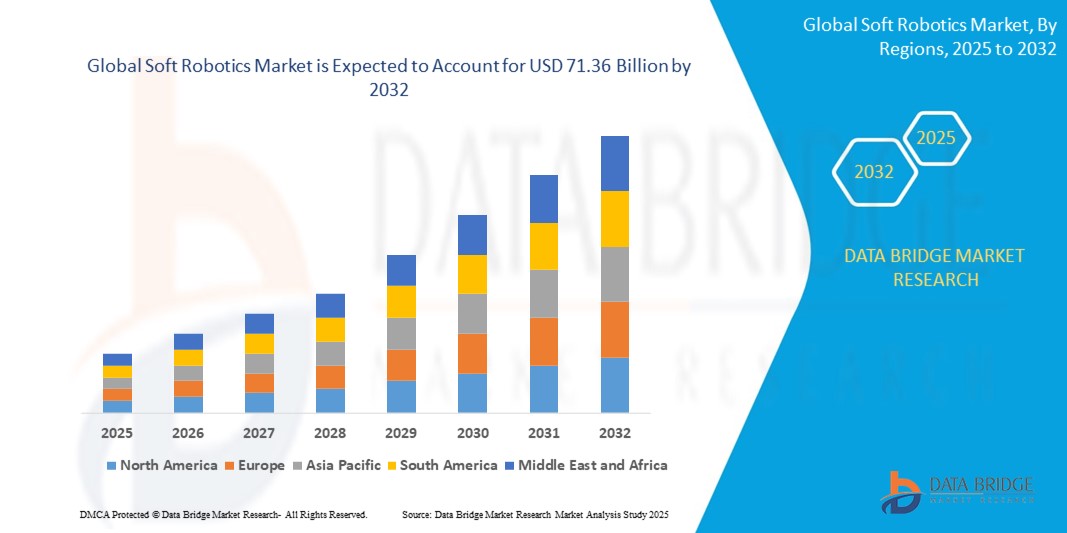
Soft Robotics Market Size
- The global soft robotics market size was valued at USD 4.78 billion in 2024 and is expected to reach USD 71.36 billion by 2032, at a CAGR of 40.20% during the forecast period
- The market growth is primarily driven by advancements in flexible materials, increasing adoption of automation across industries, and the rising demand for safe human-robot collaboration in various applications
- Growing consumer and industrial demand for adaptable, lightweight, and safe robotic solutions is positioning soft robotics as a preferred technology for automation, further accelerating market expansion
Soft Robotics Market Analysis
- Soft robotics, leveraging flexible materials and adaptive designs, are becoming essential in industries requiring safe, versatile, and efficient automation solutions, particularly in medical, food processing, and logistics sectors, due to their ability to handle delicate tasks and interact safely with humans
- The surge in demand for soft robotics is fueled by the growing need for automation in complex environments, advancements in material science, and the push for safer, collaborative robotic systems
- North America dominated the soft robotics market with the largest revenue share of 41.5% in 2024, driven by early adoption of advanced robotics, significant R&D investments, and a strong presence of key industry players, with the U.S. leading in deployments, particularly in healthcare and automotive sectors, supported by innovations from established companies and startups focusing on AI-integrated soft robotics
- Asia-Pacific is expected to be the fastest-growing region during the forecast period due to rapid industrialization, increasing automation in manufacturing, and rising investments in robotics in countries such as China and Japan
- The wearable robots segment dominated the largest market revenue share of 35% in 2024, driven by its extensive adoption in the healthcare and packaging industries for process automation, particularly in rehabilitation and assistive technologies
Report Scope and Soft Robotics Market Segmentation
|
Attributes |
Soft Robotics Key Market Insights |
|
Segments Covered |
|
|
Countries Covered |
North America
Europe
Asia-Pacific
Middle East and Africa
South America
|
|
Key Market Players |
|
|
Market Opportunities |
|
|
Value Added Data Infosets |
In addition to the insights on market scenarios such as market value, growth rate, segmentation, geographical coverage, and major players, the market reports curated by the Data Bridge Market Research also include in-depth expert analysis, geographically represented company-wise production and capacity, network layouts of distributors and partners, detailed and updated price trend analysis and deficit analysis of supply chain and demand. |
Soft Robotics Market Trends
Increasing Integration of AI and Big Data Analytics
- The global soft robotics market is experiencing a transformative trend with the integration of Artificial Intelligence (AI) and Big Data analytics
- These technologies enable advanced data processing, providing deeper insights into robotic performance, environmental adaptability, and operational efficiency
- AI-powered soft robotics solutions facilitate proactive decision-making, allowing robots to adapt to dynamic environments, optimize task performance, and predict maintenance needs to prevent operational downtime
- For instances, companies are developing AI-driven soft robotic systems that analyze real-time sensory data to enhance precision in tasks such as delicate object handling in food processing or personalized rehabilitation in healthcare
- This trend enhances the value proposition of soft robotics, making them increasingly appealing for industries such as healthcare, logistics, and manufacturing
- AI algorithms can process complex datasets, including tactile feedback, motion patterns, and environmental variables, to improve the adaptability and autonomy of soft robots
Soft Robotics Market Dynamics
Driver
Rising Demand for Automation and Safe Human-Robot Interaction
- The growing demand for automation across industries such as healthcare, food and beverages, and logistics is a key driver for the global soft robotics market
- Soft robotics systems enhance safety by enabling safe human-robot interactions through their flexible, compliant materials, making them ideal for collaborative tasks in manufacturing and medical applications
- Government initiatives and funding, particularly in regions such as North America and Asia-Pacific, are promoting the adoption of soft robotics for applications such as minimally invasive surgery and precision agriculture
- The advancement of IoT and 5G technology supports the expansion of soft robotics applications, offering faster data transmission and lower latency for real-time control and monitoring
- Manufacturers are increasingly integrating soft robotics as standard features in industries requiring delicate handling or human augmentation, such as wearable robots for rehabilitation and soft grippers for logistics
Restraint/Challenge
High Development Costs and Data Security Concerns
- The high initial costs associated with the development, materials, and integration of soft robotics systems pose a significant barrier, particularly for small and medium enterprises in emerging markets
- Designing and manufacturing soft robots with advanced materials such as elastomers and flexible actuators can be complex and expensive
- Data security and privacy concerns are a major challenge, as soft robotics systems often rely on real-time data collection and transmission, raising risks of breaches or misuse of sensitive operational and user data
- The varied regulatory frameworks across countries regarding data privacy and robotic standards complicate compliance for global manufacturers and service providers
- These factors may hinder market growth, particularly in regions with high cost sensitivity or stringent data protection regulations
Soft Robotics market Scope
The market is segmented on the basis of type, components, and application.
- By Type
On the basis of type, the global soft robotics market is segmented into soft grippers, co-robots, inflated robots, wearable robots, edible robots, and others. The wearable robots segment dominated the largest market revenue share of 35% in 2024, driven by its extensive adoption in the healthcare and packaging industries for process automation, particularly in rehabilitation and assistive technologies.
The co-robots segment is expected to witness the fastest growth rate from 2025 to 2032, fueled by their ability to safely collaborate with humans in shared workspaces, enhancing productivity and flexibility in manufacturing, logistics, and healthcare. Advancements in AI and sensor technologies are further accelerating their adoption.
- By Components
On the basis of components, the global soft robotics market is segmented into hardware and software. The hardware segment is expected to hold the largest market revenue share of 60% in 2024, driven by the critical role of flexible materials, actuators, and sensors in enabling soft robotic functionalities such as gripping, movement, and adaptability across various applications.
The software segment is anticipated to experience the fastest growth rate from 2025 to 2032, driven by the increasing integration of AI and machine learning for controlling soft robots, optimizing their performance, and enabling real-time adaptability to dynamic environments.
- By Application
On the basis of application, the global soft robotics market is segmented into medical and healthcare, food and beverages, logistics, entertainment and gaming, automotive, survey and exploration, and others. The medical and healthcare segment dominated the market with a revenue share of 30% in 2024, driven by the rising demand for soft robotics in minimally invasive surgeries, rehabilitation devices, and wearable exoskeletons for mobility assistance.
The logistics segment is expected to witness rapid growth from 2025 to 2032, propelled by the increasing adoption of soft grippers for handling delicate and irregularly shaped items in warehouse automation and e-commerce fulfillment, enhancing efficiency and reducing operational costs.
Soft Robotics Market Regional Analysis
- North America dominated the soft robotics market with the largest revenue share of 41.5% in 2024, driven by early adoption of advanced robotics, significant R&D investments, and a strong presence of key industry players, with the U.S. leading in deployments, particularly in healthcare and automotive sectors, supported by innovations from established companies and startups focusing on AI-integrated soft robotics
- Consumers and industries prioritize soft robotics for enhanced safety, adaptability, and precision in applications such as medical, food processing, and logistics, particularly in regions with advanced industrial infrastructure
- Growth is fueled by advancements in soft gripper technology, wearable robotics, and AI-driven software, alongside increasing adoption in both industrial and consumer segments
U.S. Soft Robotics Market Insight
The U.S. smart lock market captured the largest revenue share of 84.8% in 2024 within North America, fueled by strong demand for automation in manufacturing and healthcare, coupled with growing investments in R&D. The trend toward collaborative robots (co-robots) and wearable robotics for rehabilitation further accelerates market expansion. Integration of soft robotics in both OEM and aftermarket applications creates a dynamic ecosystem.
Europe Soft Robotics Market Insight
The European soft robotics market is expected to witness rapid growth, driven by stringent regulations on workplace safety and a focus on sustainable automation. Industries prioritize soft grippers and co-robots for improved human-robot collaboration and operational efficiency. Countries such as Germany and France show significant adoption due to their advanced manufacturing sectors and increasing emphasis on green technologies.
U.K. Soft Robotics Market Insight
The U.K. market for soft robotics is expected to experience a high growth rate, fueled by demand for flexible automation in logistics and entertainment sectors. Increased focus on worker safety and precision in food and beverage applications drives adoption. Evolving regulations promoting safe human-robot interaction further influence market trends, balancing innovation with compliance.
Germany Soft Robotics Market Insight
Germany is expected to witness rapid growth in the soft robotics market, attributed to its leadership in advanced manufacturing and automotive industries. Consumers and businesses favor soft grippers and wearable robots for their adaptability and energy efficiency. Integration of these technologies in premium automation systems and aftermarket solutions supports sustained market growth.
Asia-Pacific Soft Robotics Market Insight
The Asia-Pacific region is expected to witness the fastest growth rate, driven by expanding industrial automation and rising investments in countries such as China, India, and Japan. Increasing awareness of soft robotics’ benefits in medical, food processing, and logistics applications boosts demand. Government initiatives promoting smart manufacturing and energy efficiency further encourage adoption of advanced soft robotics solutions.
Japan Soft Robotics Market Insight
Japan’s soft robotics market is expected to grow rapidly due to strong consumer and industry preference for high-quality, adaptable robotic systems that enhance safety and efficiency. The presence of major technology manufacturers and integration of soft robotics in OEM applications accelerate market penetration. Rising interest in aftermarket customization for entertainment and healthcare also contributes to growth.
China Soft Robotics Market Insight
China holds the largest share of the Asia-Pacific soft robotics market, driven by rapid industrialization, increasing automation in manufacturing, and growing demand for soft grippers and co-robots. The country’s expanding middle class and focus on smart manufacturing support the adoption of advanced soft robotics technologies. Strong domestic production capabilities and competitive pricing enhance market accessibility.
Soft Robotics Market Share
The soft robotics industry is primarily led by well-established companies, including:
- SoftBank Robotics (Japan)
- Panasonic Corporation (Japan)
- Robert Bosch GmbH (Germany)
- iRobot (U.S.)
- KUKA AG (Germany)
- DJI (China)
- OMRON Corporation (Japan)
- Grenzebach Group (Germany)
- Murata Machinery, Ltd. (Japan)
- Smith and Nephew plc (U.K.)
- Fanuc Corporation (Japan)
- Universal Robots (Denmark)
- ABB Ltd. (Switzerland)
- Yaskawa Electric Corporation (Japan)
- Ekso Bionics (U.S.)
What are the Recent Developments in Global Soft Robotics Market?
- In August 2024, Soft Robotics Inc. exited the soft gripper market, selling its mGrip product line—including all configurations, patents, and know-how—to J. Schmalz GmbH, a global leader in vacuum automation. This strategic divestiture enables Schmalz to expand its portfolio in automated food handling. Simultaneously, Soft Robotics launched Oxipital AI, a new venture focused on 3D vision and artificial intelligence for visual inspection, defect detection, and robotic picking—especially in the food industry. Oxipital AI leverages synthetic data and no-code tools to streamline deployment, marking a shift toward scalable, AI-driven automation solutions
- In February 2024, industry reviews emphasized the growing adoption of robotics and automation—including soft robotics—across supply chain operations to meet rising demands for speed and efficiency. Technologies such as soft grippers are increasingly used in warehouses and fulfillment centers to handle delicate items with precision, reducing damage and improving throughput. Robotics and automation are streamlining tasks such as inventory management, order picking, and packaging, while also enhancing safety and reducing labor costs. This integration reflects a broader shift toward intelligent, responsive supply chains capable of adapting to dynamic market needs and operational challenges
- In January 2024, researchers from Germany and China unveiled a miniaturized soft robot featuring a spring-such as, biocompatible structure capable of transforming into a single cell. Designed for precision medicine, this innovation holds promise for targeted drug delivery, microsurgery, and other minimally invasive procedures. The robot’s flexibility and adaptability mark a significant leap in soft robotics for medical applications, enabling safe interaction with delicate biological environments. This development reflects ongoing efforts to merge robotics and biotechnology for next-generation healthcare solutions
- In November 2023, researchers at Princeton University introduced an innovative soft robot named eViper, designed to be lightweight, flexible, and energy-efficient. Unsuch as traditional robots, eViper operates without rotary parts or legs, instead using electrical actuators that generate vibrations to propel it forward. Consuming just one watt of power, this robot showcases a breakthrough in soft robotics, offering enhanced adaptability for diverse environments. Its design emphasizes efficiency and versatility, paving the way for future applications in fields such as surgery, space exploration, and environmental monitoring. This marks a significant step toward developing next-generation robotic systems
- In June 2023, Harvard’s Wyss Institute unveiled an adaptive soft robotic glove aimed at supporting individuals with limited hand mobility. Engineered with soft actuators, the glove gently assists finger movement, enabling users to perform therapeutic exercises and daily tasks more easily. Its lightweight, textile-based design allows for comfortable, at-home rehabilitation, while integrated sensors provide feedback to therapists for personalized treatment. This breakthrough represents a major advancement in soft robotics for assistive and rehabilitative technologies, offering new hope for stroke survivors and patients with neuromuscular conditions

- Interactive Data Analysis Dashboard
- Company Analysis Dashboard for high growth potential opportunities
- Research Analyst Access for customization & queries
- Competitor Analysis with Interactive dashboard
- Latest News, Updates & Trend analysis
- Harness the Power of Benchmark Analysis for Comprehensive Competitor Tracking
Global Soft Robotics Market, Supply Chain Analysis and Ecosystem Framework
To support market growth and help clients navigate the impact of geopolitical shifts, DBMR has integrated in-depth supply chain analysis into its Global Soft Robotics Market research reports. This addition empowers clients to respond effectively to global changes affecting their industries. The supply chain analysis section includes detailed insights such as Global Soft Robotics Market consumption and production by country, price trend analysis, the impact of tariffs and geopolitical developments, and import and export trends by country and HSN code. It also highlights major suppliers with data on production capacity and company profiles, as well as key importers and exporters. In addition to research, DBMR offers specialized supply chain consulting services backed by over a decade of experience, providing solutions like supplier discovery, supplier risk assessment, price trend analysis, impact evaluation of inflation and trade route changes, and comprehensive market trend analysis.
Data collection and base year analysis are done using data collection modules with large sample sizes. The stage includes obtaining market information or related data through various sources and strategies. It includes examining and planning all the data acquired from the past in advance. It likewise envelops the examination of information inconsistencies seen across different information sources. The market data is analysed and estimated using market statistical and coherent models. Also, market share analysis and key trend analysis are the major success factors in the market report. To know more, please request an analyst call or drop down your inquiry.
The key research methodology used by DBMR research team is data triangulation which involves data mining, analysis of the impact of data variables on the market and primary (industry expert) validation. Data models include Vendor Positioning Grid, Market Time Line Analysis, Market Overview and Guide, Company Positioning Grid, Patent Analysis, Pricing Analysis, Company Market Share Analysis, Standards of Measurement, Global versus Regional and Vendor Share Analysis. To know more about the research methodology, drop in an inquiry to speak to our industry experts.
Data Bridge Market Research is a leader in advanced formative research. We take pride in servicing our existing and new customers with data and analysis that match and suits their goal. The report can be customized to include price trend analysis of target brands understanding the market for additional countries (ask for the list of countries), clinical trial results data, literature review, refurbished market and product base analysis. Market analysis of target competitors can be analyzed from technology-based analysis to market portfolio strategies. We can add as many competitors that you require data about in the format and data style you are looking for. Our team of analysts can also provide you data in crude raw excel files pivot tables (Fact book) or can assist you in creating presentations from the data sets available in the report.













