What is the Software Defined Automation (SDA) Market Size and Growth Rate?
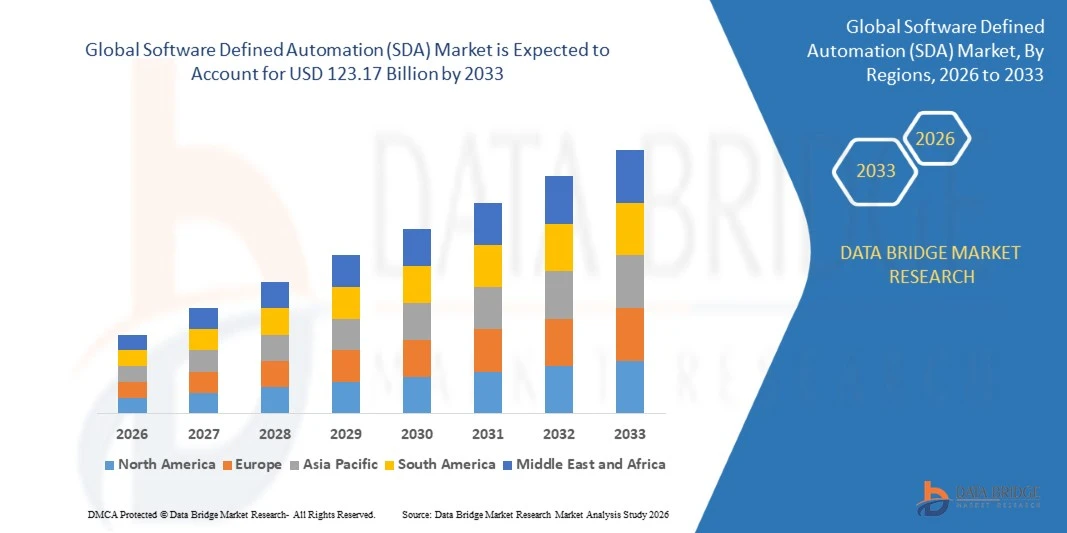
- As per Data Bridge Market Research analysis, the software defined automation (SDA) market was valued at USD 44.10 billion in 2025 and is projected to reach USD 123.17 billion by 2033, growing at a CAGR of 13.70% from 2026 to 2033.
- The market is experiencing consistent growth driven by rising demand for flexible, hardware-independent control architectures, increasing adoption of virtual controllers and containerized applications, and expanding use of industrial AI across automotive, electronics, food and beverage, pharmaceutical, and energy sectors.
- The increasing shift from fixed hardware controllers to software-centric automation, combined with growing integration of control, edge computing, and enterprise IT systems, is supporting market adoption. Software defined automation is being applied across industrial IoT, orchestration, and supervisory control, supported by edge AI hardware and an industrial IoT platform, offering manufacturers faster engineering and easier scaling.
Market Size & Forecast
- Global Market Value (2025): USD 44.10 Billion
- Expected Market Value (2033): USD 123.17 Billion
- Forecast CAGR (2026–2033): 13.70%
- Leading Region in 2025: Europe
- Fastest Growing Region: Asia Pacific
What are the Major Takeaways of the Software Defined Automation (SDA) Market?
- Europe dominated the software defined automation (SDA) market with the largest revenue share of 35.22% in 2025, supported by a strong base of automation vendors, early virtual controller deployments, and advanced automotive and machinery manufacturing.
- Asia-Pacific is expected to be the fastest-growing region at a CAGR of 15.90% from 2026 to 2033, fueled by large-scale factory automation, electronics manufacturing, and government-supported smart manufacturing programs.
- The software segment led the market with a 46.83% share in 2025, driven by growing adoption of engineering, orchestration, and control software that decouples applications from hardware.
- Services are the fastest-growing component, projected to register a CAGR of 16.74%, reflecting rising demand for migration planning, integration, and lifecycle management of virtualized control systems.
- The SCADA/HMI & supervisory software segment dominated the technology category with a 28.36% revenue share in 2025, led by its large installed base and role as the operational layer of automation systems.
- Virtual PLC & soft controllers are the fastest-growing technology type, with a CAGR of 16.80%, driven by demand for hardware-independent, centrally managed, and safety-certified control.
- Automotive accounted for 29.84% of the market share in 2025, preferred for its high automation density and early adoption of virtualized shop-floor control.
Report Scope and Software Defined Automation (SDA) Market Segmentation
|
Attributes |
Software Defined Automation (SDA) Key Market Insights |
|
Segments Covered |
|
|
Countries Covered |
North America
Europe
Asia-Pacific
Middle East and Africa
South America
|
|
Key Market Players |
|
|
Market Opportunities |
|
|
Value Added Data Infosets |
In addition to the market insights such as market value, growth rate, market segments, geographical coverage, market players, and market scenario, the market report curated by the Data Bridge Market Research team includes in-depth expert analysis, import/export analysis, pricing analysis, production consumption analysis, and pestle analysis. |
What is the Key Trend in the Software Defined Automation (SDA) Market?
- Software defined automation is moving from concept to production, with control logic increasingly running as virtual PLCs on industrial PCs and standard server infrastructure while physical inputs, outputs, drives, and motors remain on the shop floor.
- For instance, in March 2025, according to Siemens AG, Audi adopted the Simatic S7-1500V virtual controller for its car body assembly line at the Böllinger Höfe factory, while the Simatic S7-1500V F received TÜV safety certification as the first fail-safe virtual controller, enabling safety-sensitive applications to migrate to software defined environments.
- Virtual controllers are being combined with industrial edge platforms and AI applications, allowing control, vision inspection, and analytics workloads to share the same software infrastructure.
- Hypervisor flexibility and open engineering toolchains are gaining importance, as manufacturers seek to run virtualized control on existing IT infrastructure and avoid dependence on a single hardware platform.
- For instance, in April 2026, according to Siemens AG, Industrial Edge Management 2.0 added support for hypervisors such as OpenShift and Hyper-V, while WinCC Open Architecture became available as an Edge App and for the S7-1500V virtual PLC, enabling decentralized SCADA and control to run on existing IT infrastructure.
- As virtual controller maturity, safety certification, AI integration, and open standards continue to advance, software defined automation is expected to expand from new production lines to brownfield modernization across discrete and process industries.
What are the Key Drivers of the Software Defined Automation (SDA) Market?
- The need for flexible, rapidly reconfigurable production has increased demand for automation architectures in which software can be updated, scaled, and orchestrated independently of the underlying hardware.
- For instance, in April 2025, according to Schneider Electric, the company introduced the EcoStruxure Automation Expert Platform at Hannover Messe 2025, a unified environment providing overview and management of control applications, available immediately to customers of its open, software defined automation system, which is based on the IEC 61499 standard.
- Manufacturers are adopting software defined architectures to shorten engineering cycles, simplify maintenance across plants, and enable data-driven improvements by integrating operational technology with enterprise IT.
- For instance, in January 2025, according to Siemens AG, the company presented at CES 2025 its vision of data, AI, and software defined automation converging to enable greater flexibility, optimization, and continuous improvement across industries, including the integration of Siemens Industrial Copilot with Industrial Edge.
- With industrial companies increasingly deploying AI in production, hardware-independent control platforms that host AI workloads alongside real-time control are becoming a priority for modernization programs.
What Factors Are Challenging the Growth of the Software Defined Automation (SDA) Market?
- Moving real-time control to virtualized environments introduces concerns about determinism, since timing precision, jitter, and deadline compliance must be maintained under varying computing loads.
- For instance, in October 2025, according to the IEEE CAMAD 2025 workshop, researchers at the Karlsruhe Institute of Technology evaluated CODESYS Control and OpenPLC virtual PLCs in Docker and Podman containers on a PREEMPT-RT Linux system, finding that real-time behavior depends on runtime selection and system-level tuning, particularly under increasing computational workloads.
- Converging operational technology with IT infrastructure also expands the cybersecurity attack surface, requiring new security practices, skills, and governance in plants that previously relied on isolated control networks.
- Migration from installed hardware controllers, proprietary engineering tools, and long-lived assets requires careful planning, retraining of automation engineers, and validation, which can slow adoption in brownfield facilities.
- For instance, in February 2025, according to arXiv, researchers reviewing the cybersecurity of OT networks noted that as OT systems integrate with IT systems under Industry 4.0 initiatives, they become more vulnerable to attacks including malware, ransomware, and nation-state threats, highlighting security challenges that can constrain adoption of software defined architectures.
- The combination of real-time performance requirements, cybersecurity concerns, and migration complexity can constrain adoption among risk-averse and cost-sensitive operators, particularly where proven hardware controllers continue to meet production requirements.
How is the Software Defined Automation (SDA) Market Segmented?
The software defined automation (SDA) market is segmented on the basis of component, technology, deployment, and end user.
- By Component
On the basis of component, the software defined automation (SDA) market is segmented into software, hardware, and services. The software segment dominated the market with 46.83% share in 2025, supported by growing adoption of engineering environments, virtual controllers, orchestration tools, and supervisory applications. Software allows control applications to be developed, versioned, and deployed independent of hardware. Integration with industrial AI and data platforms is expanding its role in plant operations. Subscription and licensing models are also supporting recurring revenue across installed bases.
The services segment is projected to register the fastest growth at a CAGR of 16.74% from 2026 to 2033, driven by demand for migration planning, system integration, cybersecurity assessment, training, and lifecycle support. Moving from hardware controllers to virtualized architectures requires new engineering practices and validation. Partnerships between automation vendors and consulting and integration firms are accelerating delivery capacity. Managed services for fleet orchestration and updates are further strengthening this segment.
- By Technology
On the basis of technology, the software defined automation (SDA) market is segmented into SCADA/HMI & supervisory software, virtual PLC & soft controllers, industrial edge & orchestration, digital twin & simulation, and others. The SCADA/HMI & supervisory software segment dominated the category with 28.36% share in 2025, supported by its large installed base and its role as the operational layer for monitoring and control. Decentralized SCADA running on edge infrastructure is improving flexibility. Integration with MES and controller data supports analytics and AI use cases. Demand is further supported by modernization of legacy supervisory systems.
The virtual PLC & soft controllers segment is projected to register the fastest growth at a CAGR of 16.80% from 2026 to 2033, driven by demand for hardware-independent control, centralized management, and safety-certified virtual controllers. Virtual PLCs run on industrial PCs or servers and can be scaled and updated centrally. Adoption by automotive and machinery manufacturers is demonstrating production readiness.
- By Deployment
On the basis of deployment, the software defined automation (SDA) market is segmented into on-premises, hybrid, and cloud. The on-premises segment dominated the market with 51.24% share in 2025, supported by requirements for deterministic real-time control, data security, and operation independent of external networks. Plants typically host virtual controllers on local servers or industrial PCs close to machines. On-premises deployments also align with safety and regulatory requirements in process-critical environments. Standardized IT hardware is helping reduce cost and simplify lifecycle management.
The cloud segment is projected to register the fastest growth at a CAGR of 19.10% from 2026 to 2033, supported by growing use of cloud-based engineering, version control, fleet management, and analytics for automation assets. Cloud control planes allow engineers to manage controllers and applications across multiple sites. Integration with hyperscale platforms and AI services is broadening use cases.
- By End User
On the basis of end user, the software defined automation (SDA) market is segmented into automotive, electronics & semiconductors, food & beverage, pharmaceuticals & life sciences, energy & utilities, and others. The automotive segment dominated the end-user category with 29.84% share in 2025, supported by high automation density, frequent model changeovers, and early adoption of virtualized shop-floor control. Car body assembly and quality inspection lines benefit from centralized management and AI integration. Manufacturers seek flexible production that can be reconfigured through software. Collaboration between carmakers and automation suppliers is accelerating deployments.
The pharmaceuticals & life sciences segment is projected to register the fastest growth at a CAGR of 16.30% from 2026 to 2033, driven by demand for flexible batch production, data integrity, and traceability. Software defined architectures simplify validation, change management, and documentation across sites. Growing adoption of digital twins and AI-based process monitoring is supporting demand.
Which Region Holds the Largest Share of the Software Defined Automation (SDA) Market?
- Europe dominated the software defined automation (SDA) market with the largest revenue share of 35.22% in 2025, supported by the presence of leading automation vendors, strong automotive and machinery manufacturing, and early commercial deployments of virtual controllers.
- The region also benefits from strong engineering expertise, active industry collaboration on open automation standards, and manufacturers’ focus on flexible, energy-efficient production. Increasing adoption of virtual PLCs, industrial edge platforms, and AI-assisted quality inspection, along with growing emphasis on cybersecurity and functional safety, continues to strengthen Europe’s position in the global market.
Germany Software Defined Automation (SDA) Market Insight
The Germany software defined automation (SDA) market is witnessing strong growth due to the country’s leadership in factory automation, concentration of automation vendors, and early adoption of virtualized control in automotive production. Manufacturers are increasingly deploying virtual PLCs, industrial edge platforms, and AI-based inspection to improve flexibility and reduce engineering effort. Strong collaboration between carmakers, automation suppliers, and research institutes, along with Germany’s focus on functional safety, data protection, and Industry 4.0, is driving demand for software defined automation across industrial applications.
Asia-Pacific Software Defined Automation (SDA) Market Insight
The Asia-Pacific software defined automation (SDA) market is expected to witness rapid growth, driven by large-scale factory automation, expanding electronics and automotive production, and government-backed smart manufacturing initiatives across countries such as China, Japan, and India. Growing demand for flexible production, shorter engineering cycles, and AI-enabled quality control is supporting regional expansion. In addition, the region’s strong manufacturing base and increasing investment in industrial software are accelerating adoption of virtual control architectures.
Japan Software Defined Automation (SDA) Market Insight
The Japan software defined automation (SDA) market is witnessing consistent growth due to its advanced machinery and robotics industry, strong domestic automation suppliers, and focus on productivity amid labor shortages. Manufacturers are gradually adopting virtualized control and edge-based applications alongside established programmable controllers. Moreover, strong demand for reliability, long product lifecycles, and backward compatibility with existing factory systems is shaping a measured but steady transition to software defined automation in Japan.
China Software Defined Automation (SDA) Market Insight
The China software defined automation (SDA) market is growing rapidly, driven by large-scale manufacturing, government support for intelligent manufacturing, and expanding domestic automation and industrial software suppliers. Growing use of AI-based process optimization, digital twins, and connected production lines across electronics, automotive, and process industries is boosting demand. In addition, domestic control-system vendors and rapid modernization of factories are positioning China as a key growth market for software defined automation in Asia-Pacific.
U.K. Software Defined Automation (SDA) Market Insight
The U.K. software defined automation (SDA) market is experiencing steady growth, supported by increasing adoption of digital manufacturing, advanced engineering, and process-industry modernization. Manufacturers and utilities are exploring virtualized control, simulation, and supervisory software to improve efficiency and resilience. Furthermore, the presence of leading industrial software providers and growing focus on cybersecurity and net-zero initiatives is supporting wider adoption of software defined automation in the U.K.
U.S. Software Defined Automation (SDA) Market Insight
The U.S. software defined automation (SDA) market is witnessing strong growth due to reshoring of manufacturing, investment in automation, and growing demand for flexible, AI-ready control platforms. Automation vendors, software companies, and system integrators are collaborating to deliver open, software-centric architectures for packaged goods, automotive, semiconductor, and energy applications. The country’s mature technology ecosystem and increasing integration of control with IT and cloud platforms are further driving market growth.
Which are the Top Companies in Software Defined Automation (SDA) Market?
The software defined automation (SDA) industry is primarily led by well-established companies, including:
- Siemens AG (Germany)
- Schneider Electric SE (France)
- Rockwell Automation, Inc. (U.S.)
- ABB Ltd. (Switzerland)
- Beckhoff Automation GmbH & Co. KG (Germany)
- Phoenix Contact GmbH & Co. KG (Germany)
- Bosch Rexroth AG (Germany)
- Honeywell International Inc. (U.S.)
- Emerson Electric Co. (U.S.)
- Mitsubishi Electric Corporation (Japan)
- Omron Corporation (Japan)
- Yokogawa Electric Corporation (Japan)
- CODESYS Group (Germany)
- Red Hat, Inc. (U.S.)
- Intel Corporation (U.S.)
- Advantech Co., Ltd. (Taiwan)
- AVEVA Group Limited (U.K.)
- Hitachi, Ltd. (Japan)
- Microsoft Corporation (U.S.)
- Accenture plc (Ireland)
What are Latest Developments in Software Defined Automation (SDA) Market?
- In May 2025, Schneider Electric announced that it would present its open, software defined automation and related technologies at Automate 2025 in Detroit, including an AI copilot available within its newly launched EcoStruxure Automation Expert Platform, which integrates across hardware and software platforms and provides real-time data access for operators and engineers.
- In March 2025, Siemens and Accenture announced the creation of the Accenture Siemens Business Group, a group of 7,000 professionals worldwide that will develop and market solutions combining Siemens Xcelerator industrial AI, software, and automation technology with Accenture’s data and AI capabilities, supporting industrial transformation and software defined operations.
- In March 2025, at Hannover Messe 2025, Siemens announced that it is accelerating development of an Industrial Foundation Model in collaboration with Microsoft on the Azure platform, trained on industry-specific data, while strengthening collaboration on Siemens Industrial Edge operations with Microsoft’s cloud platform.
- In April 2026, Beckhoff presented at Hannover Messe 2026 how artificial intelligence and classic control technology can be combined into a new system approach, reflecting efforts by PC-based control suppliers to embed AI directly into software-centric automation platforms.
- In May 2026, Rockwell Automation outlined in its fiscal second-quarter earnings report a shift from hardware supplier toward software-led industrial intelligence, planning to embed AI, autonomous robotics, and cloud-native software into core control layers, and cited ATS Automation’s adoption of its Logix platform for a new AI data center in Texas.
- Interactive Data Analysis Dashboard
- Company Analysis Dashboard for high growth potential opportunities
- Research Analyst Access for customization & queries
- Competitor Analysis with Interactive dashboard
- Latest News, Updates & Trend analysis
- Harness the Power of Benchmark Analysis for Comprehensive Competitor Tracking
Data collection and base year analysis are done using data collection modules with large sample sizes. The stage includes obtaining market information or related data through various sources and strategies. It includes examining and planning all the data acquired from the past in advance. It likewise envelops the examination of information inconsistencies seen across different information sources. The market data is analysed and estimated using market statistical and coherent models. Also, market share analysis and key trend analysis are the major success factors in the market report. To know more, please request an analyst call or drop down your inquiry.
The key research methodology used by DBMR research team is data triangulation which involves data mining, analysis of the impact of data variables on the market and primary (industry expert) validation. Data models include Vendor Positioning Grid, Market Time Line Analysis, Market Overview and Guide, Company Positioning Grid, Patent Analysis, Pricing Analysis, Company Market Share Analysis, Standards of Measurement, Global versus Regional and Vendor Share Analysis. To know more about the research methodology, drop in an inquiry to speak to our industry experts.
Data Bridge Market Research is a leader in advanced formative research. We take pride in servicing our existing and new customers with data and analysis that match and suits their goal. The report can be customized to include price trend analysis of target brands understanding the market for additional countries (ask for the list of countries), clinical trial results data, literature review, refurbished market and product base analysis. Market analysis of target competitors can be analyzed from technology-based analysis to market portfolio strategies. We can add as many competitors that you require data about in the format and data style you are looking for. Our team of analysts can also provide you data in crude raw excel files pivot tables (Fact book) or can assist you in creating presentations from the data sets available in the report.