


What is the Global Software Defined Radio Market Size and Growth Rate?
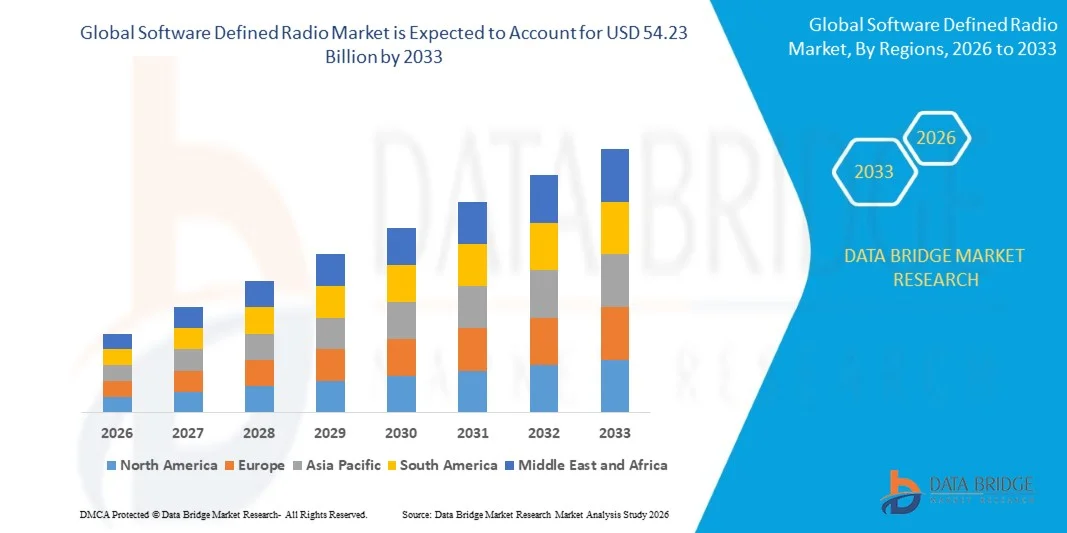
- The global software defined radio market size was valued at USD 32.04 billion in 2025 and is expected to reach USD 54.23 billion by 2033, at a CAGR of 6.80% during the forecast period
- Increasing demand for power-efficient and high-performance electronic devices, rising applications of logic analyzers in Integrated circuits, personal computers and memory devices, growing demand for error detection in digital circuits debugging and complex logic testing, proliferation in the use of internet of things devices, rising demand for technologically advanced logic analyzer, growing adoption of digital logical analyzers with advanced triggering capabilities are some of the major as well as vital factors which will likely to augment the growth of the Software Defined Radio market
What are the Major Takeaways of Software Defined Radio Market?
- Growing demand for tablets and PCs across the developing economies along with rising number of research and development activities which will further contribute by generating massive opportunities that will lead to the growth of the Software Defined Radio market
- Lack of skilled application and system along with design complexities and system interaction problems which will likely to act as market restraints factor for the growth of the Software Defined Radio
- North America dominated the software defined radio market with a 41.87% revenue share in 2025, driven by strong defense modernization programs, advanced communication infrastructure, and early adoption of next-generation wireless technologies across the U.S. and Canada
- Asia-Pacific is projected to register the fastest CAGR of 11.98% from 2026 to 2033, driven by rising defense budgets, cross-border security concerns, and rapid telecom infrastructure development across China, India, Japan, South Korea, and Southeast Asia
- The Field Programmable Gate Arrays (FPGA) segment dominated the market with a 28.6% share in 2025, owing to its high processing flexibility, parallel computing capability, and adaptability to multiple waveforms and frequency bands
Report Scope and Software Defined Radio Market Segmentation
|
Attributes |
Software Defined Radio Key Market Insights |
|
Segments Covered |
|
|
Countries Covered |
North America
Europe
Asia-Pacific
Middle East and Africa
South America
|
|
Key Market Players |
|
|
Market Opportunities |
|
|
Value Added Data Infosets |
In addition to the insights on market scenarios such as market value, growth rate, segmentation, geographical coverage, and major players, the market reports curated by the Data Bridge Market Research also include in-depth expert analysis, pricing analysis, brand share analysis, consumer survey, demography analysis, supply chain analysis, value chain analysis, raw material/consumables overview, vendor selection criteria, PESTLE Analysis, Porter Analysis, and regulatory framework. |
What is the Key Trend in the Software Defined Radio Market?
“Increasing Shift Toward Multi-Band, Compact, and AI-Enabled Software Defined Radios”
- The software defined radio market is witnessing strong adoption of compact, multi-band, and reconfigurable SDR platforms designed to support defense communications, public safety networks, satellite communication, and commercial wireless applications
- Manufacturers are introducing high-frequency, wideband SDR systems with advanced FPGA processing, improved spectrum efficiency, and enhanced interoperability across legacy and modern communication standards
- Growing demand for flexible, software-upgradable, and field-deployable communication systems is accelerating adoption across military modernization programs and next-generation telecom infrastructure
- For instance, companies such as Ettus Research, Thales Group, BAE Systems plc, and Northrop Grumman Corporation have enhanced SDR platforms with multi-band capability, secure waveforms, and real-time spectrum monitoring
- Increasing need for secure, adaptive, and interoperable communication across joint forces and commercial 5G ecosystems is accelerating the transition from hardware-based radios to software-centric architectures
- As wireless networks evolve toward 5G, satellite broadband, and tactical edge communications, SDR technology will remain central to secure, scalable, and future-ready communication systems
What are the Key Drivers of Software Defined Radio Market?
- Rising demand for secure, flexible, and upgradeable communication systems across military, aerospace, and public safety sectors is driving global SDR adoption
- For instance, during 2024–2025, companies such as L3Harris Technologies and Elbit Systems Ltd. expanded their tactical SDR portfolios to support multi-domain operations and encrypted battlefield communications
- Growing deployment of 5G infrastructure, satellite communication networks, and spectrum-efficient broadband services across North America, Europe, and Asia-Pacific is boosting commercial SDR demand
- Advancements in FPGA processing, RF front-end integration, cognitive radio capabilities, and AI-based spectrum management have strengthened performance and adaptability
- Increasing use of unmanned systems, connected battlefield platforms, and mission-critical communication networks is creating demand for high-bandwidth, low-latency SDR platforms
- Supported by sustained defense modernization budgets and telecom infrastructure investments, the Software Defined Radio market is expected to witness steady long-term growth
Which Factor is Challenging the Growth of the Software Defined Radio Market?
- High development and integration costs associated with advanced multi-band and secure SDR platforms limit adoption among smaller agencies and emerging economies
- For instance, during 2024–2025, rising semiconductor costs, supply chain constraints, and export control regulations impacted SDR component availability and pricing
- Complexity in waveform development, spectrum management, and cybersecurity integration requires highly skilled engineers and increases deployment timelines
- Stringent regulatory approvals, spectrum allocation policies, and defense compliance requirements create barriers to rapid commercialization
- Competition from conventional hardware radios in cost-sensitive markets and long product qualification cycles in defense procurement further slow adoption
- To address these challenges, manufacturers are focusing on modular architectures, software upgrades, AI-driven spectrum optimization, and cost-efficient SDR platforms to enhance global market penetration and long-term scalability
How is the Software Defined Radio Market Segmented?
The market is segmented on the basis of component, type, frequency band, application, and platform.
• By Component
On the basis of component, the software defined radio market is segmented into General Purpose Processor, Digital Signal Processor (DSP), Field Programmable Gate Arrays (FPGA), Application-Specific Integrated Circuit (ASIC), Amplifiers, Convertors (Analog-to-Digital and Digital-to-Analog), Software, and Others. The Field Programmable Gate Arrays (FPGA) segment dominated the market with a 28.6% share in 2025, owing to its high processing flexibility, parallel computing capability, and adaptability to multiple waveforms and frequency bands. FPGAs enable real-time signal processing, encryption, and waveform customization, making them ideal for defense and telecom SDR applications.
The Software segment is projected to grow at the fastest CAGR from 2026 to 2033, driven by increasing demand for software-based upgrades, AI-enabled spectrum management, and cloud-integrated radio architectures. Rising emphasis on reconfigurability and remote waveform updates is accelerating software-centric SDR deployments
• By Type
On the basis of type, the software defined radio market is segmented into General Purpose Radio, Joint Tactical Radio System (JTRS), Cognitive/Intelligent Radio, and Terrestrial Trunked Radio (TETRA). The General Purpose Radio segment dominated the market with a 35.4% share in 2025, supported by widespread adoption across commercial communication networks, public safety systems, and enterprise wireless applications. These radios offer multi-band support, interoperability, and cost-effective deployment across diverse use cases.
The Cognitive/Intelligent Radio segment is expected to grow at the fastest CAGR from 2026 to 2033, driven by advancements in AI-driven spectrum sensing, dynamic frequency allocation, and adaptive waveform configuration. Increasing demand for spectrum efficiency and interference mitigation in congested communication environments is fueling segment expansion.
• By Frequency Band
On the basis of frequency band, the software defined radio market is segmented into HF, VHF, UHF, and Other Bands. The VHF segment dominated the market with a 31.8% share in 2025, owing to its extensive use in military ground communications, aviation systems, maritime operations, and public safety networks. VHF frequencies provide reliable mid-range communication and stable signal propagation across varied terrains.
The UHF segment is projected to grow at the fastest CAGR from 2026 to 2033, driven by increasing deployment in tactical communication systems, satellite links, and urban broadband networks. UHF bands support higher data rates, improved penetration in dense environments, and enhanced compatibility with modern defense and commercial communication systems.
• By Application
On the basis of application, the software defined radio market is segmented into Defense and Commercial. The Defense segment dominated the market with a 62.7% share in 2025, supported by military modernization programs, secure communication requirements, and demand for interoperable battlefield communication systems. SDR platforms are extensively used for encrypted voice transmission, data communication, ISR coordination, and multi-domain operations.
The Commercial segment is expected to grow at the fastest CAGR from 2026 to 2033, driven by 5G infrastructure expansion, satellite broadband services, IoT connectivity, and private enterprise networks. Increasing demand for flexible and upgradeable wireless communication solutions is accelerating adoption in telecom and industrial sectors.
• By Platform
On the basis of platform, the software defined radio market is segmented into Airborne, Naval, Land, and Space. The Land segment dominated the market with a 38.9% share in 2025, as ground-based military vehicles, infantry units, and tactical command systems represent the largest deployment base for SDR technologies. Land platforms require secure, rugged, and multi-band communication systems for real-time battlefield coordination.
The Space segment is projected to grow at the fastest CAGR from 2026 to 2033, supported by rising satellite launches, defense space programs, and commercial low-earth orbit (LEO) communication constellations. Increasing demand for flexible payload communication systems and software-upgradable satellite radios is driving rapid expansion in this segment.
Which Region Holds the Largest Share of the Software Defined Radio Market?
- North America dominated the software defined radio market with a 41.87% revenue share in 2025, driven by strong defense modernization programs, advanced communication infrastructure, and early adoption of next-generation wireless technologies across the U.S. and Canada. High investments in secure tactical communication systems, spectrum-efficient radios, and interoperable battlefield networks continue to fuel regional demand
- Leading companies in North America are introducing multi-band, AI-enabled, and encryption-integrated SDR platforms with enhanced waveform flexibility and cybersecurity features, strengthening the region’s technological leadership. Continuous investment in military digitization, satellite communications, and 5G infrastructure supports long-term market expansion
- Strong defense budgets, advanced R&D ecosystems, skilled engineering workforce, and established defense contractors further reinforce North America’s dominant market position
U.S. Software Defined Radio Market Insight
The U.S. is the largest contributor within North America, supported by substantial defense spending, tactical communication upgrades, and rapid deployment of advanced wireless infrastructure. Increasing integration of SDR systems across land, airborne, and naval platforms drives sustained demand. Development of AI-driven spectrum management, secure encrypted communication, and joint-force interoperability programs further accelerates adoption. Presence of major defense contractors, strong innovation capabilities, and continuous military modernization initiatives contribute significantly to national market growth.
Canada Software Defined Radio Market Insight
Canada contributes steadily to regional expansion, supported by defense capability enhancement programs and investments in secure public safety communication networks. Growing focus on interoperability with allied defense systems and modernization of military radio platforms drives demand. Government-backed innovation initiatives and collaboration with global defense suppliers further support SDR deployment across tactical and homeland security applications.
Asia-Pacific Software Defined Radio Market
Asia-Pacific is projected to register the fastest CAGR of 11.98% from 2026 to 2033, driven by rising defense budgets, cross-border security concerns, and rapid telecom infrastructure development across China, India, Japan, South Korea, and Southeast Asia. Expanding satellite communication networks, military digitization programs, and 5G rollouts significantly increase SDR adoption. Growing domestic manufacturing capabilities and technology transfer agreements further strengthen regional production and deployment.
China Software Defined Radio Market Insight
China is a major contributor to Asia-Pacific growth due to significant military modernization programs and expanding domestic communication technology development. Investments in advanced tactical radios, satellite communication, and secure battlefield networks continue to drive market expansion. Strong government support and large-scale manufacturing capacity further enhance adoption.
Japan Software Defined Radio Market Insight
Japan demonstrates steady growth supported by defense upgrades and advanced telecom infrastructure development. Focus on secure communication, disaster response systems, and modernization of Self-Defense Forces equipment supports SDR demand. Emphasis on reliability and technological precision strengthens long-term market stability.
India Software Defined Radio Market Insight
India is emerging as a high-growth market driven by defense modernization, border security requirements, and indigenous defense manufacturing initiatives. Increasing procurement of secure tactical radios and expansion of 5G and satellite networks are accelerating SDR adoption across defense and commercial sectors.
South Korea Software Defined Radio Market Insight
South Korea contributes significantly due to sustained military readiness programs and rapid 5G deployment. Investments in advanced communication systems, indigenous defense production, and export-oriented electronics manufacturing support consistent SDR market growth.
Which are the Top Companies in Software Defined Radio Market?
The software defined radio industry is primarily led by well-established companies, including:
- Harris Corporation (U.S.)
- Flex Radio Systems Inc. (U.S.)
- Data Soft Corporation (U.S.)
- L-3 Communications Holdings Ltd. (U.S.)
- Raytheon Technologies (U.S.)
- Astra Rafael Communication Systems (Israel)
- BAE Systems plc (U.K.)
- Indra Sistemas (Spain)
- Thales Group (France)
- Rockwell Collins (U.S.)
- ITT Corporation (U.S.)
- Elbit Systems Ltd. (Israel)
- Rohde & Schwarz GmbH & Co. KG (Germany)
- SAAB AB (Sweden)
- Northrop Grumman Corporation (U.S.)
What are the Recent Developments in Global Software Defined Radio Market?
- In December 2025, Pacific Defense introduced the SDR4320VP, an ultra-wideband, high-performance Software Defined Radio transceiver compliant with SOSA, CMOSS, and OpenVPX standards, engineered for advanced Electronic Warfare, SIGINT, and radar applications with up to 1 GHz instantaneous bandwidth and rapid software waveform deployment capabilities. This launch strengthens the industry’s transition toward open-architecture, high-bandwidth, and mission-adaptive SDR platforms designed for next-generation defense operations, reinforcing the strategic shift toward modular and interoperable radio ecosystems
- In June 2025, Northrop Grumman Corporation and Hanwha Systems signed a memorandum of understanding to co-develop advanced integrated air defense systems for South Korea, combining Hanwha’s multi-function radar expertise with Northrop Grumman’s Integrated Air and Missile Defense Battle Command System (IBCS). This partnership is expected to accelerate demand for interoperable and secure Software Defined Radio solutions that enable seamless battlefield communication, real-time sensor-to-shooter connectivity, and enhanced network-centric warfare capabilities, strengthening the role of SDRs in integrated defense infrastructures
- In June 2025, Terma launched Terma SPECTRA, a Software Defined Radio TT&C modem developed in collaboration with the European Space Agency (ESA), integrating advanced Electrical Ground Support Equipment (EGSE) and Radio Frequency Special Check-Out Equipment (RF-SCOE) expertise. This development highlights growing adoption of SDR technology in space communication and satellite command systems, reinforcing the expansion of flexible and software-driven communication platforms in the aerospace domain
- In May 2025, L3Harris Technologies, Inc. delivered more than 40,000 tactical radios to Ukrainian forces and implemented rapid software updates based on frontline operational feedback to counter electronic-warfare jamming. This field-driven upgrade cycle underscores the increasing importance of software-upgradable, resilient, and adaptive SDR platforms capable of rapid waveform modification and mission-specific reconfiguration in highly contested combat environments, accelerating global demand for agile SDR solutions

- Interactive Data Analysis Dashboard
- Company Analysis Dashboard for high growth potential opportunities
- Research Analyst Access for customization & queries
- Competitor Analysis with Interactive dashboard
- Latest News, Updates & Trend analysis
- Harness the Power of Benchmark Analysis for Comprehensive Competitor Tracking
Global Software Defined Radio Market, Supply Chain Analysis and Ecosystem Framework
To support market growth and help clients navigate the impact of geopolitical shifts, DBMR has integrated in-depth supply chain analysis into its Global Software Defined Radio Market research reports. This addition empowers clients to respond effectively to global changes affecting their industries. The supply chain analysis section includes detailed insights such as Global Software Defined Radio Market consumption and production by country, price trend analysis, the impact of tariffs and geopolitical developments, and import and export trends by country and HSN code. It also highlights major suppliers with data on production capacity and company profiles, as well as key importers and exporters. In addition to research, DBMR offers specialized supply chain consulting services backed by over a decade of experience, providing solutions like supplier discovery, supplier risk assessment, price trend analysis, impact evaluation of inflation and trade route changes, and comprehensive market trend analysis.
Data collection and base year analysis are done using data collection modules with large sample sizes. The stage includes obtaining market information or related data through various sources and strategies. It includes examining and planning all the data acquired from the past in advance. It likewise envelops the examination of information inconsistencies seen across different information sources. The market data is analysed and estimated using market statistical and coherent models. Also, market share analysis and key trend analysis are the major success factors in the market report. To know more, please request an analyst call or drop down your inquiry.
The key research methodology used by DBMR research team is data triangulation which involves data mining, analysis of the impact of data variables on the market and primary (industry expert) validation. Data models include Vendor Positioning Grid, Market Time Line Analysis, Market Overview and Guide, Company Positioning Grid, Patent Analysis, Pricing Analysis, Company Market Share Analysis, Standards of Measurement, Global versus Regional and Vendor Share Analysis. To know more about the research methodology, drop in an inquiry to speak to our industry experts.
Data Bridge Market Research is a leader in advanced formative research. We take pride in servicing our existing and new customers with data and analysis that match and suits their goal. The report can be customized to include price trend analysis of target brands understanding the market for additional countries (ask for the list of countries), clinical trial results data, literature review, refurbished market and product base analysis. Market analysis of target competitors can be analyzed from technology-based analysis to market portfolio strategies. We can add as many competitors that you require data about in the format and data style you are looking for. Our team of analysts can also provide you data in crude raw excel files pivot tables (Fact book) or can assist you in creating presentations from the data sets available in the report.













