Software Development Artificial Intelligence (AI) Market Overview
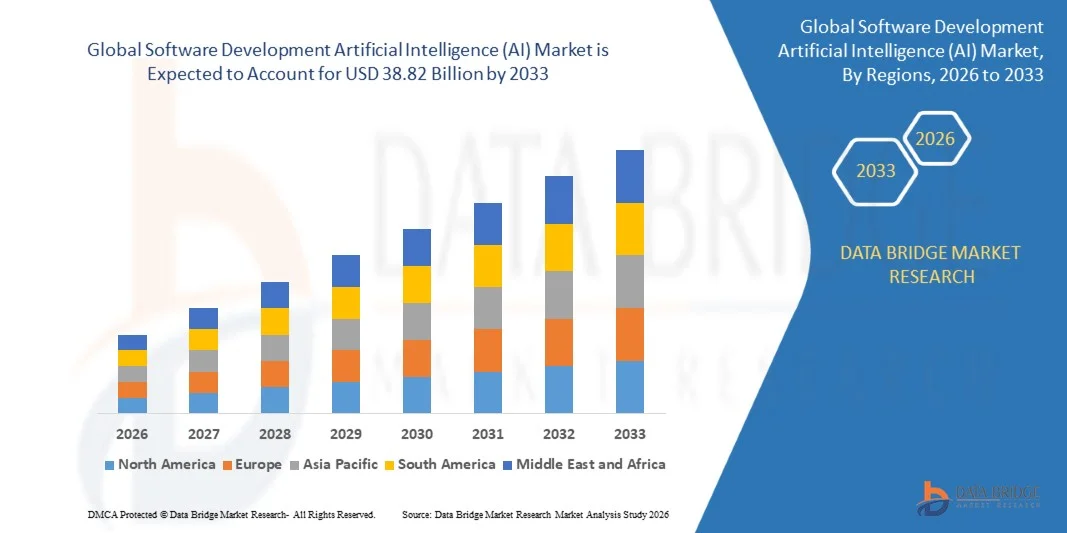
The Software Development Artificial Intelligence (AI) Market was valued at USD 14.0 billion in 2025 and is projected to reach USD 38.82 billion by 2033, growing at a CAGR of 13.60% from 2026 to 2033. The Software Development Artificial Intelligence (AI) Market is experiencing consistent growth driven by increasing demand for intelligent software solutions, rapid advancements in machine learning and generative AI technologies, and expanding applications across software development, enterprise automation, cybersecurity, and digital transformation initiatives.
The growing need for faster software development cycles, improved developer productivity, and automated coding solutions is compelling organizations, software companies, and enterprises to adopt AI-powered development tools. AI-assisted coding platforms, automated testing solutions, and intelligent debugging systems are transforming traditional software development processes by enabling faster code generation, improving software quality, and reducing development costs. The increasing adoption of generative AI, large language models (LLMs), and AI-powered programming assistants is further accelerating market growth across industries as businesses focus on building scalable, secure, and efficient software applications.
Key Market Trends & Insights
- North America dominated the Software Development Artificial Intelligence (AI) Market with the largest revenue share of 35.6% in 2025, supported by the strong presence of AI technology companies, advanced software development ecosystems, high adoption of AI-powered coding platforms, and significant investments in machine learning research and enterprise automation. The region’s dominance is further strengthened by widespread adoption of AI development tools among software companies, technology enterprises, and research institutions across the United States and Canada.
- The knowledge acquisition and analysis segment dominated the market with a share of 44.18% in 2025, driven by increasing need for structured data processing and model training in AI development.
- Asia-Pacific is expected to be the fastest-growing region at a CAGR of 18.9% from 2026 to 2033, fueled by rapid digital transformation, increasing AI investments, expansion of software development hubs, and growing adoption of AI-powered automation across China, India, Japan, South Korea, and Southeast Asian countries. Government initiatives supporting artificial intelligence development and rising demand for intelligent software solutions are further accelerating regional growth.
- Neural Networks are the fastest-growing AI approach segment, projected to register a CAGR from 2026 to 2033, reflecting increasing demand for deep learning, generative AI, predictive analytics, and advanced automation in software development. Neural network-based approaches are being increasingly adopted for code generation, software testing, bug detection, and intelligent programming assistance.
Market Size & Forecast
- Global Market Value (2025): USD 14.0 Billion
- Expected Market Value (2033): USD 38.82 Billion
- Forecast CAGR (2026–2033): 13.60%
- Leading Region in 2025: North America
- Fastest Growing Region: Asia-Pacific
Report Scope and Software Development Artificial Intelligence (AI) Market Segmentation
|
Attributes |
Software Development Artificial Intelligence (AI) Key Market Insights |
|
Segments Covered |
|
|
Countries Covered |
North America · U.S. · Canada · Mexico Europe · Germany · France · U.K. · Netherlands · Switzerland · Belgium · Russia · Italy · Spain · Turkey · Rest of Europe Asia-Pacific · China · Japan · India · South Korea · Singapore · Malaysia · Australia · Thailand · Indonesia · Philippines · Rest of Asia-Pacific Middle East and Africa · Saudi Arabia · U.A.E. · South Africa · Egypt · Israel · Rest of Middle East and Africa South America · Brazil · Argentina · Rest of South America |
|
Key Market Players |
• OpenAI (U.S.) |
|
Market Opportunities |
· Growing Adoption of Generative AI and AI-Powered Coding Assistants · Expansion of AI-Driven Software Development in Enterprise Digital Transformation · Integration of AI with Cloud Computing, Low-Code/No-Code Platforms, and DevOps Solutions |
|
Value Added Data Infosets |
In addition to the insights on market scenarios such as market value, growth rate, segmentation, geographical coverage, and major players, the market reports curated by the Data Bridge Market Research also include in-depth expert analysis, geographically represented company-wise production and capacity, network layouts of distributors and partners, detailed and updated price trend analysis and deficit analysis of supply chain and demand. |
Software Development Artificial Intelligence (AI) Market Trends
Trend: Growth in Generative AI and AI-Assisted Software Development
The Software Development Artificial Intelligence (AI) Market is witnessing rapid adoption of AI-powered coding assistants, automated testing platforms, and intelligent software development tools that improve developer productivity and accelerate application delivery. Software companies are increasingly integrating AI technologies to automate code generation, debugging, documentation, software testing, and workflow optimization. The emergence of generative AI platforms based on large language models (LLMs) is transforming traditional software engineering practices by enabling developers to create, review, and optimize code more efficiently. For instance, tools such as GitHub Copilot and other AI-based developer assistants are being increasingly adopted by enterprises to reduce development time and enhance coding accuracy. The growing demand for faster software releases, digital transformation initiatives, and cloud-based application development is further accelerating AI adoption across software development environments.
Software Development Artificial Intelligence (AI) Market Dynamics
Key Market Driver: Growing Adoption of AI-Powered Coding and Automation Tools
The increasing adoption of AI-driven software development tools is a major growth driver for the Software Development Artificial Intelligence (AI) Market. Organizations across industries are leveraging AI to automate repetitive programming tasks, improve software quality, detect coding errors, and enhance developer efficiency. AI-powered platforms are enabling advanced capabilities such as automated code generation, predictive analytics, intelligent debugging, and software testing optimization. According to industry trends, enterprises are increasing investments in AI development platforms as demand grows for faster application development and improved software delivery cycles. For instance, GitHub reported strong growth in the adoption of GitHub Copilot, with millions of developers using AI-assisted coding capabilities to improve productivity. In addition, increasing enterprise migration toward cloud computing, digital applications, and automation solutions is creating significant demand for AI-enabled software development technologies.
Key Restraint/Challenge: Data Privacy, Security Risks, and High Implementation Complexity
A significant challenge in the Software Development Artificial Intelligence (AI) Market is the complexity associated with implementing AI systems while maintaining data security and regulatory compliance. AI-based software development platforms require access to large volumes of code repositories, development data, and operational information, creating concerns related to intellectual property protection, cybersecurity, and unauthorized data usage. Organizations also face challenges related to integrating AI tools with existing software development workflows, infrastructure limitations, and the requirement for skilled AI professionals. For example, enterprises adopting generative AI-based coding platforms must establish governance frameworks to manage risks related to AI-generated code quality, security vulnerabilities, and compliance requirements. These challenges can limit adoption among small and medium-sized organizations with limited technical resources.
Key Market Opportunity: Integration of Generative AI and Autonomous Software Development Platforms
The integration of generative AI, machine learning, and advanced automation technologies presents a significant opportunity for the Software Development Artificial Intelligence (AI) market. AI-powered platforms are evolving beyond basic coding assistance toward autonomous software development capabilities, including automated application design, code optimization, testing automation, and intelligent project management. The rapid advancement of large language models (LLMs) is enabling developers to create software solutions through natural language interactions, reducing development complexity and improving productivity. For instance, companies are increasingly exploring AI agents capable of performing software engineering tasks such as generating code, identifying bugs, and managing development workflows. Furthermore, the expansion of AI adoption across industries including healthcare, finance, automotive, and enterprise software is creating new opportunities for AI-driven development platforms. The combination of cloud-based AI infrastructure, low-code/no-code platforms, and advanced machine learning technologies is expected to strengthen market growth across developed and emerging economies.
Software Development Artificial Intelligence (AI) Market Scope
The software development artificial intelligence market is segmented on the basis of programming languages, development phases, approaches and application.
- By Programming Language
On the basis of programming language, the Software Development Artificial Intelligence (AI) Market is segmented into Python, R, Lisp, Prolog, Java, and Others. The Python segment dominated the market with a share of 38.62% in 2025, owing to its simplicity, extensive AI/ML libraries, and strong adoption in data science and deep learning applications. Python is widely used in neural network development, natural language processing, and predictive analytics due to frameworks such as TensorFlow, PyTorch, and Scikit-learn. Its strong community support and cross-platform compatibility further strengthen its dominance. Growing enterprise adoption in automation and AI-based software development is also accelerating demand. Python’s flexibility allows integration with big data tools and cloud platforms. Increasing use in autonomous systems and robotics is further boosting its market position. The language’s rapid prototyping capability makes it preferred for AI research and deployment. Rising investment in AI startups globally is reinforcing Python adoption. Educational institutions also prefer Python for AI training programs. Continuous updates and open-source availability ensure long-term dominance. Strong developer ecosystem continues to support scalability across industries.
The R language segment is expected to witness the fastest growth at a CAGR of 7.4% from 2026 to 2033, driven by increasing demand for statistical computing and data visualization in AI applications. R is widely used in academic research, healthcare analytics, and financial modeling. Its strong capability in handling complex datasets makes it suitable for machine learning workflows. Growing adoption in predictive analytics and business intelligence tools is accelerating growth. Integration with AI libraries such as caret and mlr is improving usability. Rising demand for data-driven decision-making across enterprises is supporting adoption. R is increasingly used in combination with Python for hybrid AI models. Expanding use in genomics and bioinformatics is also contributing to growth. Open-source availability enhances accessibility for researchers. Cloud-based analytics platforms are integrating R-based AI models. Increasing enterprise focus on advanced analytics is boosting demand. Strong academic usage ensures continuous innovation in the language.
- By Development Phases
On the basis of development phases, the market is segmented into planning, knowledge acquisition and analysis, and system evaluation. The knowledge acquisition and analysis segment dominated the market with a share of 44.18% in 2025, driven by increasing need for structured data processing and model training in AI development. This phase is critical for collecting high-quality datasets used in machine learning and deep learning models. Enterprises rely heavily on this stage to ensure accurate AI model outputs. Growing adoption of big data platforms is strengthening this segment. Integration of cloud-based data lakes and AI pipelines is improving efficiency. Demand for real-time analytics is further boosting growth. Companies are investing heavily in data labeling and preprocessing tools. Increasing use of automated data extraction systems is reducing manual effort. This phase is essential for improving model accuracy and performance. Expanding enterprise AI projects across industries is reinforcing dominance. Strong demand from BFSI, healthcare, and automotive sectors is driving adoption. Continuous improvements in data engineering tools are supporting growth.
The system evaluation segment is expected to witness the fastest growth at a CAGR of 7.1% from 2026 to 2033, due to rising focus on model validation, testing, and performance optimization. AI systems require continuous evaluation to ensure reliability and accuracy in real-world applications. Growing deployment of autonomous systems is increasing demand for robust evaluation frameworks. Enterprises are adopting automated testing environments for AI models. Integration of simulation-based validation tools is boosting adoption. Increasing regulatory requirements for AI transparency are supporting growth. Demand for bias detection and model fairness evaluation is rising. Cloud-based testing platforms are enhancing scalability. Continuous AI lifecycle management is strengthening this segment. Use of A/B testing in AI model deployment is increasing. Expansion of MLOps practices is further accelerating growth. Industries such as automotive and healthcare are heavily investing in system evaluation tools.
- By Approaches
On the basis of approaches, the Software Development Artificial Intelligence (AI) Market is segmented into Natural Language Processing Techniques, Neural Networks, Fuzzy Logic, Ant Colony Optimization (ACO), General Algorithm, Tabu Search, Bee Colony, Data Mining, and Others. The Neural Networks segment dominated the market with a share of 36.84% in 2025, driven by its strong capability to learn complex patterns from large datasets and its widespread use in deep learning applications. Neural networks are extensively used in computer vision, speech recognition, predictive analytics, and autonomous systems. The growing adoption of deep learning frameworks such as TensorFlow and PyTorch is strengthening segment dominance. Increasing deployment of AI in automotive, healthcare, and financial services is boosting demand. Neural networks support high accuracy in real-time decision-making applications. Rising investments in AI infrastructure are further accelerating adoption. Cloud-based GPU acceleration is enhancing training efficiency. Expanding use in generative AI models is reinforcing growth. Continuous improvements in algorithm architectures are improving scalability. Strong enterprise demand for intelligent automation is supporting expansion. Integration with edge computing devices is increasing deployment flexibility. Overall, neural networks remain the core foundation of modern AI systems.
The Natural Language Processing (NLP) Techniques segment is expected to witness the fastest growth at a CAGR of 7.6% from 2026 to 2033, driven by increasing demand for conversational AI, chatbots, and intelligent virtual assistants. NLP is widely used in customer service automation, sentiment analysis, and document processing. Growing enterprise adoption of generative AI tools is accelerating NLP usage. Expansion of multilingual AI systems is boosting global applicability. Integration with large language models is significantly improving performance. Businesses are increasingly adopting NLP for workflow automation. Rising demand in healthcare documentation and legal tech is strengthening growth. E-commerce platforms are using NLP for recommendation engines and customer interaction. Advancements in transformer-based architectures are enhancing accuracy. Cloud-based AI APIs are making NLP more accessible. Increasing focus on human-machine interaction is driving adoption. Continuous innovation in LLMs is reshaping NLP applications.
- By Application
On the basis of application, the Software Development Artificial Intelligence (AI) Market is segmented into Expert System, Project Management, and Others. The Expert System segment dominated the market with a share of 42.11% in 2025, driven by its widespread use in decision-support systems across industries such as healthcare, BFSI, automotive, and manufacturing. Expert systems replicate human decision-making using rule-based AI models. Organizations use them to improve operational efficiency and reduce decision errors. Increasing adoption in diagnostic systems and risk assessment tools is supporting growth. Integration with machine learning models is improving system intelligence. Rising demand for automated advisory systems is boosting deployment. Enterprises are leveraging expert systems for fraud detection and predictive maintenance. Cloud deployment is enhancing scalability and accessibility. Continuous improvements in knowledge-based systems are strengthening performance. Growing enterprise automation initiatives are accelerating adoption. Strong use in regulatory compliance systems is expanding applications. Overall, expert systems remain a core AI application area.
The Project Management segment is expected to witness the fastest growth at a CAGR of 7.3% from 2026 to 2033, driven by increasing adoption of AI-powered project planning and execution tools. AI is being used to optimize resource allocation, timeline forecasting, and risk management. Growing enterprise digitization is boosting demand for intelligent project management platforms. Integration with predictive analytics is improving project success rates. AI-based scheduling tools are enhancing productivity. Increasing use in IT and construction industries is accelerating adoption. Automation of repetitive project tasks is reducing operational burden. Cloud-based collaboration tools are strengthening scalability. AI-driven dashboards are improving real-time monitoring. Demand for agile project management solutions is rising. Enterprises are focusing on cost reduction and efficiency improvement. Continuous innovation in AI assistants is supporting growth.
Software Development Artificial Intelligence (AI) Market Regional Analysis
North America dominated the Software Development Artificial Intelligence (AI) Market with the largest revenue share of 35.6% in 2025, supported by the strong presence of AI technology companies, advanced software development ecosystems, high adoption of AI-powered coding platforms, and significant investments in machine learning research and enterprise automation. The region benefits from the presence of leading technology companies, cloud service providers, and AI research organizations driving innovation in generative AI, automated software development, and intelligent programming solutions. Widespread adoption of AI development tools among software companies, enterprises, and research institutions across the United States and Canada is further strengthening regional market growth.
U.S. Software Development Artificial Intelligence (AI) Market Insight
The U.S. software development artificial intelligence (AI) market is witnessing strong growth due to increasing investments in generative AI technologies, enterprise automation, and AI-powered software development platforms. The country’s strong technology ecosystem, presence of major AI companies, and high adoption of machine learning and cloud-based development tools are driving demand across industries. Software developers and enterprises are increasingly adopting AI-assisted coding, automated testing, and intelligent debugging solutions to improve productivity, reduce development time, and enhance software quality. Growing investments in AI research and large language model development are further supporting market expansion in the U.S.
Europe Software Development Artificial Intelligence (AI) Market Insight
The Europe software development artificial intelligence (AI) market remains a major contributor to global revenue, driven by increasing digital transformation initiatives, rising adoption of AI development tools, and strong investments in enterprise automation. The region’s focus on responsible AI development, cybersecurity, and advanced software solutions is encouraging organizations to integrate artificial intelligence into software engineering workflows. Growing demand for automated programming, AI-based analytics, and intelligent application development across industries such as finance, healthcare, manufacturing, and automotive is supporting market growth throughout Europe.
U.K. Software Development Artificial Intelligence (AI) Market Insight
The U.K. software development artificial intelligence (AI) market is experiencing steady growth, supported by a strong technology sector, increasing AI investments, and growing adoption of AI-powered software development platforms. The country’s expanding ecosystem of AI startups, research institutions, and software companies is driving innovation in machine learning, natural language processing, and automated development solutions. Increasing use of AI tools for code generation, software testing, and application optimization is further contributing to market growth.
Germany Software Development Artificial Intelligence (AI) Market Insight
The Germany software development artificial intelligence (AI) market is expanding steadily due to the country’s strong industrial base, advanced engineering capabilities, and increasing adoption of AI-driven software solutions. Enterprises across automotive, manufacturing, healthcare, and industrial sectors are integrating AI into software development processes to improve automation, efficiency, and digital transformation. Investments in AI research, industrial automation, and intelligent software platforms are further supporting the growth of the AI software development ecosystem in Germany.
Asia-Pacific Software Development Artificial Intelligence (AI) Market Insight
The Asia-Pacific software development artificial intelligence (AI) market is expected to be the fastest-growing region at a CAGR of 18.9% from 2026 to 2033, fueled by rapid digital transformation, increasing AI investments, expansion of software development hubs, and growing adoption of AI-powered automation across China, India, Japan, South Korea, and Southeast Asian countries. Government initiatives supporting artificial intelligence development, rising technology adoption, and increasing demand for intelligent software solutions are accelerating regional growth. The expansion of cloud computing, enterprise AI applications, and software outsourcing capabilities is further driving market opportunities across the region.
Japan Software Development Artificial Intelligence (AI) Market Insight
The Japan software development artificial intelligence (AI) market is witnessing consistent growth due to rising investments in AI research, automation technologies, and intelligent software development solutions. Japanese technology companies and enterprises are increasingly adopting AI-powered programming tools, machine learning platforms, and automated software systems to improve productivity and address workforce challenges. The country’s focus on robotics, advanced computing, and digital transformation is further supporting the adoption of AI-based software development technologies.
China Software Development Artificial Intelligence (AI) Market Insight
The China software development artificial intelligence (AI) market is growing rapidly, driven by increasing government support for AI innovation, expanding software development capabilities, and rising adoption of intelligent automation solutions. The country’s growing technology ecosystem, investments in large language models, and increasing use of AI-powered software platforms are accelerating market growth. Rising demand for automated coding, enterprise AI applications, and digital transformation solutions across industries is positioning China as one of the fastest-growing markets for Software Development Artificial Intelligence (AI) globally.
Software Development Artificial Intelligence (AI) Market Share
The Software Development Artificial Intelligence (AI) industry is primarily led by well-established companies, including:
- OpenAI (U.S.)
- Microsoft Corporation (U.S.)
- Google LLC (U.S.)
- IBM Corporation (U.S.)
- Amazon Web Services (AWS) (U.S.)
- NVIDIA Corporation (U.S.)
- Meta Platforms, Inc. (U.S.)
- Oracle Corporation (U.S.)
- Salesforce Inc. (U.S.)
- SAP SE (Germany)
- Intel Corporation (U.S.)
- Adobe Inc. (U.S.)
- Accenture plc (Ireland)
- Tata Consultancy Services (TCS) (India)
- Infosys Limited (India)
- Wipro Limited (India)
- Capgemini SE (France)
- Cognizant Technology Solutions (U.S.)
- HCL Technologies Limited (India)
- ServiceNow Inc. (U.S.)
- GitHub (U.S.)
- Hugging Face (U.S.)
- DataRobot Inc. (U.S.)
- UiPath Inc. (U.S.)
- Palantir Technologies Inc. (U.S.)
- C3.ai Inc. (U.S.)
- SAS Institute Inc. (U.S.)
- Dataiku (France)
- Mistral AI (France)
- Anthropic (U.S.)
- DeepMind (United Kingdom)
- Baidu Inc. (China)
- Alibaba Cloud (China)
- Tencent Cloud (China)
- Samsung Electronics (South Korea)
- Fujitsu Limited (Japan)
- NEC Corporation (Japan)
Latest Developments in Software Development Artificial Intelligence (AI) Market
- In June 2021, GitHub (Microsoft) and OpenAI officially announced GitHub Copilot in technical preview, introducing an AI-powered code completion tool integrated into Visual Studio Code. The solution leveraged OpenAI Codex to generate code suggestions based on natural language prompts, marking one of the earliest large-scale commercial applications of generative AI in software development
- In June 2022, GitHub Copilot was launched in general availability for developers worldwide after a successful preview phase. The tool enabled AI-assisted coding across multiple programming languages and became one of the first mainstream AI developer tools widely adopted across software engineering workflows
- In March 2023, Microsoft announced GitHub Copilot X, introducing next-generation AI-powered development capabilities such as chat-based coding assistance, pull request support, and integration with developer workflows. This expanded Copilot beyond code completion into an AI-powered software engineering assistant
- In December 2023, GitHub launched Copilot Chat in general availability, enabling developers to interact with an AI assistant directly within IDEs like Visual Studio Code. The feature allowed natural language-based code explanation, debugging, and generation, significantly enhancing developer productivity
- In May 2024, Microsoft introduced Copilot Studio, allowing enterprises to build and customize AI agents for business and software development workflows. The platform enabled organizations to integrate generative AI into software creation, testing, and automation processes at scale
- In May 2025, GitHub announced a new autonomous coding agent for GitHub Copilot at Microsoft Build 2025, enabling AI systems to independently write code, fix bugs, and create pull requests with minimal human intervention, marking a shift toward agentic software development

- Interactive Data Analysis Dashboard
- Company Analysis Dashboard for high growth potential opportunities
- Research Analyst Access for customization & queries
- Competitor Analysis with Interactive dashboard
- Latest News, Updates & Trend analysis
- Harness the Power of Benchmark Analysis for Comprehensive Competitor Tracking
Data collection and base year analysis are done using data collection modules with large sample sizes. The stage includes obtaining market information or related data through various sources and strategies. It includes examining and planning all the data acquired from the past in advance. It likewise envelops the examination of information inconsistencies seen across different information sources. The market data is analysed and estimated using market statistical and coherent models. Also, market share analysis and key trend analysis are the major success factors in the market report. To know more, please request an analyst call or drop down your inquiry.
The key research methodology used by DBMR research team is data triangulation which involves data mining, analysis of the impact of data variables on the market and primary (industry expert) validation. Data models include Vendor Positioning Grid, Market Time Line Analysis, Market Overview and Guide, Company Positioning Grid, Patent Analysis, Pricing Analysis, Company Market Share Analysis, Standards of Measurement, Global versus Regional and Vendor Share Analysis. To know more about the research methodology, drop in an inquiry to speak to our industry experts.
Data Bridge Market Research is a leader in advanced formative research. We take pride in servicing our existing and new customers with data and analysis that match and suits their goal. The report can be customized to include price trend analysis of target brands understanding the market for additional countries (ask for the list of countries), clinical trial results data, literature review, refurbished market and product base analysis. Market analysis of target competitors can be analyzed from technology-based analysis to market portfolio strategies. We can add as many competitors that you require data about in the format and data style you are looking for. Our team of analysts can also provide you data in crude raw excel files pivot tables (Fact book) or can assist you in creating presentations from the data sets available in the report.