Soil pH Adjusters Market Size
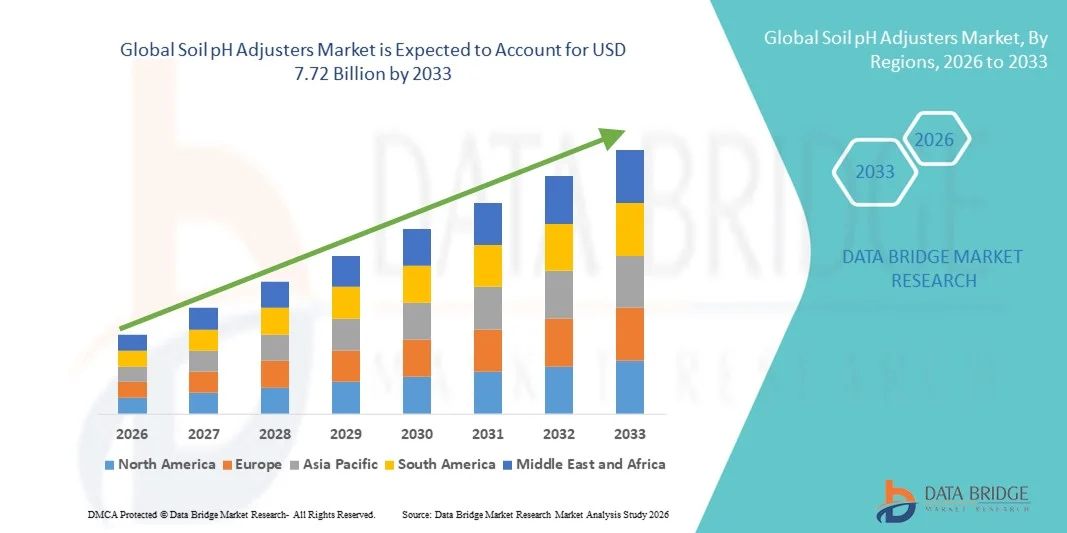
- The global soil pH adjusters market size was valued at USD 4.05 billion in 2025 and is expected to reach USD 7.72 billion by 2033, at a CAGR of 8.40% during the forecast period
- The market growth is largely fueled by the increasing adoption of modern agricultural practices and sustainable soil management techniques, leading to higher demand for effective soil pH balancing solutions in both conventional and organic farming systems
- Furthermore, rising awareness among farmers and agribusinesses regarding soil fertility optimization, nutrient availability, and crop yield improvement is establishing soil pH adjusters as essential inputs for enhancing soil health and long-term productivity. These converging factors are accelerating the adoption of soil pH correction products, thereby significantly boosting the industry's growth
Soil pH Adjusters Market Analysis
- Soil pH adjusters, designed to neutralize acidic or alkaline soils, are increasingly vital components of modern agricultural practices due to their role in improving microbial activity, nutrient uptake, and overall soil structure
- The escalating demand for soil pH adjusters is primarily fueled by the growing focus on precision farming, government initiatives promoting soil health, and increasing adoption of eco-friendly and bio-based soil amendment solutions
- North America dominated the soil pH adjusters market with a share of 39% in 2024, due to advanced agricultural practices, high adoption of precision farming, and the growing focus on sustainable soil management
- Asia-Pacific is expected to be the fastest growing region in the soil pH adjusters market during the forecast period due to expanding agricultural activities, increasing soil acidity in key crop-producing nations, and growing awareness of sustainable soil enhancement
- Weed control segment dominated the market with a market share of 58.8% in 2025, due to its crucial role in maintaining crop productivity and minimizing nutrient competition. Farmers increasingly prefer pH-adjusting weed control agents that improve the effectiveness of herbicides and soil conditioners under varying soil conditions. The widespread use of integrated weed management practices in major agricultural regions further contributes to the steady growth of this segment
Report Scope and Soil pH Adjusters Market Segmentation
|
Attributes |
Soil pH Adjusters Key Market Insights |
|
Segments Covered |
|
|
Countries Covered |
North America
Europe
Asia-Pacific
Middle East and Africa
South America
|
|
Key Market Players |
|
|
Market Opportunities |
|
|
Value Added Data Infosets |
In addition to the insights on market scenarios such as market value, growth rate, segmentation, geographical coverage, and major players, the market reports curated by the Data Bridge Market Research also include import export analysis, production capacity overview, production consumption analysis, price trend analysis, climate change scenario, supply chain analysis, value chain analysis, raw material/consumables overview, vendor selection criteria, PESTLE Analysis, Porter Analysis, and regulatory framework. |
Soil pH Adjusters Market Trends
Increasing Adoption of Precision Agriculture
- The demand for soil pH adjusters is rising significantly with the rapid adoption of precision agriculture practices aimed at improving crop productivity through data-driven decision-making. Farmers are relying on technologies such as GPS mapping, soil sensors, and remote monitoring systems to assess and address soil pH imbalances more accurately, ensuring optimal nutrient availability for specific crops
- For instance, Yara International ASA integrated soil analysis solutions with its precision farming tools to help farmers apply lime and sulfur accurately for targeted soil pH correction. This integration allows improved use efficiency and reduced input costs, while enhancing overall soil health and sustainability outcomes
- Advancements in digital agriculture such as real-time soil sensors and automated applicators are enabling more precise application of pH adjusters. These technologies provide continuous soil pH data and allow for variable rate applications, minimizing wastage of materials such as lime or gypsum and ensuring consistent pH balance across farmlands
- The growing focus on sustainable farming practices is also driving the use of eco-friendly pH adjusters derived from natural sources. Products containing organic acids, calcium carbonate, and agricultural lime are being preferred for their ability to improve soil structure while minimizing environmental impact
- In addition, collaboration between agricultural technology providers and fertilizer producers is promoting innovation in soil treatment solutions. Companies are developing integrated nutrient management systems that combine pH adjustment, soil testing, and fertility control, thereby improving overall field performance under precision agriculture frameworks
- This increasing synergy between pH management and precision farming technologies is transforming agricultural productivity. As farmers seek higher yields with lower environmental footprints, the role of soil pH adjusters within advanced farming ecosystems continues to strengthen globally
Soil pH Adjusters Market Dynamics
Driver
Growing Awareness of Soil Fertility and Crop Yield Improvement
- Increasing awareness among farmers and agronomists about the importance of soil fertility in ensuring sustainable crop yield is driving the market for soil pH adjusters. Balanced soil pH plays a vital role in nutrient availability, microbial activity, and overall plant health, leading to improved productivity and profitability in farming operations
- For instance, The Mosaic Company has expanded educational initiatives in partnership with local agricultural agencies to demonstrate how maintaining optimal soil pH enhances nutrient uptake. Such efforts are encouraging farmers to adopt lime-based and sulfur-based pH adjusting products for improving field efficiency and yield consistency
- Governments and agricultural institutions are promoting programs aimed at improving soil health by encouraging regular testing and corrective use of soil amendments. Awareness campaigns on the benefits of maintaining proper soil pH are being supported by subsidies and technical assistance programs for small and medium-sized farmers
- Increased adoption of cash crops and high-value horticultural produce has further fueled demand for pH management solutions. Farmers cultivating pH-sensitive crops such as sugarcane, coffee, and fruits are investing in soil pH adjustment to optimize nutrient absorption and achieve higher commercial returns
- The expanding knowledge base, coupled with the availability of precision soil testing kits and agronomic advisory platforms, is empowering farmers to make more informed decisions. This growing awareness and accessibility of soil fertility management tools are expected to sustain the growth momentum of the soil pH adjusters market globally
Restraint/Challenge
Variability in Soil pH Across Regions
- The high variability of soil pH across different geographies and climatic zones presents a major challenge to the widespread application of standardized pH adjustment products. Differences in soil composition, organic matter, and rainfall patterns significantly affect soil reaction to acidifying or alkalizing agents, making a single formulation unsuitable for all conditions
- For instance, BASF SE and Nutrien Ltd. have conducted regional soil studies showing that lime requirements vary substantially even within the same country. These variations compel manufacturers to customize formulations or dosing recommendations, increasing product development and distribution complexities
- This heterogeneity in soil types also complicates adoption among small-scale farmers who may lack access to precise soil analysis tools. Without accurate pH testing, there is a risk of over- or under-application of pH adjusters, which can damage crop yields and soil structure over time
- In addition, logistical and cost challenges related to transporting bulky soil amendments such as lime or gypsum to remote agricultural areas hinder consistent usage. This is especially prevalent in developing regions where supply chain infrastructure remains underdeveloped
- Addressing the challenge requires localized product strategies, improved soil testing access, and education on optimal dosing practices. Establishing regional research centers and extension programs focused on site-specific soil pH correction will be essential in mitigating variability challenges and supporting sustainable crop management globally
Soil pH Adjusters Market Scope
The market is segmented on the basis of function, type, and technology.
- By Function
On the basis of function, the Soil pH Adjusters market is segmented into soil protection, other weed control, and soil fertility. The soil fertility segment dominated the market with the largest revenue share in 2025, driven by the growing emphasis on enhancing crop yield and improving soil nutrient balance. Farmers increasingly use pH adjusters to optimize nutrient availability and microbial activity, ensuring better plant growth and productivity. The rise in precision agriculture practices and the use of soil testing to determine pH requirements further strengthen the adoption of pH adjusters for fertility improvement, particularly in high-value crops and horticultural applications.
The soil protection segment is anticipated to witness the fastest growth rate from 2026 to 2033, supported by increasing soil degradation and acidification issues across agricultural lands. Rising awareness regarding sustainable land management and the prevention of nutrient leaching is encouraging the use of pH adjusters that stabilize soil structure. In addition, supportive government initiatives promoting soil health restoration and organic soil protection methods are driving demand for eco-friendly soil pH balancing products in both developed and emerging economies.
- By Type
On the basis of type, the Soil pH Adjusters market is segmented into weed control and pest control. The weed control segment dominated the market in 2025 with the largest revenue share of 58.8%, owing to its crucial role in maintaining crop productivity and minimizing nutrient competition. Farmers increasingly prefer pH-adjusting weed control agents that improve the effectiveness of herbicides and soil conditioners under varying soil conditions. The widespread use of integrated weed management practices in major agricultural regions further contributes to the steady growth of this segment.
The pest control segment is expected to record the fastest growth rate from 2026 to 2033, driven by the growing incidence of soil-borne pests and the need for effective pH balance to suppress pest activity. Advanced formulations that combine pH adjustment with pest deterrence are gaining popularity among farmers aiming to enhance soil resilience. Moreover, the adoption of sustainable pest control solutions that improve soil biodiversity while maintaining chemical balance is propelling segment expansion across developing agricultural markets.
- By Technology
On the basis of technology, the Soil pH Adjusters market is segmented into physiochemical, biological treatment, phytoremediation, and thermal technology. The physiochemical segment dominated the market in 2025 with the largest revenue share, as these methods are highly effective in achieving rapid soil pH correction and nutrient stabilization. The growing use of lime-based and chemical neutralizers for acidic soils supports strong adoption, particularly in intensive agricultural regions. Their compatibility with modern mechanized farming systems and cost efficiency further enhance market penetration.
The biological treatment segment is anticipated to witness the fastest growth from 2026 to 2033, driven by increasing demand for environmentally sustainable and organic soil management solutions. Microbial and enzyme-based pH adjusters are gaining traction due to their ability to improve soil structure, nutrient cycling, and carbon retention. The shift toward organic farming practices and reduced reliance on chemical inputs is accelerating adoption, supported by government policies and consumer preference for sustainable agricultural production systems.
Soil pH Adjusters Market Regional Analysis
- North America dominated the soil pH adjusters market with the largest revenue share of 39% in 2025, driven by advanced agricultural practices, high adoption of precision farming, and the growing focus on sustainable soil management
- The region’s farmers are increasingly investing in pH balancing solutions to improve crop yield and soil fertility. Supportive government programs promoting regenerative agriculture and soil conservation are also contributing to strong market growth
- The demand is further reinforced by the region’s robust agrochemical sector and the adoption of innovative soil amendment technologies across the U.S. and Canada
U.S. Soil pH Adjusters Market Insight
The U.S. Soil pH Adjusters market captured the largest revenue share in 2025 within North America, supported by extensive farmland, growing awareness of soil acidification, and the implementation of precision soil management practices. Farmers are increasingly relying on pH adjusters to optimize nutrient uptake and maintain long-term soil health. The presence of major agrochemical manufacturers and strong R&D initiatives aimed at sustainable soil correction methods continue to drive the market forward. Moreover, the expanding organic farming sector and government incentives for soil restoration strengthen market demand across various crop types.
Europe Soil pH Adjusters Market Insight
The Europe Soil pH Adjusters market is projected to grow at a significant CAGR during the forecast period, attributed to the increasing focus on environmental sustainability and stringent agricultural soil quality regulations. European farmers are emphasizing sustainable soil management to maintain productivity and comply with the European Green Deal’s objectives. The demand for organic and bio-based soil conditioners is rising, particularly in Western Europe. Continuous technological innovation and government support for sustainable agriculture are expected to further propel market expansion.
U.K. Soil pH Adjusters Market Insight
The U.K. Soil pH Adjusters market is anticipated to record robust growth during the forecast period, driven by the adoption of sustainable farming practices and the shift toward organic agriculture. Farmers in the U.K. are prioritizing soil pH balancing to improve crop resilience and nutrient absorption efficiency. The increasing frequency of soil degradation and climate-related challenges is encouraging greater use of advanced soil correction products. Moreover, national programs promoting soil health improvement and carbon reduction are reinforcing market growth.
Germany Soil pH Adjusters Market Insight
The Germany Soil pH Adjusters market is expected to expand steadily, supported by the country’s strong agricultural base and emphasis on soil sustainability. German farmers are increasingly using pH adjustment products to enhance soil structure, promote biological activity, and reduce environmental impacts. The nation’s focus on sustainable agriculture underpinned by technological innovation is boosting demand for high-quality pH correction materials. Moreover, collaborations between research institutions and agri-tech companies are fostering innovation in soil conditioning products.
Asia-Pacific Soil pH Adjusters Market Insight
The Asia-Pacific Soil pH Adjusters market is projected to grow at the fastest CAGR during 2026–2033, driven by expanding agricultural activities, increasing soil acidity in key crop-producing nations, and growing awareness of sustainable soil enhancement. Governments across the region are actively promoting soil health programs to improve productivity and food security. The rising adoption of advanced pH correction technologies and low-cost fertilizers is supporting market penetration in both small- and large-scale farms.
China Soil pH Adjusters Market Insight
The China Soil pH Adjusters market accounted for the largest revenue share in Asia-Pacific in 2025, owing to its extensive agricultural land, rapid soil acidification in key regions, and strong government initiatives promoting sustainable farming. The increasing adoption of lime-based and organic pH balancing agents is enhancing crop yields and supporting national food production goals. In addition, the presence of major local manufacturers and expanding R&D investments are strengthening China’s leadership in the regional market.
India Soil pH Adjusters Market Insight
The India Soil pH Adjusters market is expected to witness the fastest growth rate during the forecast period, fueled by rising awareness among farmers about soil fertility management and the government’s soil health card initiatives. The prevalence of acidic and alkaline soils across major agricultural states is driving the demand for corrective solutions. The increasing adoption of bio-based and cost-effective soil conditioners, combined with ongoing rural development programs, is expected to further boost market growth in the coming years.
Soil pH Adjusters Market Share
The soil pH adjusters industry is primarily led by well-established companies, including:
- BASF SE (Germany)
- ADAMA India Private Limited (India)
- Monsanto Company (U.S.)
- Solvay (Belgium)
- AMVAC Chemical Corporation (U.S.)
- Bayer AG (Germany)
- SA Lime & Gypsum (India)
- Soil Technologies Corp (U.S.)
- SWAROOP AGROCHEMICAL INDUSTRIES (India)
- Rallis India Limited (India)
- OHP, Inc (U.S.)
- Agro Phos India Limited (India)
- Kanseho Soil Treatment SRL/BV (Netherlands)
- Element Solutions (U.S.)
- Sardar Bio Chem (India)
- UPL (India)
- Corteva (U.S.)
- Novozymes (Denmark)
- Syngenta (Switzerland)
Latest Developments in Global Soil pH Adjusters Market
- In November 2025, Omya International AG launched a new business unit focused on specialty materials including advanced soil-conditioning products. This move strengthens their global distribution network, increases the availability of ultrafine mineral-based pH adjusters, and positions the company to capture a larger share of the premium segment. The launch is expected to accelerate adoption of high-efficiency pH management solutions, particularly in regions prioritizing sustainable soil practices and high-value crop production
- In November 2025, Omya introduced its “Top Flow® Ca” liquid limestone solution for soil conditioning and pH correction. This rapid-acting, application-flexible solution allows farmers to adjust soil pH more efficiently compared to traditional methods. Its introduction is expected to drive market preference toward liquid formulations and create opportunities for suppliers to expand into regions with intensive, high-output farming where quick pH correction is critical
- In 2025, AgriTec International expanded the use of its “Pro‑Cal®” bio-activated liquid calcium product, which neutralizes soil acidity faster than traditional ag-lime and enhances nutrient uptake. This development offers a competitive edge by reducing correction time and supporting precision agriculture practices. It also encourages the adoption of liquid calcium amendments, especially in markets where improving crop yield and soil health is a top priority
- In mid-2025, Rovensa Next promoted its “Spray Plus” pH corrector, designed to maintain optimal pH in spray water as well as indirectly benefiting soil health. By bridging soil pH adjustment with crop spray applications, the product expands the market for integrated pH solutions. This innovation is expected to attract growers seeking multi-functional products that improve nutrient efficiency and overall crop performance
- In 2025, Hyz Agro launched “Pachakakka Chips,” a green-lime based organic soil pH regulator tailored for acidic soils in organic farming. This product highlights the growing demand for eco-friendly soil pH solutions and is likely to boost adoption among organic and small-scale farms. It reinforces the trend toward sustainable agriculture and encourages market growth in the environmentally conscious segment

- Interactive Data Analysis Dashboard
- Company Analysis Dashboard for high growth potential opportunities
- Research Analyst Access for customization & queries
- Competitor Analysis with Interactive dashboard
- Latest News, Updates & Trend analysis
- Harness the Power of Benchmark Analysis for Comprehensive Competitor Tracking
Data collection and base year analysis are done using data collection modules with large sample sizes. The stage includes obtaining market information or related data through various sources and strategies. It includes examining and planning all the data acquired from the past in advance. It likewise envelops the examination of information inconsistencies seen across different information sources. The market data is analysed and estimated using market statistical and coherent models. Also, market share analysis and key trend analysis are the major success factors in the market report. To know more, please request an analyst call or drop down your inquiry.
The key research methodology used by DBMR research team is data triangulation which involves data mining, analysis of the impact of data variables on the market and primary (industry expert) validation. Data models include Vendor Positioning Grid, Market Time Line Analysis, Market Overview and Guide, Company Positioning Grid, Patent Analysis, Pricing Analysis, Company Market Share Analysis, Standards of Measurement, Global versus Regional and Vendor Share Analysis. To know more about the research methodology, drop in an inquiry to speak to our industry experts.
Data Bridge Market Research is a leader in advanced formative research. We take pride in servicing our existing and new customers with data and analysis that match and suits their goal. The report can be customized to include price trend analysis of target brands understanding the market for additional countries (ask for the list of countries), clinical trial results data, literature review, refurbished market and product base analysis. Market analysis of target competitors can be analyzed from technology-based analysis to market portfolio strategies. We can add as many competitors that you require data about in the format and data style you are looking for. Our team of analysts can also provide you data in crude raw excel files pivot tables (Fact book) or can assist you in creating presentations from the data sets available in the report.