What is the Soil Wetting Agents Market Size and Growth Rate?
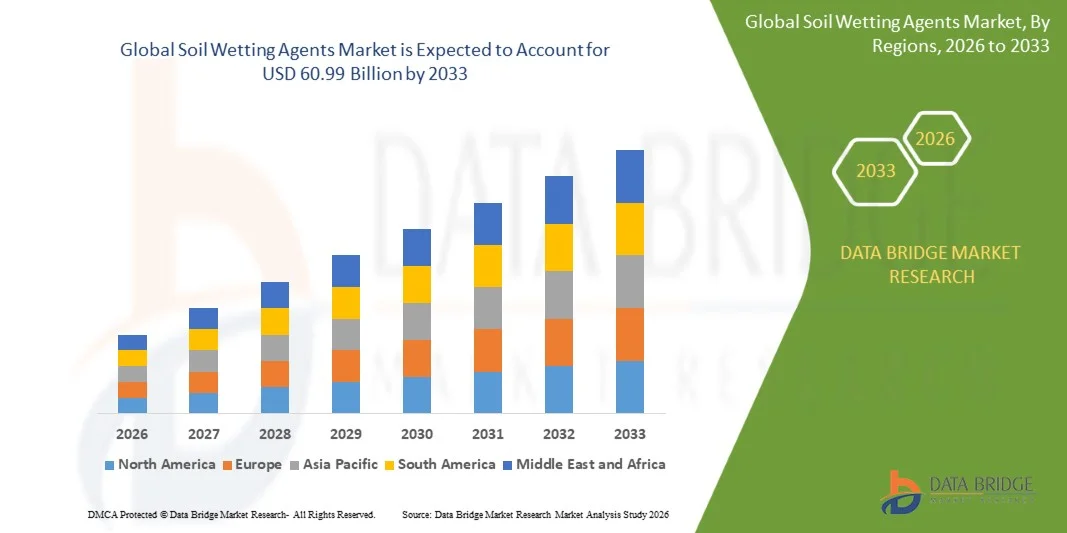
- As per Data Bridge Market Research analysis, the soil wetting agents market was valued at USD 36.85 billion in 2025 and is projected to reach USD 60.99 billion by 2033, growing at a CAGR of 6.50% from 2026 to 2033.
- The market is experiencing steady growth driven by increasing concerns over water scarcity, rising adoption of precision agriculture, and growing demand for improved soil moisture management. Farmers are increasingly using soil wetting agents to enhance water infiltration, reduce water repellency, and improve irrigation efficiency across agricultural fields and turf care applications.
- Growing investments in sustainable farming practices, expanding use of high-value crops, and increasing awareness of water conservation are further supporting market expansion. In addition, advancements in biodegradable wetting agent formulations and the integration of soil conditioning technologies are expected to accelerate adoption and improve crop productivity during the forecast period.
Market Size & Forecast
- Market Value (2025): USD 36.85 Billion
- Expected Market Value (2033): USD 60.99 Billion
- Forecast CAGR (2026–2033): 6.50%
- Leading Region in 2025: North America
- Fastest Growing Region: Asia-Pacific
What are the Major Takeaways of the Soil Wetting Agents Market?
- North America dominated the soil wetting agents market with the largest revenue share of approximately 40.5% in 2025, supported by the widespread adoption of precision agriculture, advanced irrigation infrastructure, increasing awareness of water conservation, and strong demand for efficient soil moisture management across the U.S. and Canada.
- Asia-Pacific soil wetting agents market is expected to witness the fastest growth during the forecast period from 2026 to 2033, primarily driven by the increasing adoption of precision agriculture, growing concerns over water scarcity, and rising demand for efficient irrigation practices. The region is witnessing greater use of soil wetting agents to improve water infiltration, reduce soil water repellency, and enhance crop productivity across agricultural fields, horticulture, and turf care applications.
- The agriculture segment held the largest market revenue share in 2025, driven by its widespread adoption for improving water infiltration, enhancing irrigation efficiency, reducing soil water repellency, and increasing crop productivity across field crops, cereals, oilseeds, and other commercial agricultural operations.
- The horticulture segment is expected to witness the fastest growth during the forecast period from 2026 to 2033, driven by increasing cultivation of high-value fruits, vegetables, ornamentals, and greenhouse crops, along with growing demand for efficient water management solutions and improved soil moisture retention to enhance crop quality and yield.
- The non-ionic surfactants segment held the largest market revenue share in 2025, driven by their excellent compatibility with a wide range of agricultural chemicals, superior wetting and spreading properties, low phytotoxicity, and widespread use across agricultural, horticultural, and turf care applications.
- The liquid segment is expected to witness the fastest growth during the forecast period from 2026 to 2033, driven by its compatibility with modern irrigation systems and spray equipment, rapid soil penetration, uniform distribution, and increasing adoption in precision agriculture and high-value horticultural crop production.
Report Scope and Soil Wetting Agents Market Segmentation
|
Attributes |
Soil Wetting Agents Key Market Insights |
|
Segments Covered |
|
|
Countries Covered |
North America
Europe
Asia-Pacific
Middle East and Africa
South America
|
|
Key Market Players |
|
|
Market Opportunities |
|
|
Value Added Data Infosets |
In addition to the insights on market scenarios such as market value, growth rate, segmentation, geographical coverage, and major players, the market reports curated by the Data Bridge Market Research also include import export analysis, production capacity overview, production consumption analysis, price trend analysis, climate change scenario, supply chain analysis, value chain analysis, raw material/consumables overview, vendor selection criteria, PESTLE Analysis, Porter Analysis, and regulatory framework. |
What is the Key Trend in the Soil Wetting Agents Market?
- As water scarcity, soil hydrophobicity, and rising irrigation costs continue to pressure turf managers and growers, wetting agent manufacturers are shifting away from conventional synthetic surfactants toward biodegradable, environmentally responsible formulations that reduce chemical input use while improving water efficiency.
- The key trend shaping the market is the development of patented, biodegradable surfactant technologies designed to simultaneously reduce soil water repellence, cut irrigation input volumes, and improve compatibility with biological crop-protection products. This reflects a broader shift where wetting agents are positioned not just as water-penetration aids but as multi-functional tools that also enhance the performance of biologicals, fertilizers, and nutrients applied alongside them.
- For Instance, in July 2024, Bionema Group, a Swansea-based biocontrol technology developer and recipient of the King's Award for Innovation, launched Soil-Jet BSP100, a biodegradable surfactant built on patented Polyether-Modified Polysiloxane technology, designed for the sports and turf industry. Field trials across golf courses, racecourses, football pitches, cricket pitches, and landscapes in the UK, Ireland, Canada, India, and Latin American countries demonstrated a 20-30% increase in nutrient uptake, with the company stating the recommended application rate of 1 to 2 liters per hectare is ten times lower than market alternatives, reducing turf professionals' costs by 50%. Dr. Minshad Ansari, CEO and founder of Bionema, called the product a game-changer for sports and turf management that optimizes water and nutrient utilization while fostering robust turf growth.
- As turf managers and growers continue to prioritize cost efficiency, water conservation, and compatibility with biological inputs, biodegradable, multi-functional wetting agent technologies are expected to remain a defining trend shaping innovation and product development across the global soil wetting agents market.
What are the Key Drivers of the Soil Wetting Agents Market?
- Escalating water restrictions and drought-driven conservation mandates across water-scarce regions are pushing golf courses and turf managers to adopt best management practices that reduce irrigation volumes without compromising playing surface quality, directly increasing reliance on soil wetting agents as a core water-efficiency tool.
- A key driver of the soil wetting agents’ market is regulatory and utility-driven water budget restrictions on golf courses and turf facilities, which are forcing superintendents to adopt wetting agents alongside hand-watering and drier turf management as standard best management practices to meet mandated usage caps. This regulatory pressure is translating into measurable, sustained reductions in irrigation water use, reinforcing wetting agents as an essential rather than optional input for turf water management.
- For Instance, in December 2025, by the Golf Course Superintendents Association of America (GCSAA), funded in part by the United States Golf Association through the GCSAA Foundation's Golf Course Environmental Profile program, U.S. golf courses used 31% less water in 2024 compared to 2005, applying a projected 1.63 million acre-feet of water in 2024, a 3.2% reduction since 2020 alone. The survey, based on data from nearly 1,700 golf facilities, found that golf course superintendents have increasingly adopted best management practices since 2005, with wetting agents, hand-watering, and maintaining turf under drier conditions cited as the most common water management practices driving these reductions, particularly in the Southwest region, which reported a 16.9% reduction from 2020 to 2024.
- As water utilities and regulators continue tightening irrigation budgets for golf courses and turf facilities in drought-prone regions, sustained adoption of wetting agents as a core water-conservation practice is expected to remain a key driver of growth in the global soil wetting agents’ market.
Which Factors are Challenging the Soil Wetting Agents Market?
- Despite widespread adoption across golf courses and turf facilities, the soil wetting agents category continues to grapple with unresolved scientific debate over whether marketed product categories, such as "penetrants" versus "retainers," actually perform differently in practice, complicating purchasing decisions for turf managers.
- The central challenge weighing on the market is that despite manufacturers marketing distinct product categories with different functional claims, independent university research has struggled to find clear, consistent performance differences between them, undermining the basis on which turf managers are asked to choose and pay premiums for specific formulations.
- For Instance, in July 2025, a study led by researchers formerly at the University of Arkansas, now including Doug Karcher at The Ohio State University and Daniel O'Brien at the United States Golf Association, examined wetting agent products marketed as "penetrants" and "retainers," research that began in 2017 and was supported by the Golf Course Superintendents Association of America. The study, titled "Wetting Agent Wars? Science Says There's No Winner," found no clear performance winner between the marketed product categories, raising questions about how meaningfully these commercial classifications reflect real-world differences in turf and soil outcomes.
- Until independent research can clearly validate the functional distinctions manufacturers use to market and price different wetting agent categories, this scientific ambiguity is expected to remain a key challenge complicating purchasing decisions and slowing differentiated product adoption across the global soil wetting agents market.
How is the Soil Wetting Agents Market Segmented?
The soil wetting agents market is segmented on the basis of form, application, and end use products.
- By Application
On the basis of application, the soil wetting agents market is segmented into agriculture, horticulture, landscaping, turf care, and erosion control. The agriculture segment held the largest market revenue share in 2025, driven by its widespread adoption for improving water infiltration, enhancing irrigation efficiency, reducing soil water repellency, and increasing crop productivity across field crops, cereals, oilseeds, and other commercial agricultural operations.
The horticulture segment is expected to witness the fastest growth during the forecast period from 2026 to 2033, driven by increasing cultivation of high-value fruits, vegetables, ornamentals, and greenhouse crops, along with growing demand for efficient water management solutions and improved soil moisture retention to enhance crop quality and yield.
- By Chemical Type
On the basis of chemical type, the soil wetting agents market is segmented into non-ionic surfactants, anionic surfactants, cationic surfactants, and polymeric surfactants. The non-ionic surfactants segment held the largest market revenue share in 2025, driven by their excellent compatibility with a wide range of agricultural chemicals, superior wetting and spreading properties, low phytotoxicity, and widespread use across agricultural, horticultural, and turf care applications.
The anionic surfactants segment is expected to witness the fastest growth during the forecast period from 2026 to 2033, driven by increasing demand for cost-effective soil wetting solutions, improving dispersion and penetration capabilities, and growing adoption in crop protection formulations and commercial farming applications.
- By Formulation
On the basis of formulation, the soil wetting agents market is segmented into granules, liquid, powder, and emulsifiable concentrate. The granules segment held the largest market revenue share in 2025, driven by their ease of application, extended residual activity, controlled-release characteristics, and widespread adoption in commercial farming, turf management, and landscaping applications requiring long-lasting soil moisture management.
The liquid segment is expected to witness the fastest growth during the forecast period from 2026 to 2033, driven by its compatibility with modern irrigation systems and spray equipment, rapid soil penetration, uniform distribution, and increasing adoption in precision agriculture and high-value horticultural crop production.
- By End Use
On the basis of end use, the soil wetting agents market is segmented into commercial farming, residential gardening, sports facilities, and golf courses. The commercial farming segment held the largest market revenue share in 2025, driven by the widespread adoption of soil wetting agents to improve irrigation efficiency, enhance soil moisture distribution, optimize nutrient uptake, and increase crop productivity across large-scale agricultural operations.
The residential gardening segment is expected to witness the fastest growth during the forecast period from 2026 to 2033, driven by increasing consumer interest in home gardening, rising awareness of water conservation, growing demand for sustainable lawn and garden care solutions, and the expanding availability of easy-to-use soil wetting products through retail and online distribution channels.
Which Region Holds the Largest Share of the Soil Wetting Agents Market?
- North America dominated the soil wetting agents market with the largest revenue share of approximately 40.5% in 2025, supported by the widespread adoption of precision agriculture, advanced irrigation infrastructure, increasing awareness of water conservation, and strong demand for efficient soil moisture management across the U.S. and Canada.
- The region also benefits from the presence of well-established agricultural input manufacturers, extensive commercial farming operations, growing cultivation of high-value crops, and increasing investments in sustainable farming practices. Rising adoption of advanced soil conditioning technologies and government initiatives promoting efficient water use continue to strengthen North America's leading position in the global market.
U.S. Soil Wetting Agents Market Insight
The U.S. soil dominated the soil wetting agents market with the largest revenue share in 2025 due to the increasing adoption of precision agriculture, rising focus on water conservation, and growing demand for improved irrigation efficiency. Farmers are increasingly utilizing soil wetting agents to enhance water infiltration, reduce soil water repellency, and improve nutrient uptake across field crops, specialty crops, and turf management applications. In addition, supportive government initiatives promoting sustainable agriculture and advancements in irrigation technologies are further driving market expansion.
Asia-Pacific Soil Wetting Agents Market Insight
The Asia-Pacific soil wetting agents market is expected to witness the fastest growth during the forecast period from 2026 to 2033, primarily driven by the increasing adoption of precision agriculture, growing concerns over water scarcity, and rising demand for efficient irrigation practices. The region is witnessing greater use of soil wetting agents to improve water infiltration, reduce soil water repellency, and enhance crop productivity across agricultural fields, horticulture, and turf care applications.
In addition, increasing investments in sustainable farming technologies, expanding cultivation of high-value crops, and growing awareness of soil health management are supporting market growth. The implementation of government initiatives promoting water conservation, ongoing advancements in soil conditioning technologies, and increasing adoption of modern agricultural inputs are expected to further strengthen Asia-Pacific's position as the fastest-growing regional market during the forecast period.
Japan Soil Wetting Agents Market Insight
The Japan soil wetting agents market is expected to witness the fastest growth during the forecast period from 2026 to 2033 due to the increasing adoption of precision agriculture, growing emphasis on water conservation, and rising demand for efficient soil moisture management. Farmers are increasingly using soil wetting agents to improve water infiltration, enhance irrigation efficiency, and optimize nutrient uptake, particularly in high-value horticultural crops and turf care applications. Furthermore, government initiatives promoting sustainable agricultural practices and the adoption of advanced irrigation technologies are supporting continued market expansion.
China Soil Wetting Agents Market Insight
The China soil wetting agents market is expected to witness the fastest growth during the forecast period from 2026 to 2033, driven by its large agricultural sector, increasing concerns over water scarcity, and rising adoption of modern farming practices. Growing investments in precision irrigation, expanding cultivation of high-value crops, and increasing awareness of soil health management are accelerating the demand for soil wetting agents across the country. In addition, supportive government policies encouraging efficient water use, sustainable agriculture, and improved crop productivity are positioning China as one of the fastest-growing markets for soil wetting agents globally.
Europe Soil Wetting Agents Market Insight
The Europe soil wetting agents market is expected to witness the fastest growth during the forecast period from 2026 to 2033, driven by stringent environmental regulations, increasing emphasis on sustainable farming practices, and growing adoption of water-efficient agricultural technologies. The region is witnessing rising demand for soil moisture management solutions to improve crop productivity while optimizing water use. Furthermore, increasing investments in precision agriculture and growing awareness of soil health continue to support market growth across several European countries.
Germany Soil Wetting Agents Market Insight
The Germany soil wetting agents market is expected to witness the fastest growth during the forecast period from 2026 to 2033 due to the country's strong focus on sustainable agriculture, efficient water management, and advanced farming technologies. Increasing adoption of precision irrigation systems, growing cultivation of high-value crops, and rising awareness of improving soil health are contributing significantly to market growth. In addition, ongoing research and innovation in agricultural inputs are supporting the development and adoption of advanced soil wetting agent formulations.
U.K. Soil Wetting Agents Market Insight
The U.K. soil wetting agents market is expected to witness the fastest growth during the forecast period from 2026 to 2033 owing to increasing emphasis on sustainable land management, efficient irrigation practices, and water conservation in agriculture and turf care. Rising adoption of precision farming techniques, growing maintenance of golf courses and sports fields, and increasing awareness of improving soil moisture retention are supporting continued market expansion. Moreover, favorable environmental initiatives and the growing use of advanced soil conditioning products are further driving demand across the country.
Which are the Top Companies in Soil Wetting Agents Market?
The soil wetting agents industry is primarily led by well-established companies, including:
- BASF SE (Germany)
- Evonik Industries AG (Germany)
- Croda International Plc (U.K.)
- Nufarm (Australia)
- Aquatrols Corporation of America (U.S.)
- The Andersons, Inc. (U.S.)
- Precision Laboratories, LLC (U.S.)
- Loveland Products, Inc. (U.S.)
- Brandt Consolidated, Inc. (U.S.)
- Amvac Chemical Corporation (U.S.)
- Wilbur-Ellis Company LLC (U.S.)
- Huntsman Corporation (U.S.)
- Clariant AG (Switzerland)
- Solvay SA (Belgium)
- Lamberti S.p.A. (Italy)
What are Latest Developments in Biochar for Soil Wetting Agents Market?
- In August 2025, Harrell’s LLC, a leading manufacturer and supplier of agricultural and turf care products, launched SurfaceRx, an advanced soil wetting agent developed to improve water infiltration and moisture distribution under drought and water-stressed conditions. The product incorporates innovative osmoprotectant technology that supports the natural production of osmolytes, helping plants maintain hydration during periods of environmental stress. SurfaceRx is designed to reduce soil water repellency, enhance root-zone moisture retention, improve nutrient uptake efficiency, and promote healthier turf and crop growth.
- In July 2024, Bionema Group Limited, a global biocontrol and specialty solutions company, introduced Soil-Jet BSP100, a biodegradable soil wetting surfactant specifically developed for sports turf, golf courses, and landscape management applications. The bio-based formulation enhances water penetration, improves soil moisture retention, and significantly reduces hydrophobic soil conditions, enabling more uniform water distribution and improved nutrient availability.

- Interactive Data Analysis Dashboard
- Company Analysis Dashboard for high growth potential opportunities
- Research Analyst Access for customization & queries
- Competitor Analysis with Interactive dashboard
- Latest News, Updates & Trend analysis
- Harness the Power of Benchmark Analysis for Comprehensive Competitor Tracking
Data collection and base year analysis are done using data collection modules with large sample sizes. The stage includes obtaining market information or related data through various sources and strategies. It includes examining and planning all the data acquired from the past in advance. It likewise envelops the examination of information inconsistencies seen across different information sources. The market data is analysed and estimated using market statistical and coherent models. Also, market share analysis and key trend analysis are the major success factors in the market report. To know more, please request an analyst call or drop down your inquiry.
The key research methodology used by DBMR research team is data triangulation which involves data mining, analysis of the impact of data variables on the market and primary (industry expert) validation. Data models include Vendor Positioning Grid, Market Time Line Analysis, Market Overview and Guide, Company Positioning Grid, Patent Analysis, Pricing Analysis, Company Market Share Analysis, Standards of Measurement, Global versus Regional and Vendor Share Analysis. To know more about the research methodology, drop in an inquiry to speak to our industry experts.
Data Bridge Market Research is a leader in advanced formative research. We take pride in servicing our existing and new customers with data and analysis that match and suits their goal. The report can be customized to include price trend analysis of target brands understanding the market for additional countries (ask for the list of countries), clinical trial results data, literature review, refurbished market and product base analysis. Market analysis of target competitors can be analyzed from technology-based analysis to market portfolio strategies. We can add as many competitors that you require data about in the format and data style you are looking for. Our team of analysts can also provide you data in crude raw excel files pivot tables (Fact book) or can assist you in creating presentations from the data sets available in the report.