


Solar Charge Controller Market Size
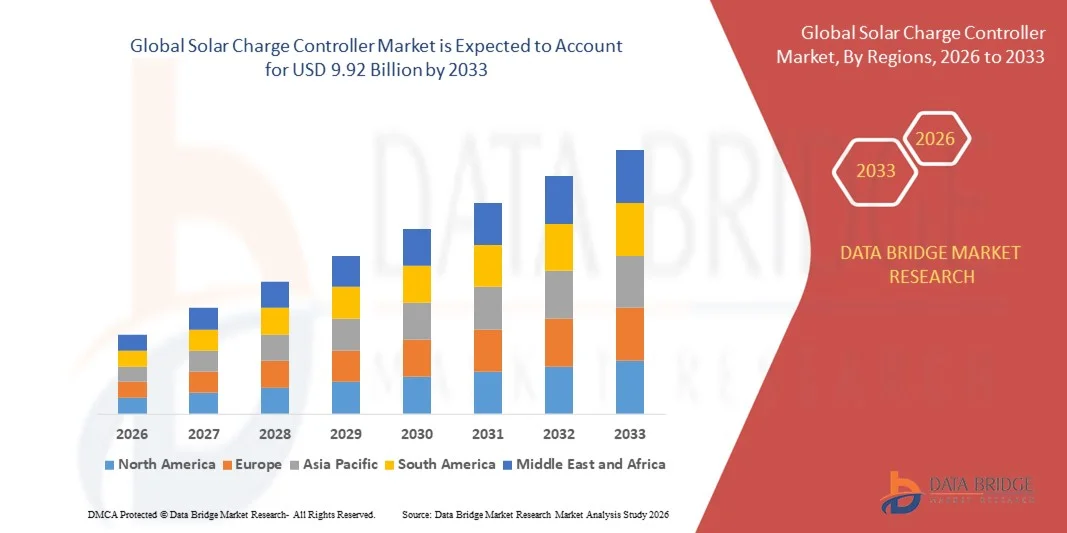
- The global solar charge controller market size was valued at USD 3.19 billion in 2025 and is expected to reach USD 9.92 billion by 2033, at a CAGR of 15.20% during the forecast period
- The market growth is largely fuelled by the increasing adoption of solar energy systems, rising demand for off-grid and hybrid solar installations, and the growing emphasis on renewable energy for sustainable power generation
- The surge in government incentives, subsidies, and supportive policies for solar energy deployment is further boosting market expansion
Solar Charge Controller Market Analysis
- Rising global focus on energy efficiency, decarbonization, and reliable electricity supply is propelling the demand for solar charge controllers
- Increasing electrification in remote and rural areas, coupled with declining solar panel costs, is expanding the market opportunities for advanced charge control solutions
- North America dominated the solar charge controller market with the largest revenue share in 2025, driven by increasing adoption of solar energy systems, supportive government policies, and growing awareness of renewable energy benefits
- Asia-Pacific region is expected to witness the highest growth rate in the global solar charge controller market, driven by rising energy demand, technological advancements in solar solutions, and favorable government policies across countries such as China, Japan, and India
- The MPPT segment held the largest market revenue share in 2025, driven by its high efficiency in energy conversion, ability to optimize solar power utilization, and compatibility with a wide range of solar installations. MPPT controllers are particularly popular in commercial and industrial setups where maximizing energy harvest is critical
Report Scope and Solar Charge Controller Market Segmentation
|
Attributes |
Solar Charge Controller Key Market Insights |
|
Segments Covered |
|
|
Countries Covered |
North America
Europe
Asia-Pacific
Middle East and Africa
South America
|
|
Key Market Players |
|
|
Market Opportunities |
|
|
Value Added Data Infosets |
In addition to the insights on market scenarios such as market value, growth rate, segmentation, geographical coverage, and major players, the market reports curated by the Data Bridge Market Research also include import export analysis, production capacity overview, production consumption analysis, price trend analysis, climate change scenario, supply chain analysis, value chain analysis, raw material/consumables overview, vendor selection criteria, PESTLE Analysis, Porter Analysis, and regulatory framework. |
Solar Charge Controller Market Trends
Rise of Advanced Solar Energy Management Systems
- The growing adoption of solar charge controllers is transforming the solar energy sector by enabling efficient, real-time management of solar power systems. These devices allow operators to optimize battery performance, prevent overcharging, and extend the lifespan of solar installations, resulting in enhanced energy efficiency and cost savings. In addition, modern controllers support smart monitoring features, predictive maintenance, and automated load management, ensuring consistent power availability
- Increasing demand for off-grid and hybrid solar installations is accelerating the deployment of advanced solar controllers. These systems are particularly valuable in remote and under-resourced areas, reducing reliance on conventional power sources and ensuring uninterrupted energy supply. Furthermore, they help in integrating renewable energy with existing grids, supporting decentralized energy solutions and community electrification projects
- The ease of integration with solar panels, inverters, and battery storage systems makes modern solar charge controllers attractive for both residential and commercial applications. Operators benefit from improved system performance, lower maintenance requirements, and scalable energy solutions. They also enable real-time performance analytics and remote troubleshooting, increasing operational efficiency and lowering overall system downtime
- For instance, in 2023, several renewable energy projects in Africa reported enhanced energy reliability and reduced battery degradation after implementing MPPT and PWM solar charge controllers, enabling optimized energy distribution and reduced operational costs. The improved energy output also supported local microgrid development, empowering communities and reducing dependency on diesel generators
- While solar charge controllers are improving energy management and system efficiency, their impact depends on technological innovation, compatibility with different solar setups, and user training. Manufacturers must focus on developing reliable, cost-effective, and user-friendly solutions to fully capitalize on growing market demand. In addition, interoperability with IoT platforms and mobile monitoring apps is becoming a key differentiator for market leaders
Solar Charge Controller Market Dynamics
Driver
Increasing Adoption of Solar Energy and Growing Awareness of Renewable Power Benefits
- The global shift toward renewable energy and sustainable power solutions is driving the demand for solar charge controllers. Governments and private sectors are prioritizing clean energy initiatives, supporting widespread deployment of solar energy systems. This trend is reinforced by international climate goals and renewable energy subsidies, boosting adoption in both urban and rural regions
- Consumers and businesses are increasingly adopting solar solutions to reduce electricity costs, achieve energy independence, and minimize carbon footprints. This trend is bolstered by incentives, subsidies, and declining costs of solar installations. The rising awareness of environmental benefits, coupled with corporate sustainability mandates, is further accelerating adoption of energy management technologies
- Technological advancements in MPPT and smart solar controllers are enabling better energy efficiency, real-time monitoring, and remote system management, further promoting market adoption. These innovations also allow predictive maintenance, automated load optimization, and integration with smart home or industrial IoT systems, enhancing overall energy utilization and system longevity
- For instance, in 2022, multiple government-backed solar projects in India integrated advanced charge controllers, enhancing grid stability and optimizing battery storage efficiency, driving further investments in solar infrastructure. Such deployments demonstrated improved ROI, reduced energy losses, and higher reliability, encouraging additional large-scale solar projects
- While adoption and technological support are propelling market growth, ongoing efforts are needed to enhance affordability, standardization, and accessibility of solar charge controllers across residential, commercial, and industrial sectors. Training programs, financing solutions, and improved local manufacturing capabilities are critical to scaling adoption in emerging markets
Restraint/Challenge
High Initial Cost and Technical Complexity of Solar Charge Controllers
- The high investment required for advanced solar charge controllers, including MPPT-enabled and IoT-integrated systems, limits adoption among small-scale consumers and cost-sensitive regions. The complexity of installation and configuration adds to the adoption barrier. Moreover, some consumers lack awareness of the benefits of modern charge controllers, slowing replacement of older systems
- In remote or off-grid locations, lack of trained personnel and limited technical knowledge can affect optimal system performance. Users may struggle with setup, monitoring, and maintenance of complex solar controller systems, reducing effectiveness. This often results in suboptimal energy utilization and increased downtime, discouraging wider adoption
- Supply chain limitations for electronic components, sensors, and communication modules can hinder availability and timely deployment of solar charge controllers, particularly in emerging markets. Manufacturing delays, shipping costs, and dependency on imported components further exacerbate challenges in scaling installations efficiently
- For instance, in 2023, several solar projects in Southeast Asia faced delays due to shortages of MPPT controllers and compatible inverters, affecting project timelines and operational efficiency. These delays also increased project costs and slowed energy delivery to end-users, highlighting the need for robust local supply chains
- While technological improvements enhance system performance, addressing cost, accessibility, and technical skill gaps remains essential for the long-term growth and broader adoption of solar charge controllers globally. Manufacturers and policymakers must collaborate to provide affordable solutions, local training programs, and support infrastructure to unlock full market potential
Solar Charge Controller Market Scope
The market is segmented on the basis of product type, battery type, and end users.
- By Product Type
On the basis of product type, the solar charge controller market is segmented into simple 1 or 2 stage controls and maximum power point tracking (MPPT), pulse-width modulation (PWM) controllers. The MPPT segment held the largest market revenue share in 2025, driven by its high efficiency in energy conversion, ability to optimize solar power utilization, and compatibility with a wide range of solar installations. MPPT controllers are particularly popular in commercial and industrial setups where maximizing energy harvest is critical.
The simple 1 or 2 stage controls segment is expected to witness the fastest growth rate from 2026 to 2033, driven by their affordability, ease of installation, and suitability for small-scale or residential solar systems. These controllers provide basic charge regulation and are preferred in off-grid applications and emerging markets where cost-effective energy solutions are in demand.
- By Battery Type
On the basis of battery type, the market is segmented into lead-acid/AGM/gel batteries and lithium batteries. The lead-acid/AGM/gel battery segment held the largest market revenue share in 2025 due to its widespread use, cost-effectiveness, and reliability in various solar energy applications. These batteries are commonly paired with both residential and small commercial solar systems.
The lithium battery segment is expected to witness the fastest growth rate from 2026 to 2033, driven by higher energy density, longer lifecycle, and lower maintenance requirements. Lithium-based systems are increasingly preferred in off-grid, hybrid, and industrial applications where performance, durability, and reduced operational costs are critical.
- By End Users
On the basis of end users, the solar charge controller market is segmented into residential, non-residential, and industrial. The industrial segment held the largest market revenue share in 2025, fueled by large-scale solar installations, renewable energy projects, and the growing demand for efficient energy management in manufacturing and utility sectors.
The residential segment is expected to witness the fastest growth rate from 2026 to 2033, driven by the increasing adoption of rooftop solar systems, government incentives for home solar installations, and growing consumer awareness of energy savings and sustainability benefits. Residential users are increasingly installing MPPT and PWM controllers to maximize efficiency and ensure reliable power supply.
Solar Charge Controller Market Regional Analysis
- North America dominated the solar charge controller market with the largest revenue share in 2025, driven by increasing adoption of solar energy systems, supportive government policies, and growing awareness of renewable energy benefits
- Consumers and businesses in the region value energy efficiency, reduced electricity costs, and reliable solar power management offered by advanced MPPT and PWM controllers
- This widespread adoption is further supported by high disposable incomes, technological awareness, and incentives for clean energy deployment, establishing solar charge controllers as a preferred solution for residential, commercial, and industrial solar installations
U.S. Solar Charge Controller Market Insight
The U.S. solar charge controller market captured the largest revenue share in 2025 within North America, fueled by the growing penetration of solar photovoltaic (PV) systems and increasing emphasis on energy independence. Residential and commercial consumers are prioritizing efficient battery management and longer system lifespans through MPPT and PWM controllers. In addition, the integration of smart solar controllers with IoT and remote monitoring systems is enhancing market growth and driving demand for advanced energy management solutions.
Europe Solar Charge Controller Market Insight
The Europe solar charge controller market is expected to witness the fastest growth rate from 2026 to 2033, primarily driven by renewable energy mandates, rising electricity costs, and environmental sustainability initiatives. Increased adoption of off-grid and hybrid solar installations in residential, commercial, and industrial sectors is supporting demand. Consumers in the region are also seeking reliable, high-efficiency controllers to optimize battery performance and reduce operational costs.
U.K. Solar Charge Controller Market Insight
The U.K. solar charge controller market is projected to witness significant growth from 2026 to 2033, driven by government incentives for solar adoption, rising awareness of clean energy benefits, and increasing installation of domestic solar PV systems. Both residential and commercial users are opting for MPPT and PWM controllers for enhanced energy efficiency, battery protection, and seamless integration with solar inverters and storage solutions.
Germany Solar Charge Controller Market Insight
The Germany solar charge controller market is expected to grow steadily from 2026 to 2033, fueled by high renewable energy targets, technological innovation, and strong solar PV adoption. German consumers are increasingly choosing advanced solar controllers for efficient energy management, improved battery lifespan, and reduced maintenance costs. Integration with smart grid systems and IoT-enabled monitoring is further driving market expansion.
Asia-Pacific Solar Charge Controller Market Insight
The Asia-Pacific solar charge controller market is anticipated to witness the fastest growth rate from 2026 to 2033, driven by rapid urbanization, increasing electricity demand, and large-scale solar projects in countries such as China, India, and Japan. Rising awareness of energy efficiency and government support for renewable energy adoption are boosting demand for MPPT and PWM controllers. The region is also benefiting from local manufacturing, making solar controllers more affordable and accessible.
Japan Solar Charge Controller Market Insight
The Japan solar charge controller market is expected to witness strong growth from 2026 to 2033, due to high adoption of residential and commercial solar systems, technological advancements, and energy conservation initiatives. Consumers prioritize controllers that optimize battery performance, extend system lifespan, and allow smart monitoring. The aging population and focus on sustainable energy solutions are further encouraging adoption of user-friendly, reliable solar controllers.
China Solar Charge Controller Market Insight
The China solar charge controller market accounted for the largest revenue share in Asia-Pacific in 2025, attributed to the country’s expanding solar PV capacity, government incentives, and high renewable energy adoption. Residential, commercial, and industrial users increasingly rely on MPPT and PWM controllers to optimize battery usage, improve energy efficiency, and minimize electricity costs. Domestic manufacturing capabilities and cost-effective solutions are key factors supporting market growth.
Solar Charge Controller Market Share
The Solar Charge Controller industry is primarily led by well-established companies, including:
- BEIJING EPSOLAR TECHNOLOGY CO., LTD. (China)
- SUNGROW (China)
- Morningstar Corp (U.S.)
- Wenzhou Xihe Electric Co., Ltd. (China)
- SHENZHEN ALENSON ELECTRONIC CO., LTD. (China)
- Luminous India (India)
- Genasun (U.S.)
- Arise India Ltd. (India)
- Delta Electronics, Inc. (Taiwan)
- Easy Photovoltech Private Limited (India)
- Phocos (Germany)
- Kavita Solar Energy Private Limited (India)
- Samlex America Inc. (U.S.)
- TrackSun Solar Pvt. Ltd. (India)
- Green Roshni India Private Limited (India)
- Studer Innotec (Switzerland)
- Victron Energy B.V. (Netherlands)
- Schneider Electric (France)
- Loom Solar Pvt. Ltd. (India)
- Arise India Ltd. (India)
Latest Developments in Global Solar Charge Controller Market
- In February 2024, BEIJING EPSOLAR TECHNOLOGY CO., LTD. launched the XTRA-N G3 Series MPPT Solar Charge Controller, an advanced addition to its XTRA lineup. The device features a sophisticated MPPT algorithm, adaptive charging, lithium battery compatibility, integrated Bluetooth, and IP33 protection. It is designed to optimize solar energy efficiency, provide stable voltage output, and ensure quiet, reliable operation. This launch strengthens the company’s market presence by offering high-performance, user-friendly solar charge solutions for residential and commercial applications
- In February 2023, Morningstar Corporation introduced the GenStar MPPT fully integrated solar DC system controller, expanding its innovative product portfolio. The system supports 200V models ranging from 60 to 100 Amperes and incorporates built-in control and communication features. With ReadyBlock expansion and ReadyRail architecture, users can easily upgrade and expand their systems. This development enhances operational flexibility, improves energy management, and positions Morningstar as a key player in efficient solar power solutions

- Interactive Data Analysis Dashboard
- Company Analysis Dashboard for high growth potential opportunities
- Research Analyst Access for customization & queries
- Competitor Analysis with Interactive dashboard
- Latest News, Updates & Trend analysis
- Harness the Power of Benchmark Analysis for Comprehensive Competitor Tracking
Global Solar Charge Controller Market, Supply Chain Analysis and Ecosystem Framework
To support market growth and help clients navigate the impact of geopolitical shifts, DBMR has integrated in-depth supply chain analysis into its Global Solar Charge Controller Market research reports. This addition empowers clients to respond effectively to global changes affecting their industries. The supply chain analysis section includes detailed insights such as Global Solar Charge Controller Market consumption and production by country, price trend analysis, the impact of tariffs and geopolitical developments, and import and export trends by country and HSN code. It also highlights major suppliers with data on production capacity and company profiles, as well as key importers and exporters. In addition to research, DBMR offers specialized supply chain consulting services backed by over a decade of experience, providing solutions like supplier discovery, supplier risk assessment, price trend analysis, impact evaluation of inflation and trade route changes, and comprehensive market trend analysis.
Data collection and base year analysis are done using data collection modules with large sample sizes. The stage includes obtaining market information or related data through various sources and strategies. It includes examining and planning all the data acquired from the past in advance. It likewise envelops the examination of information inconsistencies seen across different information sources. The market data is analysed and estimated using market statistical and coherent models. Also, market share analysis and key trend analysis are the major success factors in the market report. To know more, please request an analyst call or drop down your inquiry.
The key research methodology used by DBMR research team is data triangulation which involves data mining, analysis of the impact of data variables on the market and primary (industry expert) validation. Data models include Vendor Positioning Grid, Market Time Line Analysis, Market Overview and Guide, Company Positioning Grid, Patent Analysis, Pricing Analysis, Company Market Share Analysis, Standards of Measurement, Global versus Regional and Vendor Share Analysis. To know more about the research methodology, drop in an inquiry to speak to our industry experts.
Data Bridge Market Research is a leader in advanced formative research. We take pride in servicing our existing and new customers with data and analysis that match and suits their goal. The report can be customized to include price trend analysis of target brands understanding the market for additional countries (ask for the list of countries), clinical trial results data, literature review, refurbished market and product base analysis. Market analysis of target competitors can be analyzed from technology-based analysis to market portfolio strategies. We can add as many competitors that you require data about in the format and data style you are looking for. Our team of analysts can also provide you data in crude raw excel files pivot tables (Fact book) or can assist you in creating presentations from the data sets available in the report.













