What is the Solar Farm Automation Market Size and Growth Rate?
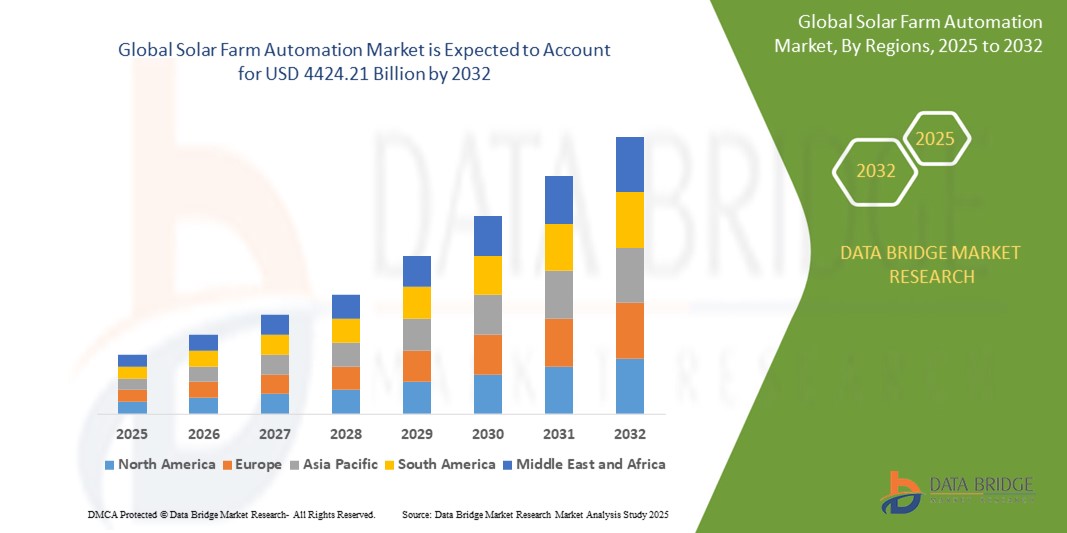
- As per Data Bridge Market Research Analysis the global Solar Farm Automation market was valued at USD 594.38 million in 2024 and is expected to reach USD 4424.21 billion by 2032
- During the forecast period of 2025 to 2032 the market is likely to grow at a CAGR of 28.52%, primarily driven by the increasing demand for efficient and cost-effective energy solutions
- This growth is driven by factors such as the rising adoption of renewable energy sources, advancements in automation technologies, and the need for optimized energy production and management in solar farms
Market Size & Forecast
Global Market Value (2024): USD 594.38 million
Expected Market Value (2032): USD 4424.21 billion
Forecast CAGR (2025–2032): 28.52%
What are the Major Takeaways of Solar Farm Automation Market?
- The global solar farm automation market is experiencing significant growth due to the increasing shift towards renewable energy sources. As the demand for solar energy continues to rise, automation technologies are becoming more integral to improving efficiency and reducing operational costs in solar farms
- Technological advancements in automation are enhancing the overall performance of solar farms. Automation systems now offer solutions for real-time monitoring, predictive maintenance, and optimal energy management, which helps reduce downtime and improve energy output
- The integration of artificial intelligence and machine learning into solar farm automation systems is driving the market forward. These technologies enable solar farms to automatically adjust to weather conditions, optimize power generation, and predict equipment failure, thereby improving operational reliability and efficiency
- The increasing adoption of Internet of Things (IoT) technologies is also contributing to market growth. IoT devices allow solar farm operators to collect and analyze data from various sources, leading to better decision-making and operational management
- The market is witnessing the introduction of new and innovative automation products designed to meet the evolving needs of the industry
- For instance, solar panel tracking systems have become more automated, allowing them to adjust their position throughout the day to capture maximum sunlight, improving energy efficiency
Report Scope and Solar Farm Automation Market Segmentation
|
Attributes |
Solar Farm Automation Key Market Insights |
|
Segments Covered |
|
|
Countries Covered |
North America
Europe
Asia-Pacific
Middle East and Africa
South America
|
|
Key Market Players |
|
|
Market Opportunities |
|
|
Value Added Data Infosets |
In addition to the insights on market scenarios such as market value, growth rate, segmentation, geographical coverage, and major players, the market reports curated by the Data Bridge Market Research also include import export analysis, production capacity overview, production consumption analysis, price trend analysis, climate change scenario, supply chain analysis, value chain analysis, raw material/consumables overview, vendor selection criteria, PESTLE Analysis, Porter Analysis, and regulatory framework. |
What is the Key Trend in the Solar Farm Automation Market?
“Integration of Artificial Intelligence and Robotics”
- The global solar farm automation market is witnessing a significant trend towards the integration of artificial intelligence and robotics
- These technologies are enhancing the efficiency and scalability of solar farm operations
- For instance, Terabase Energy, a company based in Northern California, has developed a robotics-assisted assembly line called Terafab, which automates the construction of solar farms. This system has been piloted in the United States and aims to reduce construction costs and timelines
- The integration of AI and robotics allows for real-time monitoring, predictive maintenance, and optimal energy management, thereby improving operational efficiency and reducing costs
Solar Farm Automation Market Dynamics
Driver
“Increasing Demand for Renewable Energy”
- The growing global demand for renewable energy is a primary driver of the solar farm automation market
- Governments and organizations worldwide are investing in renewable energy sources to reduce carbon emissions and combat climate change
- For Instance, in the U.S., significant capital expenditures in data centers, driven by the AI race
- This surge in energy demand has highlighted the need for efficient and scalable solar energy solutions, thereby driving the adoption of automation technologies in solar farms
Opportunity
“Expansion in Emerging Markets”
- Emerging markets present a significant opportunity for the solar farm automation market
- These regions often have abundant land and favourable weather conditions for solar energy generation
- The adoption of automation technologies can enhance the efficiency and scalability of solar farms in these areas
- For instance, the Middle East and Africa are witnessing increased investments in solar energy projects, creating a demand for advanced automation solutions to optimize operations and reduce costs
Restraint/Challenge
“High Initial Investment and Infrastructure Challenges”
- One of the key challenges facing the solar farm automation market is the high initial investment required for automation technologies
- The implementation of advanced systems such as AI-driven monitoring, robotics, and predictive maintenance tools entails substantial capital expenditure
- Additionally, integrating these technologies with existing infrastructure can be complex and costly
- For instance, the deployment of Terafab's robotics-assisted assembly line involves significant investment in automation systems and infrastructure
- These financial and technical barriers can hinder the widespread adoption of solar farm automation, particularly in regions with limited financial resources or underdeveloped infrastructure
How is the Solar Farm Automation Market Segmented?
The market is segmented on the basis product and application.
|
Segmentation |
Sub-Segmentation |
|
By Product |
|
|
By Application |
|
Which Region Holds the Largest Share of the Solar Farm Automation Market?
“Asia-Pacific is the Dominant Region in the Solar Farm Automation Market”
- The Asia-Pacific region is the leading market for solar farm automation, driven by rapid industrialization and a strong push towards renewable energy adoption
- Countries such as China and India are investing heavily in solar infrastructure, resulting in increased demand for automation solutions to enhance efficiency and scalability
- The presence of numerous businesses competing in the target market contributes to the region's dominance
- Government policies and incentives in countries such as China and India are encouraging the development of solar farms, further boosting the demand for automation technologies
- The region's vast geographical area and varying climatic conditions necessitate advanced automation systems to optimize solar energy generation and distribution
“North America is Projected to Register the Highest Growth Rate”
- North America is experiencing significant growth in the solar farm automation market, with the U.S. leading the charge
- The increasing adoption of new technologies and automation processes across various industries is propelling market expansion
- Investments in large-scale solar projects and the integration of automation systems are enhancing operational efficiency and reducing costs
- The region's focus on sustainability and reducing carbon emissions is driving the demand for renewable energy solutions, including automated solar farms
- Technological advancements and the presence of key market players in the region are contributing to the rapid growth of the solar farm automation market in North America
Which are the Top Companies in Solar Farm Automation Market?
The market competitive landscape provides details by competitor. Details included are company overview, company financials, revenue generated, market potential, investment in research and development, new market initiatives, global presence, production sites and facilities, production capacities, company strengths and weaknesses, product launch, product width and breadth, application dominance. The above data points provided are only related to the companies' focus related to market.
The Major Market Leaders Operating in the Market Are:
- ABB Ltd (Switzerland)
- Abengoa Solar SA (Spain)
- AllEarth Renewables (U.S.)
- Array Technologies (U.S.)
- DEGERenergie GmbH & Co. KG (Germany)
- Emerson Electric Co. (U.S.)
- Energia Ercam S.A. (Spain)
- Haosolar Co. Ltd (China)
- Heliopower (U.S.)
- M.B Control & Systems Pvt. Ltd. (India)
- Mecasolar (Spain)
- Mitsubishi Electric Corporation (Japan)
- Siemens AG (Germany)
- Smarttrak Solar Systems (India)
- Yokogawa Electric Corporation (Japan)
What are Latest Developments in Solar Farm Automation Market?
- In April 2025, SoftBank's Vision Fund 2 invested USD 130 million in Terabase Energy, a Northern California-based company specializing in robotics-assisted solar farm construction. This funding aims to scale Terabase’s automated assembly line, which utilizes robots and artificial intelligence to prefabricate solar farm sections on-site
- In March 2025, Terabase Energy deployed its Terafab construction automation system at the White Wing Ranch solar project in Arizona, marking one of the first commercial applications of this technology. The Terafab system automates the construction of solar farms, reducing labor dependency and enhancing productivity. This deployment signifies a significant step towards the widespread adoption of automation in solar farm construction, aiming to reduce costs and accelerate project timelines
- In February 2025, India added 25.2 gigawatts of solar capacity in 2024, marking a 204% increase compared to the previous year. Large-scale solar projects accounted for over 87% of the total capacity additions, with Rajasthan, Gujarat, and Maharashtra leading the installations. This surge in solar capacity underscores the growing demand for solar energy solutions and highlights the potential for automation technologies to enhance efficiency and scalability in solar farm operations
- In January 2025, ABB Ltd. achieved a milestone by delivering automation solutions to 5-gigawatt solar power plants in India. This accomplishment underscores ABB's commitment to enhancing the efficiency and scalability of solar farms through advanced automation technologies. The integration of automation solutions is pivotal in optimizing energy production and management in large-scale solar installations, contributing to the global transition towards renewable energy sources
- In December 2024, ACWA Power, a local utilities company, signed an agreement with the Water and Electricity Holding Company (Badeel) to build the world's largest single-site solar power plant in Al Shuaibah, Mecca province. The solar facility, expected to start operations by the end of 2025, will have a generation capacity of 2,060 megawatts. This ambitious project highlights the growing demand for large-scale solar energy solutions and the role of automation technologies in enhancing the efficiency and scalability of solar farm operations.

- Interactive Data Analysis Dashboard
- Company Analysis Dashboard for high growth potential opportunities
- Research Analyst Access for customization & queries
- Competitor Analysis with Interactive dashboard
- Latest News, Updates & Trend analysis
- Harness the Power of Benchmark Analysis for Comprehensive Competitor Tracking
Table of Content
1 INTRODUCTION
1.1 OBJECTIVES OF THE STUDY
1.2 MARKET DEFINITION
1.3 OVERVIEW OF GLOBAL SOLAR FARM AUTOMATION MARKET
1.4 CURRENCY AND PRICING
1.5 LIMITATION
1.6 MARKETS COVERED
2 MARKET SEGMENTATION
2.1 KEY TAKEAWAYS
2.2 ARRIVING AT THE GLOBAL SOLAR FARM AUTOMATION MARKET
2.2.1 VENDOR POSITIONING GRID
2.2.2 TECHNOLOGY LIFE LINE CURVE
2.2.3 MARKET GUIDE
2.2.4 COMPANY POSITIONING GRID
2.2.5 MULTIVARIATE MODELLING
2.2.6 STANDARDS OF MEASUREMENT
2.2.7 TOP TO BOTTOM ANALYSIS
2.2.8 VENDOR SHARE ANALYSIS
2.2.9 DATA POINTS FROM KEY PRIMARY INTERVIEWS
2.2.10 DATA POINTS FROM KEY SECONDARY DATABASES
2.3 GLOBAL SOLAR FARM AUTOMATION MARKET: RESEARCH SNAPSHOT
2.4 ASSUMPTIONS
3 MARKET OVERVIEW
3.1 DRIVERS
3.2 RESTRAINTS
3.3 OPPORTUNITIES
3.4 CHALLENGES
4 EXECUTIVE SUMMARY
5 PREMIUM INSIGHTS
5.1 CASE STUDIES
5.2 REGULATORY FRAMEWORK
5.3 TECHNOLOGICAL TRENDS
5.4 PRICING ANALYSIS
5.5 VALUE CHAIN ANALYSIS
6 IMPACT OF COVID-19 PANDEMIC ON THE GLOBAL SOLAR FARM AUTOMATION MARKET
6.1 ANALYSIS ON IMPACT OF COVID-19 ON THE MARKET
6.2 AFTERMATH OF COVID-19 AND GOVERNMENT INITIATIVE TO BOOST THE MARKETREV
6.3 STRATEGIC DECISIONS FOR MANUFACTUERS AFTER COVID-19 TO GAIN COMPETITIVE MARKET SHARE
6.4 PRICE IMPACT
6.5 IMPACT ON DEMAND
6.6 IMPACT ON SUPPLY CHAIN
6.7 CONCLUSION
7 GLOBAL SOLAR FARM AUTOMATION MARKET, BY TYPE
7.1 OVERVIEW
7.2 SOLAR TRACKER
7.3 SUPERVISORY CONTROL AND DATA ACQUISITION (SCADA)
7.4 DISTRIBUTED CONTROL SYSTEM (DCS)
7.5 PROGRAMMABLE LOGIC CONTROLLER (PLC)
7.6 OTHERS
8 GLOBAL SOLAR FARM AUTOMATION MARKET, BY TECHNOLOGY
8.1 OVERVIEW
8.2 PASSIVE MATRIX OLED (PMOLED) DISPLAY
8.3 ACTIVE MATRIX OLED (AMOLED) DISPLAY
8.4 OTHERS
9 GLOBAL SOLAR FARM AUTOMATION MARKET, BY ORGANIZATION SIZE
9.1 OVERVIEW
9.2 SMALL SCALE ORGANIZATIONS
9.3 MEDIUM SCALE ORGANIZATIONS
9.4 LARGE SCALE ORGANIZATIONS
10 GLOBAL SOLAR FARM AUTOMATION MARKET, BY UTILITY
10.1 OVERVIEW
10.2 AC (ALTERNATE CURRENT)
10.3 DC (DIRECT CURRENT)
11 GLOBAL SOLAR FARM AUTOMATION MARKET, BY APPLICATION
11.1 OVERVIEW
11.2 CONSUMER ELECTRONICS
11.2.1 BY TYPE
11.2.1.1. SOLAR TRACKER
11.2.1.2. SUPERVISORY CONTROL AND DATA ACQUISITION (SCADA)
11.2.1.3. DISTRIBUTED CONTROL SYSTEM (DCS)
11.2.1.4. PROGRAMMABLE LOGIC CONTROLLER (PLC)
11.2.1.5. OTHERS
11.3 MANUFACTURING
11.3.1 BY TYPE
11.3.1.1. SOLAR TRACKER
11.3.1.2. SUPERVISORY CONTROL AND DATA ACQUISITION (SCADA)
11.3.1.3. DISTRIBUTED CONTROL SYSTEM (DCS)
11.3.1.4. PROGRAMMABLE LOGIC CONTROLLER (PLC)
11.3.1.5. OTHERS
11.4 HEALTHCARE
11.4.1 BY TYPE
11.4.1.1. SOLAR TRACKER
11.4.1.2. SUPERVISORY CONTROL AND DATA ACQUISITION (SCADA)
11.4.1.3. DISTRIBUTED CONTROL SYSTEM (DCS)
11.4.1.4. PROGRAMMABLE LOGIC CONTROLLER (PLC)
11.4.1.5. OTHERS
11.5 POWER & ENERGY
11.5.1 BY TYPE
11.5.1.1. SOLAR TRACKER
11.5.1.2. SUPERVISORY CONTROL AND DATA ACQUISITION (SCADA)
11.5.1.3. DISTRIBUTED CONTROL SYSTEM (DCS)
11.5.1.4. PROGRAMMABLE LOGIC CONTROLLER (PLC)
11.5.1.5. OTHERS
11.6 RESIDENTIAL
11.6.1 BY TYPE
11.6.1.1. SOLAR TRACKER
11.6.1.2. SUPERVISORY CONTROL AND DATA ACQUISITION (SCADA)
11.6.1.3. DISTRIBUTED CONTROL SYSTEM (DCS)
11.6.1.4. PROGRAMMABLE LOGIC CONTROLLER (PLC)
11.6.1.5. OTHERS
11.7 AGRICULTURE
11.7.1 BY TYPE
11.7.1.1. SOLAR TRACKER
11.7.1.2. SUPERVISORY CONTROL AND DATA ACQUISITION (SCADA)
11.7.1.3. DISTRIBUTED CONTROL SYSTEM (DCS)
11.7.1.4. PROGRAMMABLE LOGIC CONTROLLER (PLC)
11.7.1.5. OTHERS
11.8 OTHERS
11.8.1 BY TYPE
11.8.1.1. SOLAR TRACKER
11.8.1.2. SUPERVISORY CONTROL AND DATA ACQUISITION (SCADA)
11.8.1.3. DISTRIBUTED CONTROL SYSTEM (DCS)
11.8.1.4. PROGRAMMABLE LOGIC CONTROLLER (PLC)
11.8.1.5. OTHERS
12 GLOBAL SOLAR FARM AUTOMATION MARKET, BY REGION
Global Solar Farm Automation Market, (ALL SEGMENTATION PROVIDED ABOVE IS REPRESENTED IN THIS CHAPTER BY COUNTRY)
12.1 NORTH AMERICA
12.1.1 U.S.
12.1.2 CANADA
12.1.3 MEXICO
12.2 EUROPE
12.2.1 GERMANY
12.2.2 FRANCE
12.2.3 U.K.
12.2.4 ITALY
12.2.5 SPAIN
12.2.6 RUSSIA
12.2.7 TURKEY
12.2.8 BELGIUM
12.2.9 NETHERLANDS
12.2.10 SWITZERLAND
12.2.11 REST OF EUROPE
12.3 ASIA PACIFIC
12.3.1 JAPAN
12.3.2 CHINA
12.3.3 SOUTH KOREA
12.3.4 INDIA
12.3.5 AUSTRALIA
12.3.6 SINGAPORE
12.3.7 THAILAND
12.3.8 MALAYSIA
12.3.9 INDONESIA
12.3.10 PHILIPPINES
12.3.11 REST OF ASIA PACIFIC
12.4 SOUTH AMERICA
12.4.1 BRAZIL
12.4.2 ARGENTINA
12.4.3 REST OF SOUTH AMERICA
12.5 MIDDLE EAST AND AFRICA
12.5.1 SOUTH AFRICA
12.5.2 EGYPT
12.5.3 SAUDI ARABIA
12.5.4 U.A.E
12.5.5 ISRAEL
12.5.6 REST OF MIDDLE EAST AND AFRICA
13 GLOBAL SOLAR FARM AUTOMATION MARKET,COMPANY LANDSCAPE
13.1 COMPANY SHARE ANALYSIS: GLOBAL
13.2 COMPANY SHARE ANALYSIS: NORTH AMERICA
13.3 COMPANY SHARE ANALYSIS: EUROPE
13.4 COMPANY SHARE ANALYSIS: ASIA-PACIFIC
13.5 MERGERS & ACQUISITIONS
13.6 NEW PRODUCT DEVELOPMENT AND APPROVALS
13.7 EXPANSIONS
13.8 REGULATORY CHANGES
13.9 PARTNERSHIP AND OTHER STRATEGIC DEVELOPMENTS
14 GLOBAL SOLAR FARM AUTOMATION MARKET, SWOT AND DBMR ANALYSIS
15 GLOBAL SOLAR FARM AUTOMATION MARKET, COMPANY PROFILE
15.1 EMERSON ELECTRIC COMPANY
15.1.1 COMPANY SNAPSHOT
15.1.2 REVENUE ANALYSIS
15.1.3 GEOGRAPHIC PRESENCE
15.1.4 PRODUCT PORTFOLIO
15.1.5 RECENT DEVELOPMENTS
15.2 HONEYWELL INTERNATIONAL, INC
15.2.1 COMPANY SNAPSHOT
15.2.2 REVENUE ANALYSIS
15.2.3 GEOGRAPHIC PRESENCE
15.2.4 PRODUCT PORTFOLIO
15.2.5 RECENT DEVELOPMENTS
15.3 MITSUBISHI ELECTRIC CORPORATION
15.3.1 COMPANY SNAPSHOT
15.3.2 REVENUE ANALYSIS
15.3.3 GEOGRAPHIC PRESENCE
15.3.4 PRODUCT PORTFOLIO
15.3.5 RECENT DEVELOPMENTS
15.4 TRABANT SOLAR, INC
15.4.1 COMPANY SNAPSHOT
15.4.2 REVENUE ANALYSIS
15.4.3 GEOGRAPHIC PRESENCE
15.4.4 PRODUCT PORTFOLIO
15.4.5 RECENT DEVELOPMENTS
15.5 SIEMENS AG
15.5.1 COMPANY SNAPSHOT
15.5.2 REVENUE ANALYSIS
15.5.3 GEOGRAPHIC PRESENCE
15.5.4 PRODUCT PORTFOLIO
15.5.5 RECENT DEVELOPMENTS
15.6 GENERAL ELECTRIC COMPANY
15.6.1 COMPANY SNAPSHOT
15.6.2 REVENUE ANALYSIS
15.6.3 GEOGRAPHIC PRESENCE
15.6.4 PRODUCT PORTFOLIO
15.6.5 RECENT DEVELOPMENTS
15.7 YOKOGAWA ELECTRIC CORPORATION
15.7.1 COMPANY SNAPSHOT
15.7.2 REVENUE ANALYSIS
15.7.3 GEOGRAPHIC PRESENCE
15.7.4 PRODUCT PORTFOLIO
15.7.5 RECENT DEVELOPMENTS
15.8 ABB GROUP
15.8.1 COMPANY SNAPSHOT
15.8.2 REVENUE ANALYSIS
15.8.3 GEOGRAPHIC PRESENCE
15.8.4 PRODUCT PORTFOLIO
15.8.5 RECENT DEVELOPMENTS
15.9 ABENGOA SOLAR SSA
15.9.1 COMPANY SNAPSHOT
15.9.2 REVENUE ANALYSIS
15.9.3 GEOGRAPHIC PRESENCE
15.9.4 PRODUCT PORTFOLIO
15.9.5 RECENT DEVELOPMENTS
15.1 FIRST SOLAR, INC
15.10.1 COMPANY SNAPSHOT
15.10.2 REVENUE ANALYSIS
15.10.3 GEOGRAPHIC PRESENCE
15.10.4 PRODUCT PORTFOLIO
15.10.5 RECENT DEVELOPMENTS
15.11 NEXTRACKER, INC
15.11.1 COMPANY SNAPSHOT
15.11.2 REVENUE ANALYSIS
15.11.3 GEOGRAPHIC PRESENCE
15.11.4 PRODUCT PORTFOLIO
15.11.5 RECENT DEVELOPMENTS
15.12 HAOSOLAR CO LTD
15.12.1 COMPANY SNAPSHOT
15.12.2 REVENUE ANALYSIS
15.12.3 GEOGRAPHIC PRESENCE
15.12.4 PRODUCT PORTFOLIO
15.12.5 RECENT DEVELOPMENTS
15.13 ROCKWELL AUTOMATION, INC
15.13.1 COMPANY SNAPSHOT
15.13.2 REVENUE ANALYSIS
15.13.3 GEOGRAPHIC PRESENCE
15.13.4 PRODUCT PORTFOLIO
15.13.5 RECENT DEVELOPMENTS
15.14 HELIOPOWER
15.14.1 COMPANY SNAPSHOT
15.14.2 REVENUE ANALYSIS
15.14.3 GEOGRAPHIC PRESENCE
15.14.4 PRODUCT PORTFOLIO
15.14.5 RECENT DEVELOPMENTS
15.15 FRONTIER TECHNOLOGY, INC
15.15.1 COMPANY SNAPSHOT
15.15.2 REVENUE ANALYSIS
15.15.3 GEOGRAPHIC PRESENCE
15.15.4 PRODUCT PORTFOLIO
15.15.5 RECENT DEVELOPMENTS
15.16 ENERGIA ERCAM SA
15.16.1 COMPANY SNAPSHOT
15.16.2 REVENUE ANALYSIS
15.16.3 GEOGRAPHIC PRESENCE
15.16.4 PRODUCT PORTFOLIO
15.16.5 RECENT DEVELOPMENTS
15.17 ARRAY TECHNOLOGIES, INC
15.17.1 COMPANY SNAPSHOT
15.17.2 REVENUE ANALYSIS
15.17.3 GEOGRAPHIC PRESENCE
15.17.4 PRODUCT PORTFOLIO
15.17.5 RECENT DEVELOPMENTS
15.18 ARZAN SOLAR, INC
15.18.1 COMPANY SNAPSHOT
15.18.2 REVENUE ANALYSIS
15.18.3 GEOGRAPHIC PRESENCE
15.18.4 PRODUCT PORTFOLIO
15.18.5 RECENT DEVELOPMENTS
15.19 MECASOLAR
15.19.1 COMPANY SNAPSHOT
15.19.2 REVENUE ANALYSIS
15.19.3 GEOGRAPHIC PRESENCE
15.19.4 PRODUCT PORTFOLIO
15.19.5 RECENT DEVELOPMENTS
15.2 ALLEARTH RENEWABLES, INC
15.20.1 COMPANY SNAPSHOT
15.20.2 REVENUE ANALYSIS
15.20.3 GEOGRAPHIC PRESENCE
15.20.4 PRODUCT PORTFOLIO
15.20.5 RECENT DEVELOPMENTS
15.21 SOFCON SYSTEMS
15.21.1 COMPANY SNAPSHOT
15.21.2 REVENUE ANALYSIS
15.21.3 GEOGRAPHIC PRESENCE
15.21.4 PRODUCT PORTFOLIO
15.21.5 RECENT DEVELOPMENTS
15.22 SMP ROBOTICS
15.22.1 COMPANY SNAPSHOT
15.22.2 REVENUE ANALYSIS
15.22.3 GEOGRAPHIC PRESENCE
15.22.4 PRODUCT PORTFOLIO
15.22.5 RECENT DEVELOPMENTS
15.23 FLUIX LIMITED
15.23.1 COMPANY SNAPSHOT
15.23.2 REVENUE ANALYSIS
15.23.3 GEOGRAPHIC PRESENCE
15.23.4 PRODUCT PORTFOLIO
15.23.5 RECENT DEVELOPMENTS
15.24 STERLING & WILSON RENEWABLES ENERGY
15.24.1 COMPANY SNAPSHOT
15.24.2 REVENUE ANALYSIS
15.24.3 GEOGRAPHIC PRESENCE
15.24.4 PRODUCT PORTFOLIO
15.24.5 RECENT DEVELOPMENTS
NOTE: THE COMPANIES PROFILED IS NOT EXHAUSTIVE LIST AND IS AS PER OUR PREVIOUS CLIENT REQUIREMENT. WE PROFILE MORE THAN 100 COMPANIES IN OUR STUDIES AND HENCE THE LIST OF COMPANIES CAN BE MODIFIED OR REPLACED ON REQUEST.
16 CONCLUSION
17 QUESTIONNAIRE
18 RELATED REPORTS
19 ABOUT DATA BRIDGE MARKET RESEARCH

Data collection and base year analysis are done using data collection modules with large sample sizes. The stage includes obtaining market information or related data through various sources and strategies. It includes examining and planning all the data acquired from the past in advance. It likewise envelops the examination of information inconsistencies seen across different information sources. The market data is analysed and estimated using market statistical and coherent models. Also, market share analysis and key trend analysis are the major success factors in the market report. To know more, please request an analyst call or drop down your inquiry.
The key research methodology used by DBMR research team is data triangulation which involves data mining, analysis of the impact of data variables on the market and primary (industry expert) validation. Data models include Vendor Positioning Grid, Market Time Line Analysis, Market Overview and Guide, Company Positioning Grid, Patent Analysis, Pricing Analysis, Company Market Share Analysis, Standards of Measurement, Global versus Regional and Vendor Share Analysis. To know more about the research methodology, drop in an inquiry to speak to our industry experts.
Data Bridge Market Research is a leader in advanced formative research. We take pride in servicing our existing and new customers with data and analysis that match and suits their goal. The report can be customized to include price trend analysis of target brands understanding the market for additional countries (ask for the list of countries), clinical trial results data, literature review, refurbished market and product base analysis. Market analysis of target competitors can be analyzed from technology-based analysis to market portfolio strategies. We can add as many competitors that you require data about in the format and data style you are looking for. Our team of analysts can also provide you data in crude raw excel files pivot tables (Fact book) or can assist you in creating presentations from the data sets available in the report.