Solar Home Systems Market Size
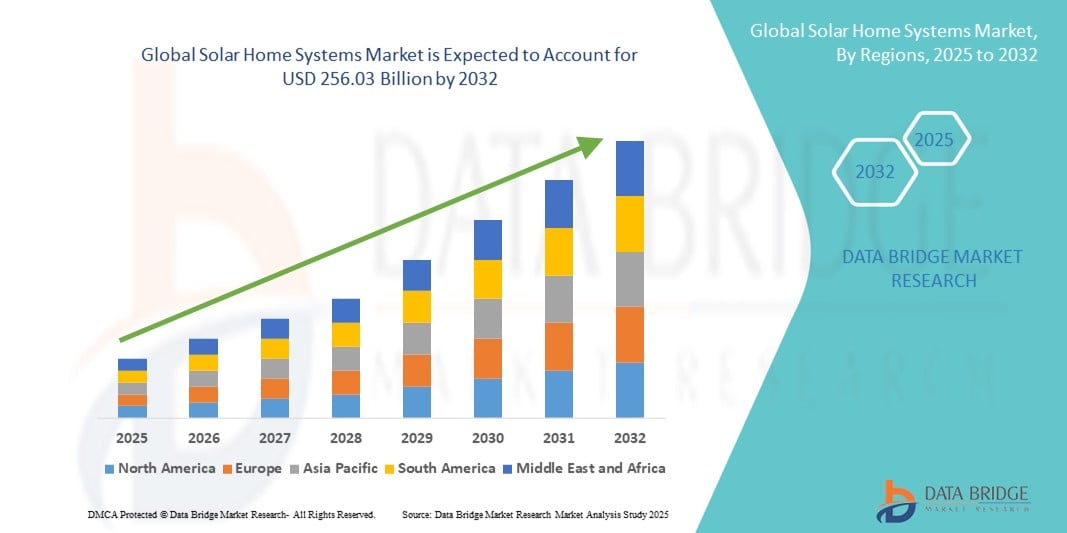
- The global solar home systems market size was valued at USD 82.54 billion in 2024 and is expected to reach USD 256.03 billion by 2032, at a CAGR of 15.20% during the forecast period
- The market growth is The market growth is driven by rising demand for renewable and clean energy solutions, increasing government incentives, growing rural electrification initiatives, and technological advancements in solar panel efficiency and battery storage
- Expanding adoption of solar home systems across both urban and rural areas is supported by falling solar installation costs and increasing awareness of energy independence and cost savings
Solar Home Systems Market Analysis
- The solar home systems market is witnessing strong growth as more households, businesses, and institutions seek sustainable energy solutions to reduce reliance on traditional grid electricity and lower carbon footprints
- Advancements in energy storage technologies and smart solar management systems are enhancing performance, enabling users to maximize energy utilization and monitor systems in real-time
- Asia-Pacific dominated the global solar home systems market with the largest revenue share of 38.4% in 2024, driven by large-scale electrification projects, high solar potential, and strong policy support in countries such as China, India, and Australia
- Middle East & Africa is expected to be the fastest-growing region during the forecast period due to expanding off-grid electrification initiatives, abundant sunlight availability, and the growing need for energy access in remote communities
- The residential customers segment dominated the largest market revenue share of 34.8% in 2024, driven by the growing adoption of solar energy for household electricity needs, rising awareness of renewable energy benefits, and increasing government incentives for rooftop solar installations
Report Scope and Solar Home Systems Market Segmentation
|
Attributes |
Solar Home Systems Key Market Insights |
|
Segments Covered |
|
|
Countries Covered |
North America
Europe
Asia-Pacific
Middle East and Africa
South America
|
|
Key Market Players |
|
|
Market Opportunities |
|
|
Value Added Data Infosets |
In addition to the insights on market scenarios such as market value, growth rate, segmentation, geographical coverage, and major players, the market reports curated by the Data Bridge Market Research also include import export analysis, production capacity overview, production consumption analysis, price trend analysis, climate change scenario, supply chain analysis, value chain analysis, raw material/consumables overview, vendor selection criteria, PESTLE Analysis, Porter Analysis, and regulatory framework. |
Solar Home Systems Market Trends
Growing Adoption of Hybrid Solar Solutions with Advanced Energy Storage
- The global solar home systems market is witnessing a strong trend toward the adoption of hybrid systems integrated with advanced energy storage technologies
- These systems combine solar generation with battery storage and backup capabilities, ensuring continuous power supply even during grid outages or low sunlight conditions
- Hybrid solar solutions enable better energy management, allowing consumers to store excess electricity for peak demand periods or sell it back to the grid in regions with net-metering policies
- For instance, several companies are launching solar home systems with AI-driven energy optimization, which analyzes consumption patterns and weather forecasts to maximize energy efficiency and cost savings
- This trend is making solar solutions more attractive to residential, commercial, industrial, and institutional customers who seek energy independence and long-term cost benefits
- Energy storage integration also supports remote and off-grid communities, enabling reliable electricity access while reducing dependence on diesel generators and other fossil-fuel-based backup systems
Solar Home Systems Market Dynamics
Driver
Rising Demand for Clean Energy and Government Incentives
- The growing global focus on renewable energy adoption, driven by climate change concerns and the need to reduce carbon emissions, is a major driver for the solar home systems market
- Many governments are introducing subsidies, tax credits, and favorable financing options such as solar loans and power purchase agreements (PPAs) to encourage adoption across residential, commercial, and institutional segments
- Technological advancements in photovoltaic (PV) panels, concentrated solar power (CSP), and integrated systems are improving efficiency, lowering costs, and expanding application possibilities
- In Asia-Pacific, the dominating region for solar home systems, large-scale initiatives in countries such as China, India, and Japan are accelerating deployment through both grid-tied and off-grid projects
- The Middle East and Africa, the fastest growing region, is witnessing rising adoption due to the combination of abundant sunlight, high energy demand, and increasing focus on energy diversification
- Expanding awareness about energy independence and the economic benefits of solar systems is further boosting demand across both urban and rural markets
Restraint/Challenge
High Initial Costs and Technical Integration Barriers
- The significant upfront investment required for purchasing and installing solar home systems, especially medium and large-scale units, remains a challenge for many customers in price-sensitive markets
- Integrating solar systems with existing electrical infrastructure, particularly for hybrid and utility-scale applications, can involve complex engineering and high labor costs
- Data security is less of an issue compared to automotive telematics, but concerns around performance monitoring platforms, system hacking, or unauthorized remote control can emerge with IoT-enabled solar systems
- The fragmented regulatory environment, with varying policies for grid connection, net-metering, and renewable energy incentives across countries, creates operational challenges for global manufacturers and service providers
- Limited access to affordable financing options in certain emerging markets can deter adoption, especially among rural households and small businesses, despite the long-term savings potential of solar energy
Solar Home Systems market Scope
The market is segmented on the basis of customer type, system size, technology type, financing options, and end-use application.
- By Customer Type
On the basis of customer type, the global solar home systems market is segmented into residential customers, commercial customers, industrial customers, and institutional clients. The residential customers segment dominated the largest market revenue share of 34.8% in 2024, driven by the growing adoption of solar energy for household electricity needs, rising awareness of renewable energy benefits, and increasing government incentives for rooftop solar installations. Residential users are attracted to solar home systems for their ability to reduce electricity bills, provide energy independence, and offer reliable backup during power outages. Advancements in compact, aesthetically integrated solar designs have further boosted adoption in this segment.
The industrial customers segment is expected to register the fastest growth rate from 2025 to 2032, fueled by large-scale manufacturing facilities seeking to reduce operational costs, achieve sustainability targets, and comply with renewable energy mandates. High energy consumption, coupled with rising grid tariffs, makes solar home systems an attractive investment for industrial users. The integration of energy storage solutions and smart energy management systems enables industries to optimize solar usage, improve efficiency, and ensure uninterrupted operations.
- By System Size
On the basis of system size, the global solar home systems market is categorized into small systems (up to 1 kW), medium systems (1 kW – 5 kW), large systems (5 kW – 20 kW), and utility-scale systems (above 20 kW). The medium systems (1 kW – 5 kW) segment accounted for the highest revenue share in 2024, supported by their suitability for both residential and small commercial applications. These systems strike a balance between affordability and power output, making them a preferred choice for households and small businesses aiming for partial or full energy self-sufficiency.
The utility-scale systems (above 20 kW) segment is anticipated to grow at the fastest CAGR from 2025 to 2032, driven by government-backed large-scale solar deployment programs, rising corporate investments in renewable energy infrastructure, and increasing demand from industrial and institutional clients. These systems deliver high capacity for large facilities, enable bulk power generation, and contribute significantly to national renewable energy targets.
- By Technology Type
On the basis of technology type, the global solar home systems market is segmented into photovoltaic (PV) systems, concentrated solar power (CSP) systems, solar thermal systems, and integrated systems. The photovoltaic (PV) systems segment held the largest revenue share in 2024, attributed to their falling installation costs, wide availability, and proven efficiency in converting sunlight into electricity. PV technology dominated due to its versatility, scalability, and ability to integrate with battery storage solutions for round-the-clock power supply.
The integrated systems segment is projected to grow at the fastest rate from 2025 to 2032, as demand rises for solutions that combine PV panels, storage batteries, inverters, and smart energy management into a single package. These all-in-one solutions cater to residential, commercial, and off-grid applications, reducing installation complexity and ensuring optimal system performance.
- By Financing Options
On the basis of financing options, the global solar home systems market is segmented into outright purchase, solar loans, power purchase agreements (PPAs), and leasing options. The outright purchase segment dominated the market share in 2024, driven by customers seeking long-term ownership benefits, maximum savings on electricity bills, and full eligibility for subsidies and tax credits. Direct purchase appeals to homeowners and businesses with sufficient capital to invest upfront in renewable energy infrastructure.
The power purchase agreements (PPAs) segment is expected to record the fastest growth from 2025 to 2032, as this model allows customers to adopt solar without high upfront costs. Under PPAs, third-party providers install, own, and maintain the solar systems while customers pay for the energy generated at agreed rates—often lower than grid prices. This approach is particularly gaining traction among commercial and institutional clients seeking predictable energy costs and minimal operational burden.
- By End-Use Application
On the basis of end-use application, the global solar home systems market is segmented into grid-tied applications, off-grid applications, hybrid systems, and backup power solutions. The grid-tied applications segment held the largest revenue share in 2024, supported by the rapid expansion of national and regional electricity grids in developing economies, net metering policies, and the growing appeal of selling excess power back to the grid. These systems enable users to reduce dependence on fossil fuels while ensuring a stable electricity supply.
The off-grid applications segment is projected to witness the fastest growth from 2025 to 2032, driven by rising demand in rural and remote areas lacking reliable grid access. Off-grid solar systems, often paired with battery storage, are crucial for improving electrification rates in underserved communities, particularly across the Middle East & Africa. Increasing donor-funded solar projects and pay-as-you-go business models are further accelerating adoption in these regions.
Solar Home Systems Market Regional Analysis
- Asia-Pacific dominated the global solar home systems market with the largest revenue share of 38.4% in 2024, driven by large-scale electrification projects, high solar potential, and strong policy support in countries such as China, India, and Australia
- Consumers and end users prioritize solar home systems for reliable access to electricity, cost savings versus diesel/kerosene, battery-backed backup power, and energy independence in areas with unreliable grids
- Market growth is being accelerated by technological advances — higher-efficiency PV, improved lithium-ion and flow battery storage, integrated smart inverters and energy management systems
Japan Solar Home Systems Market Insight
Japan’s market shows steady growth for high-quality, compact solar home systems with battery backup and integrated smart inverters. Consumer preference for reliable, durable systems and strong presence of major electronics and automotive suppliers (supplying batteries and inverters) helps OEM and aftermarket growth. Grid-tied and hybrid systems for resilience are popular among residential and institutional clients.
China Solar Home Systems Market Insight
China holds the largest share within Asia-Pacific, buoyed by massive PV manufacturing, falling component costs, strong government support for household solar and storage, and large numbers of residential and commercial rooftop installations. China’s vast supply chain and scale economics make solar home systems more accessible across urban and rural segments.
Middle East & Africa (MEA) Solar Home Systems Market Insight
The Middle East & Africa region is the fastest-growing market for solar home systems, supported by urgent electrification needs in parts of Africa, high solar irradiation across MENA, and rapid expansion of pay-as-you-go and micro-financing business models. Off-grid and backup power solutions are especially important where grid reliability is low; companies scaling in West and Central Africa are demonstrating rapid consumer adoption. Strategic public–private programs and growing investor interest are accelerating rollout
North America Solar Home Systems Market Insight
The North America solar home systems market is mature with significant uptake in residential rooftop and small commercial systems, driven by federal and state incentives, net-metering policies, and growing consumer interest in home resilience and electrification. The region shows strong demand for integrated PV + storage solutions and financing structures (solar loans, PPA for multi-family / commercial). OEM & installer networks and stringent interconnection standards support wider adoption.
U.S. Solar Home Systems Market Insight
The U.S. leads North America with the largest share in 2024. Growth is driven by: residential electrification trends, large state-level incentive programs (tax credits, rebates), rising utility rates, and consumer demand for backup power and home energy management. Residential customers remain the largest segment, while commercial and institutional clients increasingly deploy medium to large rooftop systems with battery backup and financing (loans, leases, PPAs).
Europe Solar Home Systems Market Insight
Europe’s market growth is supported by ambitious decarbonization targets, rooftop solar incentive programs, and strong interest in self-consumption and hybrid systems. Consumers and businesses focus on grid-tied and hybrid solutions that combine PV with energy storage to improve energy security and reduce bills. Regulatory frameworks in Germany, France, Spain and Italy are driving both retrofit solar home system projects and new-build integration.
U.K. Solar Home Systems Market Insight
The U.K. market is expanding due to rising residential interest in rooftop PV and battery systems for bill reduction and resilience. Government policy shifts toward home energy upgrades, plus emerging finance options and local installer networks, are encouraging uptake across residential and small commercial segments. Institutional adoption is growing for schools and health centres as backup and hybrid solutions.
Germany Solar Home Systems Market Insight
Germany remains a leading European market, with high penetration of residential PV + storage systems and progressive feed-in/net-metering regimes. German customers often prefer high-quality, branded PV + battery systems and integrated energy management for energy efficiency and self-consumption. The country’s strong solar manufacturing and installer base supports innovation and competitive pricing.
Solar Home Systems Market Share
The solar home systems industry is primarily led by well-established companies, including:
- ABB (Switzerland)
- Array Technologies, Inc. (U.S.)
- Enphase Energy (U.S.)
- Greenlight Planet (Kenya)
- Jinko Solar (China)
- LG Electronics (South Korea)
- Lumos (Netherlands)
- ovSolar Inc. (China)
- Phocos (Germany)
- Reliance Industries Ltd. (India)
- Schneider Electric SE (France)
- Shell plc (Netherlands)
- SMA Solar Technology AG (Germany)
- SolarEdge (Israel)
- SunPower Corporation (U.S.)
- Tata Power Co. Ltd. (India)
- Tesla (U.S.)
- Trina Solar (China)
- Yingli Solar (China)
What are the Recent Developments in Global Solar Home Systems Market?
- In November 2024, Fronius International launched the Wattpilot Flex, a sleek and efficient wallbox designed to revolutionize home EV charging. Available in Home and Pro versions, this smart charger enables users to power their electric vehicles using self-generated solar energy or low-cost grid electricity, thanks to its dynamic PV optimization and intelligent charging modes. With features such as RFID authentication, LAN/WLAN connectivity, and a permanently integrated Type 2 cable, it offers seamless integration and user-friendly operation. The Pro version includes a MID-compliant meter for precise energy tracking, ideal for fleet and company car billing
- In February 2024, JA Solar launched its DeepBlue 4.0 Series of photovoltaic modules, engineered to deliver high efficiency, high output, and exceptional reliability. These modules incorporate n-type Bycium+ cell technology, which enables power outputs of up to 650W and module efficiencies reaching 23.3%. Designed for diverse applications—including residential PV systems, commercial installations, and utility-scale projects—the DeepBlue 4.0 Series helps reduce the levelized cost of energy (LCOE) and optimize system performance. The launch reflects JA Solar’s commitment to innovation and sustainability, reinforcing its position as a global leader in solar technology.
- In January 2024, Waaree Energies launched the Radiance 5 kW On Grid Single Phase Bifacial Topcon DCR Solar Kit, a comprehensive and high-performance solution tailored for residential solar energy needs. This all-in-one kit includes bifacial DCR Topcon solar panels, a 5 kW inverter, and essential accessories for seamless installation and grid connectivity. Engineered for maximum efficiency, the system harnesses solar power even in low-light conditions and supports net metering, helping homeowners reduce electricity bills and carbon footprint. With robust build quality and smart design, it offers a reliable path to energy independence
- In October 2023, Tata Power—launched a consumer mobile app aimed at enhancing service delivery and customer engagement in the rural solar home systems market. Introduced on Mahatma Gandhi Jayanti, the app empowers rural users with features such as new connection requests, bill payments, energy consumption tracking, and customer support. It reflects TP Renewable Microgrid’s commitment to sustainability and self-reliance, aligning with Gandhiji’s vision of empowered villages and clean energy access

- Interactive Data Analysis Dashboard
- Company Analysis Dashboard for high growth potential opportunities
- Research Analyst Access for customization & queries
- Competitor Analysis with Interactive dashboard
- Latest News, Updates & Trend analysis
- Harness the Power of Benchmark Analysis for Comprehensive Competitor Tracking
Data collection and base year analysis are done using data collection modules with large sample sizes. The stage includes obtaining market information or related data through various sources and strategies. It includes examining and planning all the data acquired from the past in advance. It likewise envelops the examination of information inconsistencies seen across different information sources. The market data is analysed and estimated using market statistical and coherent models. Also, market share analysis and key trend analysis are the major success factors in the market report. To know more, please request an analyst call or drop down your inquiry.
The key research methodology used by DBMR research team is data triangulation which involves data mining, analysis of the impact of data variables on the market and primary (industry expert) validation. Data models include Vendor Positioning Grid, Market Time Line Analysis, Market Overview and Guide, Company Positioning Grid, Patent Analysis, Pricing Analysis, Company Market Share Analysis, Standards of Measurement, Global versus Regional and Vendor Share Analysis. To know more about the research methodology, drop in an inquiry to speak to our industry experts.
Data Bridge Market Research is a leader in advanced formative research. We take pride in servicing our existing and new customers with data and analysis that match and suits their goal. The report can be customized to include price trend analysis of target brands understanding the market for additional countries (ask for the list of countries), clinical trial results data, literature review, refurbished market and product base analysis. Market analysis of target competitors can be analyzed from technology-based analysis to market portfolio strategies. We can add as many competitors that you require data about in the format and data style you are looking for. Our team of analysts can also provide you data in crude raw excel files pivot tables (Fact book) or can assist you in creating presentations from the data sets available in the report.