


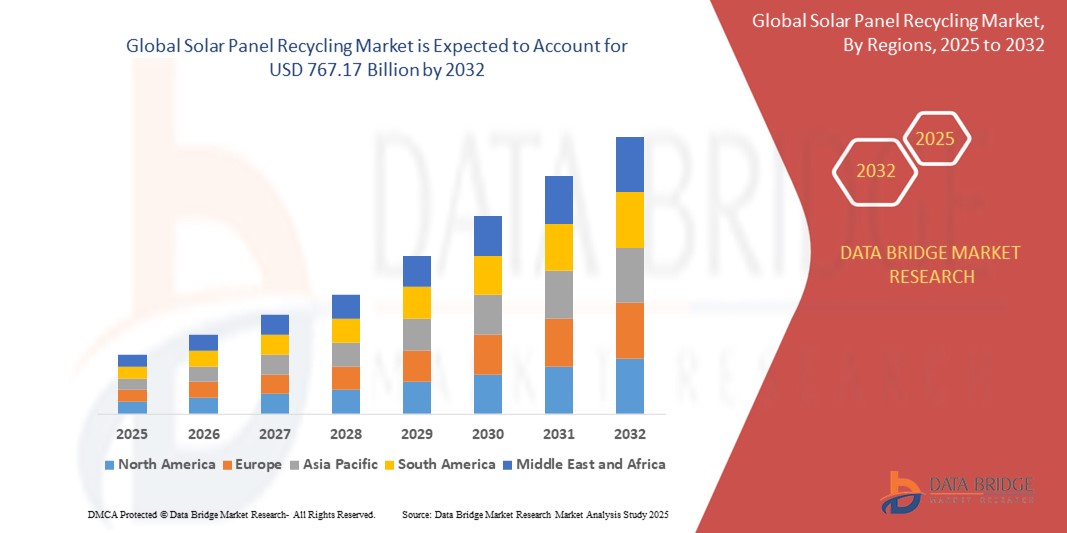
Solar Panel Recycling Market Size
- The global solar panel recycling market was valued at USD 246.47 billion in 2024 and is expected to reach USD 767.17 billion by 2032
- During the forecast period of 2025 to 2032 the market is likely to grow at a CAGR of 15.25%, primarily driven by the increasing need for sustainable disposal solutions and the growing volume of decommissioned solar panels
- This growth is driven by factors such as the rising focus on circular economy practices, stringent environmental regulations, and the growing emphasis on the recycling of valuable materials
Solar Panel Recycling Market Analysis
- The surge in solar energy adoption worldwide has led to a significant rise in the number of solar panels reaching the end of their operational lifespan. This trend necessitates the development of efficient recycling processes to manage the growing volume of decommissioned panels
- Innovations in recycling methods, such as mechanical, thermal, and laser techniques, have enhanced the efficiency and cost-effectiveness of material recovery from old panels. These advancements facilitate the extraction of valuable materials such as silicon, silver, and aluminum, which can be reused in manufacturing new panels
- Recycling solar panels reduces the environmental impact associated with landfilling and minimizes the need for virgin raw materials. Additionally, the recovery of precious metals contributes to economic savings and supports the circular economy by reintroducing materials into the production cycle
- Governments are implementing stricter regulations and offering incentives to promote solar panel recycling.
- For instance, the European Union's Waste Electrical and Electronic Equipment Directive mandates the recycling of solar panels, encouraging manufacturers to adopt sustainable practices
- The growing demand for recycled materials has attracted investments in recycling infrastructure. Companies such as Solarcycle are establishing facilities to produce recycled glass for solar panels, aiming to meet the increasing demand for sustainable materials in panel manufacturing
- For Instance, Solarcycle plans to build a USD 344 million factory in Georgia to produce recycled glass for solar panels, creating over 600 jobs and supporting domestic solar panel manufacturers
Report Scope and Solar Panel Recycling Market Segmentation
|
Attributes |
Solar Panel Recycling Key Market Insights |
|
Segments Covered |
|
|
Countries Covered |
North America
Europe
Asia-Pacific
Middle East and Africa
South America
|
|
Key Market Players |
|
|
Market Opportunities |
|
|
Value Added Data Infosets |
In addition to the insights on market scenarios such as market value, growth rate, segmentation, geographical coverage, and major players, the market reports curated by the Data Bridge Market Research also include import export analysis, production capacity overview, production consumption analysis, price trend analysis, climate change scenario, supply chain analysis, value chain analysis, raw material/consumables overview, vendor selection criteria, PESTLE Analysis, Porter Analysis, and regulatory framework. |
Solar Panel Recycling Market Trends
“Technological Advancements in Recycling Processes”
- The global solar panel recycling market is witnessing significant advancements in recycling technologies, which are enhancing the efficiency and effectiveness of material recovery from end-of-life panels
- Mechanical, thermal, and laser-based processes are being refined to improve the extraction of valuable materials such as silicon, silver, and aluminium
- For instance, laser-based recycling techniques are gaining traction due to their precision and ability to minimize material loss
- These innovations are not only making recycling more cost-effective but also contributing to the sustainability of the solar industry by promoting a circular economy
- As these technologies evolve, they are expected to play a crucial role in addressing the growing volume of solar panel waste and ensuring the responsible disposal and reuse of materials
Solar Panel Recycling Market Dynamics
Driver
“Stringent Environmental Regulations”
- The implementation of stringent environmental regulations is a significant driver of the solar panel recycling market
- Policies such as the European Union's Waste Electrical and Electronic Equipment Directive mandate the collection and recycling of solar panels, ensuring the recovery and reuse of valuable materials while mitigating ecological impact
- Similarly, countries such as Japan and South Korea have enacted legislation to promote the recycling of solar panels, further stimulating market growth
- These regulatory frameworks not only encourage responsible disposal practices but also create a conducive environment for the development and adoption of advanced recycling technologies, thereby accelerating the growth of the solar panel recycling market
Opportunity
“Expansion of Recycling Infrastructure”
- The rapid growth in solar panel installations presents a substantial opportunity for the expansion of recycling infrastructure
- As more panels reach the end of their operational lifespan, the demand for efficient recycling solutions is increasing. Investing in state-of-the-art recycling facilities can enable the recovery of valuable materials and reduce the environmental impact associated with solar panel waste
- For Instance, in Brisbane, Australia, Pan Pacific Recycling is transforming old solar panels into valuable materials such as silver and copper, processing 30,000 panels annually with plans to expand to 240,000 panels
- This initiative highlights the potential for growth in the recycling sector and underscores the importance of developing robust infrastructure to manage the increasing volume of solar panel waste
Restraint/Challenge
“Regulatory Fragmentation”
- A significant challenge facing the solar panel recycling market is the lack of standardized regulations across different regions
- This inconsistency creates significant hurdles for recycling companies, who must navigate a complex landscape of varying compliance requirements, which can differ widely from one country to another
- In some regions, stringent regulations may mandate the recycling of solar panels and other electronic waste, providing clear guidelines and sometimes financial incentives for recycling.
- For Instance, in other parts of the world, such regulations may be lax or non-existent, offering little motivation for solar panel manufacturers and owners to recycle, thus limiting the development of a robust recycling infrastructure
- This regulatory fragmentation can lead to several issues. First, it complicates the ability of recycling companies to operate on a global scale, as they must adapt their operations and strategies to meet the specific legal demands of each market
- Additionally, the lack of uniformity in regulations can result in inefficiencies and increased costs, as companies may need to invest in multiple compliance measures to meet diverse requirements
- Furthermore, inconsistent regulations can create disparities in recycling rates and material recovery efficiencies, hindering the overall progress toward a circular economy in the solar industry
- To address these challenges, there is a need for international collaboration to establish standardized regulations and incentives that promote efficient and widespread solar panel recycling practices
Solar Panel Recycling Market Scope
The market is segmented on the basis process, product, and shelf life
|
Segmentation |
Sub-Segmentation |
|
By Process |
|
|
By Product |
|
|
By Shelf Life |
|
Solar Panel Recycling Market Regional Analysis
“Europe is the Dominant Region in the Solar Panel Recycling Market”
- Europe holds the largest share in the global solar panel recycling market, driven by its substantial installed base of solar photovoltaic systems and stringent environmental regulations
- The European Union's Waste Electrical and Electronic Equipment Directive mandates the recycling of solar panels, ensuring responsible disposal and material recovery
- Countries such as Germany are at the forefront, developing innovative recycling technologies and receiving EU funding to enhance recycling efficiency
- Significant investments are being made to establish advanced recycling facilities, supporting the region's commitment to sustainability and circular economy principles
- Europe's dominance is expected to continue, with projections indicating substantial growth in the coming years due to increasing solar installations and recycling initiatives
“Asia-Pacific is Projected to Register the Highest Growth Rate”
- The Asia-Pacific region is experiencing the fastest growth in the solar panel recycling market, fueled by the region's leading position in solar energy production and consumption
- Countries such as India have introduced programs such as extended producer responsibility, compelling manufacturers to manage the recycling of their products
- China's implementation of guidelines by the ministry of industry and information technology promotes the recycling and reuse of solar photovoltaic panels, addressing the challenges posed by aging installations
- The region is witnessing innovations in recycling technologies, including mechanical and laser processes, to efficiently recover materials from decommissioned panels
Solar Panel Recycling Market Share
The market competitive landscape provides details by competitor. Details included are company overview, company financials, revenue generated, market potential, investment in research and development, new market initiatives, global presence, production sites and facilities, production capacities, company strengths and weaknesses, product launch, product width and breadth, application dominance. The above data points provided are only related to the companies' focus related to market.
The Major Market Leaders Operating in the Market Are:
- First Solar, Inc. (U.S.)
- Echo Environmental, LLC (U.S.)
- SILCONTEL LTD (Bulgaria)
- Canadian Solar Inc. (Canada)
- SunPower Corporation (U.S.)
- Reiling GmbH & Co. KG (Germany)
- Trina Solar Limited (China)
- Aurubis AG (Germany)
- SiC Processing GmbH (Germany)
- Oliytech Solar (Uzbekistan)
- KAMALA REFINERY Yingli Energy China Co Ltd (China)
- Hanwha Group (South Korea)
- ECS Refining, LLC (U.S.)
Latest Developments in Global Solar Panel Recycling Market
- In November 2024, SOLARCYCLE announced plans to establish a 5 GW solar panel recycling facility in Georgia, which is set to become the largest in the U.S. This facility is engineered to process up to 10 million solar panels annually, addressing a significant portion of the anticipated 25-30% of solar modules projected to reach their end-of-life by 2030
- In September 2024, Canadian Solar Inc. formed a strategic partnership with SOLARCYCLE, positioning itself as a leader in the solar industry by providing extensive recycling services for crystalline silicon solar modules to its U.S. customers. Under this collaboration, SOLARCYCLE will be the exclusive recycling partner for Canadian Solar, which will also function as an OEM partner. This alliance allows Canadian Solar’s customers to access recycling services upfront at purchase
- In May 2024, less than a year after launching its first PV recycling facility in Germany, Reiling made two significant technological breakthroughs in recycling silicon-based PV modules. They substantially enhanced the quality of recovered PV glass and successfully implemented industrial-scale silicon recovery. These advancements represent critical milestones in the processing of PV modules for advancing toward a closed recycling loop for solar panel materials
- In February 2024, Veolia announced plans to launch more than 40 solar projects on its selected non-hazardous restored landfills, aiming for a total installed capacity of 300 MW. These photovoltaic panels would cover approximately 400 hectares, generating enough electricity to power 130,000 households. The initial plants are scheduled to become operational by 2027
- In January 2024, First Solar inaugurated its fully vertically integrated solar manufacturing facility in Tamil Nadu, marking its sixth operational factory. This facility joins First Solar’s existing operational factories in the U.S., Malaysia, and Vietnam. The facility with an annual capacity of 3.3 GW would employ around 1,000 people directly. The project, which represents an investment of approximately USD 700 million, including USD 500 million in financing from the U.S. International Development Finance Corporation (DFC)

- Interactive Data Analysis Dashboard
- Company Analysis Dashboard for high growth potential opportunities
- Research Analyst Access for customization & queries
- Competitor Analysis with Interactive dashboard
- Latest News, Updates & Trend analysis
- Harness the Power of Benchmark Analysis for Comprehensive Competitor Tracking
Global Solar Panel Recycling Market, Supply Chain Analysis and Ecosystem Framework
To support market growth and help clients navigate the impact of geopolitical shifts, DBMR has integrated in-depth supply chain analysis into its Global Solar Panel Recycling Market research reports. This addition empowers clients to respond effectively to global changes affecting their industries. The supply chain analysis section includes detailed insights such as Global Solar Panel Recycling Market consumption and production by country, price trend analysis, the impact of tariffs and geopolitical developments, and import and export trends by country and HSN code. It also highlights major suppliers with data on production capacity and company profiles, as well as key importers and exporters. In addition to research, DBMR offers specialized supply chain consulting services backed by over a decade of experience, providing solutions like supplier discovery, supplier risk assessment, price trend analysis, impact evaluation of inflation and trade route changes, and comprehensive market trend analysis.
Data collection and base year analysis are done using data collection modules with large sample sizes. The stage includes obtaining market information or related data through various sources and strategies. It includes examining and planning all the data acquired from the past in advance. It likewise envelops the examination of information inconsistencies seen across different information sources. The market data is analysed and estimated using market statistical and coherent models. Also, market share analysis and key trend analysis are the major success factors in the market report. To know more, please request an analyst call or drop down your inquiry.
The key research methodology used by DBMR research team is data triangulation which involves data mining, analysis of the impact of data variables on the market and primary (industry expert) validation. Data models include Vendor Positioning Grid, Market Time Line Analysis, Market Overview and Guide, Company Positioning Grid, Patent Analysis, Pricing Analysis, Company Market Share Analysis, Standards of Measurement, Global versus Regional and Vendor Share Analysis. To know more about the research methodology, drop in an inquiry to speak to our industry experts.
Data Bridge Market Research is a leader in advanced formative research. We take pride in servicing our existing and new customers with data and analysis that match and suits their goal. The report can be customized to include price trend analysis of target brands understanding the market for additional countries (ask for the list of countries), clinical trial results data, literature review, refurbished market and product base analysis. Market analysis of target competitors can be analyzed from technology-based analysis to market portfolio strategies. We can add as many competitors that you require data about in the format and data style you are looking for. Our team of analysts can also provide you data in crude raw excel files pivot tables (Fact book) or can assist you in creating presentations from the data sets available in the report.













