


Solar-Powered Security Camera Market Overview
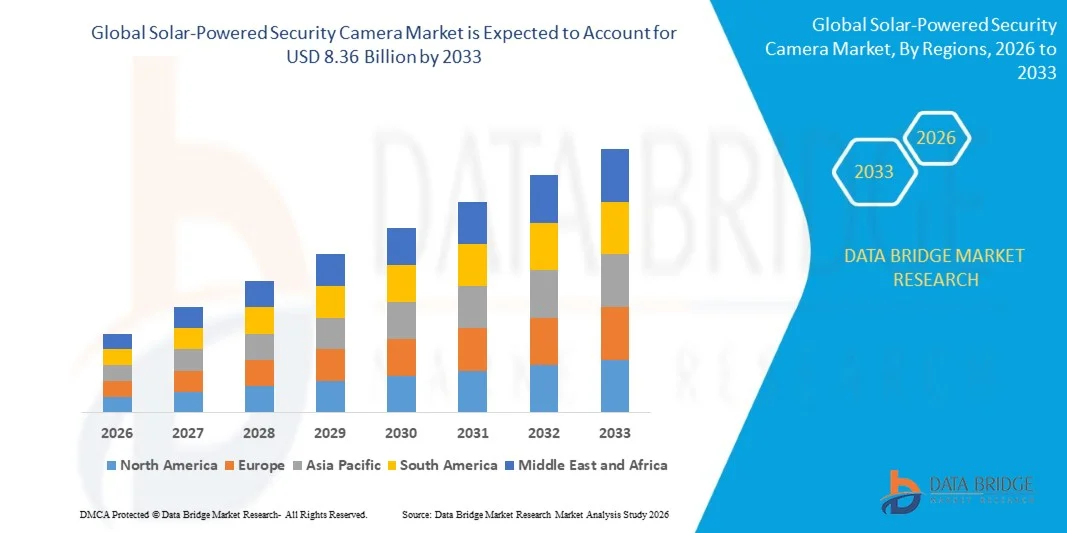
The Solar-Powered Security Camera Market was valued at USD 2.57 billion in 2025 and is projected to reach USD 8.36 billion by 2033, growing at a CAGR of 15.90% from 2026 to 2033. The market is witnessing strong and sustained growth driven by rising global security concerns, rapid expansion of off-grid and remote surveillance deployments, and accelerating adoption of renewable energy-powered electronics across residential, commercial, public safety, and critical infrastructure applications. Growing consumer preference for wireless, installation-friendly security solutions that eliminate dependence on grid electricity, combined with significant advancements in solar panel efficiency, lithium battery energy density, and AI-powered video analytics, is substantially expanding the addressable market for solar-powered surveillance systems worldwide.
The increasing operational complexity of deploying conventional wired surveillance infrastructure across remote industrial sites, border zones, construction projects, and rural communities is compelling end users to adopt solar-powered camera systems that deliver continuous, self-sustaining operation without grid connectivity requirements. Advancements in 4G LTE and 5G cellular connectivity, combined with the integration of on-device artificial intelligence for person detection, vehicle recognition, and behavioral analytics, are enabling solar-powered cameras to deliver enterprise-grade surveillance performance in locations previously considered impractical or cost-prohibitive for conventional security infrastructure. In addition, growing regulatory emphasis on perimeter security for critical infrastructure facilities, expanding smart city surveillance programs across Asia-Pacific and the Middle East, and rising homeowner investment in smart home security ecosystems are further accelerating the global adoption of solar-powered security camera solutions.
Key Market Trends & Insights
- Asia-Pacific dominated the Solar-Powered Security Camera Market with the largest revenue share of approximately 38.4% in 2025, supported by rapid urbanization, large-scale smart city surveillance initiatives in China, India, and Southeast Asian nations, significant government investment in solar energy infrastructure, and the presence of major solar-powered security camera manufacturers including Hikvision, Dahua Technology, and Reolink. The region benefits from competitive manufacturing cost structures, high consumer demand for affordable home security solutions, and expanding government programs for solar energy adoption across rural and urban communities.
- North America is expected to be the fastest-growing region, recording a strong CAGR from 2026 to 2033, with the U.S. and Canada driving strong adoption of premium solar-powered security cameras through high smart home penetration rates exceeding 45% in 2025, growing integration with Amazon Alexa, Google Home, and Apple HomeKit platforms, and significant residential investment in off-grid security solutions. Leading brands including Arlo Technologies, Ring LLC, and Blink Home Security are sustaining strong regional growth through continuous product innovation and platform ecosystem investments.
- The Fixed Cameras segment held the largest market revenue share of approximately 41.6% in 2025, driven by the dominant residential demand for affordable, simple-to-install, single-angle solar cameras for home entrance, driveway, and perimeter monitoring applications. The low unit cost and minimal installation complexity of fixed solar cameras make them the most widely adopted product type across global e-commerce channels, particularly among first-time residential security buyers in North America, Europe, and Asia-Pacific.
- The Bullet Cameras segment accounted for approximately 32.7% of product revenue in 2025, supported by strong adoption in outdoor residential surveillance, commercial property perimeter monitoring, and public area security applications where the bullet camera’s distinctive visible deterrent appearance, long-range directional monitoring capability, and robust weatherproof housing provide a compelling combination of surveillance performance and crime deterrence. Solar-powered bullet cameras are particularly favored for parking lots, warehouse exteriors, and retail facility perimeter applications.
- The Wi-Fi segment held the largest market revenue share of approximately 62.4% in 2025, reflecting dominant residential and commercial adoption of Wi-Fi connected solar cameras that leverage existing broadband infrastructure to deliver seamless cloud storage, real-time mobile notifications, and smart home platform integration without incurring recurring cellular data subscription costs. The proliferation of dual-band Wi-Fi 6 connectivity across leading solar camera product lines from Arlo Technologies, Ring, and Reolink is further reinforcing Wi-Fi segment leadership by delivering faster video streaming and more reliable connectivity in dense urban residential environments.
- The Cellular segment accounted for approximately 37.6% of connectivity revenue in 2025 and is projected to register the fastest growth at a CAGR of approximately 19.7% from 2026 to 2033, driven by the rapidly expanding deployment of solar-powered cameras in remote off-grid locations including construction sites, agricultural and forestry properties, oil and gas facilities, border surveillance zones, and rural critical infrastructure where Wi-Fi connectivity is unavailable and cellular network coverage provided by 4G LTE and 5G infrastructure represents the only viable real-time video transmission option.
- The Online segment held the largest market revenue share of approximately 58.6% in 2025, driven by strong direct-to-consumer e-commerce sales through Amazon, manufacturer online stores, and regional retail platforms including JD.com, Flipkart, and Lazada that collectively deliver competitive pricing, detailed product specification comparisons, verified consumer reviews, and convenient home delivery that align perfectly with the self-installation nature of the solar-powered security camera product category. The Online segment is further supported by growing manufacturer investment in digital marketing and social commerce channels targeting residential security buyers.
- The Offline segment accounted for approximately 41.4% of distribution revenue in 2025, reflecting the continued importance of physical retail channels including consumer electronics retailers, home improvement stores such as Home Depot and Lowe’s, and security system integrator dealerships for customers seeking in-person product demonstrations, professional installation services, and integrated commercial surveillance system design consultancy. The Offline segment is expected to sustain steady growth driven by commercial and government procurement through security system integrators and value-added reseller channels.
- The Residential segment held the largest market revenue share of approximately 47.8% in 2025, reflecting the massive global consumer market for affordable, easy-to-install solar-powered home security cameras that provide reliable surveillance of home entrances, driveways, backyards, and perimeter areas without the cost and complexity of professional electrical installation. The growing adoption of smart home security systems, expanding homeowner awareness of solar-powered camera benefits, and increasing availability of affordable entry-level solar camera products across global e-commerce channels are sustaining dominant residential demand.
- The Commercial segment accounted for approximately 28.4% of application revenue in 2025, driven by strong adoption across retail facilities, hospitality properties, logistics warehouses, construction sites, and office complexes deploying solar-powered cameras to monitor external perimeters, parking areas, loading docks, and temporary construction zones where wired camera infrastructure is either unavailable or cost-prohibitive. The Commercial segment is projected to grow at a CAGR of approximately 16.8% from 2026 to 2033, driven by expanding enterprise adoption of solar PTZ and AI-enabled camera systems.
Market Size & Forecast
- Global Market Value (2025): USD 2.57 Billion
- Expected Market Value (2033): USD 8.36 Billion
- Forecast CAGR (2026–2033): 15.90%
- Leading Region in 2025: Asia-Pacific
- Fastest Growing Region: North America
Report Scope and Solar-Powered Security Camera Market Segmentation
|
Attributes |
Sportech Textiles Key Market Insights |
|
Segments Covered |
· By Product: Fixed Cameras, Bullet Cameras, Pan-Tilt-Zoom (PTZ) Cameras, and Others · By Connectivity: Wi-Fi and Cellular · By Distribution Channel: Online and Offline · By Application: Residential, Commercial, Public Safety, and Critical Infrastructure |
|
Countries Covered |
North America · U.S. · Canada · Mexico Europe · Germany · France · U.K. · Netherlands · Switzerland · Belgium · Russia · Italy · Spain · Turkey · Rest of Europe Asia-Pacific · China · Japan · India · South Korea · Singapore · Malaysia · Australia · Thailand · Indonesia · Philippines · Rest of Asia-Pacific Middle East and Africa · Saudi Arabia · U.A.E. · South Africa · Egypt · Israel · Rest of Middle East and Africa South America · Brazil · Argentina · Rest of South America |
|
Key Market Players |
• Arlo Technologies, Inc. (U.S.) |
|
Market Opportunities |
• Expanding Deployment of Solar-Powered Surveillance Across Remote Critical Infrastructure and Off-Grid Industrial Site Security Applications • Growing Integration of AI-Powered Video Analytics and Smart Home Ecosystems Driving Premium Solar Camera Adoption in Residential and Commercial Sectors |
|
Value Added Data Infosets |
In addition to the insights on market scenarios such as market value, growth rate, segmentation, geographical coverage, and major players, the market reports curated by the Data Bridge Market Research also include in-depth expert analysis, geographically represented company-wise production and capacity, network layouts of distributors and partners, detailed and updated price trend analysis and deficit analysis of supply chain and demand. |
Solar-Powered Security Camera Market Trends
Trend: Integration of Artificial Intelligence and Smart Home Ecosystem Connectivity Transforming Solar Camera Value Propositions
The Solar-Powered Security Camera Market is being fundamentally reshaped by the rapid integration of on-device artificial intelligence capabilities including person detection, vehicle recognition, facial identification, package detection, and behavioral anomaly analysis directly within solar-powered camera hardware, dramatically elevating the surveillance intelligence and actionable alert quality delivered by self-powered wireless camera systems. Leading manufacturers including Arlo Technologies, Ring LLC, and Reolink Innovation have invested heavily in embedding dedicated AI inference processors within their solar camera product lines, enabling real-time video analysis without cloud dependency that simultaneously reduces false alarm rates, conserves battery power, and improves user experience for both residential and commercial customers.
Smart home ecosystem integration is emerging as a critical commercial differentiator for solar-powered security camera manufacturers serving the residential market, as consumers increasingly expect seamless interoperability between solar cameras and Amazon Alexa, Google Home, Apple HomeKit, and emerging Matter smart home standard platforms. Industry data from 2025 indicates that the global smart home market reached penetration rates exceeding 45% in North America and 38% in Europe, with integrated security systems representing one of the most frequently purchased smart home categories. Solar-powered cameras with native platform integrations enable voice-activated monitoring, automated lighting responses to motion detection events, and unified security dashboards that significantly improve the perceived value and stickiness of solar camera installations in smart-home-enabled households.
The convergence of solar power independence with AI-enhanced surveillance intelligence and smart home connectivity is establishing a compelling three-way value proposition that is accelerating solar camera adoption beyond the traditional off-grid niche into mainstream residential, commercial retail, and urban property management applications. Manufacturers reporting sales data from 2025 indicate that AI-enabled solar cameras commanded a 25–35% price premium over equivalent non-AI models while achieving higher sell-through rates, demonstrating that end users are increasingly willing to pay for intelligence features that meaningfully reduce false alarms and improve actionable security outcomes from their solar-powered surveillance investments.
Solar-Powered Security Camera Market Dynamics
Key Market Driver: Rising Security Concerns and Accelerating Demand for Off-Grid Wireless Surveillance Solutions
The rapid global escalation of residential property crime, commercial theft, vandalism, and trespassing incidents, combined with the growing complexity and cost of conventional wired surveillance infrastructure deployment across diverse property types and geographic environments, is generating substantial and sustained demand for solar-powered security cameras that deliver reliable, self-sustaining surveillance without grid electricity dependency or professional installation requirements. Solar-powered security cameras address a fundamentally unmet surveillance need across the massive global inventory of properties, construction sites, agricultural land, remote facilities, and rural communities were extending electrical infrastructure to support conventional camera systems is either technically impractical or commercially unviable.
The expansion of the global construction industry, off-grid renewable energy installations, agricultural property monitoring, and remote industrial operations is creating rapidly growing demand for cellular-connected solar security cameras capable of providing continuous surveillance in locations entirely lacking electrical and Wi-Fi infrastructure. In 2025, over 616,000 Reolink solar panels alone were deployed in households worldwide, demonstrating the scale of consumer adoption of solar-powered surveillance solutions. Industry estimates indicate that properties utilizing solar-powered security cameras experience a 40–60% reduction in installation costs compared to equivalent wired surveillance systems, driven by the elimination of trenching, conduit, and electrical wiring labor costs that dominate conventional CCTV installation project budgets.
The convergence of falling solar panel costs, improving lithium battery energy density, and the declining per-unit cost of AI-capable camera processors is enabling solar-powered security cameras to achieve performance parity with grid-powered systems at increasingly competitive price points, removing the historical cost premium barrier that previously limited adoption to premium residential and commercial customers. Manufacturers across the market are reporting that entry-level solar-powered security cameras with adequate AI detection capabilities are now commercially available in the USD 50–120 price range, making solar surveillance accessible to a broadly expanded consumer demographic across both developed and emerging markets.
Key Restraint/Challenge: Solar Energy Intermittency, Adverse Weather Performance, and Battery Reliability Limitations
The Solar-Powered Security Camera Market faces significant performance and reliability constraints related to the inherent variability of solar energy generation across geographic locations, seasonal conditions, and adverse weather events that can limit solar panel energy harvesting and compromise camera operational continuity in critical surveillance applications. Regions with extended periods of cloud cover, low solar irradiance during winter months, or frequent severe weather events present meaningful performance challenges for solar-powered cameras relying on fixed-capacity solar panels and lithium battery systems that may not sustain continuous recording and connectivity through prolonged periods of insufficient solar input.
Battery degradation under extreme temperature conditions, particularly in cold-climate deployments where lithium battery capacity can be reduced by 20–40% in sub-zero temperatures, and the accelerated aging of outdoor-exposed solar panels in high-UV and high-temperature environments, present significant product reliability challenges that can erode consumer confidence and increase warranty return rates for solar-powered camera manufacturers. Industry service data indicates that battery-related performance issues represent the most common cause of customer dissatisfaction and product returns across the solar-powered security camera category, underscoring the commercial importance of continued investment in battery management technology, thermal regulation systems, and solar panel efficiency improvements that collectively sustain reliable all-weather camera operation.
Key Market Opportunity: Expansion of Smart City Surveillance Programs and Government Critical Infrastructure Security Mandates
The accelerating global investment in smart city development, urban public safety infrastructure, and government-mandated perimeter security for critical national infrastructure is creating substantial market expansion opportunities for solar-powered security camera manufacturers capable of delivering scalable, rapidly deployable, and maintenance-efficient surveillance solutions for large-scale public sector deployments. Governments across Asia-Pacific, the Middle East, Europe, and North America are implementing increasingly comprehensive smart city surveillance programs requiring the installation of thousands of interconnected security cameras across public spaces, transportation corridors, border zones, and utility facilities where solar power independence provides compelling operational advantages over grid-connected alternatives.
The U.S. Department of Homeland Security, the European Union’s Critical Entities Resilience Directive, and equivalent regulatory frameworks across major economies are establishing increasingly stringent perimeter security requirements for energy facilities, water infrastructure, transportation networks, and financial system infrastructure that are driving procurement of advanced solar-powered PTZ and fixed camera systems for remote monitoring applications. Market projections indicate that government and critical infrastructure procurement of solar-powered security camera systems could represent a USD 1.8–2.4 billion market opportunity by 2033, driven by regulatory security mandates, smart city program investments, and the unique operational suitability of solar-powered cameras for securing geographically dispersed infrastructure assets across remote and off-grid locations.
Solar-Powered Security Camera Market Scope
The Solar-Powered Security Camera Market is segmented on the basis of product, connectivity, distribution channel, and application.
- By Product
On the basis of product, the solar-powered security camera market is segmented into Fixed Cameras, Bullet Cameras, Pan-Tilt-Zoom (PTZ) Cameras, and Others. The Fixed Cameras segment held the largest market revenue share of approximately 41.6% in 2025, driven by the dominant residential demand for affordable, simple-to-install, single-angle solar cameras for home entrance, driveway, and perimeter monitoring applications. The low unit cost and minimal installation complexity of fixed solar cameras make them the most widely adopted product type across global e-commerce channels, particularly among first-time residential security buyers in North America, Europe, and Asia-Pacific.
The Bullet Cameras segment accounted for approximately 32.7% of product revenue in 2025, supported by strong adoption in outdoor residential surveillance, commercial property perimeter monitoring, and public area security applications where the bullet camera’s distinctive visible deterrent appearance, long-range directional monitoring capability, and robust weatherproof housing provide a compelling combination of surveillance performance and crime deterrence. Solar-powered bullet cameras are particularly favored for parking lots, warehouse exteriors, and retail facility perimeter applications.
- By Connectivity
On the basis of connectivity, the solar-powered security camera market is segmented into Wi-Fi and Cellular. The Wi-Fi segment held the largest market revenue share of approximately 62.4% in 2025, reflecting dominant residential and commercial adoption of Wi-Fi connected solar cameras that leverage existing broadband infrastructure to deliver seamless cloud storage, real-time mobile notifications, and smart home platform integration without incurring recurring cellular data subscription costs. The proliferation of dual-band Wi-Fi 6 connectivity across leading solar camera product lines from Arlo Technologies, Ring, and Reolink is further reinforcing Wi-Fi segment leadership by delivering faster video streaming and more reliable connectivity in dense urban residential environments.
The Cellular segment accounted for approximately 37.6% of connectivity revenue in 2025 and is projected to register the fastest growth at a CAGR of approximately 19.7% from 2026 to 2033, driven by the rapidly expanding deployment of solar-powered cameras in remote off-grid locations including construction sites, agricultural and forestry properties, oil and gas facilities, border surveillance zones, and rural critical infrastructure where Wi-Fi connectivity is unavailable and cellular network coverage provided by 4G LTE and 5G infrastructure represents the only viable real-time video transmission option.
- By Distribution Channel
On the basis of distribution channel, the solar-powered security camera market is segmented into Online and Offline. The Online segment held the largest market revenue share of approximately 58.6% in 2025, driven by strong direct-to-consumer e-commerce sales through Amazon, manufacturer online stores, and regional retail platforms including JD.com, Flipkart, and Lazada that collectively deliver competitive pricing, detailed product specification comparisons, verified consumer reviews, and convenient home delivery that align perfectly with the self-installation nature of the solar-powered security camera product category. The Online segment is further supported by growing manufacturer investment in digital marketing and social commerce channels targeting residential security buyers.
The Offline segment accounted for approximately 41.4% of distribution revenue in 2025, reflecting the continued importance of physical retail channels including consumer electronics retailers, home improvement stores such as Home Depot and Lowe’s, and security system integrator dealerships for customers seeking in-person product demonstrations, professional installation services, and integrated commercial surveillance system design consultancy. The Offline segment is expected to sustain steady growth driven by commercial and government procurement through security system integrators and value-added reseller channels.
- By Application
On the basis of application, the market is segmented into Residential, Commercial, Public Safety, and Critical Infrastructure. The Residential segment held the largest market revenue share of approximately 47.8% in 2025, reflecting the massive global consumer market for affordable, easy-to-install solar-powered home security cameras that provide reliable surveillance of home entrances, driveways, backyards, and perimeter areas without the cost and complexity of professional electrical installation. The growing adoption of smart home security systems, expanding homeowner awareness of solar-powered camera benefits, and increasing availability of affordable entry-level solar camera products across global e-commerce channels are sustaining dominant residential demand.
The Commercial segment accounted for approximately 28.4% of application revenue in 2025, driven by strong adoption across retail facilities, hospitality properties, logistics warehouses, construction sites, and office complexes deploying solar-powered cameras to monitor external perimeters, parking areas, loading docks, and temporary construction zones where wired camera infrastructure is either unavailable or cost-prohibitive. The Commercial segment is projected to grow at a CAGR of approximately 16.8% from 2026 to 2033, driven by expanding enterprise adoption of solar PTZ and AI-enabled camera systems.
Solar-Powered Security Camera Market Regional Analysis
Asia-Pacific Solar-Powered Security Camera Market Insight
Asia-Pacific dominated the Solar-Powered Security Camera Market with the largest revenue share of 38.4% in 2025, supported by the region’s position as the world’s largest consumer electronics manufacturing hub, massive and rapidly expanding smart city surveillance investment programs across China, India, Japan, and Southeast Asian nations, and the presence of leading solar-powered camera manufacturers including Hikvision, Dahua Technology, EZVIZ, and Reolink. The region benefits from highly competitive manufacturing cost structures enabling affordable solar camera product pricing for price-sensitive emerging market consumers, large-scale government smart city program procurement driving public safety and critical infrastructure camera deployments, and expanding rural electrification initiatives that simultaneously increase awareness and demand for solar-powered electronics. China’s ambitious social governance surveillance infrastructure programs and India’s Smart Cities Mission initiative are generating significant large-volume procurement of solar-powered camera systems across hundreds of urban development projects.
China Solar-Powered Security Camera Market Insight
The China solar-powered security camera market accounted for the largest market revenue share in Asia-Pacific in 2025, driven by the country’s dominant position in global security camera manufacturing, massive domestic smart city and public safety surveillance program deployment, and substantial export volumes from Chinese manufacturers serving global residential and commercial customers through e-commerce channels. Hikvision Digital Technology and Dahua Technology collectively represent the world’s largest security camera manufacturers by volume, with both companies maintaining substantial and growing solar-powered product portfolios serving domestic Chinese smart city programs and international commercial customers. China’s extensive 5G network infrastructure rollout is further enabling cellular-connected solar camera deployments across urban and semi-rural surveillance applications nationwide.
Japan Solar-Powered Security Camera Market Insight
The Japan solar-powered security camera market is expected to witness steady growth from 2026 to 2033 within the Asia-Pacific region, supported by rising demand for energy-efficient surveillance solutions, increasing adoption of smart home technologies, and strong emphasis on public safety and infrastructure monitoring. Consumers and enterprises in Japan highly value low-maintenance, wireless, and eco-friendly security systems that reduce dependence on grid electricity while offering continuous monitoring capabilities. This growing preference is further supported by Japan’s advanced IoT ecosystem, high urban population density, and strong focus on disaster preparedness and remote monitoring applications, establishing solar-powered security cameras as an increasingly preferred solution across residential, commercial, and public infrastructure segments
North America Solar-Powered Security Camera Market Insight
North solar-powered security camera market is expected to witness steady growth from 2026 to 2033, driven by high consumer awareness of renewable energy benefits, well-established smart home ecosystems with penetration rates exceeding 45%, and premium pricing tolerance among residential customers investing in integrated solar-powered security solutions. The region’s growth trajectory is anchored by the integration of solar-powered security cameras with leading smart home platforms including Amazon Alexa, Google Home, and Apple HomeKit, enabling voice-activated monitoring and ecosystem automation that significantly elevates the perceived value of solar-powered surveillance investments. Companies including Arlo Technologies, Ring LLC, and Blink Home Security have invested heavily in product development and platform partnerships to capture the growing North American smart home security market, establishing strong brand recognition and recurring subscription revenue streams through cloud storage and AI monitoring service plans.
U.S. Solar-Powered Security Camera Market Insight
The U.S. solar-powered security camera market is expected to witness steady growth from 2026 to 2033, driven by the country’s high consumer electronics adoption rates, strong residential investment in home security systems, and growing deployment of cellular-connected solar cameras across remote agricultural properties, construction sites, and rural border monitoring applications. Federal investment in critical infrastructure security, including Department of Homeland Security grants supporting perimeter surveillance upgrades at energy and water facilities, is generating incremental commercial and government procurement of solar-powered PTZ and fixed camera systems. The U.S. market benefits from a highly competitive and innovative product landscape, with leading brands continuously releasing advanced AI-capable solar camera models that progressively expand the addressable residential and commercial market.
Europe Solar-Powered Security Camera Market Insight
The Europe solar-powered security camera market is expected to witness steady growth from 2026 to 2033, driven by strong regulatory emphasis on energy efficiency and renewable energy adoption aligned with the European Green Deal objectives, growing consumer demand for sustainable home security solutions, and expanding government investment in smart city and public safety infrastructure across Western and Eastern European urban centers. Germany, the U.K., France, and the Netherlands are leading regional adoption, supported by strong consumer awareness of solar energy benefits, high broadband and smart home penetration rates, and growing commercial demand from retail, logistics, and construction sectors deploying solar cameras at remote monitoring locations. The European Union’s Critical Entities Resilience Directive is further expanding critical infrastructure solar camera procurement across member states.
U.K. Solar-Powered Security Camera Market Insight
The U.K. solar-powered security camera market is expected to witness steady growth from 2026 to 2033, driven by strong homeowner investment in garden, driveway, and property perimeter security solutions, growing adoption of solar-powered cameras as sustainable alternatives to battery-only wireless cameras, and increasing deployment across construction sites and agricultural properties where grid connectivity is unavailable. The U.K.’s existing strong market for consumer smart home security products, combined with growing awareness of solar-powered camera sustainability benefits and government net-zero energy transition incentives, is creating a supportive commercial environment for solar camera market expansion. Leading global brands including Ring and Arlo maintain strong U.K. retail channel presence through major electronics retailers and online platforms.
Germany Solar-Powered Security Camera Market Insight
The Germany solar-powered security camera market is expected to witness strong growth from 2026 to 2033, driven by the country’s world-leading solar energy adoption rates and highly developed residential solar panel installation ecosystem that creates strong consumer familiarity and acceptance of solar-powered electronics, combined with growing corporate security investment across logistics, manufacturing, and retail sectors deploying solar cameras at remote outdoor monitoring locations. Germany’s stringent data protection regulations under the GDPR framework are simultaneously shaping product development requirements for solar-powered security camera manufacturers serving the German market, driving investment in local data storage options and privacy-preserving AI analytics that comply with German consumer data protection expectations.
Solar-Powered Security Camera Market Share
The Solar-Powered Security Camera industry is primarily led by well-established companies, including:
- Arlo Technologies, Inc. (U.S.)
- Ring LLC, an Amazon Company (U.S.)
- Reolink Innovation Limited (Hong Kong)
- Hikvision Digital Technology Co., Ltd. (China)
- Dahua Technology Co., Ltd. (China)
- EZVIZ Inc. (China)
- Lorex Technology Inc. (Canada)
- Swann Communications Pty Ltd. (Australia)
- Blink Home Security, an Amazon Company (U.S.)
- Soliom Solar Security Cameras (U.S.)
- Bosch Security Systems, Inc. (Germany)
- Netgear Inc. (U.S.)
- Zmodo Technology Corporation Ltd. (U.S.)
- Amcrest Technologies LLC (U.S.)
- Eufy Security, an Anker Brand (U.S.)
Latest Developments in Solar-Powered Security Camera Market
- In March 2026, Reolink Innovation Limited (Hong Kong) introduced its Solar Floodlight Cam featuring proprietary SolarEase technology, a 2K HD camera, 1,000-lumen floodlights, and a 7,800mAh battery system capable of sustaining a full day of camera operation from as little as one hour of sunlight. The product, launched initially in the U.S. and subsequently expanded to the U.K. and global markets, integrates on-device AI detection for people, vehicles, and animals, while operating completely wire-free and supporting integration with the Reolink Home Hub and NVR systems for whole-home solar security expansion.
- In April 2025, Reolink Innovation Limited (Hong Kong) announced that over 616,000 Reolink solar panels were deployed globally in 2025 alone, collectively generating more than 67,452 kWh of solar electricity to power security cameras and avoiding approximately 67.5 metric tons of CO₂ Reolink simultaneously introduced its enhanced SolarEase charging platform with a 26% improved solar conversion efficiency rating, designed to maintain reliable camera performance in low-light and partially shaded outdoor conditions across global residential and commercial deployments.
- In March 2025, Arlo Technologies, Inc. (U.S.) launched its Universal Solar Panel accessory compatible with a broader range of Arlo camera and floodlight products including the Pro 5 and Ultra 2 camera lines, offering multiple connector options to simplify solar power integration across existing Arlo installations. The Universal Solar Panel launch reflects Arlo’s strategic commitment to expanding solar-powered continuous operation as a standard feature across its premium residential security camera ecosystem, reducing customer reliance on battery replacement and cloud subscription plan interruptions.
- In February 2025, BOE Technology Group (China) secured a major 15 million-panel display order connected to solar-powered IoT device integrations, reflecting growing intersection between advanced display technologies and solar-powered surveillance applications in smart city and commercial security programs across Asia-Pacific markets. The announcement underscores the deepening integration of solar power technology into the broader consumer electronics and intelligent security device ecosystem serving both residential and public infrastructure applications.
- In January 2025, Hikvision Digital Technology Co., Ltd. (China) expanded its solar-powered security camera product family with new-generation models delivering up to 7 days of continuous operation without sunlight through advanced battery management systems, enhanced solar panel mounting flexibility, and support for the Hikvision Embedded Open Platform (HEOP) enabling third-party application integration. The expanded solar product range targets both residential and critical infrastructure applications, supporting government smart city surveillance programs and commercial property security deployments across global markets.

- Interactive Data Analysis Dashboard
- Company Analysis Dashboard for high growth potential opportunities
- Research Analyst Access for customization & queries
- Competitor Analysis with Interactive dashboard
- Latest News, Updates & Trend analysis
- Harness the Power of Benchmark Analysis for Comprehensive Competitor Tracking
Global Solar Powered Security Camera Market, Supply Chain Analysis and Ecosystem Framework
To support market growth and help clients navigate the impact of geopolitical shifts, DBMR has integrated in-depth supply chain analysis into its Global Solar Powered Security Camera Market research reports. This addition empowers clients to respond effectively to global changes affecting their industries. The supply chain analysis section includes detailed insights such as Global Solar Powered Security Camera Market consumption and production by country, price trend analysis, the impact of tariffs and geopolitical developments, and import and export trends by country and HSN code. It also highlights major suppliers with data on production capacity and company profiles, as well as key importers and exporters. In addition to research, DBMR offers specialized supply chain consulting services backed by over a decade of experience, providing solutions like supplier discovery, supplier risk assessment, price trend analysis, impact evaluation of inflation and trade route changes, and comprehensive market trend analysis.
Data collection and base year analysis are done using data collection modules with large sample sizes. The stage includes obtaining market information or related data through various sources and strategies. It includes examining and planning all the data acquired from the past in advance. It likewise envelops the examination of information inconsistencies seen across different information sources. The market data is analysed and estimated using market statistical and coherent models. Also, market share analysis and key trend analysis are the major success factors in the market report. To know more, please request an analyst call or drop down your inquiry.
The key research methodology used by DBMR research team is data triangulation which involves data mining, analysis of the impact of data variables on the market and primary (industry expert) validation. Data models include Vendor Positioning Grid, Market Time Line Analysis, Market Overview and Guide, Company Positioning Grid, Patent Analysis, Pricing Analysis, Company Market Share Analysis, Standards of Measurement, Global versus Regional and Vendor Share Analysis. To know more about the research methodology, drop in an inquiry to speak to our industry experts.
Data Bridge Market Research is a leader in advanced formative research. We take pride in servicing our existing and new customers with data and analysis that match and suits their goal. The report can be customized to include price trend analysis of target brands understanding the market for additional countries (ask for the list of countries), clinical trial results data, literature review, refurbished market and product base analysis. Market analysis of target competitors can be analyzed from technology-based analysis to market portfolio strategies. We can add as many competitors that you require data about in the format and data style you are looking for. Our team of analysts can also provide you data in crude raw excel files pivot tables (Fact book) or can assist you in creating presentations from the data sets available in the report.













